Grateful Ignacio Yockers followed parents' footsteps and became a Sooner
Huge year for him. Hit 100% senior season, broke onto international scene for Spain and continues to train and excel all-around. Career not complete
Elite athlete and Elite Scholar…Ig's the total package
Excellence in the gym and the classroom 👏
Ignacio Yockers is the recipient of the NCAA Elite Scholar Athlete award for the 2026 Division I Men’s Gymnastics Championships!
#BoomerSooner | #GymU
An 1800s Cowboy Christmas on the Cherokee Strip
Pawnee Bill recalled that one of the first Christmas trees in the Cherokee Strip appeared in 1880 on a ranch where he worked.
"Old man Constable had just returned to the Strip from running 20,000 Texas Longhorn steers to Armour and Company in Chicago. In that bustling city the cattleman had been impressed by a beautiful Christmas tree... when (he) returned to the Strip, Christmas was only five days away, and he decided they had to have a tree for the ranch."
"'Whar you going to get the evergreen tree from?' asked old many Wharton."
"'Why, down on the Cimaroon River. It's only one day's drive from here. We'll send Scotty down in the morning.'"
"Scotty left the next morning to search for an evergreen along the Cimarron River... When he found one he thought Constable would take a fancy to, he chopped the bushy cedar down, tied the branches close to the trunk, and he set off for the ranch, and when he set up the tree all the cowboys elbowed each other with delight."
Information from "Christmas in Oklahoma" by Linda Kennedy Rosser (1982). ISBN: 0-86546-050-7.
Photo courtesy of the Oklahoma Historical Society.
Jenkins, Elvin W. Settlers Irrigation Ditch, photograph, February 21, 1941; (https://t.co/jHeLeg04BJ: accessed December 15, 2025), The Gateway to Oklahoma History, https://t.co/idXiulAjC4; crediting Oklahoma Conservation Historical Society.
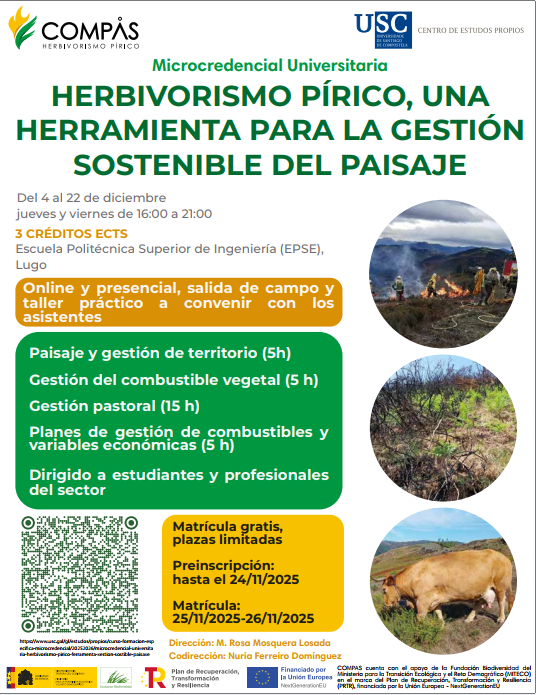
🔥CURSO DE POSGRADO @UniversidadeUSC: Microcredencial Universitaria en Herbivorismo Pírico, una herramienta para la gestión sostenible del paisaje
📅4-22 diciembre
✅ Matrícula GRATIS
👉 https://t.co/dAoln0yjd9
@FBiodiversidad#ProyectosPRTR#NextGenerationEU
Do Wild Grazers Prefer Recent Burns?
Read the new factsheet about Fire Effects on Big Game Animals of the Great Plains! https://t.co/blVR5Bz4mK
Pyric Herbivory: Instinctual foraging driven by high-quality regrowth after recent fire.
- Shifts use by wildlife and livestock.
- Provides rest to unburned areas and waterways.
- Creates habitat variability for other wildlife.
White-tailed Deer
In burned areas, roundhead lespedeza was grazed and purple prairie clover was preferred while both were avoided in unburned areas. Percent of plants grazed was higher in burned areas than unburned (Nisi et al. 2015).
Elk
Up to 1 year after fire, elk use days on burned areas increased by an average of 94 while elk use days on unburned areas decreased by an average of 69. (van Dyke & Darragh 2007)
Mule Deer
Selected for prescribed burns in almost all seasons with greater selection for more recent burns (<2 years old). (Roerick et al. 2019)
Pronghorn
Used burned range significantly more than unburned. They used burned prickly pear cactus heavily. (Courtney 1989)
Bighorn Sheep
Used burned sites more than adjacent unburned sites on all areas studied. (Brentz & Woodward 1988)
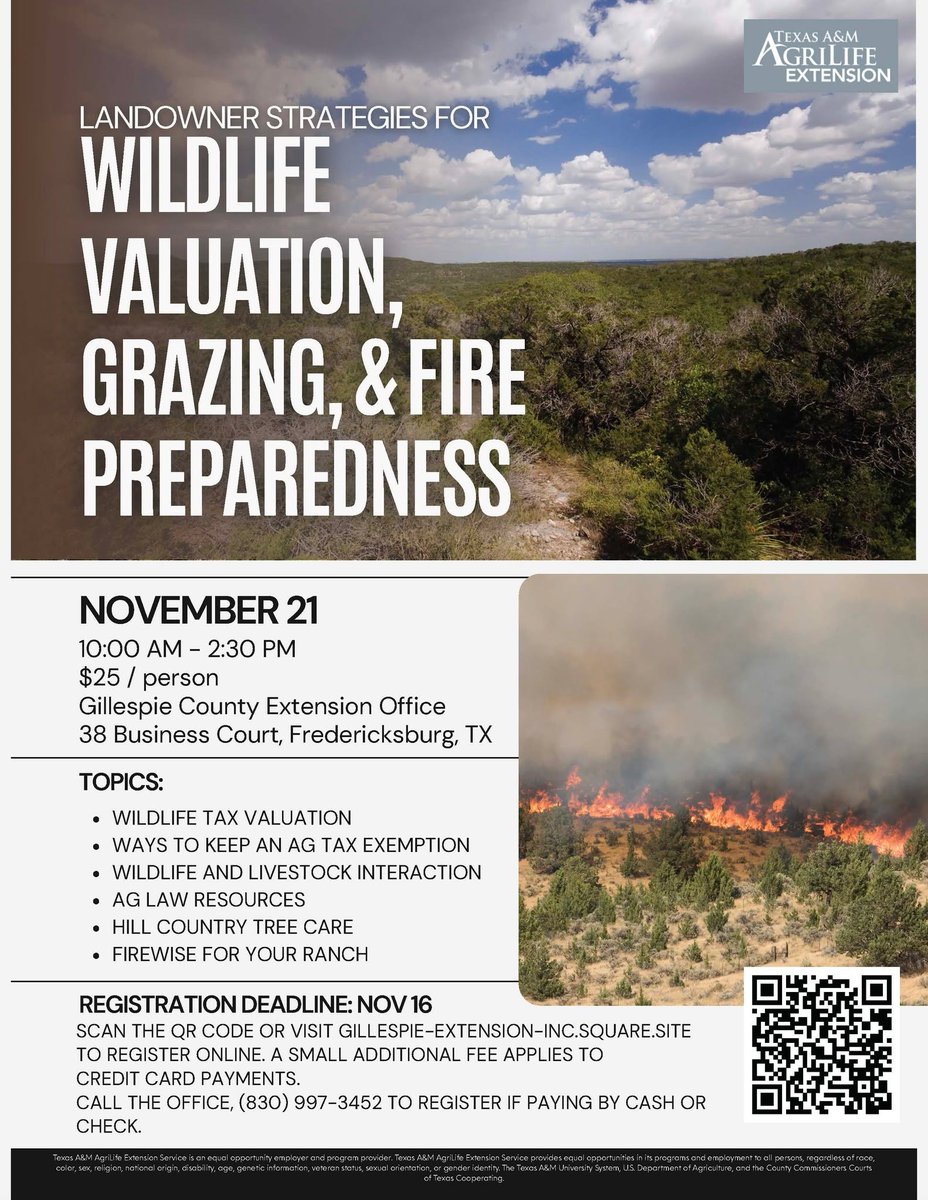
🌾🔥 Landowner Strategies Workshop 🔥🌾
📅 November 21 | ⏰ 10:00 AM – 2:30 PM
📍 Gillespie County Extension Office, Fredericksburg, TX
💲 $25 per person
From wildlife valuation and ag tax exemptions to fire preparedness, this workshop is packed with tools every landowner needs!
Topics include:
✅ Wildlife tax valuation & keeping your ag exemption
✅ Wildlife & livestock interaction
✅ Ag law resources
✅ Hill Country tree care
✅ Firewise planning for your ranch
📝 Registration deadline: November 16
👉 https://t.co/6KaWIxV3eT or call (830) 997-3452 to register.
#WestTexasRangelands #WildlifeManagement #TexasRanching #FirePreparedness
Grassland Birds in Decline
Eastern Meadowlark (Sturnella magna)
79% population decline (1966-2022)
Identification
- Yellow belly with a black "V" on chest
- Long, spear-shaped bill
- Short tail
Best Practices for Habitat Management
- Graze with moderate intensity
- Patch-burn graze
- Wait to cut hay until after mid-June
- Limit herbicide use
Scissor-tailed Flycatcher (Tyrannus forficatus)
44% population decline (1966-2022)
Identification
- Light grey head
- Pinkish-orange flank
- Long, black, forked tail
Best Practices for Habitat Management
- Maintain intact grasslands
- Apply prescribed fire
- Graze with moderate intensity
- Maintain shrub patches (5-30% of area)
Dickcissel (Spiza americana)
44% population decline (1966-2022)
Identification
- Sparrow-like
- Yellow eyebrow & chest
- Rust colored shoulders
Best Practices for Habitat Management
- Maintain intact grasslands
- Apply prescribed fire
- Graze with low intensity
- Limit herbicide use
¡Concluyen los Juegos Mundiales Universitarios con buenos resultados para el #TeamESP de #GA en las finales!
🤸🏻♀️ Ainara Sautua 8ª paralelas
🤸🏻♂️ Unai Baigorri 7º salto
🤸🏻♂️ Ignacio Yockers 4º arcos
🤸🏻♂️ Pau Jiménez 8º anillas
¡Buen trabajo!
Extremely proud of Ignacio Yockers at the World University Games!
He placed 4th (14.200) in the pommel horse final today - after qualifying 6th - and placed 9th in the all-around finals yesterday.
Scores » https://t.co/77PhICEIeM
Prickly Pear, Patch Burning & Pronghorn
at the USDA Agricultural Research Service Central Plains Experimental Range
- 13 inches annual rainfall
- shortgrass prairie
- fuel loads 490-1,048 lbs/ac
Pasture Sizes: 160 acres
Cattle Grazing: yearlings from mid-May to September
PRONGHORN DENSITY on burned vs unburned
- Winter: 26 times greater on burn patch
- Spring: 7 times greater on burn patch
PRICKLY PEAR DENSITY
- 54-71% reduction on patch burns with pronghorn grazing
- 6 years after fire, prickly pear density remained lower
Fire Removed Spines & Increased Use of Prickly Pear by Pronghorns
Data from Patch Burn Grazing Management in a Semiarid Grassland: Consequences for Pronghorn, Plains Pricklypear, and Wind Erosion (Augustine & Derner, 2015) https://t.co/JbD8Bui0Ty
Ignacio placed 9th in the all-around at the World University Games!
He posted the highest pommel horse score in the all-around final. He’ll compete in the pommel horse final at 7:15 am CT tomorrow!
Scores » https://t.co/M8wNNhqNND
PPE! - What is it? What does it do??
PPE stand for "Personal Protective Equipment"
Wildland firefighters wear PPE to stay safe while working in high-heat, high-risk environments. It’s designed to protect from all the unpredictable things the fireline life throws their way.