Everything we call real is made of things that cannot be regarded as real.
If quantum mechanics hasn't profoundly shocked you, you haven't understood it yet.
— Niels Bohr
The economic and demographic effects of corruption.
Cost of land in our urban areas is far higher than what our GDP per capita would dictate. The ratio of land value to per capita GDP is probably higher in India than anywhere else. As an example, land prices in Chennai or Bengaluru rival that of cities like New York which has a vastly higher per capita GDP.
The key reason?
First, vast sums of political corruption money is parked in real estate. This raises real estate prices and high real estate prices affect everything downstream.
Second, corruption in building approvals and the like - the famous DTCP - raises construction costs, on top of already higher real estate costs.
Third, corruption in private school regulatory compliance enforcement raises school fees.
Fourth, corruption in private hospital regulatory compliance enforcement raises health care costs.
Fifth, household goods need sales outlets and those pay higher rents due to high real estate prices and construction costs.
So housing, education, healthcare and household goods - all of these now cost higher.
As a direct consequence, the economic burden on the average person gets worse. Young people, facing all these costs, postpone marriage, and postpone children or have fewer children.
That directly affects our demographics.
While this issue exists in many parts of India, Tamil Nadu, being the most urbanized of the bigger states, is particularly hit hard.
So corruption is becoming an existential threat to our society.
If you worry about the super-low birth rate in Tamil Nadu, way below replacement, understand that corruption raising our cost of living is one of the major causes, not the only cause, but a big one in our context.
The stories of partition are so horrifying
My paternal grandfather was narrating the story how his 16 y/o real sister was poisoned by his parents coz a crowd had gathered outside his home in Pakistan, to r@pe her as she was pretty
Dario's args:
"Opensource you can see the source, here you cannot see inside the model"
- yes you can that's literally the open weights part btw.
- I cannot see the weights inside Claude, but I can GLM 5.2
- Models like Nemotron3 Ultra go further, all the data, training scripts, and model is opensource.
"Alot of the benefits like many people working on it, being additive doesn't work in same way"
- yes it does. We have seen endless fine tunes of various open source models for real improvements.
"Ultimately you have to host it on the cloud"
- no you dont. Dario is seemingly totally unaware of smaller moes and even dense models like qwen 27B.
Not only does dario not take part in social media, I am beginning to think he's never tried open source models at all and has no idea wtf hes on about
Decisions about how to use AI in your organization are increasingly organizational design and strategy decisions, not IT choices: How do you integrate agents into your firm? What intelligence will you outsource? What are the boundaries of the firm? What is the role of people?
The new Claude Tag feature seems extremely useful, but at the same time, a dangerous bargain for enterprises because of the pricing model and the risk of lock-in. The four big changes together mean that you interact with Claude as a coworker instead of a tool (the same Claude instance for everyone instead of each worker; soaks up tacit knowledge without your telling it; acts on its own; and does so asynchronously). All clearly very useful, but completely flips the interaction paradigm. https://t.co/iWpePXGiL8
Let’s talk about lock-in. As far as I can tell, Claude maintains its own memories in this new way of working; the human team members can’t see and edit them. (System administrators presumably can, but they have other things to do!) Tacit knowledge thus goes from a weakness of AI agents to a major strength — it seems inevitable that as teams and orgs start to use Claude this way, it will become the main queryable repository of all their tacit knowledge, creating dependence and stickiness. Effectively, Claude is a coworker that you can’t fire without *every* team losing workflows and know-how.
By the way, it also seems to introduce a new and pervasive security risk, since Claude can be integrated into private channels as well, and can be given access to repositories and tools even if the users in that channel don’t have access to them. Anthropic has introduced an interesting but complicated access control model to handle all this: https://t.co/l4oB5SVk9r But I’m not sure I trust people to understand and implement it correctly, nor the LLMs to be sufficiently robust against threats like prompt injection.
What about pricing? Claude is not like regular coworkers, because it bills for every token it produces. And it can do an unbounded amount of work, asynchronously and without being asked. In the current model, when AI is a tool, enterprises set per-user budgets, which creates accountability and keeps cost somewhat manageable. When everyone shares a Claude, it will be much harder to track and control spending. Of course you can set a token budget, but turning off Claude for the month for everybody when the budget is hit risks bringing work to a screeching halt.
When AI companies talk about the next stage of AI being a “drop-in replacement” for human workers, it should be understood not as a technical innovation but a business model innovation, enabling more value capture and rent extraction. AI companies are no longer competing for a share of enterprises’ IT budgets but rather a share of their entire labor spend, which is orders of magnitude bigger. Claude Tag is a big milestone in this evolution. This shift is very good for AI companies, but it is unclear if it is good for their customers.
I have lived in Germany for 30 years. I also have travelled in almost 40 countries in Europe, South, Middle and North America, North Africa and Asia before coming to India. Yet, of all the countries I visited, I clearly love India the most. I once even dreamt that in front of me there was a thick, 3-dimensional map of India. Looking at it my heart expanded and I felt great love. Still dreaming I was surprised that one can love a country so much.
It was, however, not love at first sight. After my first visit during my studies, I supposedly even said, “Never again India”, my mother claimed. I had come back to Germany weak from a stomach upset. Only on my second visit – intended as a short stopover that lasts meanwhile 45 years – India showed me what amazing treasure she hides under her noisy and often challenging surface.
I realized that in India an intensive, dedicated and essential inner search for what is truly true has been made since time immemorial. The findings of this search are startling and comforting to all of humanity and corroborated by modern nuclear physics:
‘Beneath’ EVERY appearance in this universe, including our own person, there is the same ‘Real Presence’ (or whatever one wants to call That which is formless and nameless) – living, loving, indestructible, mighty, infinite. To uncover it is the purpose of life and its fulfillment.
Every country has good and bad people. But India has also wise and enlightened people, more than any other place, and they make India special – a country of light (Bharat) in spite of occasional, apparent darkness.
May the Light illumine the intellect of all….
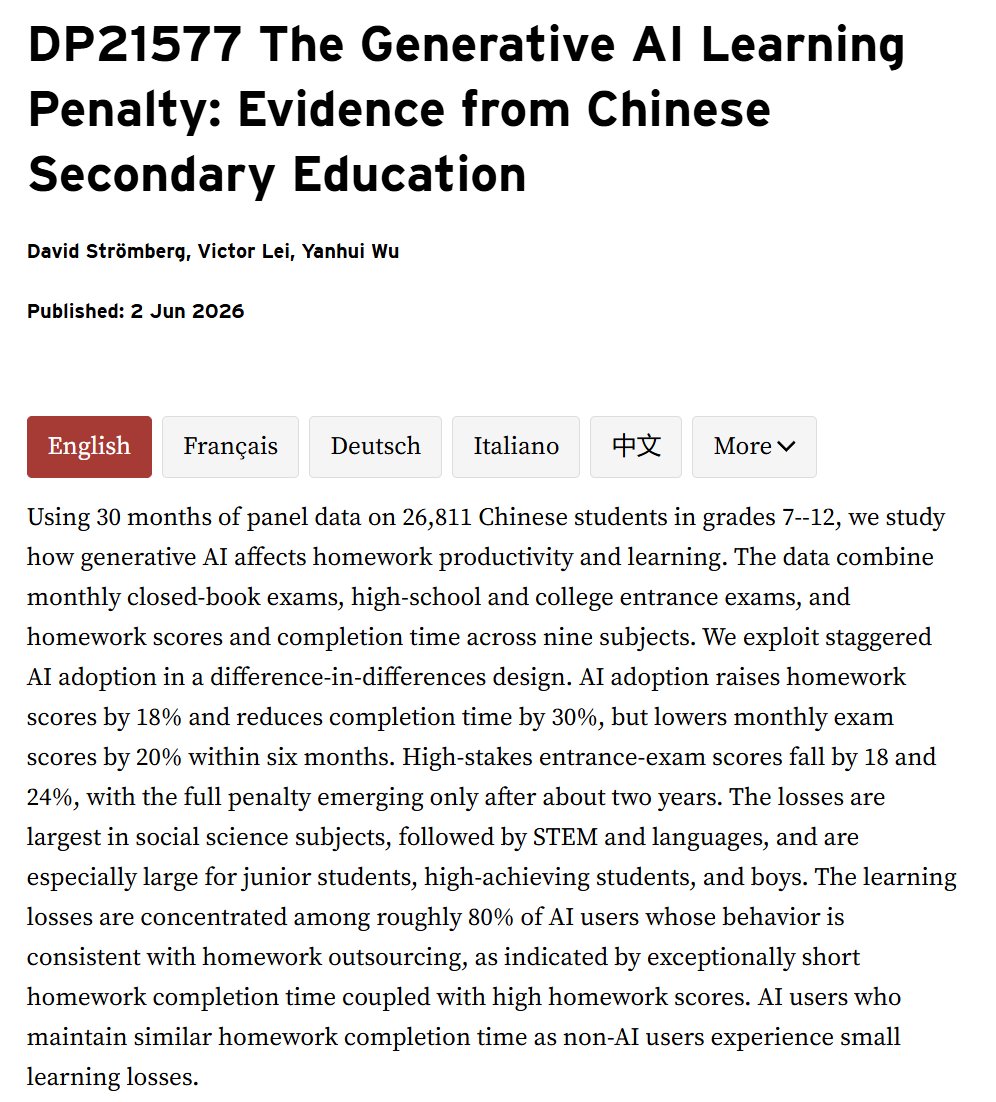
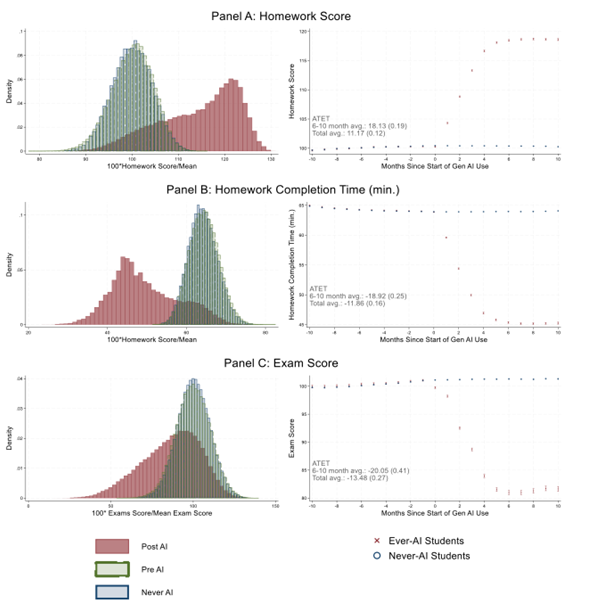
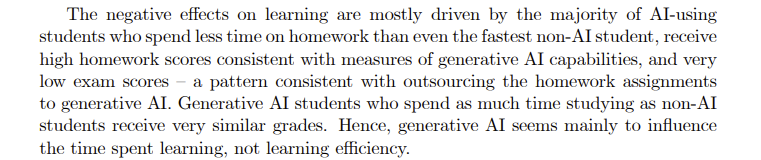
More evidence, from a large-scale study in China, that using AI hurts learning if it undermines mental effort. When homework time drops due to AI use, so do test scores.
Across studies, a theme: AI tutoring in support of classes is good, using AI to "help" with homework is bad.
I have given AA a hard time about its previous agentic evaluation but this looks like a good and impressive benchmark for real world knowledge work that is unsaturated and had private hold out tests.
This is one to watch - I didn’t see a human comparison score though?
40 years in shipping gave me one unusual qualification as a historian: I had no academic orthodoxies to protect.
When I began researching the history of maritime trade, I followed the sea lanes backwards into deep antiquity. Without exception, they converged on the Indian subcontinent. This was not the book I had intended to write.
I must give credit to my editor, who gave an unknown author with a controversial approach, an opportunity. His first attempts to find peer reviewers encountered significant resistance. The argument that India sat at the centre of ancient world trade, not its periphery, was considered, to put it gently, inconvenient.
What I found, and what I could not stop finding, is that placing India at the centre of world history does not simply revise one chapter. It cascades. Correct the starting assumption and you are forced to reconsider the origins of mathematics, medicine, philosophy, linguistics, religion. Each conclusion leads to another. I came to call these the collateral heresies.
My three books explain the architecture of how they connect.
If you work in a field where received wisdom is protected by institutional interest rather than evidence, you will recognise the pattern. The question is whether the evidence eventually wins.
This is big: all access to Mythos and Fable AI models disabled for everyone outside America.
First thoughts:
1. Technology is the ultimate weapon. National sovereignty, national security, all of it is now about technology.
2. Globalization is dead and Bharat must find her own way ahead.
We must keep these two ideas in mind.
What can our government do right now? Ensure that orgs in India embrace smaller models, both Indian and Chinese open source ones. With a bit of effort, we can make them work. Anyway, why pay money to people who don't even want to sell to you?
We must deepen our R&D. Sarvam has been on it and we have been on it but remember that the latest models cost not only huge GPU budgets to train, the GPUs themselves are restricted. So we can't afford the scale of money (of the order of $100+ billion to even get in the game!) and even if we could come up with the money, we can't get all the GPUs. I would not like to ask the government to fund tens of billions of dollars on this anyway - the money has far better uses.
Zoho has been pursuing alternative R&D approaches that are far, far less expensive but by its nature cutting edge R&D takes time and we are patient. I am confident we will get there.
Any remaining people in India who have delusions about globalization should wake up now.
HARD RULE: Everything Anthropic says is marketing bullshit.
This is nonsense. They absolutely can’t slow down or they will die. This is a cover story for the models slowing down all by themselves.
They have stolen all the data there is to steal. It’s diminishing returns now.