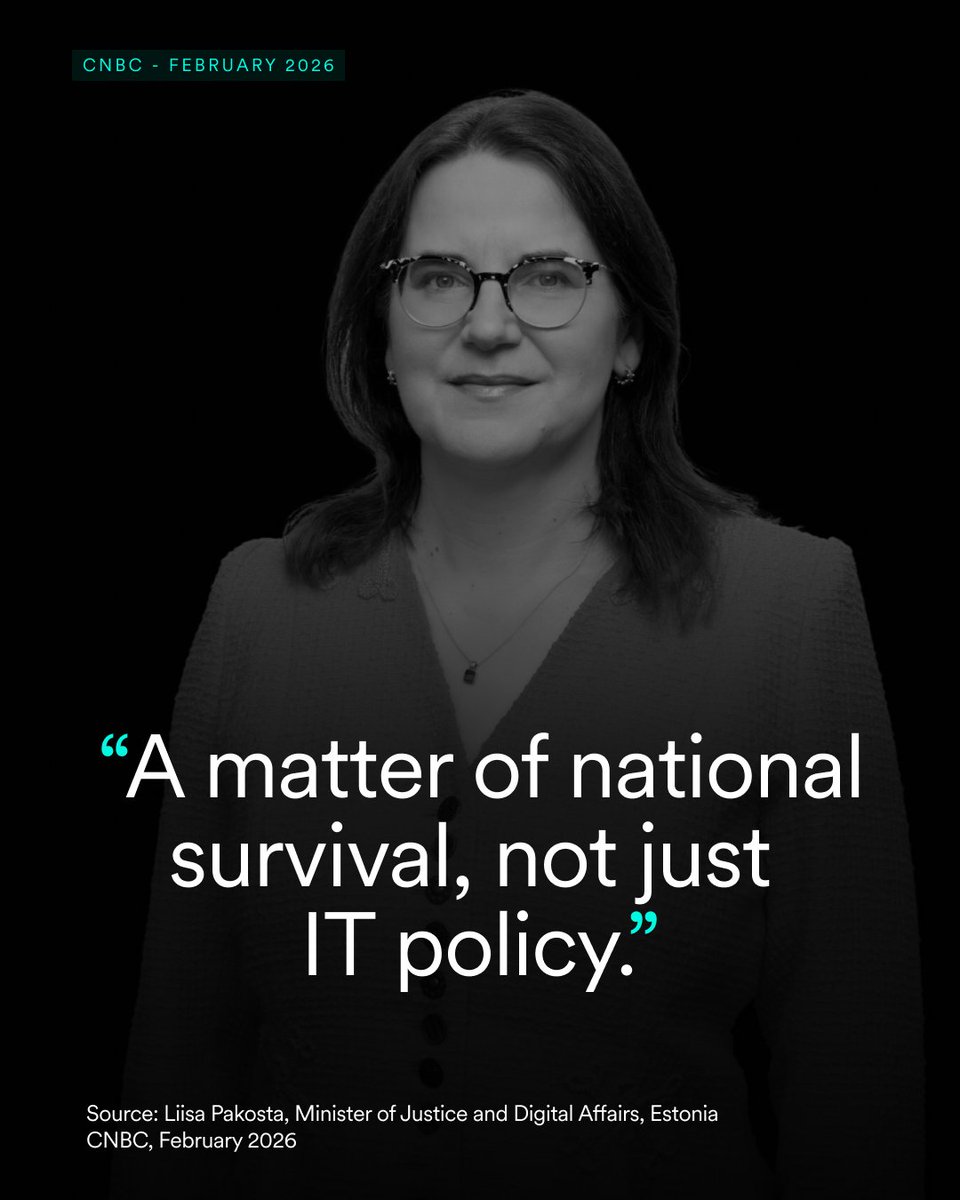
"A matter of national survival, not just IT policy."
That's Estonia's Minister of Justice and Digital Affairs. To CNBC. February 2026.
She was talking about digital sovereignty. Not theory. Operational reality.
This year, for the first time, the US included "sovereign cloud" in its National Trade Estimate Report on Foreign Trade Barriers. References to cloud and data localization increased 50% from the previous year. Countries building independent cloud infrastructure are now listed alongside tariffs and import restrictions.
The US runs two instruments. The CLOUD Act compels access to data wherever it's stored. Trade policy designates nations that build independent cloud infrastructure as foreign trade barrier offenders.
Estonia called it survival. The US called it a trade barrier.
What you name something tells you who controls it.
🚨⚔️ELON MUSK DECLARE LA GUERRE À OPENAI AU TRIBUNAL
Ce matin, Musk est venu témoigner et il balance sans filtre :
« Si on n’arrête pas ça, l’humanité va droit dans le mur. L’IA pourrait dépasser l’intelligence humaine dès l’année prochaine… et entre de mauvaises mains, c’est la fin. »
Il accuse OpenAI d’avoir trahi sa mission initiale :
- Créé comme organisation NON PROFIT et OPEN SOURCE pour protéger l’humanité.
- Sam Altman l’a transformé en machine à fric.
Musk : « Si un type peu fiable contrôle l’IA la plus puissante, c’est un danger existentiel pour toute l’espèce humaine. »
Il défend xAI, SpaceX et Starlink comme les vrais remparts pour l’avenir.
Musk vs Altman, round 1 terminé… et ça continue demain.
Query vs Update Calls on the Internet Computer $ICP
On the Internet Computer, every app uses two types of calls: queries and updates. Together they balance speed and security.
Query calls are the fast ones. They’re read-only, run on a single node, and return results in under 200 ms. Perfect for loading UI data or anything that doesn’t change state.
Update calls are for real changes. They go through full network consensus, which takes 1–3 seconds, but the result becomes permanent and secure.
Queries give you Web2 speed, updates give you Web3 trust and that combination makes the IC feel smooth, responsive, and reliable.
Authentication vs Authorization
When you log into an app, two things happen behind the scenes. First, the system checks who you are: that’s authentication. This could be Face ID, a password, a wallet signature, or Internet Identity.
Once your identity is confirmed, the app checks what you’re allowed to do: that’s authorization. Can you edit your profile? Delete a post? Access admin features?
One proves your identity. The other controls your permissions. Together, they keep apps secure and user-friendly. $ICP
🔄 What’s “Reverse Gas” and why is it important?
Most blockchains make users pay gas for every action.
Every click. Every update. Every interaction. Great for decentralization, terrible for UX.
The Internet Computer flips this model. This is called reverse gas.
💡 Developers pay, users don’t.
Apps run on cycles loaded into the canister,
and the canister pays for computation. Not the user.
And the best part: anybody can top up a canister to keep it running.
✨ Why it matters
- Smooth, web-like experience
- Zero-friction onboarding
- Predictable developer costs
- Anyone can fund the app
- Makes fully on-chain frontends possible
- Web2 convenience with Web3 security
On the Internet Computer, apps feel like the normal web: fast, free, and seamless, without sacrificing decentralization. $ICP
🛂 What Is Internet Identity?
Internet Identity is the Internet Computer’s passwordless login system. No usernames. No passwords. No seed phrases. Just secure sign-in using the devices you already own.
🧠 How it works
You register your phone, laptop, YubiKey or biometric login. Your device creates a unique, anonymous key for each dapp you use. So apps can’t track you across services.
🔒 Why it’s secure
- Powered by WebAuthn
- Hardware-backed authentication
- No passwords to steal
- No private keys to manage
- Phishing-resistant
🌍 Why users love it
- One-click login
- No wallet required
- Private by default
- Easy recovery by adding new devices
✨ Internet Identity feels like single sign on but without Big Tech and tracking. $ICP
📦 What Are the Storage Limits on the Internet Computer?
The IC isn’t like traditional blockchains with tiny storage limits. It’s built to store real application data directly on-chain.
🧠 Per-canister storage
- Heap memory: ~4 GB (fast runtime state)
- Stable memory: up to hundreds of GB per canister. Perfect for large datasets, files, logs, and user data.
🧱 Scale across multiple canisters
Need more than a single canister can hold? Just add more. Your app scales horizontally, like sharded storage or microservices.
🌍 No global cap
The IC expands by adding new subnets, so total network storage grows as demand grows.
🧪 Blob Storage (announced)
A new upcoming feature designed for massive, low-cost storage of large files and media. Making it even easier to handle heavy on-chain data workloads.
✨ In short:
A single canister can store hundreds of GB and your app can scale to unlimited storage. $ICP
What’s the IC Equivalent of REST APIs?
On the Internet Computer, you don’t build REST routes. You expose Candid methods inside your canister; typed functions your frontend can call directly.
It’s different from traditional APIs so it takes a moment to get used to…
but once it clicks, it feels cleaner and more direct.
🧠 Candid = the IC’s API layer
Every method, input and output is defined with strong typing.
No JSON endpoints or URL-based routing, the interface is the contract.
🗂️ Canisters take the role of API servers
In Web2, you call a URL like GET /users/123.
On the IC, you call a method defined in your canister, such as get_user(“123”).
Same idea; fetch data from your backend but without HTTP routes or manual parsing. Your app communicates with the canister via an agent,
which handles serialization and transport for you.
⚡ Two types of calls
• Query calls: fast, read-only
• Update calls: state-changing, processed through consensus
✨ Why it’s great
• Strong typing end-to-end
• Automatic serialization
• Predictable, self-documenting interfaces
• Simpler than REST once you understand the model
• Fully on-chain backend logic
On the Internet Computer, your backend isn’t a REST API. It’s a typed, decentralized interface you call like a function. $ICP
What Is PocketIC?
PocketIC is like having a mini Internet Computer on your laptop. Perfect for fast, reliable testing. It simulates the IC locally so you can test your canisters without deploying to mainnet or running a full replica.
🧠 Why developers use it
• Run multiple canisters locally
• Test cross-canister calls
• Advance time for timers or governance logic
• Zero cycles needed
• Fast, deterministic, repeatable tests
• Works great in CI pipelines
⚙️ What it can do
- Test updates and queries
- Simulate subnets
- Try upgrades safely
- Reproduce real IC behavior more accurately than dfx start
✨ In short: PocketIC gives you a lightweight, programmable Internet Computer you can use for development and automated testing. $ICP
What Is Chain Key Cryptography?
Chain Key Cryptography is the tech that lets the Internet Computer act like one unified blockchain, even though it runs across thousands of independent nodes.
🧠 One public key
The entire network uses a single public key to verify messages and signatures. No matter how big the IC grows, it still behaves like one system.
🔐 Threshold signatures
No node has the full secret key. Each node holds only a share, and only a threshold working together can create a valid signature, keeping the network secure and decentralized.
🔄 Keys evolve automatically
As nodes join or leave, the IC updates its cryptography on the fly without downtime and without changing its identity.
⚡ Why it matters
• Lets the IC run at massive scale
• Enables direct Bitcoin & Ethereum integrations
• Allows canisters to serve the web (HTTPS)
• Makes the network self-healing and secure
✨ Chain Key Cryptography is what powers the Internet Computer’s speed, security, and seamless interoperability. $ICP
The DFINITY Global R&D Session for November 2025 is LIVE! 🚀
Highlights include: SEV-enabled nodes, a live demo of Dogecoin integration, new WASM canister fuzzing tools, and the latest on NNS recovery processes.
Watch here: https://t.co/uCHWSUUIG2
Can I Use My Existing Frontend Frameworks on the Internet Computer? $ICP
Yes, absolutely. 🙌
You can keep using React, Vue, Svelte, Vite, Next.js, or even plain HTML/CSS/JS. Your workflow stays the same: build your app, generate your dist/ folder… and instead of deploying to Vercel or Netlify, you deploy it to a canister.
You can do this directly using dfx, or use a hosting service like https://t.co/zuYZC4xY6m that also supports automated cycle top-ups, easy custom domains, and smooth deployments.
🧠 How it works: Your frontend is just static assets: HTML, JS, CSS. A canister serves those files on the open internet like a global CDN…but fully decentralized.
✨ Same tools. Same frameworks. Just a new way to host without servers.
How fast is the Internet Computer?
Very fast and not just compared to other blockchains, but to the traditional internet itself. 🚀
The Internet Computer delivers true web-speed performance: read-only queries respond in around 200 milliseconds, while updates that change data are securely finalized in just 2–3 seconds. All while running apps directly on the open internet.
Real-time experience
Users interact with apps as smoothly as with any cloud-based website or service.
Parallel processing
Each subnet of nodes handles its own workloads, allowing the network to scale and stay lightning-fast. No matter how big it grows.
Globally distributed
Independent data centers around the world share the load, keeping everything responsive, stable, and always online.
The Internet Computer isn’t just fast for Web3. It’s built for real-time, internet-scale experiences. Speed, scale, and stability without servers. $ICP