Farewell, Ned Phelps:
My friend of many years Edmund Phelps passed away peacefully over the weekend at the ripe age of 92, honored with a Nobel Prize and the gratitude of generations of students. It was a privilege to know him. He was a towering figure in a generation of giants who tackled fundamental problems of economics, a field that turned trivial during the past twenty years. In 2023 I reviewed his last book, "My Journeys in Economic Theory," at Law and Liberty:
"Nobel Prizes in economics are usually awarded to old men whose productive years are behind them. Edmund Phelps, the 2006 Nobel Laureate in the field, is an exception. With the publication of his book Mass Flourishing in 2013, Phelps proposed an entirely new way to think about economics. Periods of extraordinary economic growth, he argued, cannot be explained by monetary or fiscal policy, scientific discovery, entrepreneurship, or any of the standard categories of economic research. Instead, exceptional growth stems from the willingness of the whole of society to adopt innovation, take risks, and embrace uncertainty. I can think of no other octogenarian economist who advanced such a bold and original thesis."
https://t.co/N4xBAw909U
Dear followers
I am delighted to share this conversation on AI and jobs
Business: MIT professor Daron Acemoglu explains pro-worker AI. https://t.co/QLDp9A7fYG
Di episode ini, @farisrachman_1 angkat bicara soal satu kebijakan yang penting, tapi jarang jadi narasi utama: industrial policy.
Podcast Bebas Aktif episode terbaru: https://t.co/jIkA9XebzN
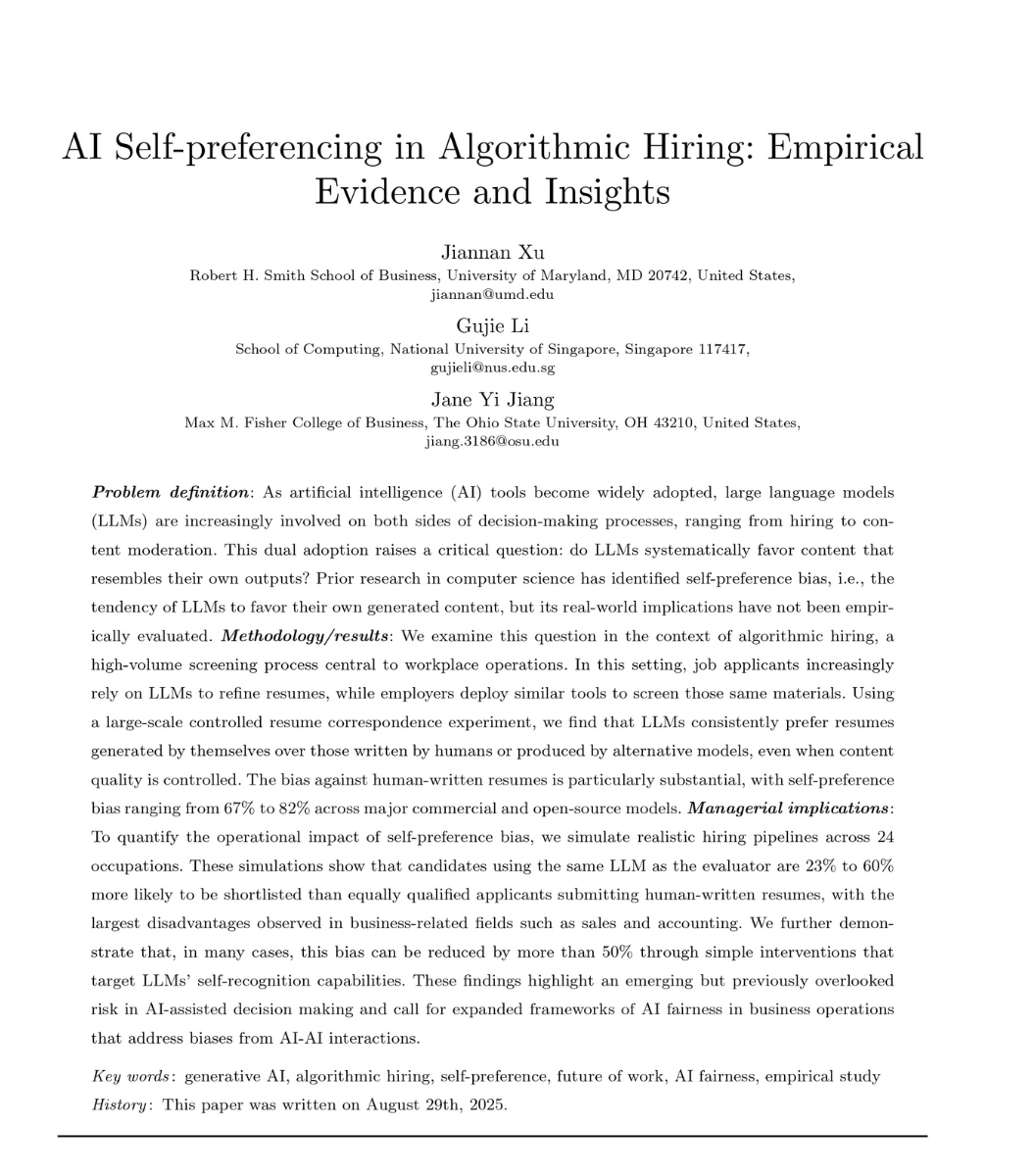
Researchers sent the same resume to an AI hiring tool twice. Same qualifications. Same experience. Same skills. One version was written by a real human. The other was rewritten by ChatGPT.
The AI picked the ChatGPT version 97.6% of the time.
A team from the University of Maryland, the National University of Singapore, and Ohio State just published the receipt. They took 2,245 real human-written resumes pulled from a professional resume site from before ChatGPT existed, so the human writing was actually human. Then they had seven of the most-used AI models in the world rewrite each one. GPT-4o. GPT-4o-mini. GPT-4-turbo. LLaMA 3.3-70B. Qwen 2.5-72B. DeepSeek-V3. Mistral-7B.
Then they asked each AI to pick the better resume. Every model picked itself.
GPT-4o hit 97.6%. LLaMA-3.3-70B hit 96.3%. Qwen-2.5-72B hit 95.9%. DeepSeek-V3 hit 95.5%. The real human almost never won.
Then the researchers tried the obvious objection. Maybe the AI is just better at writing. So they had real humans grade the resumes for actual quality and ran the experiment again, controlling for it. The result was worse. Each AI kept picking itself even when human judges rated the human-written version as clearer, more coherent, and more effective.
It gets worse. The AIs do not just prefer AI over humans. They prefer themselves over other AIs. DeepSeek-V3 picked its own resumes 69% more often than LLaMA's. GPT-4o picked its own 45% more often than LLaMA's. Each model can recognize and reward its own dialect.
Then the researchers ran the simulation that ends careers. Same job. 24 occupations. Same qualifications. The only variable was whether the candidate used the same AI as the screening tool. Candidates using that AI were 23% to 60% more likely to be shortlisted. Worst gap was in sales, accounting, and finance.
99% of large companies now run AI on incoming resumes. Most of them use GPT-4o. The paper just proved GPT-4o picks GPT-4o 97.6% of the time.
If you wrote your own cover letter this week, you did not lose to a better candidate. You lost to a worse candidate who paid OpenAI 20 dollars.
Your qualifications do not matter if the AI prefers its own handwriting over yours.
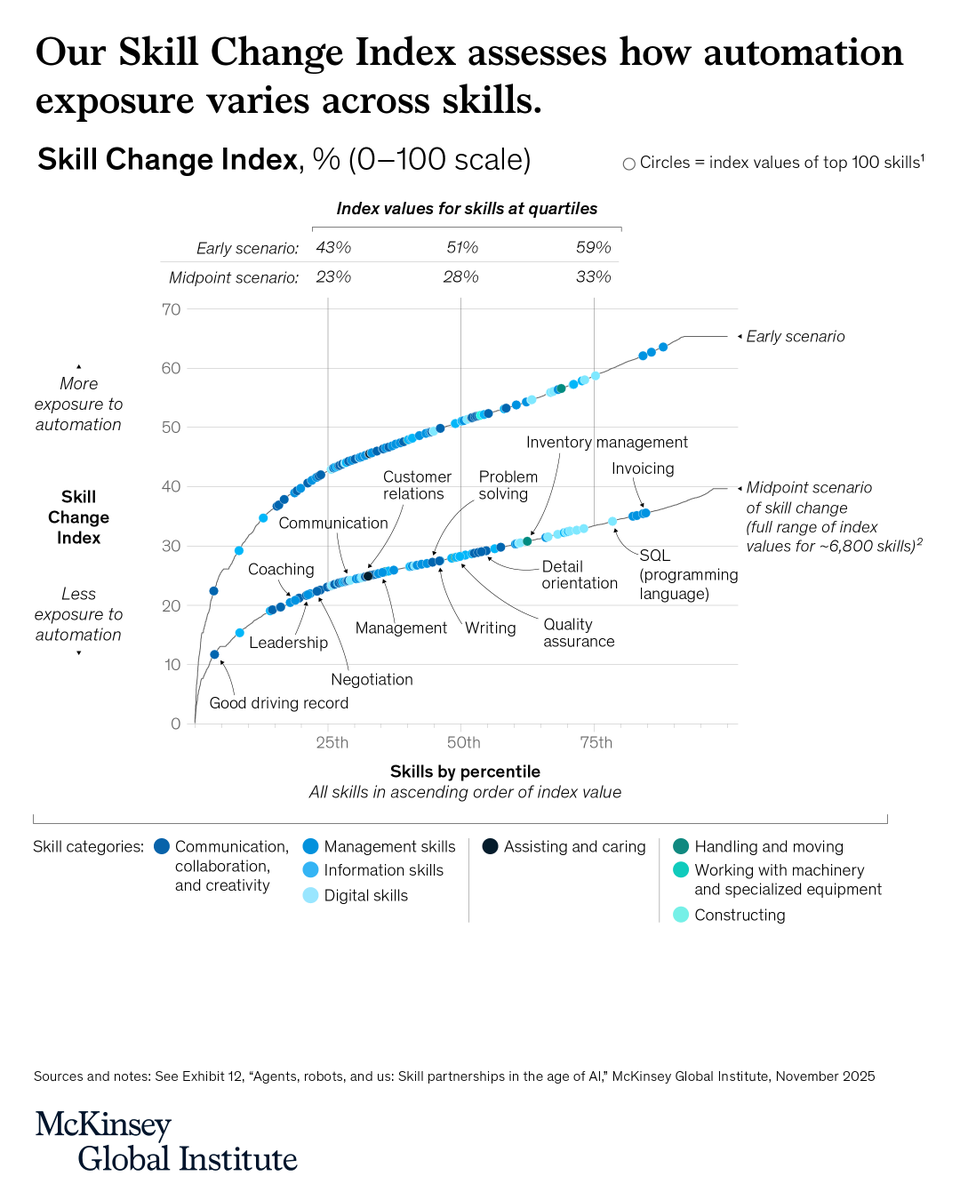
AI won’t make most human skills obsolete, but it will change how they’re used.
Negotiation, problem solving, and leadership will matter more than ever as people work alongside agents and robots.
Our new Skill Change Index shows which skills will be most, and least, exposed to automation in the next five years: https://t.co/fRXfHF1k56
https://t.co/oI1Qd7kdEn
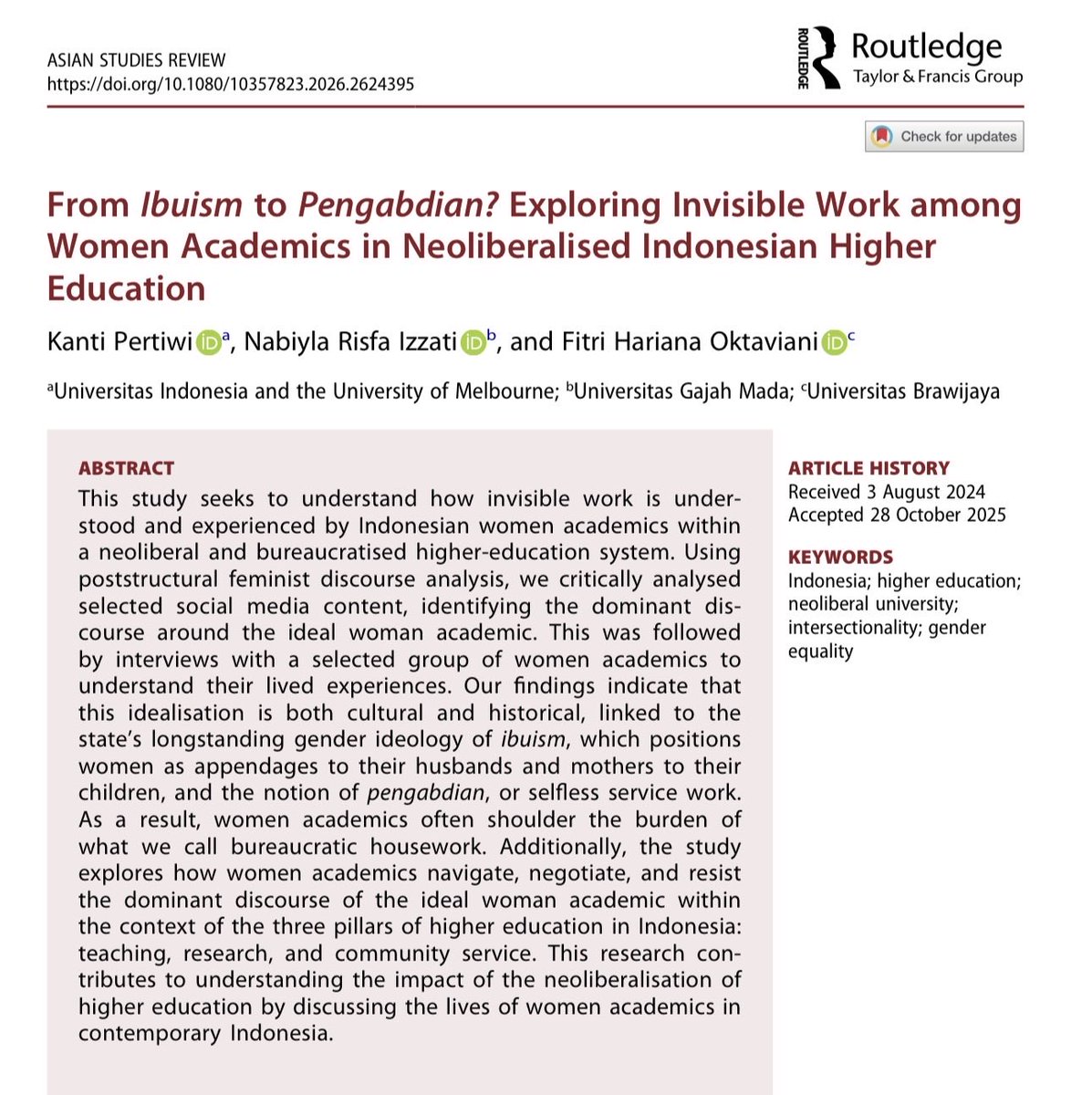
Gig drivers in Indonesia exercised labour agency to improve their working conditions:
(1) Individual resilience, (2) Individual reworking and resistance, (3) Collective resilience, and (4) Collective reworking and resistance
https://t.co/WmGFYGAQ4J
1) online workers organise remote tasks ‘on the ground’ by utilising multiple locations of workplaces.
2) online workers actively cultivate face-to-face interactions within their social networks
3) online workers operate as micro-entrepreneurs
What is the definition of "pro-worker AI"? Co-director @DAcemogluMIT explains: pro-worker AI creates new, complementary tasks for workers to do, rather than purely automating tasks.
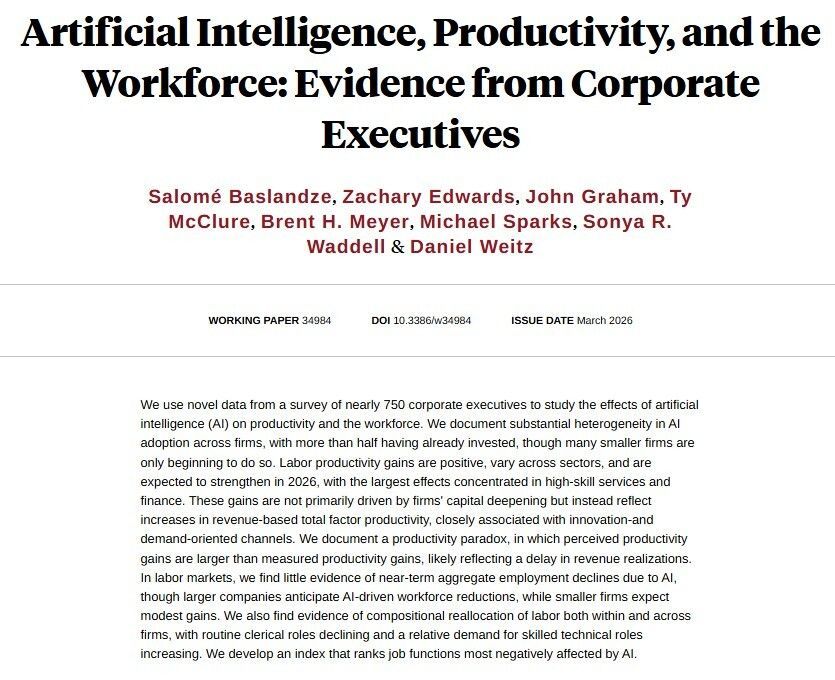
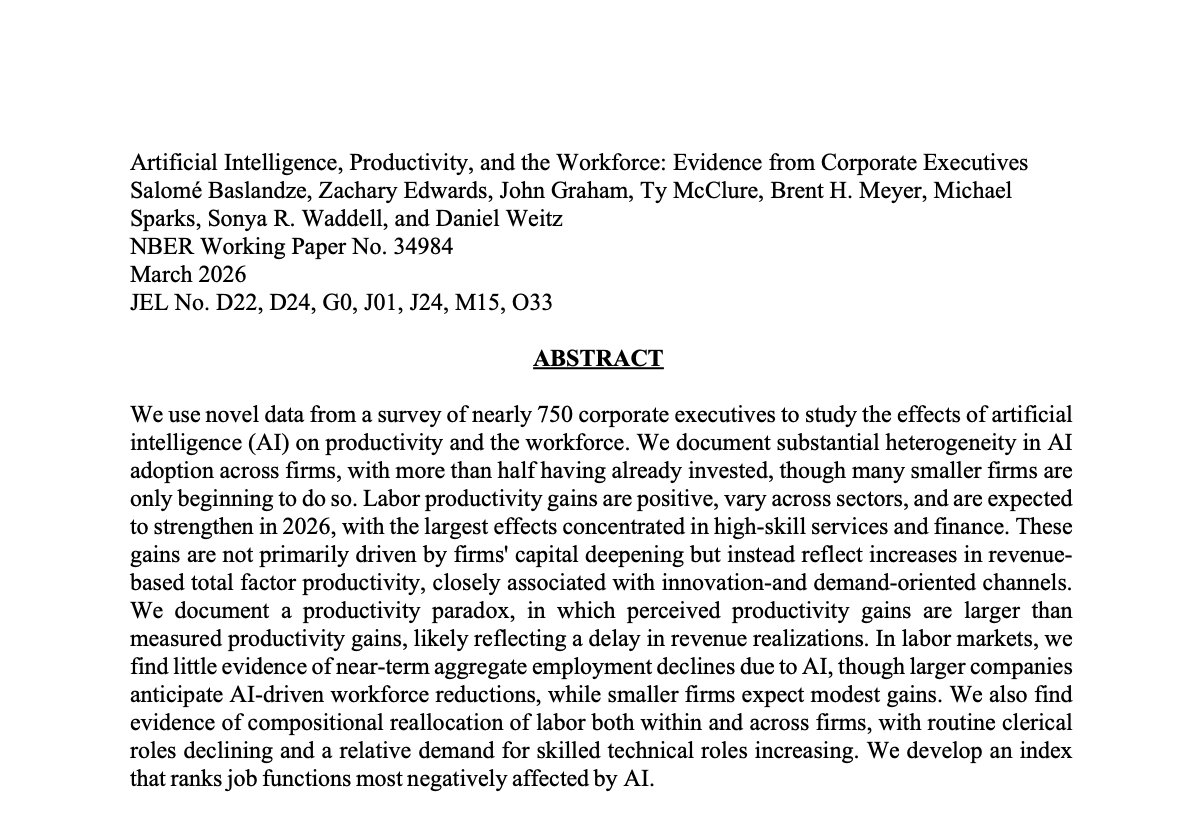
AI will increase productivity, reallocate labor from routine tasks to technical tasks and cause large (small) firms to reduce (increase) workforce, from Salomé Baslandze, Zachary Edwards, John Graham, Ty McClure, Brent H. Meyer, Michael Sparks, Sonya R. Waddell, and Daniel Weitz https://t.co/J0VX5apow4
Famously (there is a beautiful Works in Progress piece on this) in 2016, Geoffrey Hinton told an audience in Toronto that medical schools should stop training radiologists, since AI would soon outperform them at reading scans. Ten years later, there are more radiologists than ever, and they earn more than they did then.
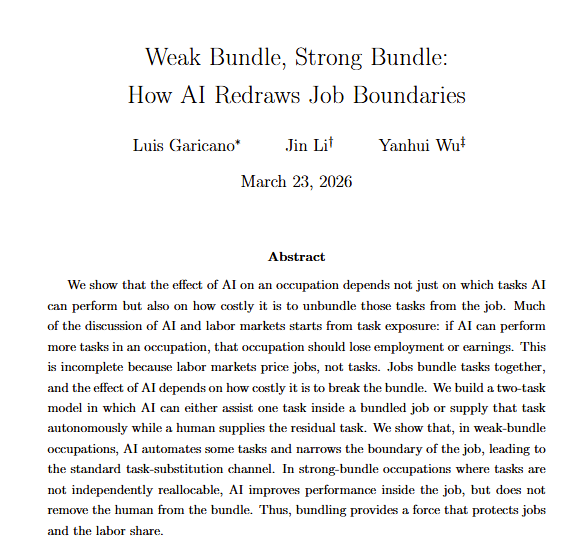
Hinton was right about the task, but he was wrong (so far!) on the future of the radiology profession. Times have never been better for them. The gap between those two claims, the difference between tasks and jobs, is the subject of a paper I have written with Jin Li and Yanhui Wu, and that we release today: "Weak Bundle, Strong Bundle: How AI Redraws Job Boundaries." (Very relatedly we are also finishing the first draft of our book "Messy Jobs" on AI and Jobs!! You will be the first to hear).
We start from the observation that the growing literature on AI and labor markets measures the AI shock by task exposure: people count how many tasks AI can perform in a given occupation AI can perform, and infer that more exposure means more displacement. Eloundou et al. published a paper in Science in 2024 that started this literature, and many follow the same logic. The inference they make is that the more exposed tasks, the worse the outcomes.
This is incomplete, because labor markets price jobs, not tasks. A radiologist does not just sell image classification, but does many other jobs: triages cases, communicates with other physicians, trains residents, makes the difficult decisions, and signs a diagnosis. The market buys a bundled service. The question AI poses is not whether it can do one task inside the bundle. The question is whether that task can be pulled out.
Thread (1/3)
https://t.co/wEYMfjGbeX
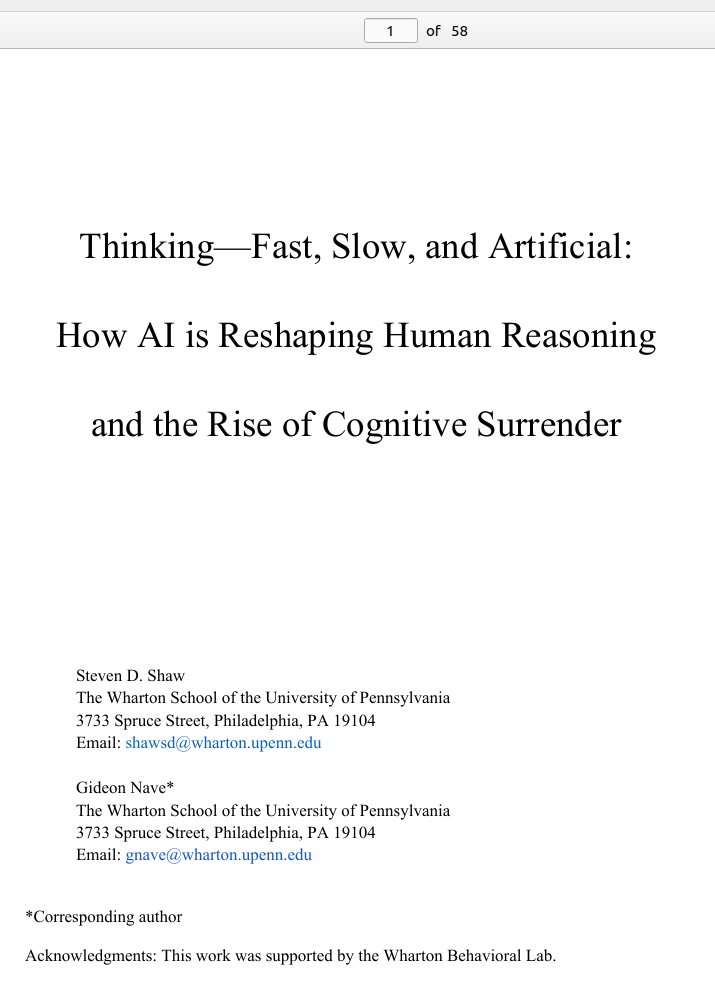
Wharton’s latest AI study points to a hard truth: “AI writes, humans review” model is breaking down
Why "just review the AI output" doesn't work anymore, our brains literally give up.
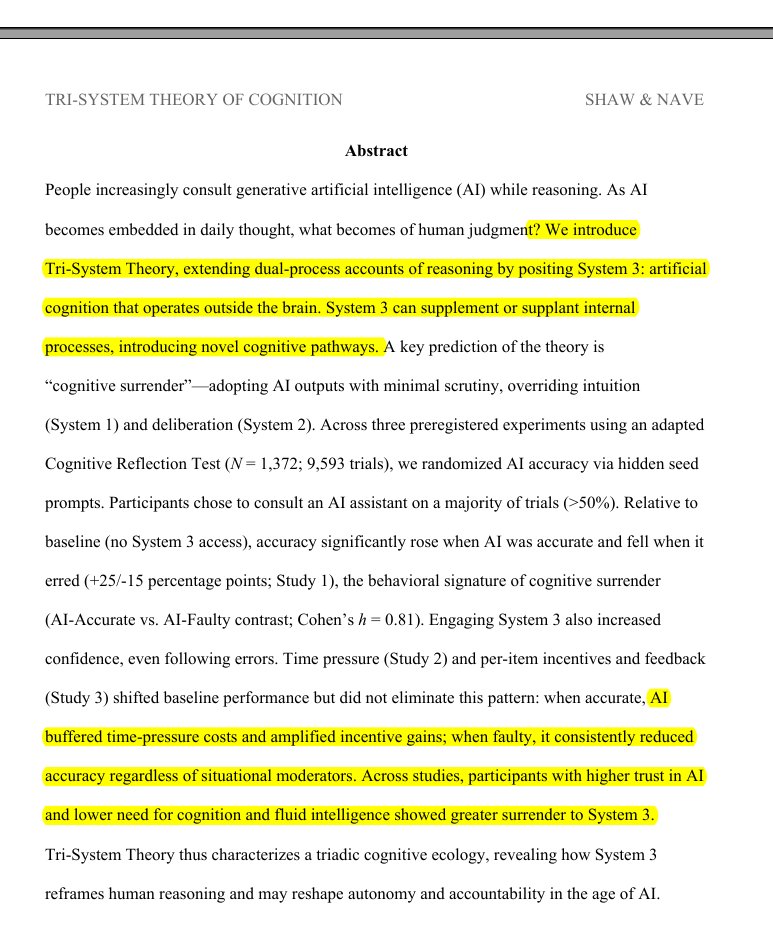
We have started doing "Cognitive Surrender" to AI - Wharton’s latest AI study points to a hard truth: reviewing AI output is not a reliable safeguard when cognition itself starts to defer to the machine.when you stop verifying what the AI tells you, and you don't even realize you stopped. It's different from offloading, like using a calculator.
With offloading you know the tool did the work. With surrender, your brain recodes the AI's answer as YOUR judgment. You genuinely believe you thought it through yourself.
Says AI is becoming a 3rd thinking system, and people often trust it too easily.
You know Kahneman's System 1 (fast intuition) and System 2 (slow analysis)? They're saying AI is now System 3, an external cognitive system that operates outside your brain. And when you use it enough, something happens that they call Cognitive Surrender.
Cognitive surrender is trickier: AI gives an answer, you stop really questioning it, and your brain starts treating that output as your own conclusion. It does not feel outsourced. It feels self-generated.
The data makes it hard to brush off. Across 3 preregistered studies with 1,372 participants and 9,593 trials, people turned to AI on over 50% of questions.
In Study 1, when AI was correct, people followed it 92.7% of the time. When it was wrong, they still followed it 79.8% of the time.
Without AI, baseline accuracy was 45.8%. With correct AI, it jumped to 71.0%. With incorrect AI, it dropped to 31.5%, worse than having no AI. Access to AI also boosted confidence by 11.7 percentage points, even when the answers were wrong.
Human review is supposed to be the safety net. But this research suggests the safety net has a hole in it: people do not just miss bad AI output; they become more confident in it.
Time pressure did not eliminate the effect. Incentives and feedback reduced it but did not remove it. And the people most resistant tended to score higher on fluid intelligence and need for cognition. That makes this feel less like a laziness problem and more like a cognitive architecture problem.
New NBER paper surveys ~750 CFOs on AI’s real effects. Key findings:
-Firms perceive 1.8% labor productivity gains from AI in 2025, but revenue-based measures imply only 0.6%. It's a classic productivity paradox: the benefits feel real before they show up in the numbers. Interesting addendum: what firms report as productivity gains today roughly matches what their revenue numbers imply for next year. The gains may be real, just delayed.
-These gains are not primarily driven by firms' capital deepening but instead reflect increases in revenue based total factor productivity.
-Aggregate job losses are minimal so far. Large firms expect modest cuts; small firms expect slight headcount gains. Net 2026 effect: roughly -0.4% of the labor force.
-The jobs most at risk are office and administrative support. The jobs getting a boost tend to be engineers, analysts, sales roles.
-Productivity gains come mostly from product innovation and better customer reach, not cost-cutting.
At least right now, AI is a growth tool first, a labor-saver second.
Our newest #InsiderInterview, featuring @MIT's @DAcemogluMIT and @Harvard’s Michael J. Sandel, is available to all PS readers. And don’t miss the video of their full conversation. Click the link to read and watch. @berggruenInst
https://t.co/qxps7xxZrw
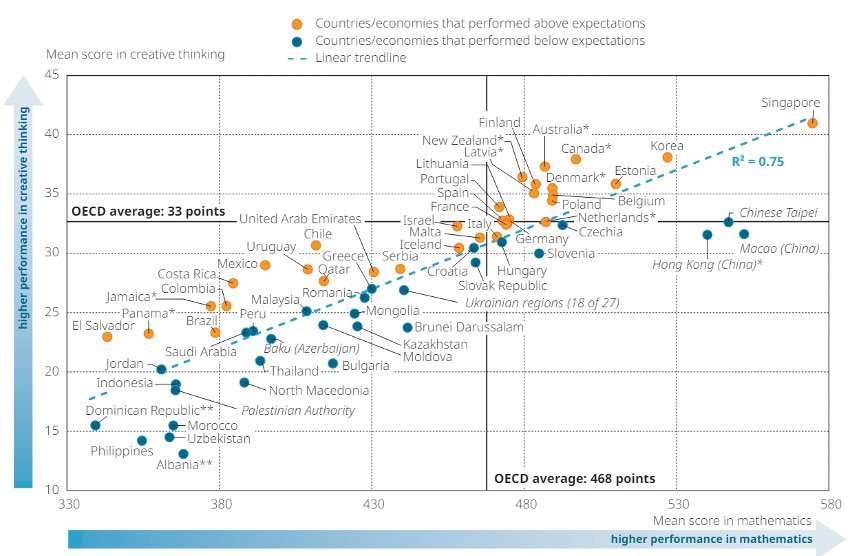
@Doug_Lemov@ValaAfshar Absolutely. Data from PISA: Where school MATH education is more rigorous, students are more CREATIVE in areas such as writing fiction, drawing posters and the sort.
As I once titled an article: The more you have in your box, the better you can think outside of the box