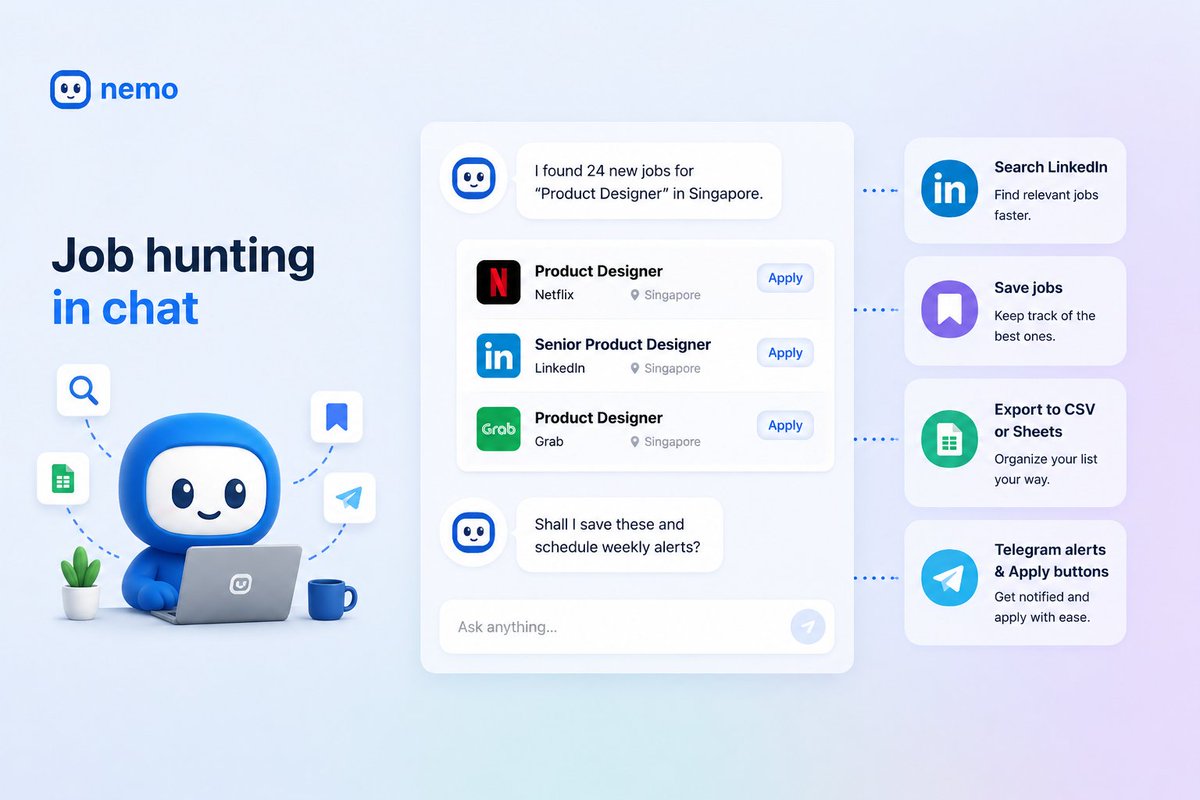
My friend job hunts with LinkedIn in one tab and a spreadsheet in another.
Now Nemo finds the jobs, saves them, and texts her one a day with an Apply button.
She applied to eight last night. In her pajamas.
@HeyNemoAI Going from LinkedIn plus spreadsheets to one chat is a huge simplification. Less tab switching means more time focusing on the actual opportunities.
🇸🇬 JUST IN: Singapore proposes BANNING stablecoin issuers from paying yield to holders.
The Monetary Authority of Singapore wants 100% reserve backing at all times, segregated custody, stress testing, and mandatory wind-down plans.
Only licensed issuers can call their tokens "MAS-regulated stablecoins."
The US GENIUS Act, the EU's MiCA, Hong Kong, and Japan already enforce similar rules.
FIVE of the world's biggest financial hubs now regulate stablecoins as payment tools, not investments.
@Msamalam you realized japan also has tons of these with special services also right? 🤣
esp maid cafes and japanese students waiting for random old men to take them home at the sidewalks
My teammate ran an overnight agent job on Fable 5 and flinched at the bill every morning.
Last night he ran it on Fable 5.1, which beats Fable 5 and Opus 5 across the board.
Same $10/$50 per token price, but cache reads dropped from $1.00 to $0.25 a million. Invoice fell 45%.
> Anime is getting too expensive to make
> Relies on Isekai to pander to the western audience
> Isekai doesn’t require Japanese culture
If Japan tries to appeal to the western audience, over time it could result in the end of Otaku culture as we know it
EL ANIME YA NO ES PARA JAPÓN
Yusuke Onuki, presidente de Bushiroad Move y veterano productor, escribió sobre una cruda realidad de la industria: muchas series de anime ya no se aprueban pensando en lo que le gusta al público japonés.
Producir una temporada cuesta en promedio unos 2.3 millones de dólares, y la estructura de ingresos de este segmento depende en un 90 por ciento de plataformas de streaming extranjeras. Por ello, los inversores confían más en historias de reencarnación con cifras de lectores comprobadas que en apuestas originales sin ese respaldo.
Estas tramas se venden fácil en Occidente al no requerir contexto cultural japonés. Sin embargo, Onuki advierte que la sobreexplotación del formato ya empezó a agotar las novelas más populares disponibles para adaptar.
El anime dejó de diseñarse para el público japonés y se convirtió en un cálculo de rentabilidad para el mercado global.