If @inecnigeria wants to regain public trust, it has to overcompensate by being very transparent. Help Nigerians understand your decision-making process.
Take the mock election, for example. You shouldn't wait for people to start insinuating that you want to use the exercise to collect data for the ruling party before you tell Nigerians that dummy ballots will be used. We should have seen samples of those ballot papers already.
Tell us the reasoning behind selecting the two polling units per ward. Was it purely random, or did you look at past election results from those polling units? Or was it for logistical reasons?
What are the KPIs for this exercise, so we can know whether it succeeded or not? Go further and make a public dashboard showing all the issues identified, where they happened, and how they were fixed.
Livestream the accreditation and result collation process. Carry Nigerians along.
But with INEC, these things seem too much to ask. You want Nigerians to trust you, yet you make zero effort to earn that trust. No wahala.
*● TINUBU INCREASED ALL THINGS UNDER HIM*
Tinubu increased International Passport from N35,000 to N165,000
Increased university fees from N25,000 to N250,000
Increased CAC registration from N10,000 to N52,000
Increased driver's license from N6,500 to N65,000
*YOU CAN ADD OTHERS!
One of the biggest challenges in building https://t.co/T1C9aFSkry, beyond setting up the data pipeline, was OCR.
Polling-unit result sheets are handwritten, then photographed and uploaded to IReV. The handwriting, image quality, lighting, angles, and compression meant that traditional OCR tools simply weren’t reliable enough.
We tested several of the leading LLMs and eventually settled on a dual-model consensus approach: two different models independently read each result sheet, and a vote total is accepted only when both models agree.
Even with that safeguard, we knew there would still be a small chance of incorrectly reading some polling-unit results.
Before Osun, we tested the system using results from Ekiti and Anambra, and the results gave us enough confidence to deploy it at scale.
Now that INEC has announced the official results for all 30 LGAs in Osun, we can finally compare the official statewide collation with what Mundx independently produced from polling-unit results uploaded to IReV.
The result is encouraging:
Mundx’s polling-unit tally was about 95.68% accurate compared with the final INEC statewide results, despite having only 97.77% of polling units included in its count.
That means an automated, LLM-based system was able to get remarkably close to the final official result while working from an incomplete set of polling-unit uploads and doing so much faster and more cost-efficiently than manual collation.
This has reinforced something we strongly believed while building the system: LLM-based OCR is incredibly powerful, especially for documents that traditional OCR struggles with.
There is still more work to do. We will continue strengthening the validation layers, improving how the system handles difficult result sheets and edge cases, and making the platform even more resilient ahead of 2027.
Thank you to everyone who followed the project, tested the platform, shared feedback, and sent kind words throughout the election.
Congratulations Governor Adeleke.
If you want to continue doing business in Lagos make sure you vote for me in 2027.. Agreement is agreement. You do for me, I do for you”
~ Tinubu dares the Igbos living in Lagos
We started out doing the wrong search.
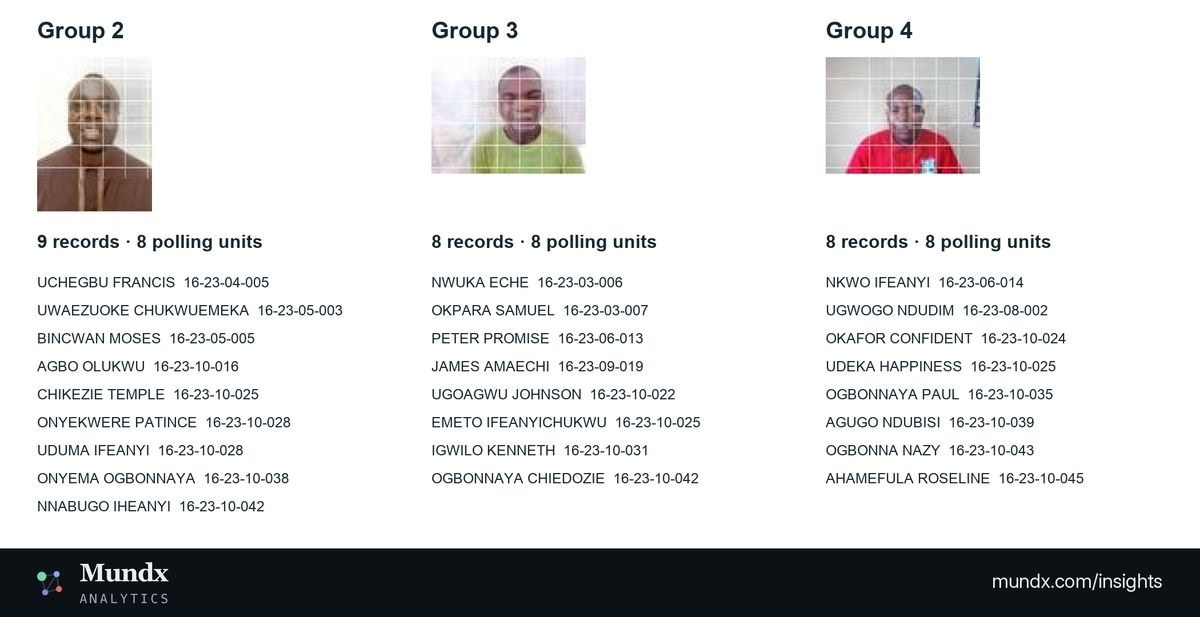
We were looking for the same photo repeated within one polling unit. The bigger problem is the same photo repeated across different polling units and different wards.
In Oru East LGA, Imo State, 18,966 voter records share just 7,580 distinct photos. The same image appears in several records, under different names, across different polling units and wards.
The image below is a sample of three of those photos.
@inecnigeria, please explain:
1. Will a PVC be issued for each of these records?
2. If one person ends up holding several PVCs, can they move from one polling unit to another on election day, get accredited, and vote at each one?
3. Why did INEC’s ABIS (Automated Biometric Identification System) not remove records that share the same photo?
4. Does BVAS compare a voter’s face and fingerprints against the whole register, or only against the register for the polling unit they show up at?