My blog on System 0 in the Astra era:
As spatial grounding (S1/2) improves, we need dynamics-grounded controllers (S0) and expressive interfaces that let Astra steer physical interaction.
Hope this resonates or sparks disagreement. I’d love your thoughts!
https://t.co/EFfVOqiTu1
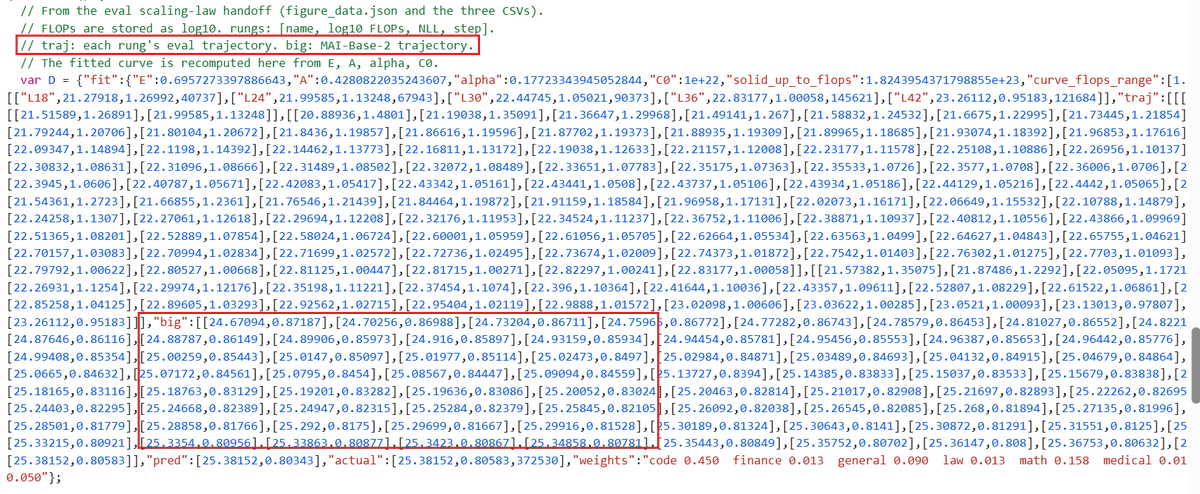
I was thinking too much about how MAI produced the fit and didn't realize that the simple "ln L residual with 1e-3 Huber" (which is the classic Chinchilla Approach 3) can produce it.
@iamgrigorev I fit it with L2 loss and got E≈0.65 which extrapolates worse than E≈0.695.
And I found that the given parameters have a higher RMSE than the L2 loss fit, but completely forgot the classic Huber loss (it was midnight), so I assumed hidden data points were used.
Autoresearch with coding agents can now run for days on a single problem, but we've seen an increasing number of cases where they stop improving early. We address this issue with a simple idea: forgetting.
Introducing our new paper: "Scaling Discovery Requires Forgetting"
ImageNet should be retired.
GPIC with FD is a good text-to-image benchmark. it has 100M samples with rich annotation (imagenet has only 1.28M with cls label).
so researchers have to play with multi-epoch (even >100) on imagenet supporting 1B size cls-to-image model training, which is clearly overfitting and never gonna work at real setup. people in https://t.co/hUTPBQPInl already fonud that there is no strong signal that the tech we use in imagenet could be transferred to real text-to-image setup.
I kept thinking if diffusion is actually super good, or it just good at imagenet overfit setup. now seems AR model can do things good at large-scale as well.
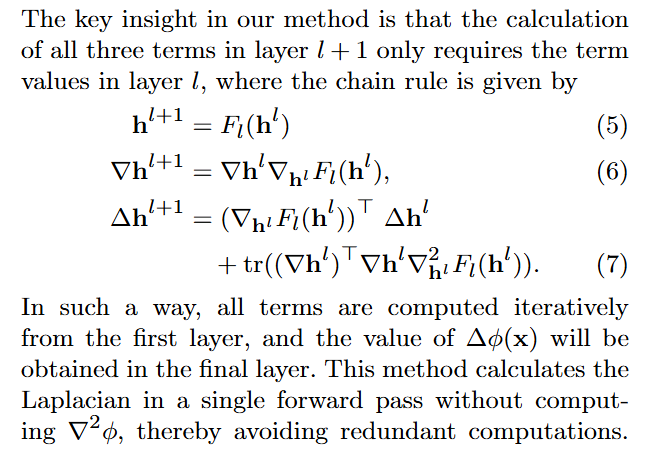
Just came across LapJAX(https://t.co/BeBolyzBP5) (again).
One interesting thing is that JAX's taylor mode AD(https://t.co/IlGU5QJj3R) can do nearly the same thing as LapJAX (one diff: hvv instead of laplacian).
See discussion in 2022: https://t.co/WX6EXCcQlA
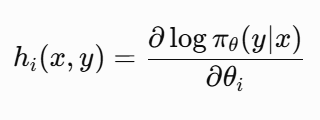
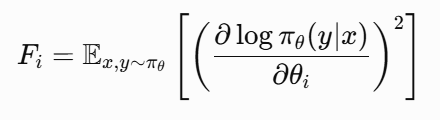
Key insight is E_{y~π}[h_i(y)²] is sparse, but E_{y~D}[h_i(y)²] is not.
(the paper use an effective signal perspective, where SFT has unbouned (q/π - b) signal; b is arbitrary bias)
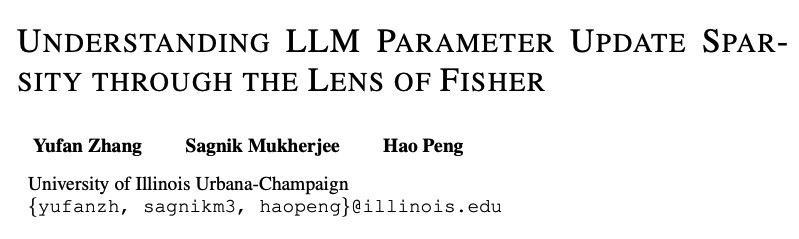
Why are LLM parameter updates so sparse during post-training? 🔍
In our new paper, we study this phenomenon through the lens of Fisher information, connecting theory and empirical findings across RL, SFT, and on-policy distillation.
A thread on what we found 🧵👇
Why are LLM parameter updates so sparse during post-training? 🔍
In our new paper, we study this phenomenon through the lens of Fisher information, connecting theory and empirical findings across RL, SFT, and on-policy distillation.
A thread on what we found 🧵👇
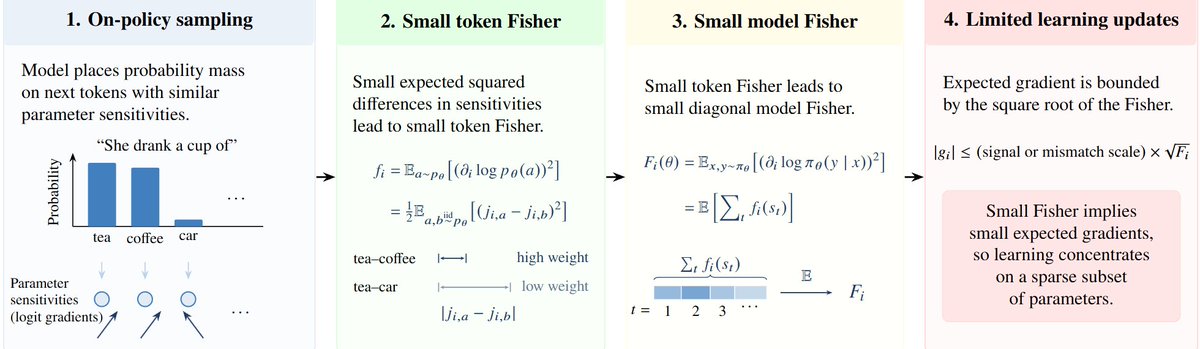
The paper’s point: on-policy, the score has zero mean, so |g_i| <= sqrt(E[Var(r|x)]) * sqrt(F_i) for any reward.
F_i depends only on the model, so you can rank coordinates before seeing rewards
training only the top 0.1% by initial Fisher recovers ~85% of the full gain on on-policy PG based methos. IIUC @yufanzh_
cc @_arohan_ in case you are interested.
interestingly this is NOT very scaling-pilled, as you can get decent success rate with only 4k parallel environment and 25k PPO iterations, which is "merely" 3200M steps.
(1/6) From @GoogleDeepmind’s AlphaGo to AlphaZero, we saw machines find moves that reached beyond what we’d imagined for them. No one taught them those strategies. They emerged from reinforcement learning: playing, failing, and trying again under a single binary task reward for success or failure. Inspired by them, we couldn’t help but wonder: what might a robot discover if we gave it that same freedom to learn?
That question led us to AlphaNIST. Starting tabula rasa, with that same binary reward plus only a simple control cost, a single policy solves all 20 @NIST assembly tasks at a 98.2% success rate in simulation. More surprising still, AlphaNIST can complete 10 different tasks in a row, receiving that reward only once, after all 10 are done.
Just as AlphaGo’s strategies surprised its creators, AlphaNIST discovered dexterous strategies we couldn’t have come up with ourselves.
Paper: https://t.co/HZBYgG7SWK
Website: https://t.co/VyUKiYFI2y
Conditioning in robotics is so strong that we don't need a generative model to fill the gap between observation and action.
A simple regression is enough, it works on VLA and even WAM.
And it admits 1-pass inference and simpler RL algorithm.
🤖 Why do generative policies beat regression policies? Multi-modality? Manifold adherence? Or more?
Our analysis suggests: highly imbalanced gradients under MSE!
A loss change closes the gap: no denoising, competitive performance, faster inference.
📄 https://t.co/gw8fYSr3dz
Anthropic released their 2021 research roadmap earlier this year (because of copyright litigation); I think some people might find it interesting: https://t.co/CpilF8XguE
(1/6) From @GoogleDeepmind’s AlphaGo to AlphaZero, we saw machines find moves that reached beyond what we’d imagined for them. No one taught them those strategies. They emerged from reinforcement learning: playing, failing, and trying again under a single binary task reward for success or failure. Inspired by them, we couldn’t help but wonder: what might a robot discover if we gave it that same freedom to learn?
That question led us to AlphaNIST. Starting tabula rasa, with that same binary reward plus only a simple control cost, a single policy solves all 20 @NIST assembly tasks at a 98.2% success rate in simulation. More surprising still, AlphaNIST can complete 10 different tasks in a row, receiving that reward only once, after all 10 are done.
Just as AlphaGo’s strategies surprised its creators, AlphaNIST discovered dexterous strategies we couldn’t have come up with ourselves.
Paper: https://t.co/HZBYgG7SWK
Website: https://t.co/VyUKiYFI2y