you just had to be there…
Curren$y “Address” was floating around the blogs like it wasn’t supposed to be this hard.
soon as it hit mtv jams it was a wrap
blog era really gave artists a whole new life.
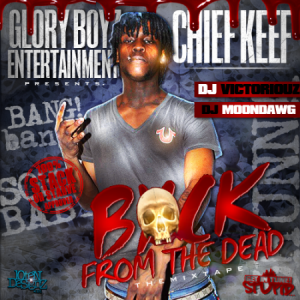
14 years ago today, #ChiefKeef released ‘Back from the Dead’, the mixtape that helped push Chicago drill music onto the national stage. The project featured the breakout anthem “Don’t Like” with Lil Reese, it exploded online and quickly became one of the most viral street records of the era. The buzz got so big that Kanye West jumped on the official remix alongside Pusha T, Big Sean, and Jadakiss.
Much of the tape was produced by Young Chop, whose dark, hard hitting beats helped define the early Chicago drill sound. At the time, Chief Keef was a teenager, and the mixtape’s viral momentum eventually led to him signing a major record deal later that year.
More than a decade later, #BackfromtheDead is still widely credited as one of the projects that helped introduce drill music to the mainstream.
Prodigy (of Mobb Deep) – “Keep It Thoro”
The word “genius” is thrown around a lot these days. As far as hyperbole goes, the word “genius” is most often used by fans to describe artists that are slightly above average.
Worse than the misuse of the word “genius” is the *misapplication* of the word “genius”. You see, genius is often infers “complexity”. But the spectrum of genius also includes “simplicity”. And it is here, in this range of genius, that we find Prodigy (of Mobb Deep), one of the greatest rappers in the history of hip hop/rap music.
There’s dimensions to Prodigy’s genius.
First, there’s his use of the *talk-rhyme* style.
Of all of the rhyme styles, talk-rhyme — the rhyme style in which the rapper sounds more like he’s talking than rapping — is the most difficult rhyme style to pull off.
Some rhyme styles give you cover.
They mask your defaults and inabilities. They wear down the listener’s ear, giving off a mix of blandness cosplaying as rhyme skill.
With the speed-rhyme style, where rhymes are delivered deliberately in a speedy (fast) manner, you can hide.
With the miracle lyrical rhyme style, where large groups of words are jumbled together, giving the false impression of rhyme skills, you can hide.
With the talk-rhyme style, you can’t hide.
Talk-rhyme relies on less words.
It’s powered more by the voice, and the realness of the life lived behind the voice.
Talk-rhyme is also a technical marvel. Of all hip hop/rap’s rhyme styles, it’s the one that exhibits the highest level of breath control. And this is baked into the style.
With the talk-rhyme style, you don’t hear the *gulps* of breathing between lines; you don’t hear a rapper catching his breath between transitions. This is one reason why the talk-rhyme style is the epitome of breath control.
Prodigy, one of only a handful of talk-rhymers, was a master of the talk-rhyme style. Not just because he made one of the most difficult rhyme styles look easy, but because he was deceptively simple with his rhymes.
Much of Prodigy’s genius lied in his poetry and timing:
“Ayo, … I break bread…
ribs…
hundred dollar bills… …
Peel on Ducatis…
and other four wheels/ write a book full of medicine
and generate mils”
There’s a deadpan, life-or-death quality to Prodigy’s rhymes.
This too was part of his genius…
Now, as for the “Keep It Thoro” beat.
“Keep It Thoro” is an absolutely menacing audio composite.
Aside from Prodigy’s heavy New York slang-laced phrasings and deadpan life-confident delivery, it’s the beatwork of Alchemist that also makes this song so defiantly hard.
The core groove is built around a dusty, lounge-act piano sample that jabs the exact same tone — in 1/8ths — for a count of seven times before there’s a change in the phrase: A loose note kicks off moments before the sample loops back to itself.
For the bass parts, Alchemist doesn’t go with a conventional bass line. Instead, he uses just three bass sound-stabs to anchor the groove. Two of the three bass-stabs are simply low- and high-pitched versions of the same exact sound stab; the third bass-stab, which Alchemist uses to slide into one of the others, has a slick, boom texture to it.
Some beatmakers might not (at first) understand Alchemist’s arrangement of higher tones with lower ones, but the reality is this technique of clashing textures and levels is one of the most fundamental mainstays of the beatmaking tradition.
So on “Keep It Thoro,” Alchemist is acutely aware of the fact that it’s the repetitive nature of the sampled piano phrase that actually makes the bass parts sound even more pronounced; which, in turn, gives the overall track a “booming” sonic impression.
A genius beat for a genius rhyme…
This is the kind of line that doesn’t forgive mistakes 😮💨⚠️
@colby_stevenson getting rowdy and threading the needle on a savage face while filming for 'Legend Has It'
#tgrfromthevault#tgrlegendhasit