GOOGLE CEO SUNDAR PICHAI:
"IF YOU DON'T LEARN HOW TO ORCHESTRATE AGENTS NOW, YOU'LL SPEND 2027 CATCHING UP TO PEOPLE WHO STARTED TODAY."
30 minutes on why the best engineers stopped writing code line by line and started orchestrating agents instead.
Most people think building an agent requires an engineering degree.
It doesn't.
It requires one guide and one afternoon. Watch the interview.
Then save the exact setup below. One guide. One afternoon.
That's all it takes.
The gap between you and the engineers winning in 2027 closes this weekend.
Scott Wu thinks your job won't count as work in 50 years
his point: picture a farmer from 1,000 years ago watching us
you sit in a room, talk to a few people and call it a meeting
you press buttons on a screen all day and call that a job
to someone who sewed every piece of clothing by hand that looks like nothing
and he says what comes next will be just as unrecognizable to us as we are to them
we are the ancestors who won't understand the next version of work
the early shape of it is already here, one person plus Claude doing what used to need a whole company
that's the exact setup I broke down in Loops Engineering for Quants
you can build a system that researches -> verifies -> trades while you sleep
LATEST: @VitalikButerin drops a 10,000-word post on indistinguishability obfuscation, the "final boss" of cryptography that could enable truly private smart contracts, but remains largely theoretical.
ANTHROPIC CEO, Dario Amodei:
"In the next 2 to 5 years, AI will hit the job market faster and broader than anything we've ever seen."
This isn't a forecast, it's already happening and you can't adapt while ignoring it.
38 minutes on how to win through these changes, from the CEO of a $965B company.
Watch it, then read the guide on everything Claude can do below and you'll already know more than 99% of people.
A ten-thousand word monster post trying to cover the entire tech tree behind the main lineage of obfuscation (iO) protocols:
https://t.co/46nseINlwF
Special thanks to all who helped!
⚡️ INSIGHT: Vitalik Buterin says obfuscation plus blockchains could unlock near-trustless private onchain voting, hiding the program logic while using chains to handle state.
This year, the EF is decreasing its budget by roughly 40%, which entails some difficult decisions. The goal of the decreases was set out in the Treasury Management Policy last year: the EF is transitioning into being a long-term-oriented endowment-based organization, shifting from its pre-2026 average of spending ~15% of its remaining funds each year, toward a post-2030 target of ~5% per year.
Often, when an organization goes through something like this, people try to pretend that nothing of great value was lost, that it is an efficiency increase, that the only people cut are unproductive dead weight, and everyone else stopped partying, studied the blade, entered cracked S-tier beast mode, and this was sufficient to make up for the downside. I will not try to pretend this. I respect my EF colleagues far too much to pretend that there was not much that is lost. They are brilliant people. They are dedicated engineers of whom some have worked on the Ethereum protocol for nearly a decade. They have brought a bright light to the Ethereum ecosystem with their code, their words, their warmth as human beings and their actions. My dearest hope is that they find a path that brings them fulfillment and happiness whether inside Ethereum or outside. Hopefully many will be able to bring their excellent talents and mindset to the wider Ethereum ecosystem, or the even wider CROPS world.
Instead, I will try to explain what *are* some of the grand sacrifices being made. The Ethereum Strawmap is no small thing. It is an extremely ambitious undertaking seeking to replace and augment almost every part of the protocol - consensus, proofs, privacy, account model, state, and more. This is the third iteration of Ethereum, in the same way that the Merge was the second, even if the shipping style is less Big Bang and more one-piece-at-a-time. On top of this, the EF is increasing its role in the Access Layer. We are not compromising on Ethereum being a Deeply Impressive protocol, something worthy of its place in a world with quantum computing, rockets to Mars and powerful biotech and AI, and capable of meeting the challenges that this era will bring.
Some of the deficit will be recovered through more work happening outside the EF. But not all. So what are the grand sacrifices that will enable a leaner effort to accomplish all of this? I will give a few examples (though far from an exhaustive list):
* The multi-client model will shift in the direction of multiple clients existing less for _redundancy_, and more for _specialization_. Up to this point, redundancy has been the main security strategy: if one client has a bug, if it has less than 33%, the chain keeps going and does not even stop finalizing. We are increasingly exploring moving more pieces of the protocol to a different security strategy: AI-assisted formal verification. Some smaller pieces of Ethereum (eg. BLS libraries) have worked this way already for a long time. But soon many more parts of Ethereum will likely function on this model. This may greatly reduce resource requirements of shipping a large number of EIPs. The resources saved by client teams can ideally instead be used to better serve different specialized user needs, including EF Access Layer goals.
* PSE (Privacy and Scaling Explorations) is winding down as a unit. The number of people working on ZKPs for privacy and scaling is probably as high as ever, but they are working less on "exploration" and more on *implementing* ZKP-based privacy and scaling into the Protocol and Access Layer
* Devcon will likely over time become smaller-scale, somewhat more spartan, much lower-deficit than previous years, in addition to other changes in vision in line with the Mandate.
* Fewer beyond-Ethereum megaprojects coming from EF. As I announced earlier this year, I am taking on some of the responsibility of doing projects in this category that I consider valuable with my personal funds.
* EF institutional work is reducing in scope, specializing more specifically on creating replicable test cases of highly CROPS-friendly deployments, even if at smaller scale.
These do not explain all departures; in some cases they do not explain departures at all and rather explain _reduced need for new spending_. But they are a large part of the strategy at play.
In the longer term, I personally favor a "soft lean-and-done" approach to Ethereum: once the Strawmap is completed, generally stick to security fixes and small high-value changes, and have a much higher bar for considering new feature additions to the protocol. This allows Ethereum to remain capture-resistant without demanding very large budgets. Learn less from multimillion-line-of-code behemoth projects, more from bitcoin.
The past years have been a challenging era for Ethereum. However, the ecosystem is adapting, both inside the EF and outside, and I am confident that Ethereum is very well-positioned to succeed and thrive.
https://t.co/iZiOonRYzR
london is quietly building world class hardware.
→ 2 exits before 18
→ a humanoid built 15x cheaper than anything available
i brought them and some of the best hardware and deep tech founders to MTF 2026 .👇
Ethereum is valued at only $200B and people are bearish.
A neutral global settlement layer for stablecoins, RWAs, banks, and the internet economy should be minimum $5T
That’s roughly $41,600 per ETH.
The cope after ETH reprices will be generational.
I’m happy to share that we’ve added a new category of nodes to https://t.co/CgxI17SrYh: visualization nodes.
The first node in this category is the graph node.
A graph node visually represents connected nodes as lines, curves, and points.
Vitalik Buterin: L2s afraid to fully decentralize should just be centralized servers
On July 3, 2025, Ethereum co-founder Vitalik Buterin @VitalikButerin stated in an EthCC speech video that many Layer 2 projects claiming to build on-chain retain instant backdoors or fall short of their claimed decentralization stages.
He believes that from a practical standpoint, this architecture is not much better than a traditional centralized server. Vitalik Buterin stated that if developers are afraid to make their projects truly decentralized, the most straightforward approach is to simply build a centralized server.
I'm happy to share that we added four new input types to https://t.co/CgxI17SrYh,
- Polynomials
- Linear
- Quadratic
- Vectors
In this demo, I show how to use these new types and the design decisions we are making to make mathbuilder more expressive and fluid.
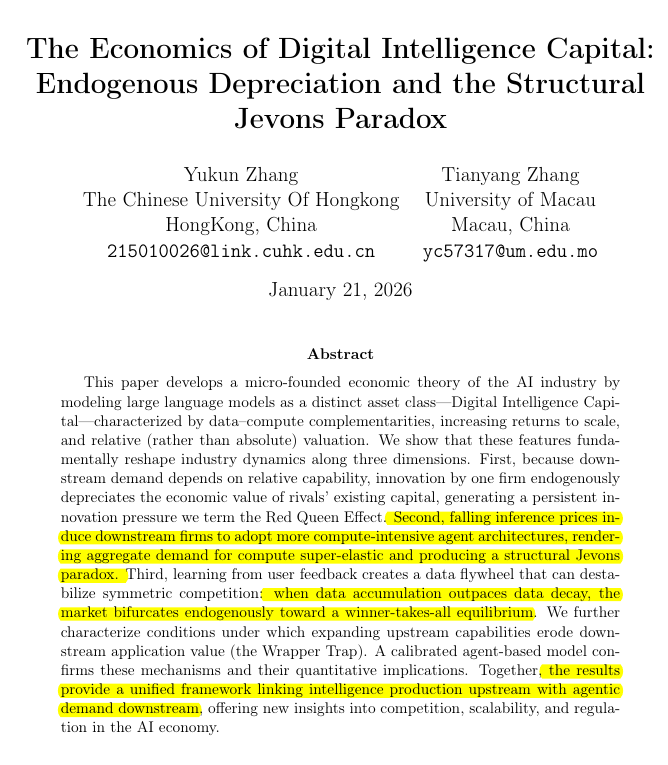
Brilliant economic paper directly models the "Structural Jevons Paradox" happening right now in the AI industry.
The cost of running an LLM is dropping, but total computing energy is exploding anyway.
It mathematically proves that as the unit cost of digital intelligence and coding drops, the aggregate demand for complex AI agents and the infrastructure to support them surges exponentially, creating a massive new downstream ecosystem that requires human management.
Reveals a massive paradox where dropping the price of AI usage does not save money, but instead encourages developers to build vastly more complex agents that eat up exponentially more computing power.
Because of this relentless progress, small companies building simple applications on top of these models get completely crushed as the core AI naturally absorbs those exact same features over time.
They also discovered a brutal dynamic where a perfectly working LLM becomes economically worthless the moment a competitor releases a smarter version.
Ultimately, the researchers prove that this combination of massive computing costs and the need for constant user data naturally pushes the entire AI industry toward an unavoidable monopoly.
---
arxiv. org/pdf/2601.12339v1
"The Economics of Digital Intelligence Capital"