LA ACTIVIDAD FÍSICA MEJORA MUCHO MAS QUE EL PESO CORPORAL
El ejercicio puede:
• mejorar sensibilidad a la insulina
• reducir presión arterial
• mejorar perfil lipídico
• preservar masa muscular
• aumentar capacidad cardiorrespiratoria
incluso con pérdidas de peso modestas.
¿Y si el objetivo principal no fuese solo adelgazar?
Nuevo artículo →https://t.co/lcIMXYsXlZ
https://t.co/ghlyA0rsYU
📢 Nuevo Scientific Statement de la American Heart Association ❤️
La actividad física debe ser un pilar en el abordaje de la #obesidad: no solo para perder peso, sino para mejorar salud cardiometabólica, fuerza, función física y bienestar 🏃♀️💪⚖️
https://t.co/XzM2N6NF0G
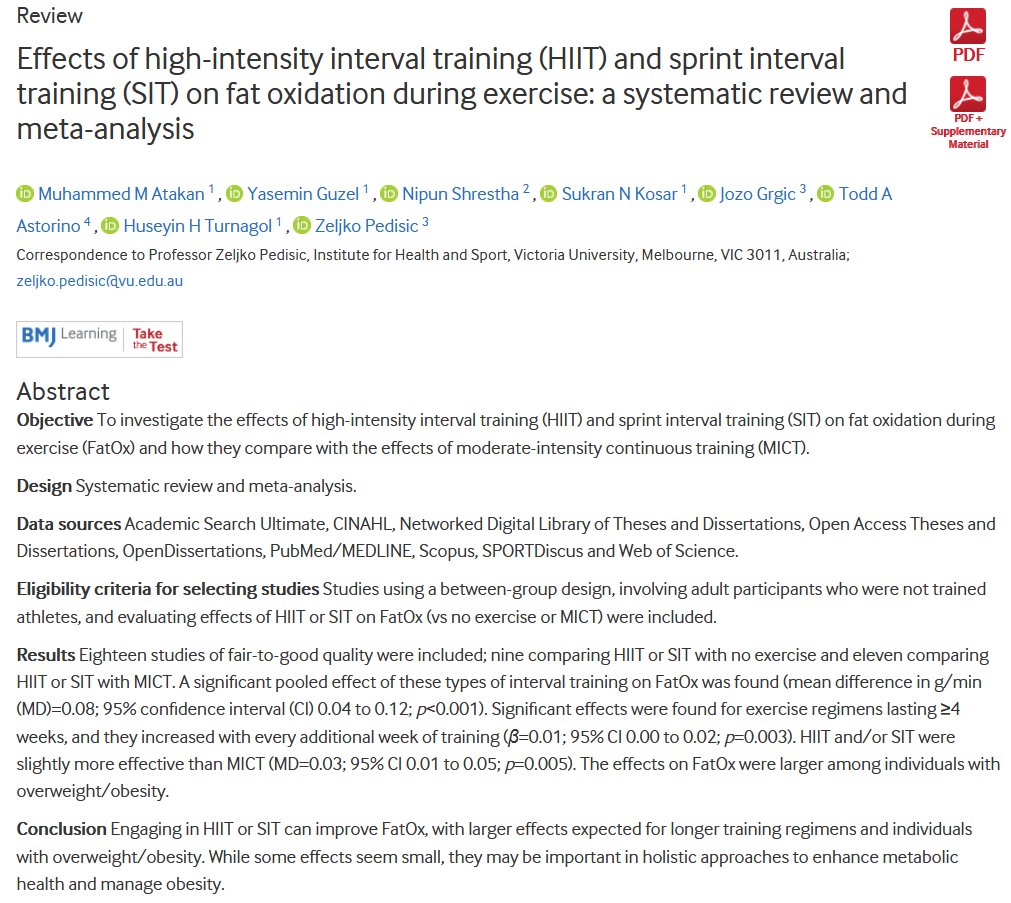
Effects of high-intensity interval training (HIIT) and sprint interval training (SIT) on fat oxidation during exercise: a systematic review and meta-analysis
https://t.co/Hf7wNSQgkW
😴 Sueño y recuperación
🛌🌍 Dormir bien no es un lujo: es salud pública.
El marco “One Sleep Health” propone mirar el sueño como pilar de salud humana, animal y planetaria: luz, ruido, trabajo, clima y desigualdad también nos quitan sueño✨
https://t.co/sDvEr6gM9y
💤Dormir es una necesidad biológica.
Revisión propone el concepto de “One Sleep Health”: el sueño conecta salud cerebral, metabolismo e inmunidad.
Menos sueño = ↑ riesgo de:
• Depresión
• Diabetes tipo 2
• Obesidad
• Enfermedad cardiovascular
• Deterioro cognitivo
🧬Ciencia
🆕Revisión: el ejercicio mantenido a lo largo de la vida podría reprogramar el metabolismo de las células T CD4+, mejorar el equilibrio Th17/Treg, reducir la inflamación crónica y preservar la inmunidad con la edad 🏃♀️💪
https://t.co/t4QCIn6UZG
📱 Aplicación práctica
La actividad física ligera también cuenta: caminar despacio, hacer tareas de casa o levantarse más puede ser una vía accesible para mejorar la salud.
El mensaje de salud pública es claro: menos silla 🪑, más zapatilla 🚶♀️👟
https://t.co/L4VAOo2Bmk
Short sleep ages you. Long sleep usually means something is already aging you.
A new paper in Nature this week mapped sleep duration against biological aging across 9 organ systems in half a million UK Biobank adults aged 37 to 84. Junhao Wen's lab at Columbia used 23 different aging clocks built from MRI scans, plasma proteins, and metabolites. The relationship is U-shaped. The slowest measured aging sat between 6.4 and 7.8 hours per night. Outside that window in either direction, organs looked older than chronological age would predict.
The two arms of the U are not the same biology.
On the short-sleep side, the causal story is well established. Sleeping under 6 hours raises systemic inflammation, impairs next-morning glucose tolerance, suppresses NK cell activity, and tracks with markers of poorer overnight brain waste clearance. Mendelian randomization in this paper supports a direct causal effect of short sleep on aging biology. Short sleep drives the wear and tear.
On the long-sleep side, the picture flips. Consistently sleeping over 8 or 9 hours is a well-documented marker of underlying disease, not a damaging behavior in itself. It tracks with major depression, undiagnosed sleep apnea, hypothyroidism, chronic inflammation, and neurodegenerative disease. The authors note that Mendelian randomization could not strongly support reverse causality, but they explicitly could not exclude it either. Decades of sleep medicine argue that for most long sleepers, the long sleep is the body compensating for something already wrong.
This matters because the practical advice for the two groups is opposite.
If you sleep under 6 hours, the levers are direct. Total sleep opportunity. Consistent timing. Morning light. Caffeine cutoff after lunch. Alcohol stopped at least three hours before bed. Sleep extension trials adding 45 to 90 minutes a night have shown measurable improvements in metabolic and cardiovascular markers.
If you consistently sleep 9 or more hours and still wake unrefreshed, the right move is to investigate what your body is recovering from. Home sleep study to rule out apnea. TSH, free T4, ferritin, CRP, vitamin D, B12. Depression and anxiety screening. A review of medications that increase sleep need.
One scenario gets lumped in with long sleepers that shouldn't be. Athletes in heavy training blocks, adolescents, people recovering from infection, and people in their first trimester genuinely need 9 to 10 hours. The paper looked at habitual sleep in adults aged 37 to 84, not acute recovery states. The curve does not apply to them the same way.
The cleaner way to state the finding: there is a window in the middle where the body looks youngest on every clock the authors built. Both sides of that window correlate with faster organ aging. The reasons differ. Short sleep does the damage. Long sleep usually shows the damage is already underway.
Este jueves nos vemos en el Congreso Nacional @SENPE_#SENPE2026 hablando sobre un tema que, probablemente, definirá el futuro real del envejecimiento saludable:
👉 El ejercicio físico basado en evidencia ya no puede entenderse como un “#estilodevida”.
Debe integrarse como terapia clínica.
Durante décadas hemos generado miles de guías, consensos y recomendaciones.
Y aun así…
▪️ Seguimos viendo fragilidad,
▪️ sarcopenia,
▪️ polifarmacia,
▪️ pérdida de autonomía,
▪️ y años de vida vividos con discapacidad.
El gran problema ya no es la falta de evidencia.
Es la falta de implementación clínica real.
En la charla abordaremos por qué el ejercicio fracasa cuando se prescribe fuera del contexto nutricional y farmacológico del paciente, y cómo el futuro del envejecimiento saludable dependerá de integrar:
✔️ ejercicio,
✔️ nutrición,
✔️ farmacología,
✔️ y función física
como un único modelo terapéutico.
Porque el objetivo no es solo vivir más.
Es mantener la #autonomía.
#SENPE #EjercicioEsMedicina #HealthyLongevity #Fragilidad #Sarcopenia #NutriciónClínica #ExerciseMedicine #LongevidadFuncional #HealthyAgeing @navarrabiomed@UNavarra 👋
My updated metabolic map is less focused on substrate utilization and thresholds and more focused on metabolic stability. I believe the shift is subtle but important.
Instead of only asking:
“What fuel is being used?”
The model also asks:
“How stable is the metabolic system under stress?”
In this framework, lactate becomes the central proxy to understand the balance, drift, or overload of the metabolic system.
Approximate translation and comparison with different models:
• Zone 1 = low metabolic stress
Clearly below LT1/VT1
• Zone 2 = metabolic equilibrium
Near LT1/VT1, where lactate production and clearance remain tightly matched and the system operates at its highest sustainable balance
• Zones 3–4 = metabolic drift
The system progressively moves away from optimal mitochondrial matching capacity, even if lactate may still achieve a “steady state”…CP/MLSS/VT2/LT2/V4…
• Zone 5+ = metabolic overload
Above CP/MLSS/VT2/LT2/V4, where no true steady state is physiologically achievable
The key conceptual distinction:
A lactate steady state is not the same as optimal metabolic equilibrium.
The metabolic equilibrium ceiling is near LT1/VT1 and Zone 2.
The steady-state ceiling is CP/MLSS/VT2/LT2/V4.
Performance is ultimately defined by how long the body can preserve metabolic equilibrium.
👶Infancia y adolescencia
Más parques y menos pantallas 🌳📵
En 15.081 niños, una revisión asoció salir al exterior —sobre todo >120 min/día— con menor miopía 👀
La infancia necesita jugar y moverse al aire libre: no es ocio, es salud 🧒🏃♀️☀️
https://t.co/YHPPwAid8J