📖 Reading The Discovery of India | Chapter 1: Ahmadnagar Fort — Life’s Philosophy (2)
Can science explain everything? And if it cannot, does religion have all the answers?
In “Life’s Philosophy”, Jawaharlal Nehru finds himself somewhere between the two.
He acknowledges that despite all its magnificent achievements, science still knows very little about the vast unknown around us. Life, for him, cannot be reduced entirely to what we can see, hear and feel. There are psychological, artistic, spiritual and other dimensions of human experience that remain difficult to understand.
But that does not lead him towards unquestioning faith either.
Mysticism fascinates him but also makes him uncomfortable. Metaphysics and philosophy appeal to his intellect, but he remains wary of speculation presented as certainty.
And then comes perhaps the clearest statement of where Nehru stands:
“Essentially, I am interested in this world, in this life, not in some other world or a future life.”
He considers questions of the soul, karma, reincarnation and life after death, but refuses to accept them simply as matters of religious faith. For him, they remain possibilities in a vast unknown about which human beings still know very little.
That is what makes this section fascinating. Nehru neither dismisses the unknown nor claims to understand it.
He remains curious, skeptical and open.
Perhaps his philosophy is less about finding certainty and more about having the courage to say: I do not know, but I will continue to question.
Listen. Reflect. Rediscover India.
If you would like to contribute your voice to The Discovery of India series, DM us and become part of this collective reading journey.
Every degree deserves a destination.
#NEEAM, the National Education and Employment Alignment Mission, aims to build clearer pathways between education, skills, qualifications and meaningful employment.
Want to contribute ideas, research or solutions? Join the mission:
🔗 https://t.co/1a325Ctcc8
🎙️📖 Reading The Discovery of India | Chapter 1: Ahmadnagar Fort — Life’s Philosophy
In “Life’s Philosophy”, Jawaharlal Nehru makes a remarkably candid admission. When asked to write about his philosophy of life, he finds himself unable to give a definite answer.
There had been a time when his ideas about life and the future seemed clearer. But war, fascism, violence, suffering and the events around him had shaken that certainty. The future now appeared “vague and shadowy”.
And this uncertainty raises a deeper moral question: What do we do when confronted with evil? Do we submit to it? Do we compromise with it? Or do we continue to resist?
Nehru had been attracted to the optimism of science, reason and progress. But human progress in knowledge had clearly not prevented war, cruelty or destruction.
Religion posed another contradiction. Much of organised religion, dogma and superstition did not appeal to his rational mind. Yet he could also see that religion gave millions of people comfort, meaning and strength in times of suffering.
So this is not Nehru presenting us with a finished philosophy.
It is Nehru searching for one.
Perhaps that is what makes this section so human, a man surrounded by enormous political and historical upheaval admitting that he does not have all the answers, but refusing to stop asking the questions. We will have more parts to this part of the chapter.
Listen. Reflect. Rediscover India.
If you would like to contribute your voice to this reading of The Discovery of India, DM us and become part of the series.
@INCIndia@IYC@Jairam_Ramesh
The Voice of Indian Youth: Key Insights from "A New Deal for Youth" Survey
⭐️ A big thank you to every student, aspirant, fresher, and young professional across India who shared their voice in our "A New Deal for Youth" survey.
Your responses are our roadmap at Young Professionals for Change to drive real reform, restore trust, and secure dignified employment.
Here is what young India told us:
⚡️Restore Exam Integrity: Eliminate paper leaks and sudden delays with strict statutory accountability for exam boards, fixed recruitment calendars, transparent evaluation, affordable fees, and local test centers.
⚡️Jobs Over Rote Degrees: Education must shift to outcome-linked learning measured by job placements, mandatory industry internships, practical lab training, and early R&D exposure.
⚡️Decentralized, Future-Ready Jobs: Youth wants high-value roles in AI, robotics, green energy, and agritech. Moving industrial and startup hubs to Tier-2 and Tier-3 towns is critical to stop forced urban migration.
How We Take Action:
➡️Students: Demand campus transparency and document systemic issues.
➡️Professionals: Mentor the next generation and close the skill gap.
➡️Policy Advocates: Turn ground realities into real political demands.
Haven't shared your voice yet? Take 3 minutes to fill out the survey:
#ANewDealForYouth #YoungProfessionalsForChange #IndianYouthCongress #YouthEmpowerment #EducationReform #JobsForYouth #StopPaperLeaks #FutureOfWork #SkillIndia #StudentPower #HopefulIndia #YouthPolicy #ChhatronKiGoonj
Despite being in power for more than a decade, the Narendra Modi government has failed to fully translate India’s demographic advantage into sufficient productive and secure employment. More frighteningly, this window is closing.
Against this record, “Viksit Bharat by 2047” risks becoming another jumla, like the missed target of making India a $5 trillion economy by FY 2024–25 and raising manufacturing’s share of GDP to 25% by 2025.
According to a recent NITI Aayog report, the number of government schools saw a reduction of about 94,000 schools. During the same period, the number of private unaided schools increased from 2.88 lakh to 3.39 lakh. NITI Aayog report raises serious questions about the state of public education. As affordable government schools disappear or merge, families are increasingly pushed towards private education, where high fees have become another nightmare.
Parents spend their savings and often take loans to educate their children. Yet even these expensive degrees are not translating into skills, secure employment or better incomes.
And it is not just us saying this. Listen to students, jobseekers and working professionals. They are all saying the same thing, we do not see a bright future ahead of us.
The protests, resentment and growing sadness among India’s youth are not what this country or its young people deserves. They have aspirations. They have dreams. But this government has failed them spectacularly.
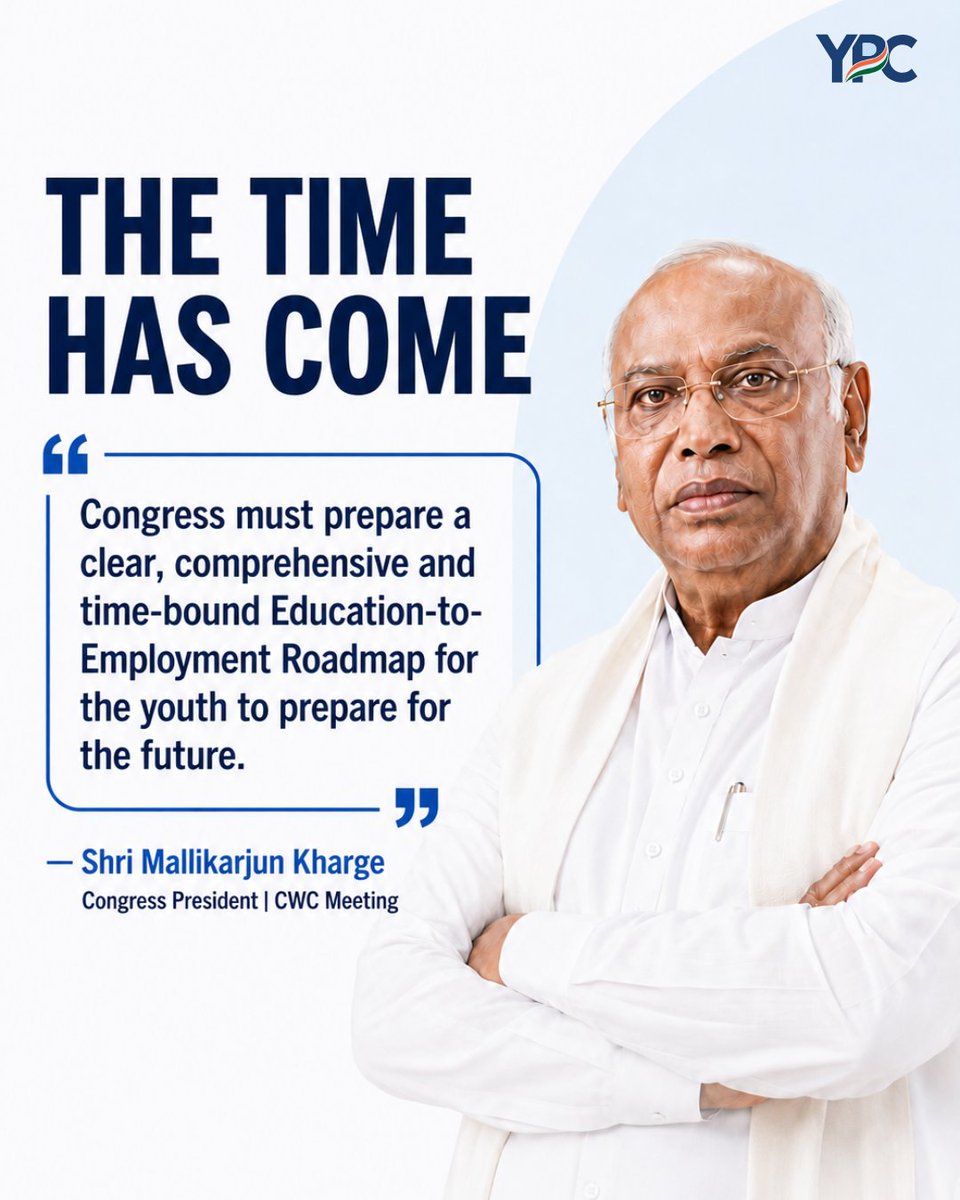
In his recent address at the Congress Working Committee (CWC) meeting, Congress President Shri @kharge ji emphasised that Congress must prepare a clear, comprehensive and time-bound Education-to-Employment Roadmap.
The BJP is no longer interested in this responsibility. It remains occupied with its own agendas and has shown little regard for the future of India’s youth. Therefore, despite being in opposition, the Congress Party has taken it upon itself to prepare this roadmap as a serious exercise.
At Young Professionals for Change, we have already been working in this direction through two initiatives.
The first is A New Deal for Youth. It is a comprehensive programme covering education, skills and jobs. We are taking an ecosystem approach and examining the complete journey from a young student to a working professional. Sign up link in comment section.
Sign up for A New Deal for Youth: https://t.co/F6jGXEPGoj
The second is NEEAM. It is National Education-Employment Alignment Mission, which focuses on one of the most urgent challenges today: the growing mismatch between education and employment and aims to align the two. Sign up link in comment section.
Sign up for NEEAM:
https://t.co/ZlRWOU5307
As Kharge ji has emphasised the need for such a roadmap, we are trying, in our own capacity, to contribute towards it.
India’s youth deserve a clear pathway from learning to earning. Let us all contribute to make that.
@INCIndia@IYC@RahulGandhi@Jairam_Ramesh
India has built an education system, but not an employment system.
Young people spend years earning degrees, yet the system rarely answers one basic question:
What jobs is this qualification designed to lead to?
#NEEAM, the National Education and Employment Alignment Mission, aims to build clearer pathways between education, skills, qualifications and meaningful employment.
Because education should not end with a degree. It should lead to opportunity.
Every Degree Deserves a Destination.
Want to contribute ideas, research or solutions? Join the mission:
🔗 https://t.co/1a325Ctcc8
#NEEAM #EveryDegreeDeservesADestination #Education #Employment #Skills #Jobs #YouthEmployment #EducationReform #FutureOfWork
@INCIndia@IYC@kharge@RahulGandhi@Jairam_Ramesh@dubeyamitabh
#NEEAM | India has built an education system, but not an employment system that aligns the degrees with a suitable destination. The link is missing.
A student spends 12 years in school, 3 to 5 years in college, and lakhs of rupees on fees and coaching. But after earning the degree, the system often has no answer to one basic question:
What jobs is this qualification designed to lead to?
- MBA holders apply for Group-C jobs. Engineers apply for clerical positions.
- PhD holders compete for jobs requiring Class 12 qualifications.
- Freshers are asked for experience, but cannot gain experience without receiving their first opportunity
This is a grave education-employment mismatch crisis.
That is why we are building the NEEAM: National Education-Employment Alignment Mission. NEEAM will work towards creating clearer pathways between education, skills, qualifications and employment. A definite system where degrees have defined destinations, skills have relevance and dignity, and young people know where their education can take them.
If you are a student, teacher, researcher, policymaker, recruiter, working professional, skilled worker, or someone who believes India needs better pathways from education to employment, we invite you to join this mission.
Link: https://t.co/1a325CsEmA
@kharge@RahulGandhi@INCIndia@IYC@dubeyamitabh
#NEEAM #Education #Employment #Skills #Jobs #YouthEmployment #FutureOfWork #EducationReform
📖 Reading The Discovery of India | Chapter 1: Ahmadnagar Fort - The War for Democracy
Writing from the confines of Ahmadnagar Fort, Jawaharlal Nehru reflects on a world at war and asks a fundamental question:
Can the "war for democracy" ever be selective?
Nehru was unequivocally opposed to Hitler, Nazism and fascism. He recalls refusing any association with Nazi Germany and reiterates the Congress position against fascist forces.
But he also questions the hypocrisy of the powerful nations of that time. Many had earlier appeased Hitler, only to turn against him when the tide changed. And while they claimed to be fighting a "war for democracy", millions of people under colonial rule were still being denied that very democracy. Congress was banned and its leadership was in prison.
Perhaps that is the larger message of the chapter that call for democracy cannot be selective and "freedom" cannot be a privilege reserved for some and denied to others.
#TheDiscoveryOfIndia #JawaharlalNehru #AhmadnagarFort #WarForDemocracy #Democracy #AntiFascism #Freedom #IndianFreedomStruggle #IdeaOfIndia #ReadingIndia
@INCIndia@Jairam_Ramesh@IYC
Can development and environmental protection move forward together?
Join us for an important conversation on “Development and Environment: Building a Better Balance”, where professionals and practitioners will explore how India can pursue growth without compromising its people, communities and natural resources.
Our speakers:
🎙️ Umang Joshi
Former Armed Forces and Climate Enthusiast
🎙️ Sadaf Khan
National Secretary, Indian Youth Congress
🎙️ Shashi Ranjan Ojha
Development Professional and Climate Action Practitioner
🎙️ Pratyusha Barua
Social Innovation Practitioner, Designer and Public Policy Professional
📅 Saturday, 22 August 2026
🕓 4 PM IST
🔴 Live on the Indian Youth Congress LinkedIn page
You can also participate through Zoom:
🔗 https://t.co/CJAgtL4MRc
Meeting ID: 871 0298 1035
Passcode: 975150
Join the conversation and help us imagine a model of development that is inclusive, sustainable and responsible.
#DevelopmentAndEnvironment #ClimateAction #SustainableDevelopment #PublicPolicy #LinkedInLive #YoungProfessionalsForChange #YPCIndia #IndianYouthCongress
For a long time, young people have been told that politics is dirty, that it is full of mud and that it is something reserved only for the regular politicians. But that is not true. It is too important to be left to politicians alone.
Politics, when practiced properly in its spirit, is a noble profession. It is public service, where you dedicate your time, energy and even your life to the cause of others aim for collective betterment.
Today, we see young people are affected by political decisions taken by others but are impacting their future. It is necessary that young people are empowered to understand those decisions, question them and participate in shaping them. It is all about ownership of one's affairs.
That is why Young Professionals for Change presents the #YPC School of Politics: The Political Leadership Programme.
This is a 12 weeks learning journey designed to help young people understand politics beyond the conventional ideas and narratives we have grown up with. It is a chance to unlearn and learn and develop a new perspective.
Over 12 classes and 12 weeks, we will explore:
1. Constitution & Democracy - Constitution, laws, institutions and democracy.
2. How Politics Works - Parties, elections, movements, power, issues, social movements and participation.
3. Political Research & Data - Research, data, sources and argument formation.
4. Political Communication - Political narratives across various media and platforms.
5. Public Speaking - Speaking, persuasion, debate and discussion.
6. Campaigns & Organising - Campaign strategy, mobilisation and collective action.
7. Social Justice & Society - Inequality, caste, class, gender, rights, reservation and representation.
8. Governance & Public Policy - Government, policymaking and citizen participation.
9. Political Writing - Articles, speeches, text content and tweets.
10. Visual Communication & Design - Graphics, videos, infographics and visual storytelling.
11. Media, Digital Politics & Technology - Media, social platforms and AI.
12. Building Political Leadership - Political identity, personal strategy, public profile and leadership.
We want to create a space where you can question what you have been told, engage with different perspectives, develop your own political understanding and acquire the practical skills required to communicate, organise people, lead and bring change.
📚 12 Classes | 12 Weeks
📅 Classes every Saturday with Assignment
🎓 Certificate of Completion and Opportunity to work with IYC team
👉 Apply now: https://t.co/OwSZWZzsM6
#YPCSchoolOfPolitics #PoliticalLeadership #YPCIndia #YoungProfessionalsForChange #YouthLeadership #Politics #Democracy #Constitution #PoliticalCommunication #PoliticalResearch #SocialJustice #Leadership #IndianYouthCongress
📖 Reading The Discovery of India | Chapter 1: Ahmadnagar Fort - Famine
Writing from the confines of Ahmadnagar Fort, Pt. Jawaharlal Nehru reflects on the devastating famine that engulfed India under colonial rule.
It was not merely a natural calamity. It exposed the cruelty of an exploitative system under which millions suffered from hunger, deprivation and neglect.
If you would like to lend your voice to this initiative, read a part of the chapter and send us a voice note. Simply DM us, and we will connect with you.
#TheDiscoveryOfIndia #JawaharlalNehru #Nehru #IndianHistory #Famine #ReadingIndia #IYC
@Jairam_Ramesh@INCIndia@IYC
📖🎙️ Reading The Discovery of India | Chapter 1: Ahmadnagar Fort, Twenty Months
We are beginning a new series where, chapter by chapter, we will read and reflect on Pt. Jawaharlal Nehru’s The Discovery of India.
Our journey begins at Ahmadnagar Fort, a place of confinement and reflection, where Pt. Nehru begins to explore India’s civilisational imagination, its history, its people and the many layers that have shaped the idea of India we call today.
For us, this series is an invitation to revisit a way of looking at India, its past, its people, its contradictions, and its remarkable continuity.
So let us read and listen together, everyday!
#TheDiscoveryOfIndia #JawaharlalNehru #ReadingIndia #IdeaOfIndia #IndianHistory #IndianCivilisation #YPC #IYC #YoungProfessionalsForChange
Politics doesn’t happen only during elections. Politics happens every day.
It is not just about quarrels between political parties or the combative arguments we see on television.
Politics is much bigger than that. It shapes our education, our jobs, our rights, our opportunities, our workplaces, our communities and, ultimately, the choices we make about our lives and future.
As citizens, understanding politics is very essential and to lead change is even more.
That is why Young Professionals for Change presents the #YPC School of Politics: The Political Leadership Programme.
This is a 12 weeks learning journey designed to help young people understand politics beyond the conventional ideas and narratives we have grown up with. It is a chance to unlearn and learn and develop a new perspective.
Over 12 classes and 12 weeks, we will explore:
1. Constitution & Democracy - Constitution, laws, institutions and democracy.
2. How Politics Works - Parties, elections, movements, power, issues, social movements and participation.
3. Political Research & Data - Research, data, sources and argument formation.
4. Political Communication - Political narratives across various media and platforms.
5. Public Speaking - Speaking, persuasion, debate and discussion.
6. Campaigns & Organising - Campaign strategy, mobilisation and collective action.
7. Social Justice & Society - Inequality, caste, class, gender, rights, reservation and representation.
8. Governance & Public Policy - Government, policymaking and citizen participation.
9. Political Writing - Articles, speeches, text content and tweets.
10. Visual Communication & Design - Graphics, videos, infographics and visual storytelling.
11. Media, Digital Politics & Technology - Media, social platforms and AI.
12. Building Political Leadership - Political identity, personal strategy, public profile and leadership.
We want to create a space where you can question what you have been told, engage with different perspectives, develop your own political understanding and acquire the practical skills required to communicate, organise people, lead and bring change.
📚 12 Classes | 12 Weeks
📅 Classes every Saturday with Assignment
🎓 Certificate of Completion and Opportunity to work with IYC team
👉 Apply now: https://t.co/OwSZWZzsM6
For the first time during a Parliament session, we saw the government look so rattled and defensive. Prime Minister Narendra Modi and Home Minister Amit Shah largely stayed away from the proceedings when the Opposition raised serious issues of national importance.
At the beginning of the Monsoon Session, we made it clear that this would be an important session and that several critical issues needed to be discussed on the floor of the House:
* NEET paper leaks and the examination system
* Allegations of theft and irregularities involving offerings at the Ram Mandir trust
* Ethanol blending in petrol and the concerns surrounding E20
* India’s foreign policy and the continuing border dispute with China
* The repeated collapse and sinking of public infrastructure
* Corruption allegations involving the Chief Ministers of Madhya Pradesh and Arunachal Pradesh
The student movement forced the Education Minister to resign and compelled the government to amend legislation introduced two years ago.
Yet, despite two days of discussion on these issues, neither Narendra Modi nor Amit Shah came to the House to respond.
Amit Shah, who remained away for much of the session, appeared towards the end and, instead of participating in the discussion, demanded that a discussion be held. It appeared more like an excuse to avoid answering the questions already being raised.
The government also failed to answer a fundamental question:
Who ordered the use of pellet guns and the brutal crackdown against protesting students?
We were repeatedly told that Home Minister Amit Shah was ready to participate in the discussion. The reality was different.
Amit Shah would come to Parliament and remain in his office, while the government’s communication machinery worked to shape the news cycle.
The question remains: If the Home Minister was ready to discuss these issues, why did he not come to the House and answer the questions being raised?
---
On 5 February 2020, Narendra Modi proudly told the Lok Sabha that his government had facilitated the creation of a trust for the construction of the Ram Temple in Ayodhya.
Today, when questions are being raised about that trust, the government says the matter is a subject for the state and cannot be discussed in Parliament.
If the issue was not a matter for Parliament, why did Narendra Modi take credit for it on the floor of the Lok Sabha in the first place?
That contradiction deserves an answer.
---
The Monsoon Session of 2026 exposed two contrasting realities.
On one side was a government trying to avoid accountability and bulldoze contentious legislation. On the other was an Opposition that demonstrated greater coordination, unity and determination to hold the government accountable.
The Opposition may not have been able to stop every Bill, but it succeeded in forcing the government to defer several major pieces of legislation, send others for committee scrutiny, and confront issues it would rather avoid.
During the Monsoon Session, two such bills were passed without discussion, which are against the Constitution and will definitely be challenged in the Supreme Court.
• Mines and Minerals (Amendment) Bill
• National Co-operative Development Corporation (Amendment) Bill
These are both bills for dangerous centralization. In these, the constitutional rights of all states are being stripped away, and the role of the central government is being further promoted.
In this monsoon session, these 4 bills could not be passed, which is a major achievement for the opposition.
• One Nation, One Election Bill
• Viksit Bharat Shiksha Adhishthan Bill
• Constitution (130th Amendment) Bill
• FCRA Bill
Another major achievement of ours is that the BJP made a lot of efforts to secure a two-thirds majority, even breaking parties, but they could not succeed in this, and the Delimitation Bill could not be passed.
India’s future deserves a fair deal one built on accessible and quality education, relevant skills and stable and dignified jobs.
Join the movement and shape the deal for youth.
Link: https://t.co/VQXrWBVOim
@IYC@INCIndia@RahulGandhi