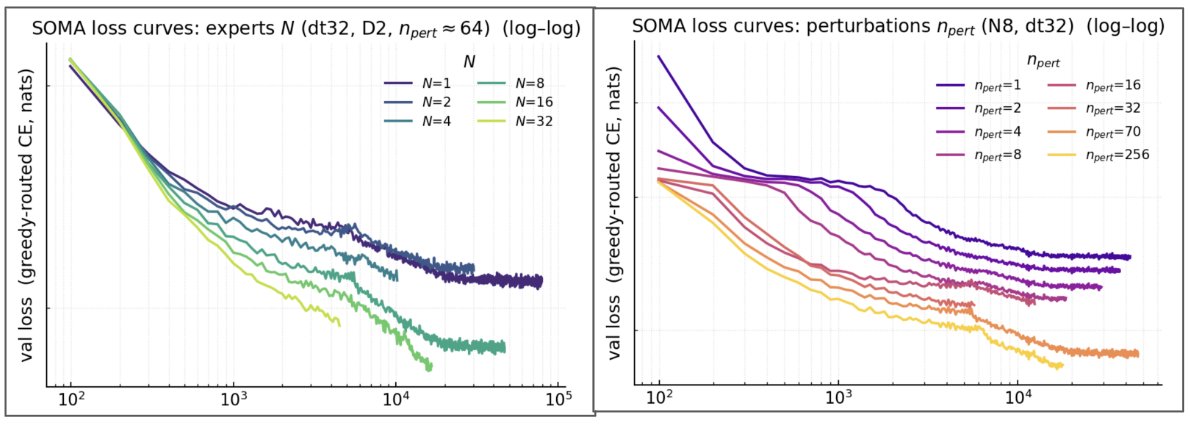
Comparing with sparse autoencoders (SAEs), we show that circuits traced directly on a model’s MLP neurons can be just as sparse and faithful. We use two advances to achieve this result.
Shapes and forms are a construct of the human mind. In ultimate reality there is nothing as shape or matter. Color blindness is a good paradigm for understanding this.
Heading to @icmlconf 2026 in Seoul🇰🇷 next week✈️
I'm co-hosting the workshop on ML for audio on Friday, July 10: https://t.co/qmlW5MPDrP
And who knows, maybe a circular gathering of diffusion practitioners will coalesce at some point during the week👀
[LG] Geometric Signatures of Reasoning: A Spectral Perspective on Task Hardness
A Masoomi, M Bazzaz, A Javanmard, V Mirrokni [Northeastern University & University of Southern California & Google Research] (2026)
https://t.co/CEgx00xjjH
NASA’s Swift space telescope is reaching the end of its two-decade run in orbit – unless a satellite launched on 3 July can give it a lifesaving boost https://t.co/6iiRkuJMrt
I will be at #ICML2026 in Korea next week presenting violin and as always in case you like ssms and hybrids dm me to grab a coffee and chat!!
I will be hanging around @MistralAI booth as well you can find me there too ;)
First, Mark was clearly talking about the industry’s progress on agentic capabilities on the whole.
But, while we’re on the topic: Our next Muse Spark update is coming soon. Big improvements in coding and agentic capabilities to be more competitive with other leading models.
Excited to get these into your hands—will be rolling out to Meta AI and our new API!
WorldLens has now added AI-powered 3D depth to Google Street View environments. Instead of a traditional flat photosphere, the update infers spatial structure from 2D panoramas.
Read how WorldLens leverages Cesium for Unity: https://t.co/k9XiwneKlQ
#CesiumForUnity#MetaQuest
Of course, love me some confirmation bias!
DCLM was for text, DCVLM is the same for vision: analyzing VLM data mix across scales. Filtering is no bueno, but the "type" mixing matters, with unfortunately (but imo expectedly) the best small-scale mix != the best mid-scale mix.
Automate your happy place🪴
“Help me Create” in the Google Home App helps you schedule tasks that automate¹ your (and your plants’) state of bliss https://t.co/NJwEzbdBVl
Another 150k iters of the same gives some more clarity for the 300m 2x faster model.
This is now finished training, and next up, going for the 4x faster model -- one step up in the mipmap pyramid.
Yiru @yranny53 tells I probably shouldn't be using ordinary (multi-level) diffusion at all, but music generation could work more better with flow matching. Once I have all the pyramid levels trained and the system up and running -- and hopefully the glassiness removed from the sound, I'll try flow matching next.
@IlyasHairline I had the same initial reaction, but after closer look i think it did have enough twists ("but with..."s) that it's fine and actually interesting.
One especially interesting finding buried in the details of https://t.co/nZ8BU9t9VU: When foundation models replace experts in rating accuracy, Gemini and Claude directionally agree with expert human raters, whereas GPT5.5 says its own answers win almost every time. Claude also seems to have a strong bias against Gemini. Any LLM-driven evaluation seems to have real pitfalls that are hard to entirely protect against.


![fly51fly's tweet photo. [LG] Geometric Signatures of Reasoning: A Spectral Perspective on Task Hardness
A Masoomi, M Bazzaz, A Javanmard, V Mirrokni [Northeastern University & University of Southern California & Google Research] (2026)
https://t.co/CEgx00xjjH https://t.co/CMqCbq1JZt](https://pbs.twimg.com/media/HMVSXwVbAAAgNOm.jpg)
![fly51fly's tweet photo. [LG] Geometric Signatures of Reasoning: A Spectral Perspective on Task Hardness
A Masoomi, M Bazzaz, A Javanmard, V Mirrokni [Northeastern University & University of Southern California & Google Research] (2026)
https://t.co/CEgx00xjjH https://t.co/CMqCbq1JZt](https://pbs.twimg.com/media/HMVSXiHaUAAGkMo.jpg)
![fly51fly's tweet photo. [LG] Geometric Signatures of Reasoning: A Spectral Perspective on Task Hardness
A Masoomi, M Bazzaz, A Javanmard, V Mirrokni [Northeastern University & University of Southern California & Google Research] (2026)
https://t.co/CEgx00xjjH https://t.co/CMqCbq1JZt](https://pbs.twimg.com/media/HMVSXJJa8AABLlc.png)



![fly51fly's tweet photo. [LG] Geometric Signatures of Reasoning: A Spectral Perspective on Task Hardness
A Masoomi, M Bazzaz, A Javanmard, V Mirrokni [Northeastern University & University of Southern California & Google Research] (2026)
https://t.co/CEgx00xjjH https://t.co/CMqCbq1JZt](https://pbs.twimg.com/media/HMVSX4mboAAIf9g.jpg)