🕯️ In memory of Oleksii Yukov, who searched for fallen soldiers for 27 years and brought the bodies of those who died in the Russia-Ukraine war home. He was killed by a Russian mine on August 5 — "Now, the dead are orphaned"
https://t.co/sn9ufCNGyH
Trump raves on social media about Zelenskyy’s imaginary ability to end the war “any time” and, in the same night, Russia launches drones right at the sleeping residential apartment in Kharkiv, killing a family of five and at least two more people. sick
⚡️"The entire family is dead." Russia launches drones at residential building of Kharkiv, kills at least 7, including 2 children, injures 20 (Photo).
https://t.co/suoGBcRaFS
@dexter_vox коли бути українцем «етнічно» може бути тільки білий, а з темношкірими людьми українська нація і країна стає «політичною» і «штучною» і «ми пасуємо мʼяч русні» - це і є расизм
The situation on one of the flanks has severely deteriorated as of today, and unfortunately, there appears to be a degree of underreporting or downplaying of the situation at the official level.
One way to help or provide relief is by supplying drones to the units there:
Given the nature of X, it's not surprising that some commentators here misinterpret or argue against points I never made. To address such comprehension issues, I’d like to clarify the core argument.
The central issue is not whether defenses should be placed in open terrain or along tree lines. The discussion is about the effectiveness of foxholes as a countermeasure against drones, and the broader claim that downsizing defensive positions to isolate team-sized elements is a sound tactical choice.
To begin with, most foxholes are basic, individual pits. These offer basic protection and have proven to be highly vulnerable to both FPV drones and drone-dropped munitions. Additionally, defenses based solely on sparse foxholes lack mobility - soldiers are essentially pinned down, with little or no ability to reposition under fire or drone surveillance. In an environment where drones operate continuously it becomes a problem.
What’s required instead is a connected trench system with cover on top, that allows for protected movement, concealing personnel from aerial observation and enabling tactical repositioning - essentially, a "tunnel network". Russians have being building such since 2023
Furthermore, when positions are manned by only a few soldiers isolated in foxholes, they cannot respond effectively to small-unit infiltration or breakthrough attempts from unexpected places. Their immobility severely limits defensive flexibility and increases the risk of being overrun or forced into panic and retreat.
On an organizational level, the issue is worsened by how these foxholes are constructed. Often, they are manually dug or even under fire, which makes proper construction almost impossible. Ideally, fortifications should be pre-built in depth before the area becomes a frontline. However, many current examples are hastily constructed in open fields without coherent tactical planning. Framing this ad-hoc digging as a natural "evolution" of battlefield defense is the core of my criticism.
Some have raised concerns about KABs (guided aerial bombs). Yes, they are a threat. However, a well-built, reinforced dugout still offers significantly better protection than a foxhole in the ground. While no fortification can guarantee survival in the case of a direct hit, KABs are not particularly precise, even with recent improvements, and reinforced positions provide much better survivability in indirect strike scenarios.
Furthermore, an FPV hit of a fox hole is far more lethal than hit of a dugout.
What truly needs to be discussed is the development of a network of reinforced dugouts, masked positions, and communication tunnels that allow troops to remain mobile, protected, and tactically responsive without being exposed to drone surveillance. The idea that last-minute foxholes dug with shovels represent meaningful battlefield evolution is dangerously reductive
I have yet to meet a single soldier who served on the front lines and agrees with General Syrski's opinion on this. His stance has been widely criticized by service members. Yet somehow, it's being presented as a success to English-speaking audiences.
❗️Russia hit Kharkiv with 2 glide bombs, injuring at least 33 people, damaging a residential area, and a civil enterprise.
Gwara journalists Hnat Holyk and Liubov Yemets documented the consequences of the Russian attack.
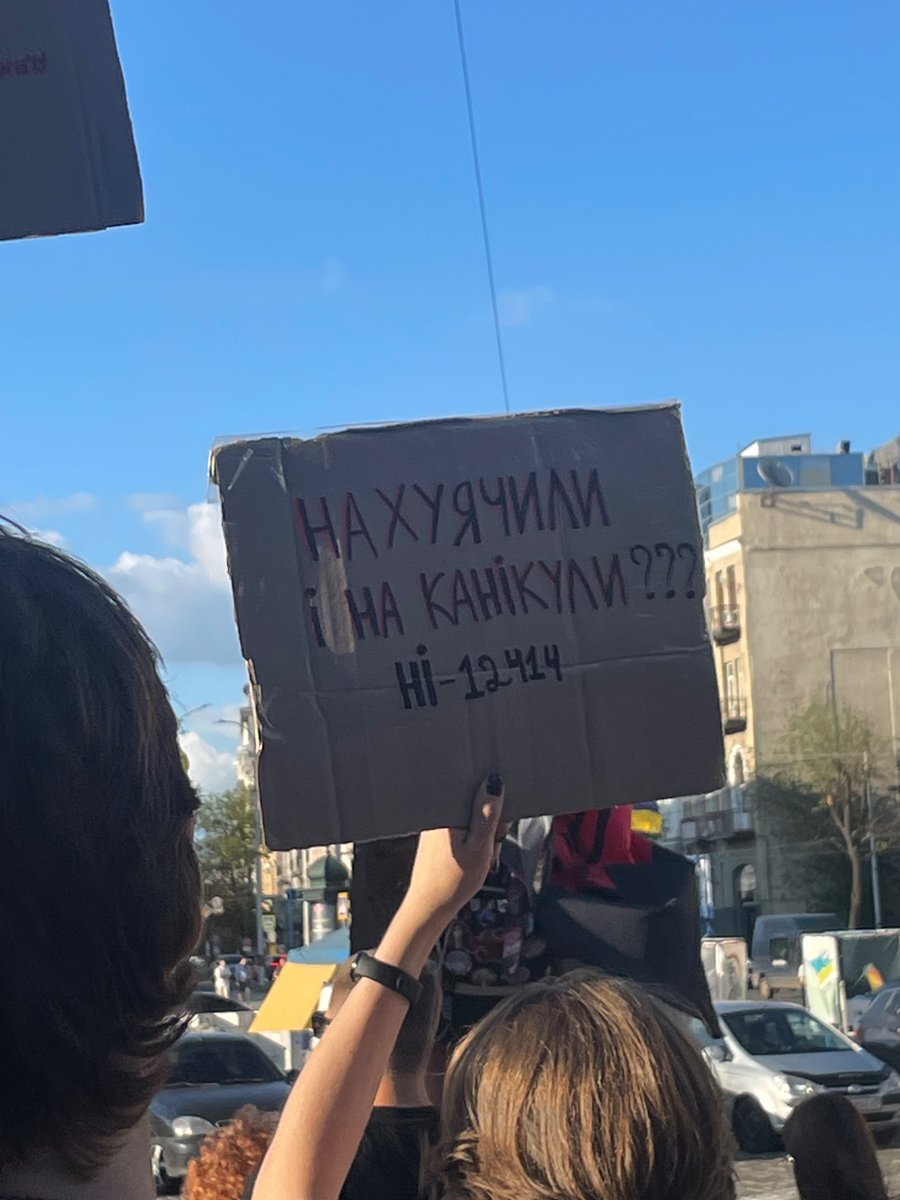
«...це не просто про демонстрацію права на авторитаризм і гальмування євроінтеграції. Це тупе хамство в умовах, коли найважливіші закони щодо обороноздатності не підписуються місяцями».
Ґварі Олена Апчел (філософиня і військослужбовиця) написала гарну колонку про те, чому протести і чому демократія і чому зараз, почитайте:
https://t.co/r99Ys4muwx