Fixing Nigeria’s cassava value chain.
Connecting farmers to inputs, processors, exporters & buyers. Handling storage, logistics, and quality of cassava.
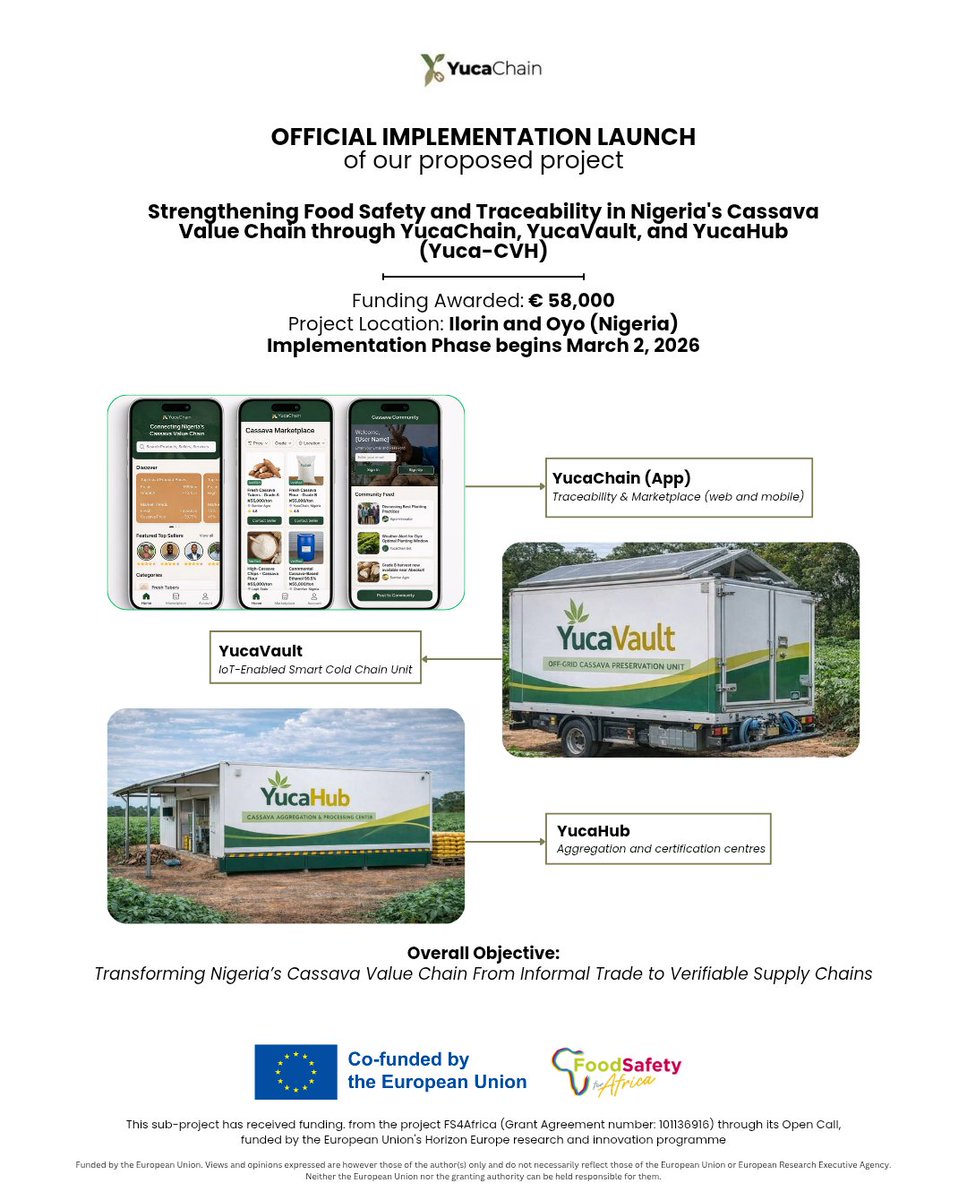
Today, we begin implementation of Yuca-CVH under the FS4Africa Open Call 1
€58,000 EU-backed funding of:
• Digital traceability (YucaChain)
• Solar-powered preservation (YucaVault)
• Structured aggregation (YucaHub)
Ilorin & Ibadan, Nigeria 🇳🇬
Follow our journey.
#cassava
It is a source of opportunity.
The real value is not only in growing cassava, but in transforming it.
Every root harvested carries the potential to feed communities, create jobs, and build wealth.
When people speak of agriculture,
they often think of only harvest.
But cassava is more than what leaves the farm.
It becomes food, flour, starch, ethanol, animal feed, and countless products that power industries.
A field of cassava is not just a source of income.
and strengthen Nigeria's position in the global cassava economy.
The opportunity is not just in producing more cassava, but in processing more of what we already grow.
#YucaChain#CassavaValueChain
A question worth asking.
Cassava is more than a food crop,it's a raw material for industries ranging from food processing to pharmaceuticals, textiles, paper, bioethanol, and starch production.
Unlocking these value added opportunities could increase farmer incomes,create jobs
Nigeria is one of the largest producers of cassava in the world.
Yet most of what we produce is consumed as garri, fufu, and other local foods.
Nothing is wrong with that.
But the real question is:
How much money are we leaving on the table by not processing cassava into higher-value industrial products?
#BillionaireFarmer
How well do you know cassava? 🤔
Test your knowledge and drop your answer in the comment👇🏾
Join the YucaChain community to learn about the cassava value chain, share insights, and connect with like-minded people building the future of agriculture.
https://t.co/kVrBONUeHp
How well do you know cassava? 🤔
Test your knowledge and drop your answer in the comment👇🏾
Join the YucaChain community to learn about the cassava value chain, share insights, and connect with like-minded people building the future of agriculture.
https://t.co/kVrBONUeHp
This is one of the most important conversations in the cassava value chain.
The ability to preserve value for longer could give farmers more options, reduce waste, and create a more efficient market for everyone involved.
THE PROBLEM WE MUST SOLVE.
We have been dealing with this PROBLEM for years, and farmers really need a solution.
Cassava is one of the most important and affordable staple foods in Nigeria. Millions of people depend on it every day.
What we need is an innovation that can significantly increase the lifespan of cassava...either while it's still in the ground or after it has been harvested.
The goal shouldn't always be to process it into garri, flour, starch, or other products just to preserve it. We need a way for cassava to remain cassava for an extra 1 or 2 years without rapidly deteriorating.
One of the reasons cassava farming can be so frustrating is that there is very little room for delay. Cassava is unforgiving.
Once it reaches maturity, the clock starts ticking. You either harvest it and process it quickly, or you risk losses from spoilage and declining quality.
This puts farmers under constant pressure and often weakens their bargaining power in the MARKET.
If a reliable and affordable preservation method existed, farmers would have more flexibility. They could store cassava longer, reduce waste, avoid panic selling, and help stabilize prices throughout the year.
A valuable lesson
Market cycles come and go, but value creation endures.
That's why at YucaChain, we believe sustainable growth comes from creating value, not just participating in the value chain.
A few years ago, Keke riders were cashing out like bankers because of the garri boom.
A farmer would pay them ₦10k–₦15k to bring cassava to the market. The buyer would still pay them another ₦30k or more to transport it to the processing site.
Some days, they made 4–5 trips.
Money was flowing.
I know a Keke rider ( my friend ) who bought land in FOUR different locations during that period.
Many were living large, changing girlfriends, spraying money, and believing the good times would never end.
Today, the story is different.
Cassava prices have dropped, the market is slow, and some of those same people are struggling to maintain their Keke, not to talk of changing engine oil.
Life has taught me one lesson:
Never mistake a good season for a permanent season.
When money is flowing, invest.
When business is booming, save.
When others are showing off, buy assets.
That ₦20,000 spent on impressing someone today could have bought a baby goat that may be worth many times more tomorrow.
The people who survive hard times are not always the highest earners.
They are the best investors.
What's the biggest lesson money has taught you?
A.D Farms
Normally, cassava should stay in the ground for about one full year before reaching full maturity.
However, there's a yellow-fleshed variety that shouldn't be left too long after maturity. Once it goes beyond about 8 months without harvesting, it can start deteriorating or rotting in the soil. That kind cassava the harvesting period is 6 months & 8 months Max.
One interesting thing about this variety is that its flesh is naturally yellow, so when processing it, there's usually no need to add palm oil to achieve that yellow color.
Nature is truly beautiful. 😍
From the way I'm looking at your cassava, the soil appears fertile and healthy. The plants seem to be doing well.
However, yours doesn't look like the yellow-fleshed variety. From its appearance, I don't think it has reached full maturity yet. It probably needs a few more months.
You can tell they're still carrying plenty of water, which is usually a sign that they haven't fully matured.
This story reminds us that some of the biggest bottlenecks in the cassava value chain are not always technical or financial. Sometimes, they are the risks that prevent opportunities from becoming reality.
I Abandoned a 25-Hectare Cassava Project Because of One Threat...
Many people see successful farmers today and think the journey is always smooth.
They don't know about the opportunities that were lost, not because of laziness or lack of knowledge, but because of insecurity.
A few years ago, I got the opportunity to manage a 25-hectare cassava project inside Ogene Forest.
The deal was sweet.
We were going to produce cassava for supply to a major chemical company in Jamata ( Unicane chemical industry company limited)for dry peeled cassava processing.
My salary had already been agreed upon ... ₦300,000 monthly.
Transportation? Sorted.
Medicals? Sorted.
Security? Sorted.
And as if that wasn't enough, I was also entitled to 5% of the project's profit.
For a young man passionate about agriculture, that was a life-changing opportunity.
We had already started preparations.
Herbicides had been purchased.
Plans had been drawn.
The land was being cleared.
Everything was moving according to schedule.
But there was one problem.
One notorious herdsman known as Ligah.
The moment news of the project reached him, the threats started.
At first, I believed dialogue could solve the problem.
I tried reaching him through the Paramount Ruler of the land, hoping peace could be brokered.
I couldn't get access.
Then I tried reaching out through a friend who was a secretary in the MACBAN association.
Still, it didn't work.
The warnings continued.
Every day the atmosphere became more tense.
Then came the day that changed everything.
In the middle of the afternoon, my mother received a phone call.
The caller's message was short but terrifying:
"Tell your big-headed son to stay away from Ogene Forest, or you will bury him."
My mother called me immediately.
The moment she repeated those words, all the confidence I had vanished.
I sat quietly and asked myself:
What is the value of money if I'm not alive to enjoy it?
A salary of ₦300,000.
Medical benefits.
Transportation.
Security.
And 5% of the profit.
Yet none of it was worth more than my life.
That day, I made one of the hardest decisions of my career.
I aborted the mission.
The project died.
The opportunity died.
The dream died.
Not because we lacked capital.
Not because we lacked knowledge.
Not because the land was not fertile.
But because insecurity defeated investment.
This is the painful reality many young Nigerians face today.
People keep asking why youths are not rushing into agriculture.
The answer is simple.
Many are willing to work hard.
Many are willing to take financial risks.
But very few are willing to risk being buried for trying to farm.
Every abandoned farm is a lost job.
Every frightened farmer is a threat to food security.
Every investor chased away by insecurity is a setback for rural development.
Nigeria can feed itself.
Nigeria can become an agricultural giant.
But no farm can thrive where fear is stronger than hope.
Looking back today, I feel the pain of what could have been.
But I also thank God for preserving my life.
Because sometimes, the greatest harvest is not the money you make.
It's the life you still have.
The attached picture was taken during the land-clearing stage of the Ogene Forest project before the mission was eventually aborted.
~Umaru Ezekiel
#Agriculture #CassavaFarming #FarmerLife #FoodSecurity #YouthInAgriculture #Agribusiness #NigeriaFarmers #FarmManagement #RuralDevelopment #FarmStories #AgricultureInNigeria #Insecurity #FarmingChallenges #SuccessMindset #FarmLife #NigeriaAgriculture #AgriculturalDevelopment #FarmInvestment #FoodProduction #FarmerStory
that make local cassava-based industries competitive.
The goal isn't to choose between food and industry, it's to build a value chain where both can thrive.
#YucaChain
It's not Eba or Amala that's holding the cassava industry back.☺️
Food security is a critical part of the cassava value chain, and millions of Nigerians depend on cassava as a staple food.
The real challenge is creating stronger pathways for industrial utilization
Serious Problem in the Cassava Value Chain 🥺🥺🥺
Agriculture experts have expressed concern over the low industrial utilisation of cassava in Nigeria despite Nigeria being the world’s largest producer of Cassava.
During the Annual General Meeting of the Industrial Cassava Stakeholders Association of Nigeria (ICSAN) stakeholders said Nigeria’s challenge is no longer cassava production but the inability to convert the crop into industrial and economic value.
Nigeria produces over 63 million metric tonnes of cassava yearly, we still lag behind Asian countries in value addition, exports and industrial processing - Asians no dey eat Eba na 😭
~80% of cassava produced in Nigeria is consumed as food (Eba and Amala people una see una life baa), while only 20% is used for industrial purposes they even said cheap imported corn starch is threatening Nigeria’s cassava processing industry.
That is to say - people importing corn starch are the ones dragging our cassava industry behind.
I have always said this - If you want your country to grow, you need to shun imports of key agricultural products.
Anytime you make Eba or eat Amala just know you're part of the people dragging us back in this country.😂
alongside food consumption.From starch and ethanol to flour and other value added products, Nigeria has the potential to unlock far more value from cassava production.
What we need is better processing infrastructure, stronger market linkages, supportive policies, and incentives