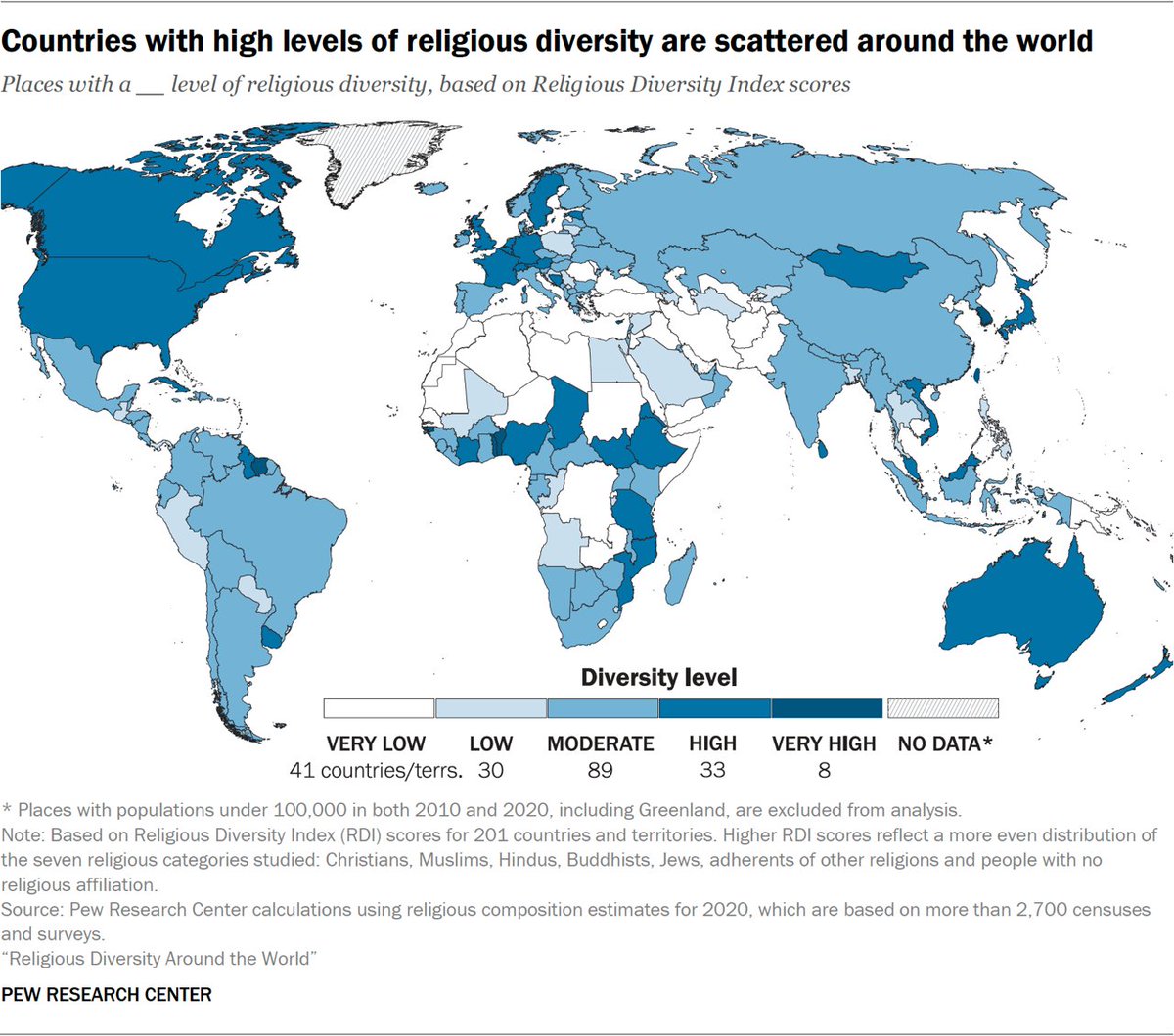
The U.S. has a high level of religious diversity, according to our analysis. Of the 201 countries and territories we studied, it ranks 32nd in religious diversity overall.
Curious which places are the most religiously diverse? Read the full report here: https://t.co/acxtR9PzVz
How common is religious switching around the world? A new Pew Research Center analysis of 117 surveys from 117 provides some answers: https://t.co/iuG1girnS0
- Hindus and Muslims rarely switch out of their religious groups, with 99% of adults (ages 18-54) still identifying with their childhood religion.
- Retention rates are lower among Christians (83%) and Buddhists (78%).
NEW: For years, my team has been working on a report about major changes in the global religious landscape between 2010 and 2020.
Here's the full thing: https://t.co/yWRV897kdJ
I'll post key findings below.
On Sept. 28, millions of people across East Asia and around the world will celebrate the birthday of Confucius – the ancient Chinese philosopher and founder of Confucianism. Here are five facts about Confucianism. https://t.co/yPxtSjimh9
Check out our NEW report on the religious composition of migrants around the world! We found that nearly half of migrants globally are Christian – a much higher share than they make up in the overall population (30%). https://t.co/4JGqXIOPAF
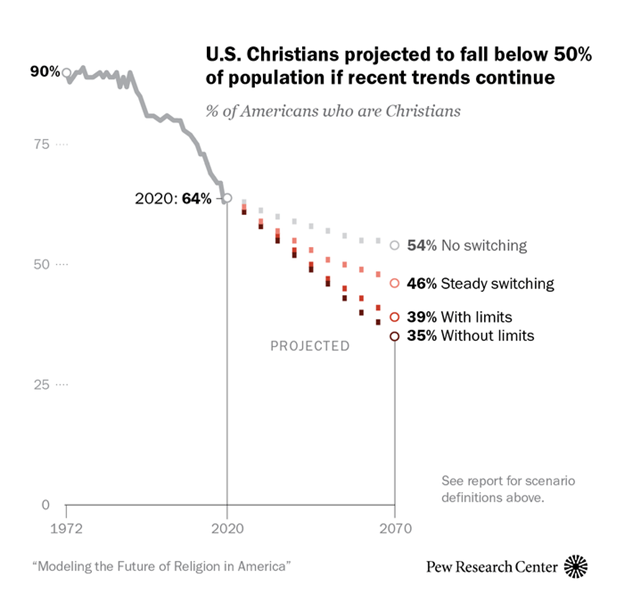
Our NEW projections show U.S. Christians are on track to lose their majority status within a few decades if recent trends continue, driven mostly by young people leaving the faith. 🧵https://t.co/iTk2OiLOOj
There are lots of fascinating findings about India’s sex ratio at birth and how it’s changing both nationally and within India’s four biggest religious communities – Hindus, Muslims, Christians and Sikhs.
I hope you can take the chance to read it: https://t.co/howVio872i
After several years of work, my team's report on India’s sex imbalance at birth (based on analysis of the National Family Health Survey (NFHS) and India’s census) has been published! https://t.co/howVio872i
Our new report details India’s religious landscape, how it’s changed since 1951, and unpacks how the vast majority of India’s modest demographic change has been driven by fertility, rather than by migration or conversion. https://t.co/076I76zQdM 1/