@MarcJSchmidt Is this rage bait? surely finding OS versions of apps, cloning them, managing dependencies, spinning up Docker are not in the same category as just telling an agent to build something
I recommend the trope of 20yo AI enthusiasts who think AI is the future of work and will replace human labor, to spend a couple of years in a traditional Fortune 500 company.
Feel in person what it’s like to receive an invitation to a meeting about an email about a ticket about a spreadsheet about a SELECT * query.
Watch 20 people debate for a month a 10 digit number that is off by one decimal.
See how access to any minor piece of data requires a workflow of permissions from five people.
Observe how any deployment requires planning at least two quarters in advance.
Pay attention to how nobody, even at the highest levels, cares one bit about productivity, let alone innovation, because the only thing they care about is their paycheck.
Then tell me AI is going to replace all human labor.
Anthropic has proven 3 things:
- Taste strongly influences whether people will like a model
- People don't care about token efficiency if the model gives good results
- Understanding intent well creates a better user experience and less prompt iterations
The most counterintuitive thing in vibe coding is that more unit tests lead to the worse code.
It's because tests are written early, before the agent's complete understanding of the deliverable has been achieved.
So then it writes a hacky implementation trying to conform to these flawed tests.
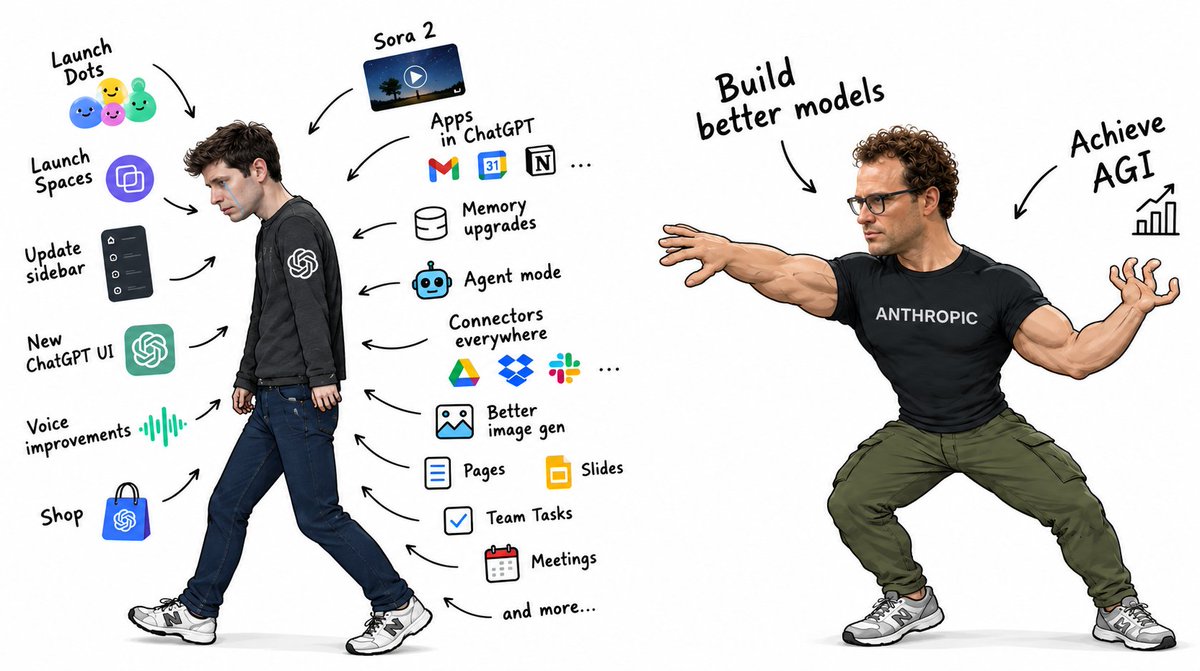
OpenAI turned ChatGPT into a feature dumpster. Shipping everything except a better model, so nobody notices it stopped being the reason you open the app.
Anthropic just lifts.
None of the wrappers matter if Claude is the one that actually finishes the job. You ship the extra layers when the weights aren’t winning.
The DRY (Don't Repeat Yourself) rule causes more architectural damage than code duplication ever will. Engineers force two completely different business modules to share a single abstraction just because they look similar today. When those modules inevitably evolve in different directions, that shared abstraction turns into a tangled mess of conditional logic.
@Angaisb_@argofowl I've been testing models with creative writing for almost a year now. I've never been impressed by any OpenAI model. They are the definition of AI slop, even the frontier models.
Claude on the other hand has made me feel the AGI on more than one occassion.
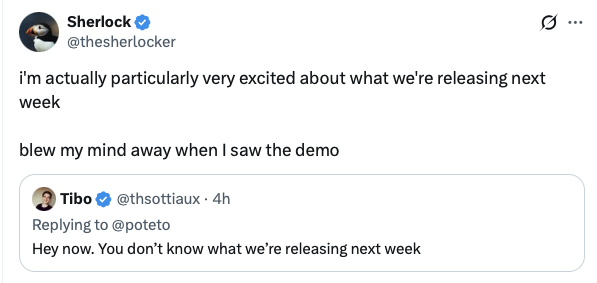
It really looks like OpenAI is launching a major, significant release next week, one that was originally intended for DevDay.
My money is still on GPT-6.1 Astra, or perhaps an even newer checkpoint released in response to Opus 5.5 / Fable 5.5.
Caveat: There was a lot of hype leading up to DevDay as well, so I remain cautiously optimistic.
IMO the only tests you should have in the age of coding agents are, in order of priority:
1. Full E2E tests. Nothing mocked out at all. Can even be something that runs in prod on test accounts via Playwright or equivalent.
2. Integration tests. Agents make more mistakes as things bleed between data/API boundaries where schemas can drift.
3. Golden tests. This helps ground the code with real examples of data, and can be used as regressions against edge cases.
Unit tests are bloat 99% of the time if you’re using a frontier model since they’re smart enough now to get the implementation (and subsequent iterations) right on the first shot, so they only add bloat at this point.