@Srikanagasabai@SriniMaama16 Watching Lost Tv series for past couple of weeks.., S05 E03 currently
&wat a hell of a Ride its been!!
Awesome storyline full of mysteries,top notch thriller with vera level twists..
Sema character building with good emotions,,
It has everything man
Lost Tv is a Must watch maama
Mannnyyyy, mannnyyy thoughts on #Baththa (possible spoilers, as always):
_____
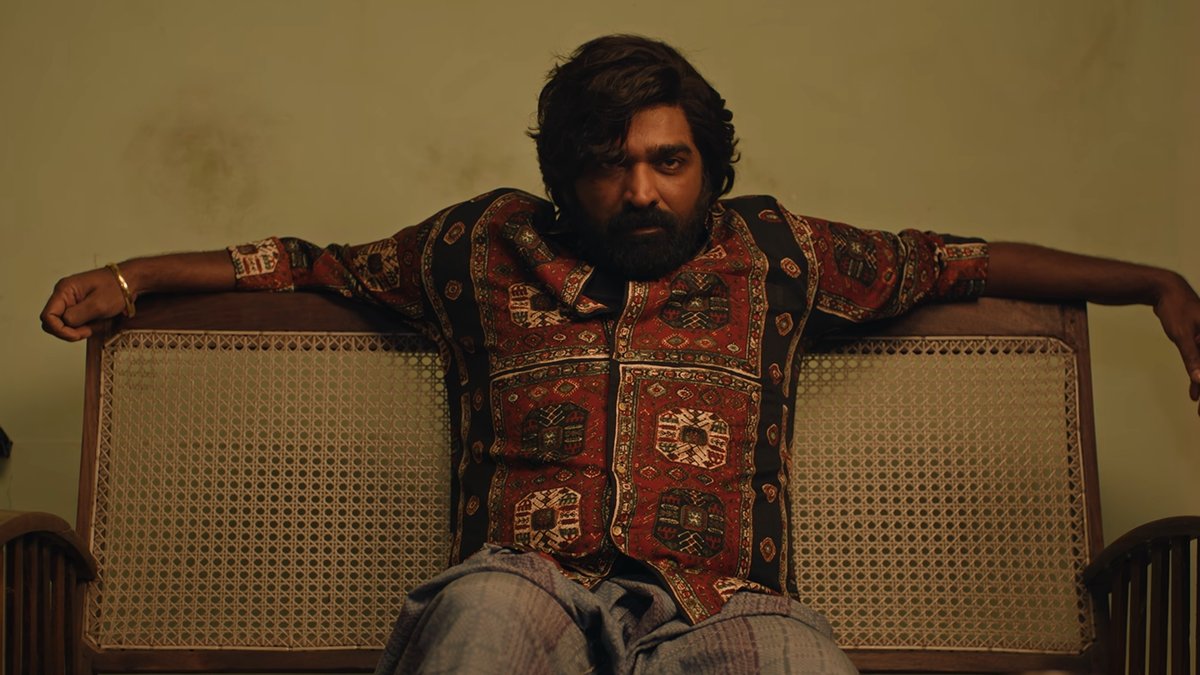
Baththa, played by Vijay Sethupathi, is a frightening gangster. He is driven by ego, and no threat scares him. At home, he casually slaps his wife, throws a plate full of food, yells at his daughter. And he seems to be getting away with everything. So, you really wonder who's gonna put him in his place. Balaji Tharaneetharan's film hints that an assassination attempt is on the cards. But as it turns out, Baththa's most dangerous adversary is not a gangster, not some man who defeats him in size and strength. Instead, it's the opposite. His reckoning comes in the form of a little, meek boy.
Baththa is full of such gorgeous ideas. The tender beauty of a child’s innocence serving as a mirror to such a gangster feels almost like a 'pure cinema' idea. For an entire half, Baththa is stuck in a school toilet, isolated and unable to get out. The premise seems almost like it might potentially get a bit too indulgent, a bit too static, maybe test your patience a bit. But Balaji's Baththa is magnificently kinetic.
And I think it's because Baththa is so cleverly written. It's got all these suspense lifelines that power the whole film: Will Sabari ever open the toilet door? Once you get the answer to that, will Sabari ever confess to Baththa? Once that gets answered, there’s another question waiting: Why did Baththa even enter this isolated toilet in the first place? The beauty of Baththa is how it comes with such heartwarming moving answers to each question. And it shows such mastery over how long to keep the suspense alive and when to provide you with the answer.
There are all these deep, psychological undertones that make this film feel so wise, and yet, so simple. The loss of innocence. The impact of bullying. The origin of malice. Baththa is about all of that, but the film is loving enough to remember that every adult was once a boy, perhaps still is. When Baththa has a moment with little Sabari, he reminisces, “I was also like you at one point.” And it's beautifully cyclical that the innocence, goodness, call it what you will, can only be regained when in the presence of a pure life form. Like in Meiyazhagan. Here, of course, it's a little boy.
I love it when films like Baththa allow for many metaphorical readings organically. That gorgeous shot of Baththa peeking out through a tiny hole in the toilet door says so much beyond words. The toilet itself feels like the stinking prison that his life seems to have become. Can Baththa find it in him to escape it? And I love that this film does it by asking an essential, but too-often ignored question. In a world where adults are constantly obsessed with teaching children, can they take a step back, and instead, learn? It feels like all of us were born perfect, and the world somehow made us lose our way.
I was astonished at how Balaji Tharaneetharan strikes a balance between humour and poignant emotion. The humour is sometimes in repetition (“Nee yenda school toilet-ku pona?”), but it’s also in Vijay Sethupathi’s expressions as he suffers. He’s tremendous in this film, particularly in the way he channels vulnerability, and in how quickly, he turns that into dry humour. Watch him beg for poignantly freedom, bringing up his daughter and wife. I cried. And then, almost immediately, I laughed as the film focusses on the abusrdity of a paper full of porai being pushed towards him from under the door.
The police may not ever get to arrest Baththa for his crimes, but does it matter? This film, and the ingenious situation it throws Baththa in, ensures that he suffers a solitary-confinement sentence that breaks and reforms him in a way. Think about it. His food gets sent under a door. The little warden turns up once in a while. Baththa's freedom is curtailed by a door he cannot easily break. Right in the beginning, you see that his power means nothing. The man who cannot be contained by rivals, police or even family, is contained by a huge toilet, and more importantly, by the terror of a child. The irony is, if Baththa had asked nicely, he would never have had to suffer.
There’s something else the film keeps returning to: the catharsis offered by a family. Almost everyone here seems to be motivated by one. A gangster becomes a villain because he was beaten up in the presence of his family. A little boy is frightened because he thinks his mistake might result in his parents being murdered. Baththa bargains for freedom by invoking his wife and daughter. So, it's quite fitting that a family function eventually becomes the setting in which gangsters heal. It all reminded me of a line from a Sai Abhyankkar song: “Karunaye kudumbama theriyudha?” We've seen so many films where the hero saves a family. In Baththa, a family saves the hero.
And I thought this all connected beautifully to the film’s idea of courage. Is courage beating people up? Is it inspiring fear? For a while, you’re wondering what Baththa thinks of Sabari’s father, because the man is presented as docile. Sabari’s mother even tells the boy, almost as a complaint, that he’s behaving exactly like his father. Yet this supposedly meek man, even at the cost of what the world might perceive as emasculation, performs a tremendous act of kindness. Baththa is shocked. Here is a man seemingly without power doing something the all-powerful gangster could not comprehend.
But the film’s greatest act of courage comes, fittingly, not from any of these men. It comes from the boy. At risk to himself, fearing mortal danger to his family, terrified of what might happen next, this little boy still ventures into the dark every day to face a monster. And at one point, the boy even releases the monster. He does this despite believing that he might get killed. It's the kind of courage adults are rarely capable of. And yet, it comes so naturally for this boy. I was truly wowed and moved.
It’s such a cleverly written film too. It shows you a snake and creates the expectation that surely the snake is going to do something. Instead, something else happens. Balaji Tharaneetharan ensures that there simply isn’t a dull moment here. Even when Baththa and the boy go shopping for a family function (exactly the sort of stretch in which you could forgive a film for taking a breather and throwing in a generic montage), it’s still channelling humour. It’s still finding little ways to establish the period, with talk of ‘safari suits’, for instance.
And the boy, Sai Prithviraj, is so good. You realise it particularly after he finally sheds that frightened-boy expression and begins to smile. It really feels like a dam finally allowing water to flow. I was a real goner during his confession, as he tears up and chokes and then slowly finds the confidence to keep going with his story. I also loved Lijomol Jose as Baththa’s wife, particularly in that scene after he returns home and begins eating her food. She doesn’t react with joy. At first, she looks almost like she isn’t sure whether what she’s seeing is really happening. Is this really the same man? And then, when she finally allows herself to believe it, she begins throwing in more and more spoonfuls of chutney. And that's enough.
And then, just when I thought that everything seemed resolved and all tensions had eased, this gorgeous film somehow finds more oxygen. Because what needed to be saved wasn't just Baththa, but the origins of his pain. And so, you get this moment where there's an audience, and after a while, you can see that Balaji Tharaneetharan has set up the film in a way that it's gonna end up with a whole group of people clapping. But the difference Baththa has with other films is, here, we also become Baththa's audience. The clapping, then, happened organically for me because the film understands that what really moves us, what truly saves us, isn't talent or power. It's far simpler and almost cliche: genuine wide-eyed love for another. I think that's what I felt for Baththa, as I walked out of the theatre wiping my eyes.
My salute to the Indian pilot Captain Smit Machchhar for his extraordinary bravery.
Despite being stabbed and seriously injured, he fought back, resisted, opened the cockpit door, and enabled passengers and crew to overpower the attacker — preventing a catastrophic mid-air disaster.
He saved the lives of 174 people, including Israeli citizens and other nationals.
I wish Captain Machchhar a speedy and full recovery.
He is a true hero.
Everyone is talking about the 39 medals.
But the real story of these Games is much better than just the medals. Let me explain.
First, these Commonwealth Games was much smaller than the last one. Only 10 sports. Last time there were 19.
And look at which sports were removed.
Wrestling. Badminton. Shooting. Table tennis. Hockey. Cricket.
These are the sports India wins in every single time. Out of our 61 medals last time, 30 came from these sports.
So think about it like this.
In the sports that were played both times, we won 31 medals last time. This time we won 39 in those same sports.
We got better in every sport we played. The total looks smaller only because so many of our sports were not there at all.
Now, first let's talk about the good stuff.
Our boxers were unbelievable. 10 medals. 7 golds.
No country in the history of the Commonwealth Games had ever won 7 boxing golds at one Games.
India just did.
And 5 of those 7 champions are women.
Preeti Pawar. Jaismine Lamboria. Sakshi Chaudhary. Priya Ghanghas. Arundhati Choudhary. Plus Sachin Siwach and Ankush Panghal.
Actually, out of India's 13 golds, 8 were won by women. Our daughters won so much at these Games for us.
Mirabai Chanu won gold again. Third Commonwealth Games in a row. Only one Indian had ever done that before her.
She had a serious back injury. She won anyway. :)
Gulveer Singh is a soldier who grew up running on village roads in Aligarh. He became the first Indian ever to win a medal in the men's 10,000m race. Then he won one more in the 5000m.
In long distance running. Where India never wins.
Our para athletes won 7 medals. That equals everything they had won in all the previous Games put together. Their best performance ever.
Dilip Gavit, who lost his arm as a child, set a Games record in his 100m race.
Even judo gave us 2 golds. Asmita Dey and Harsh Singh.
Be honest, did you even know we had judo players this good?
Now the sad parts. There were a few, unfortunately.
Neeraj Chopra got a silver only. A thrower from Sri Lanka threw 89.75m and won it.
Neeraj is coming back from an injury and said himself that he is not at full strength yet. The good news was Yash Vir Singh winning bronze right behind him.
Our weightlifters won 8 medals. But 6 of them were silver. Six times we were just one good lift away from gold. Six times it did not come. That one hurts.
And in athletics, our runners and jumpers won 10 medals but no gold. Everyone finished second or third. Nobody finished first.
Now, for years people have said the same thing about India. That we only win medals because of shooting and wrestling. Remove those, and we are nothing.
Well. This time someone actually removed them. All of them. Every sport we depend on was taken out.
And we still finished 4th in the world.
The sports that were supposed to be our weak ones carried us. Boxing. Judo. Para athletics. Long distance running.
People said we win only because of easy sports. The easy sports were removed. We won anyway. :)