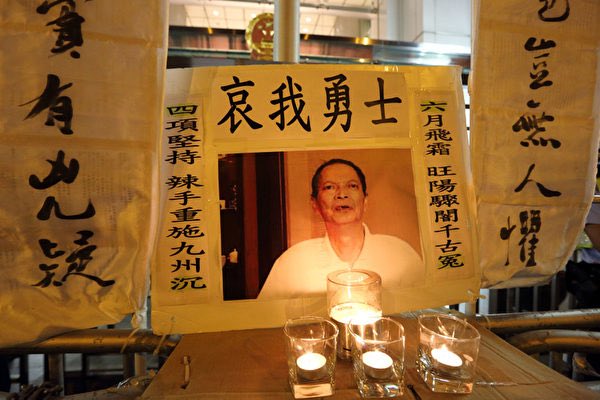
On this day 14 years ago, 1989 Tiananmen activist was murdered by Chinese State operatives after he gave an interview to Hong Kong media from his hospital room expressing his defiance against Chinese Communist Party tyranny.
His murderers masqueraded his death as suicide by hanging. But Li could not see, could not walk and struggle to hear after years of torture in Chinese prisons. How on earth did he manage to get himself hanged? China could not even be bothered trying to put together a credible lie.
RIP Li Wangyang.
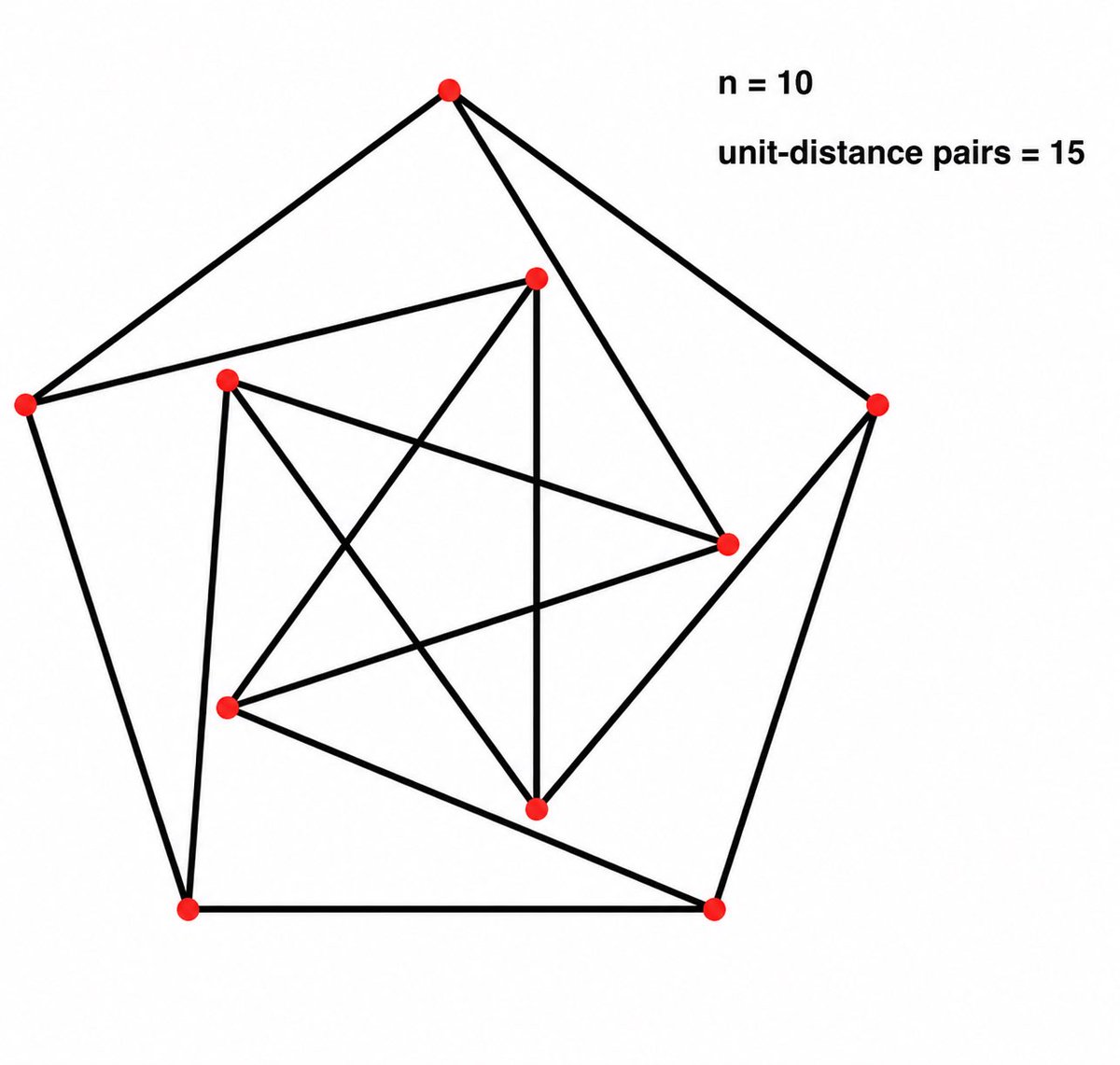
🧵(1/8) An @OpenAI internal reasoning LLM achieved an AI Math milestone: solving an open problem central to its mathematical subfield— in this case, the unit distance problem of discrete geometry.
We came across it in a side quest to truly push our model on the hardest problems.
The University of California needs the SAT back. Even the overwhelmingly liberal Berkeley faculty are fed up with the admission of unprepared students, write Svetlana Jitomirskaya and Zvezdelina Stankova
https://t.co/gmDSXxBHTu
I unequivocally support the Leiden Declaration. As a former AMS VP, current Editor-in-Chief, and someone bridging academia and industry, I see its message as urgent. AI will shape mathematics. We must uphold rigor, transparency, attribution, and culture. https://t.co/owK1HAOHrf
This is the way.
Also: why are there only two standardized testing companies? ACT or SAT, that's it? Are there companies trying to enter the competition? This is why a TI-84 still costs $200 when it should cost $5 (including $3 for shipping).
"A tribute to Euler" -- I loved this funny, fascinating lecture by the great William Dunham, one of the world's best math expositors for people who actually like math. https://t.co/ncKOrUZ8Dj via @YouTube
Fukushima's video (1986) shows a CNN that recognises handwritten digits [3], three years before LeCun's video (1989).
CNN timeline taken from [5]:
★ 1969: Kunihiko Fukushima published rectified linear units or ReLUs [1] which are now extensively used in CNNs.
★ 1979: Fukushima published the basic CNN architecture with convolution layers and downsampling layers [2]. He called it neocognitron. It was trained by unsupervised learning rules. Compute was 100 times more expensive than in 1989, and a billion times more expensive than today.
★ 1986: Fukushima's video on recognising hand-written digits [3].
★ 1988: Wei Zhang et al had the first "modern" 2-dimensional CNN trained by backpropagation, and also applied it to character recognition [4]. Compute was about 10 million times more expensive than today.
★ 1989-: later work by others [5].
REFERENCES (more in [5])
[1] K. Fukushima (1969). Visual feature extraction by a multilayered network of analog threshold elements. IEEE Transactions on Systems Science and Cybernetics. 5 (4): 322-333. This work introduced rectified linear units or ReLUs, now widely used in CNNs and other neural nets.
[2] K. Fukushima (1979). Neural network model for a mechanism of pattern recognition unaffected by shift in position—Neocognitron. Trans. IECE, vol. J62-A, no. 10, pp. 658-665, 1979. The first deep convolutional neural network architecture, with alternating convolutional layers and downsampling layers. In Japanese. English version: 1980.
[3] Movie produced by K. Fukushima, S. Miyake and T. Ito (NHK Science and Technical Research Laboratories), in 1986. YouTube: https://t.co/MUyH81L5wD
[4] W. Zhang, J. Tanida, K. Itoh, Y. Ichioka. Shift-invariant pattern recognition neural network and its optical architecture. Proc. Annual Conference of the Japan Society of Applied Physics, 1988. First "modern" backpropagation-trained 2-dimensional CNN, applied to character recognition.
[5] J. Schmidhuber (AI Blog, 2025). Who invented convolutional neural networks? https://t.co/chfcmk253b
Another major problem, this time in additive combinatorics, has fallen, this time to humans rather than AI, but using methods related to the AI solution to the unit distance conjecture.
A short, digested, human-verified version of the recent OpenAI-generated counterexample to the Erdős unit distance conjecture - Noga Alon, Thomas F. Bloom, W. T. Gowers, Daniel Litt, Will Sawin, Arul Shankar, Jacob Tsimerman, Victor Wang, Melanie M. Wood https://t.co/EcQbdkiII3
Regarding the OpenAI case, the judge & jury never actually ruled on the merits of the case, just on a calendar technicality.
There is no question to anyone following the case in detail that Altman & Brockman did in fact enrich themselves by stealing a charity. The only question is WHEN they did it!
I will be filing an appeal with the Ninth Circuit, because creating a precedent to loot charities is incredibly destructive to charitable giving in America.
OpenAI was founded to benefit all of humanity.
I asked a 12-year-old in Beijing if AI scares her.
Her answer: "If I use AI, then I will be the scary person."
While American parents debate whether kids should use AI at school, China has made it mandatory and is rushing to embed AI across society
My report from China 👇 @ABC
Breaking news: After a year-long investigation, the Justice Department concluded the Yale School of Medicine discriminated based on race in its admissions, favoring Black and Hispanic applicants over White and Asian ones. https://t.co/kdwDQK94K2
I've met with some of the worst guys on Earth - but Xi Jinping is without a doubt the coldest and most ruthless leader I've encountered.
We should be under no illusions about his malign intentions toward the US or any power that challenges him on the world stage.