Fluid lost 125k FLUID and 51.9k GHO due to a key compromise.
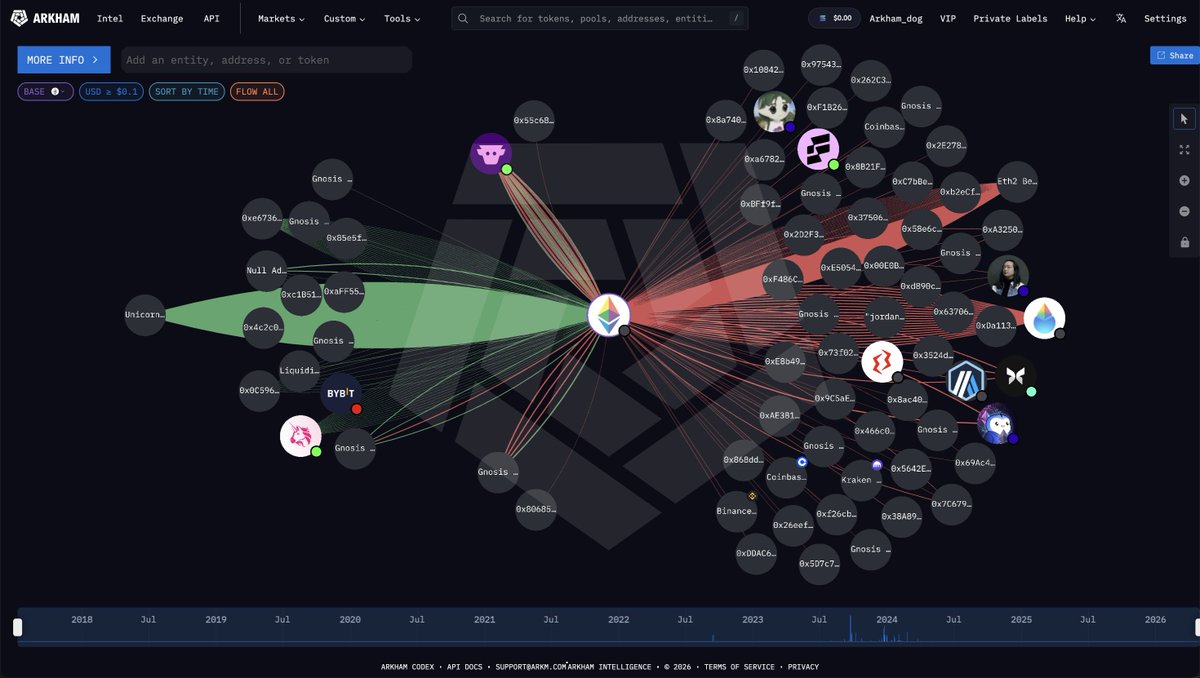
A wallet was able to claim rewards from multiple Fluid Merkle distributors using empty-proof Merkle claims, then swap funds and route ETH into Tornado Cash.
Exploiter: https://t.co/7xhmZpwqE3
The timeline on Ethereum was very tight: proposer submits root, approver approves it, exploiter claims FLUID ~24 seconds after proposal. The GHO claim followed minutes later. The same wallet then swapped the claimed GHO and FLUID, bridged some Base/Arbitrum proceeds out, and later deposited ETH into Tornado Cash Router.
Several hours later, an admin-style batched tx removed the old proposer/approver roles across multiple Fluid rewards contracts:
https://t.co/Gx4G8uPdTg
Fluid has told users that Merkle reward claiming is temporarily paused for a few days, potentially up to a week, while updates are made. They also said rewards will continue accumulating retroactively and claiming will resume once updates are complete. No communication about a key compromise or loss of funds.
We’ve raised $50M led by @dragonfly_xyz to go all in on RWAs and bring TradFi liquidity on-chain.
Today, we're launching Phase 1 of our RWA rollout to stress-test our infrastructure before bringing 100+ TradFi markets on-chain this summer.
Kelp DAO is moving rsETH to @chainlink and says LayerZero "blamed users for an issue caused by their own infrastructure failure."
@KelpDAO argues the 1-of-1 DVN setup at the center of the $300M hack was LayerZero's own documented default.
https://t.co/y0WMwHfwa5
DeFi United Has Now Raised $300M+
Is it a sign of a strong community or will a one-off solution be perceived as a weakness going forward?
Join us LIVE TOMORROW WED APRIL 29 @ 1 PM EST
W/ @DeanEigenmann@binji_x@divine_economy
Hosted by: @CamiRusso https://t.co/YxDSr6l1WZ
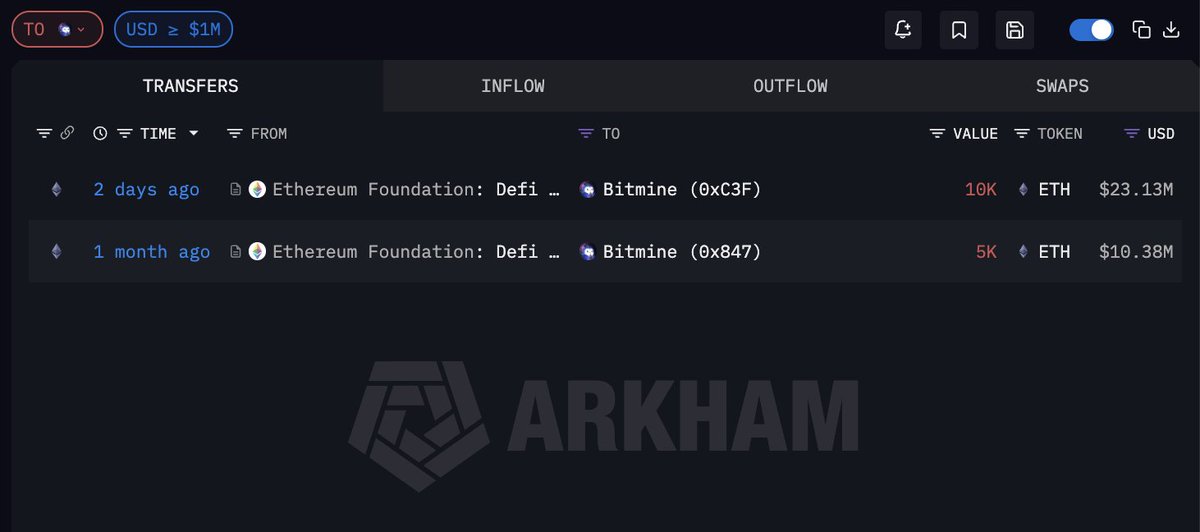
The Ethereum Foundation has so far sold $33.51M of ETH to Bitmine
Their most recent sale was only 2 days ago.
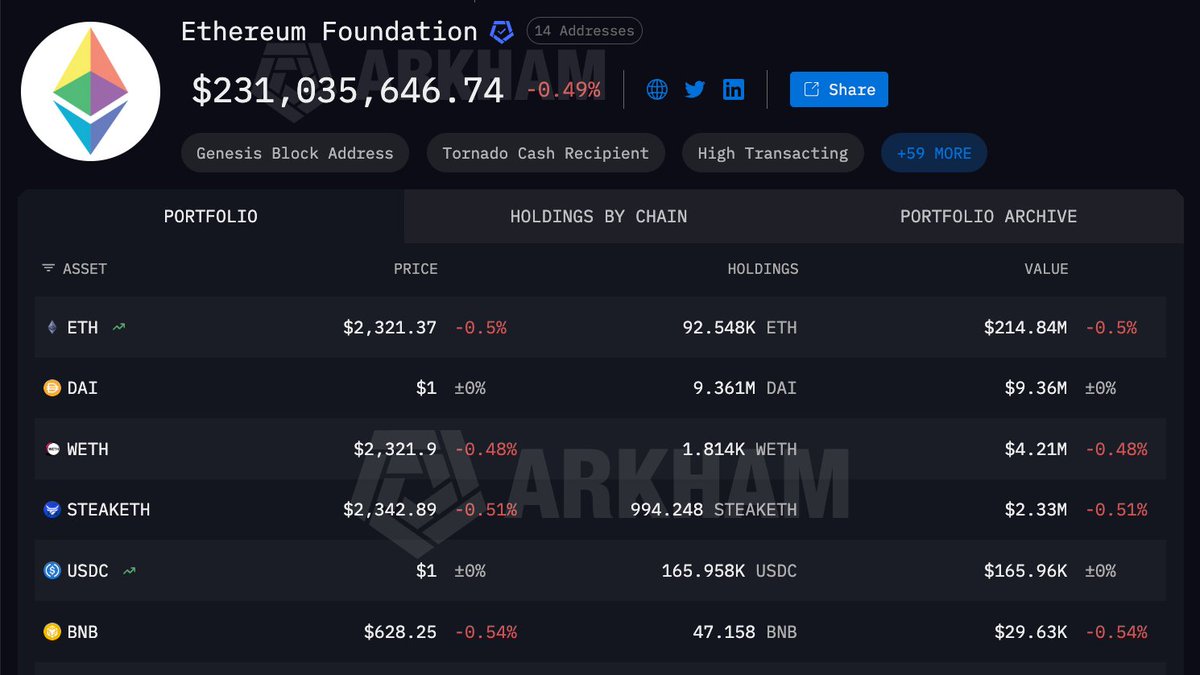
The ETH Foundation holds $214.8M ETH. If they continue selling at this rate, they will have no ETH left by 2027.
Canton founders claim ZK proofs are too risky for institutional finance. They have been making this argument to buyers and regulators, publicly and behind closed doors. It deserves a public answer.
Let's see if the argument holds — and if Canton's infrastructure passes its own test.
The argument
Their case, stated fairly: ZKPs are complex. Bugs are inevitable in any sufficiently complex system. If a flaw exists in a proof system, it could go undetected because the underlying data is private. If it goes undetected, it spreads throughout the system. This creates systemic risk. Therefore, ZKPs cannot be used for critical financial infrastructure.
This is a real concern. Let's take it seriously and follow the logic.
The flaw in the logic
Strip away the ZKP-specific language, here's the story:
Technology X can have implementation flaws. Technology X serves a mission-critical function. If it fails, the consequences are catastrophic. Therefore, Technology X can never be used.
Read it again. There is a hidden assumption doing all the work: that Technology X is your only line of defense.
If this logic held, we would not have aviation. Fly-by-wire, engine controllers, autopilot — every one of these systems has bugs, is mission-critical, and can fail catastrophically.
Nuclear reactor control systems, robotic surgery, radiation therapy dosing, implantable cardiac devices, and many other systems all run on software that can fail catastrophically. But they are somehow still in use. How?
Redundancy and containment
The foundation for these mission-critical systems is the explicit assumption in their architectures that every component will eventually fail. They all rely on two things: redundancy and containment.
Redundancy = multiple independent systems, each capable of catching a failure in the others.
Containment = when failure occurs, limit the blast radius so it cannot become systemic.
This is the only question that matters for any mission-critical system: does your architecture have more than one line of defense?
Canton's architecture
Let's apply this test to Canton.
Canton's privacy and integrity model relies on a single mechanism: trusted operators segregating data between participants. There is no cryptographic verification layer and no independent check. If a few keys of the operators in a validation domain are compromised, manipulated state propagates silently inside opaque chains of UTXOs with nothing watching. This is a real systemic risk, accelerated by the rise of AI-assisted cyberattacks.
By Canton's own logic — a single point of failure with catastrophic consequences — this is the architecture that should concern regulators.
Prividium's architecture
Now look at how Prividium is built.
Redundancy. Prividium has three independent lines of defense. First, institutional partners operate Prividium nodes within their own security environments, the same infrastructure banks already trust and regulate. Second, zero-knowledge proofs provide cryptographic integrity verification as an independent layer on top, verifying operational security rather than replacing it. Third, as ZK proof systems standardize, multiple independent provers can verify the same computation. A flaw in one implementation gets caught by another.
Containment. Each Prividium instance is an individual chain operated by an individual institution. When institutions interact across chains, Prividium's interop layer implements inter-chain accounting mechanisms that are independently enforced by the participating institutions, asset issuers, or on-chain. Even an attacker who compromises a single institution's internal IT infrastructure and simultaneously finds a ZKP bug could only affect that one Prividium instance. The damage cannot propagate to the broader network.
The net balance: Canton has a single mechanism, no fallback, silent failure propagation across the network. Prividium has layered defenses, independent verification, blast radius contained by design.
Importance of open standards
Multiple lines of defense only matter if each line is itself strong. What makes a technology strong? The depth of adversarial testing it has survived. Shaul points to a compiler bug example in his post, and it actually illustrates this well.
ZKsync embraced full EVM equivalence over a year ago. This was shaped precisely by the understanding that the more you deviate from an open standard, the larger your attack surface becomes.
And Ethereum is not battle-tested in some polite, academic sense. For over a decade, its smart contract infrastructure has been completely open to scrutiny by the most sophisticated adversarial actors in the world, with hundreds of billions of dollars at stake. Vulnerabilities and exploits fed directly back into the ecosystem: new audit standards, formal verification tools, compiler safeguards, and hardened design patterns. The EVM that exists today is the product of a decade of continuous adversarial stress testing at a scale no other smart contract platform has experienced.
Canton went the opposite direction. DAML is a proprietary smart contract language with a closed ecosystem and a fraction of the developer and security community. Every growing pain that Ethereum went through over the last ten years still lies ahead for DAML, except DAML will face them with orders of magnitude fewer eyes watching. Every maturity concern Canton raises about ZKPs applies to their own technology stack with far less mitigation available.
The safest technology is the one that has survived the longest under the harshest conditions. For smart contract infrastructure, that is Ethereum. It's not close.
So to answer the question directly: everyone agrees bugs exist. The question is whether your architecture has redundancy to catch them and containment to limit the damage when they slip through.
Cryptographic verification provides both. Trust in operators provides neither.
Discovered my Gas ID via ETHGas - turning my gas spend into rewards 🫘
As a Divine Jack, I've spent 36.0994 ETH on gas but earned 4000 Beans back.
Get your Gas ID and Beans here: https://t.co/2JM7eaICBC