You can probably tell if someone's work is good within minutes of reading it.
You've also watched someone unqualified get hired because they had the right connections. Nobody lost anything when it failed.
Your expertise saw both clearly. Both times, it didn't count.
That's the asymmetry. The people who know have no stake, and the people who decide have no signal
Thinking of hiring as prediction under uncertainty changes everything.
How predictive are the signals we're actually using?
Who'll actually thrive in this role, in this context, with this team?
These questions leads to domain experts.
The best judges of talent are the people who've done the work.
They understand what the role demands and what the candidate brings well enough to forecast fit.
That's the sharpest signal that exists.
Currently it sits outside the hiring process or gets buried in referrals no one is held to.
We are changing that by building the infrastructure where expert judgment carries real consequences.
Being right compounds. Being wrong costs something.
Your eye for talent becomes a real earning position.
Billions spent on hiring tools changed nothing.
Collectively stepping up and shaping the standards for how we validate and reward quality makes the change.
recent work.
Every project started the same way - great product, design that wasn't showing it.
If your brand isn't working as hard as you are, let's fix that.
DMs open all weekend.
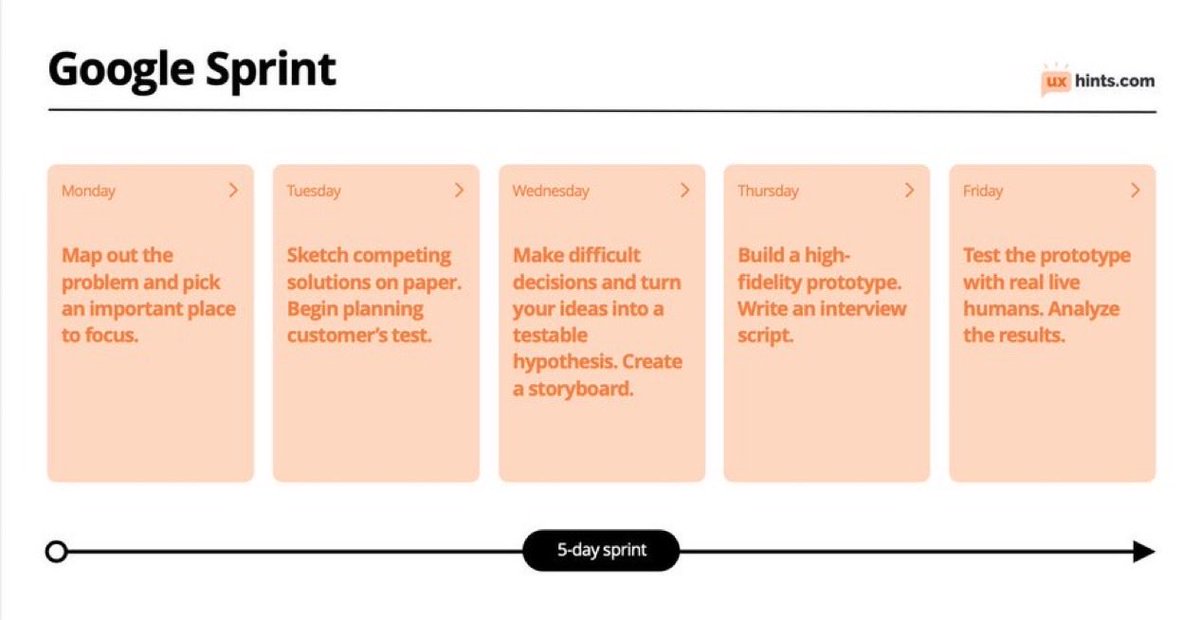
Learn about Google Design Sprints to hugely boost your next design project 🙌
Invented by Google, this is a design process that takes 5 days and addresses certain UX problems through defining a problem, brainstorming concepts, prototyping and validating a design solution.
Overview:
Monday
Map out the problem and pick an important place to focus.
Tuesday
Sketch competing solutions on paper. Begin planning customer’s test.
Wednesday
Make difficult decisions and turn your ideas into a testable hypothesis. Create a storyboard.
Thursday
Build a high- fidelity prototype. Write an interview script.
Friday
Test the prototype with real live humans. Analyze the results.
At the end of the sprint you should get the deliverables:
- Answers to the posed questions
- Flow diagrams, IA maps, storyboards, empathy maps
- Prototypes
- User testing reports
- A plan for the next steps
When to use design sprints:
- When you’re planning to launch a new product, service or a feature
- Adopting a new platform or environment
- Reiterating and improving an MVP or a product
#UX #UI #UXDesign #UIDesign #Google
Hiring never had a golden age. The failures are structural and the post-AI market is accelerating them.
Hiring is hard to solve because it is human at its core with real randomness built in. Framing it as prediction under uncertainty changes the optimization target. The question shifts from filtering out "nos" to identifying real "yeses."
That reframe surfaces the core variable: signal quality.
A hiring signal is fundamentally a statement of trust. "I trust this decision." The question becomes: what makes that trust warranted?
Vetted's answer: domain expertise with economic accountability, verified against real-world outcomes, with aligned incentives for the experts who produce the signal.
50 free websites every designer should know 👇
PNG
→ spngtree. com
→ freepngimg. com
→ stickpng. com
→ cleanpng. com
→ pngimg. com
Fonts
→ dafont. com
→ fontspace. com
→ fontsquirrel. com
→ 1001fonts. com
→ fontmeme. com
Stock Images
→ unsplash. com
→ pexels. com
→ pixabay. com
→ stocksnap. io
→ burst. shopify. com
Icons
→ https://t.co/tr23GsXCC0
→ thenounproject. com
→ heroicons. com
→ flaticon. com
→ icons8. com
Mockups
→ mockupworld. co
→ unblast. com/mockups
→ ls. graphics/free-mockups
→ graphicburger. com/mock-ups
→ mockuptree. com
Color Palettes
→ coolors. co
→ colorhunt. co
→ adobe. com/color
→ mycolor. space
→ huemint. com
Inspiration
→ dribbble. com
→ behance. net
→ awwwards. com
→ mobbin. com
→ godly. website
Illustrations
→ undraw. co
→ drawkit. com
→ blush. design
→ storyset. com
→ iradesign. io
Animations
→ lottiefiles. com
→ jitter. video
→ figmotion. com
→ motionone. github. io
→ rive. app
UI/UX Tools
→ figma. com
→ framer. com
→ webflow. com
→ canva. com
→ spline. design
Save this for later📌
Theory is cheap. Execution is the test.
Chapter 1: Testing. 100 founding domain experts across engineering, product, design, marketing, sales, ops, finance.
They set the standards. They review candidates. They define what "qualified" means in their field. They stake conviction on their assessments.
The goal: test whether structured expert consensus with real stakes and real outcome tracking produces measurably better hiring predictions than the status quo.
But even before outcome data compounds, the baseline product is already differentiated. Companies posting jobs into pre-vetted candidate pools evaluated by domain experts is a better product than any job board offers today.
We started with the pain.
Then we followed The Constraint at every single turn
- Not enough signal → need domain experts who actually know what good looks like.
- How to extract honest signal → economic accountability. Staking, slashing.
- Open markets are noisy, anyone can bet → peer-gated entry. Credibility at the gate, not just capital.
- How to sustain it → B2B. Build a signal trustworthy enough that companies pay for it.
- How to retain experts → reputation, rewards, authority, compounding network effects.
- How to make it deterministic → feed outcome data back. Every hire strengthens the next prediction.
Part 2 (thread)