We ran a randomized controlled trial to see how much AI coding tools speed up experienced open-source developers.
The results surprised us: Developers thought they were 20% faster with AI tools, but they were actually 19% slower when they had access to AI than when they didn't.
@Chris_arnade Even simple checking and savings accounts require extending credit to the customer. As such, you either end up with public banks making the same kind of credit determinations and denying service or have to figure out what to do about customers who defraud the bank.
What every voter should know about housing policy:
1. Rents reflect the balance of supply of apartments and demand for those apartments in a given area. That’s it; there’s no magic. If you want lower rents, you can hope for a recession that destroys jobs and, therefore, demand. Or you can add supply.
2. There is no amount of money that any big city government could feasibly spend that would add materially to supply. This is because, depending on the location, new apartments cost $250,000-1,100,000 to develop… building even a few hundred of those starts to stress any city budget, and many big cities need tens or hundreds of thousands.
3. On the other hand, investors (including pension funds and endowments, insurance companies, rich families, etc.) can collectively **easily** provide enough capital to build as much housing as we need **so long as they are confident they can get a reasonable return**.
To get those investors to fund the creation of the housing our society so desperately needs, we must do two things:
1. Dramatically reduce the time & complexity associated with securing governmental permission to develop housing. This means reviewing and simplifying the overlapping regulations that constrain housing production: zoning codes, building codes, parking, ADA, etc. But it also means changing the cultures within the relevant governmental agencies from “default no” to “how can we help you?”.
2. Provide certainty around on-going regulation of apartment operations.
The way investors get a return from building rentals is as follows: They hire managers to lease the apartments, collect the rents, pay operating expenses and any mortgage payments, and then send the investors the cashflow that remains.
But governments all over the country have been restricting the manner in which apartment buildings can be operated in all kinds of ways. For example: Cities have been making it harder to screen tenants, while also making it much harder to evict tenants who don’t pay.
You can see why both of those measures are politically popular. After all, who doesn’t want people to get second chances? And who wants anyone to get evicted? But, as a manager, the combination of those two regulations makes it much harder to predict, with any certainty, that the rent will get paid… and that makes it very difficult to get investors to provide capital to create more housing.
Another example: Rent control. Again, I understand why renters love rent control and why politicians want to give it to them. But, if, as has been the case in NY, LA and San Francisco, city governments hold annual rent increases below the rate of growth in the operating expenses of the buildings, the cashflow payable to the investors shrinks… making them much less likely to invest capital in building more apartments.
In conclusion:
For ~every other good or service in the economy, we allow the market to function, and the result is that we have a surplus of choice at all price points (think of food or clothes or cars), which is spectacular for the consumer.
If we want a surplus of choice at all price points in housing, we need to get comfortable with the idea of allowing the market to provide it.
And that means allowing investors to build rental apartments *and* allowing them to operate those apartments in a manner consistent with making a reasonable profit.
All around the world, people are engaged in difficult labor to produce goods for American consumers.
And in exchange they get pieces of paper that we can basically print as many as we want of.
And yet some claim that we’re the ones getting ripped off.
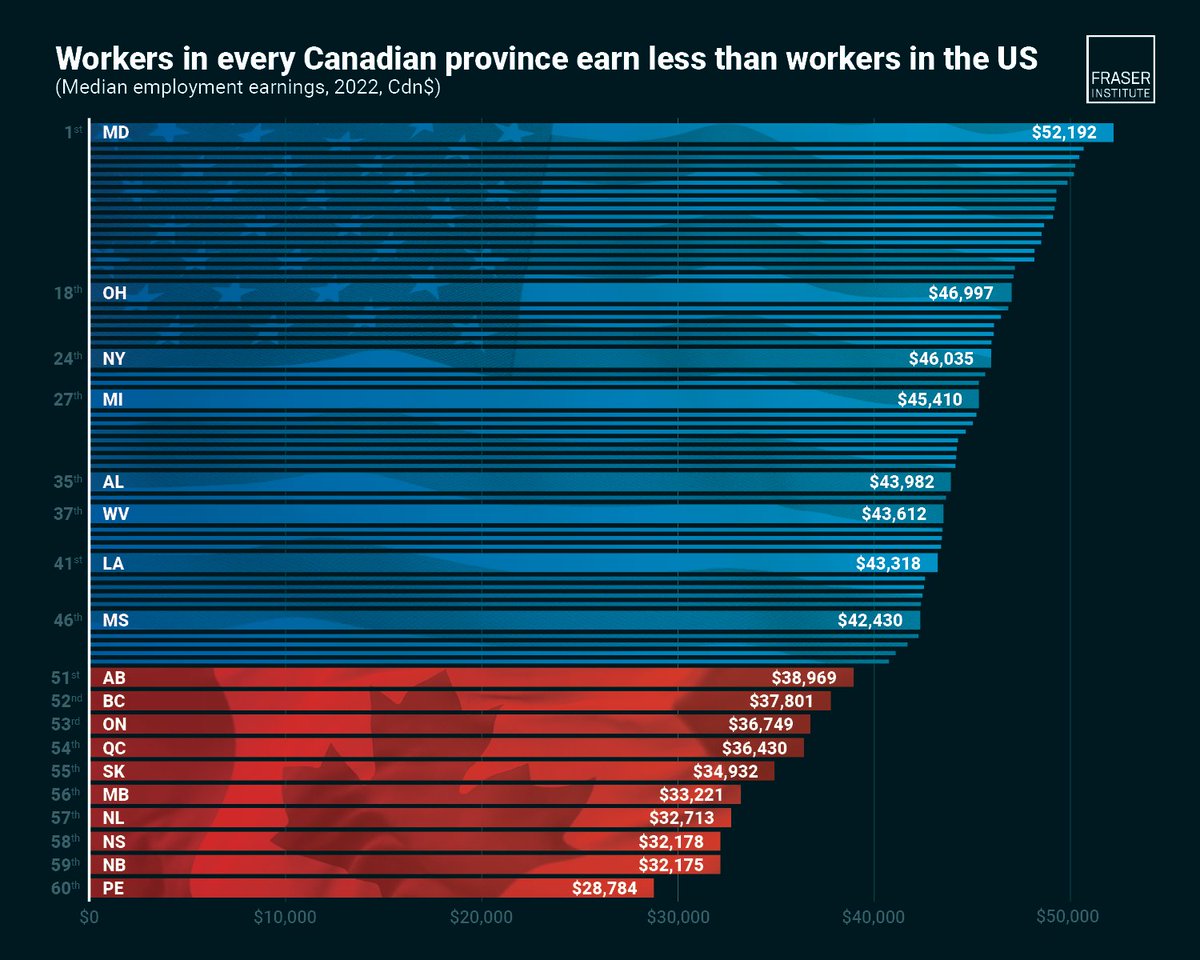
Every Canadian province is poorer than every US state, according to a new study by @FraserInstitute (using median earnings, adjusted for purchasing power parity across countries and states/provinces)
https://t.co/Hy1mOL7fEM
@Steve_Lafleur "I'm not sure how to objectively weigh one set of freedoms against another."
I'm pretty sure, free exercise of the franchise is more important than the freedom to accidentally shoot yourself in the leg in public. And FreedomHouse agrees (https://t.co/X3CC4mCOPD)
@Noahpinion That is the sound the letters make. Obviously lots of words in English are not pronounced the way they are spelled but only having read "Xi", zhi is a totally reasonable pronunciation.
eg. xylophone (ZIGH-luh-fohn), xebec (zib-EK), xenon (ZEE-nahn), xanthin (zanθan), etc.