In the Investing/Markets category, small division, a 2023 Best in Business Award honorable mention goes to @coinage_media for "He Stole $200 Million. He Gave It Back. Now He's ready to Explain Why."
#SABEWBIB
Before: buses you could outrun.
After: faster bus service and safer streets for 120,000 daily riders.
New center-running bus lanes on Flatbush Ave available now, thanks to @NYC_DOT.
🟡 NEW: Gaming industry poll finds that a bipartisan 82% majority of Americans think that prediction markets should be regulated as gambling products instead of financial ones
https://t.co/E4kUmzThcG
I have a major result to share.
I’ve found conclusive forensic evidence that the top 4 Chinese AI labs—DeepSeek, Moonshot, MiniMax and Ant Group—have built their newest models on NVIDIA’s most advanced Blackwell chips, which are barred from export to China.
This sounds insane, but I discovered that almost every AI model carries a hidden signature of the GPU that trained it. When a model is first set up, the starting values of its weights are laid out in a pattern that depends on the exact GPU. Each combination of GPU and seed number produces a unique pattern—a sort of fingerprint of the hardware used to create the model. Traces of that pattern survive training into the published model.
Again, this evidence isn’t based on any insider information or leaking. It’s based on a forensic analysis of the model weights released by the companies themselves.
I searched more than six trillion combinations of chip layout and seed number and matched them to open-weights models. In doing so, I found conclusive evidence that six Chinese AI models—including DeepSeek-V4-Pro, Kimi K3, and MiniMax-M3—were initialized on NVIDIA Blackwell systems. Four of the models match Grace Blackwell, the GB200 and GB300 parts in NVIDIA’s flagship liquid-cooled rack-scale systems.
I then verified these results on real hardware. Running unmodified PyTorch with the seeds I’d recovered, a Blackwell B300 reproduced DeepSeek-V4-Flash’s untouched starting weights bit for bit, and a rented GB200 reproduced Kimi K3’s to a correlation of 0.999995. A Hopper H100 reproduced none of DeepSeek-V4-Flash’s, and changing the seed by one broke the match. (DeepSeek’s seed is 953049583 by the way.) The method also was verified to match 24 known open-weights models to the hardware that developers said they used.
It is exceedingly unlikely that these results are a coincidence. Across six trillion combinations, the best accidental match should reach only about 8 sigma (i.e., eight standard deviations above what random chance would produce). The real matches range from 49 to 1,385 sigma, and even the weakest single test hits 20.
These were data-center-scale training runs. With some analysis of release schedules and model details, I estimate that the largest, Kimi K3 and DeepSeek-V4-Pro, used 2,000 to 3,000 Blackwell GPUs each. Clusters of this size cost on the order of $150 to $200 million each to buy, and across these labs alone would add up to more than half a billion dollars of export-controlled GPUs, not counting experimental compute or otherwise. It’s quite likely that we see multi-billion dollar expenditure on export-controlled GPUs.
I am highly confident in this result, and it has been independently verified by senior researchers at OpenAI and Anthropic. You can read the full report at https://t.co/YOtzND0Jqk.
There is much more I’ve identified about these models through other forms of checkpoint forensics like this, and will have more to share soon.
Kalshi has terminated its advisory relationship with Donald Trump Jr., after his firm 1789 Capital led a funding round for rival Polymarket this summer
story by @denitsa_tsekova & @BobbyAllyn 🖥️
Also, if anyone has an explanation for how the Times got this figure, I'd appreciate hearing it: by my math, it's more like 6% of the tokens sold that month.
A third of the tokens sold that October would've cost around $5 million, not $910k.
I went deep this weekend on the NYT's latest report on "suspicious" bets on Polymarket.
Checking the onchain data, I found what looks more like a crypto whale with a history of big bets, like $1M on Mamdani, and extensive experience DeFi yield farming and Hyperliquid trading.
The NYT recently reported on "suspicious" Polymarket bets placed before its polls were published.
The Block's onchain analysis casts doubt on the insider-trading theory, though: the trader had an extensive DeFi history and had previously made a $1 million political bet.
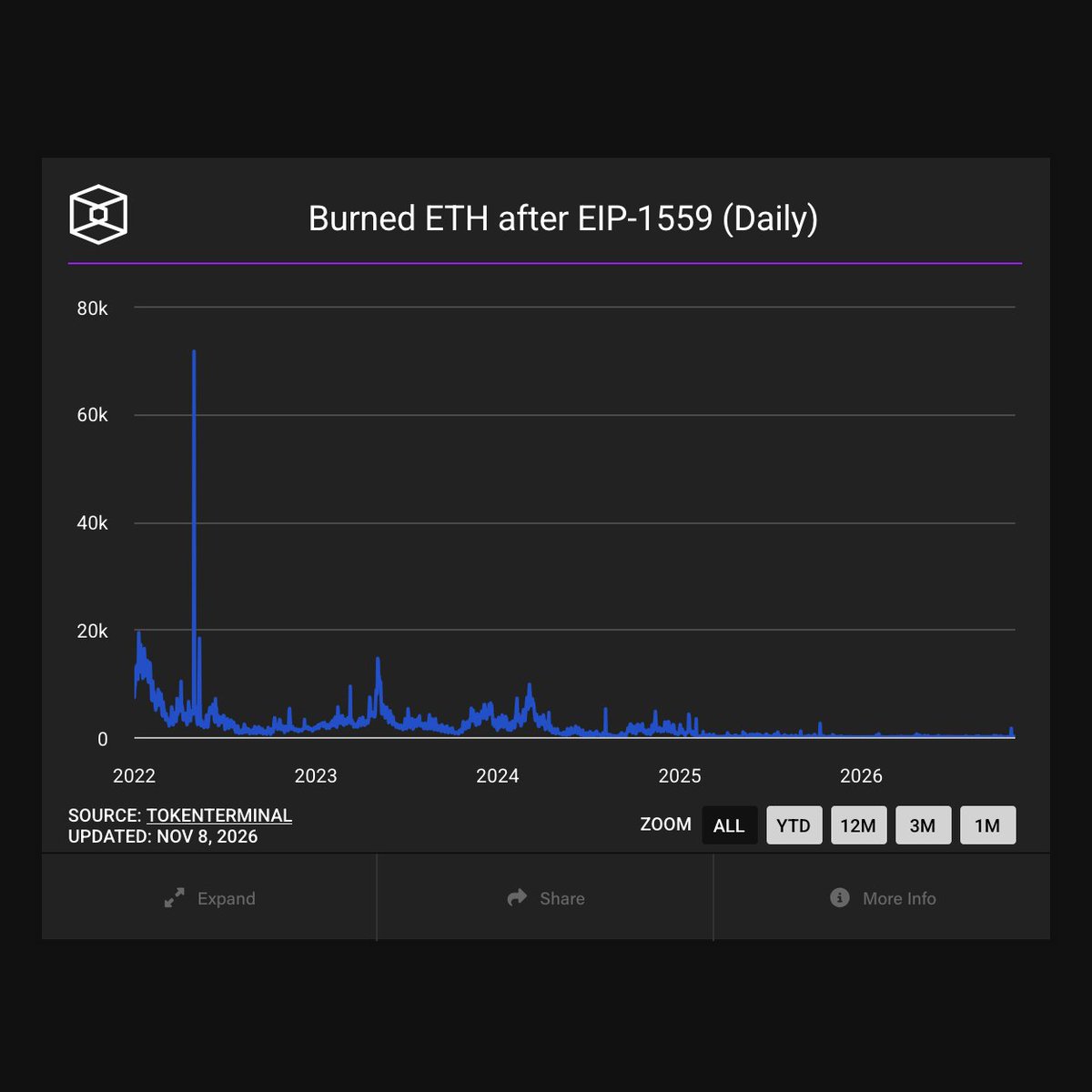
THE BLOCK: Vitalik Buterin says ETH should be valued as a store of value, not a fee-burning token. He said the burn "was never a true floor" and that optimizing for fees would require heavy protocol spending and interventionist governance.
Buterin said Ethereum should keep its fee burn, but holders "should not feel sad" if it stays below 10% of breakeven indefinitely. Ethereum has burned about 19,200 ETH so far this year, down from 1.48 million in 2022, per The Block’s data.
The thread comes five weeks after the authors of a proposal to burn a rising share of staking rewards withdrew it following industry pushback.
Interesting read: Bitcoin's code may be overdue for a general cleanup, but is that going to generate enough engagement and excitement at a time of historic... boringness in its price action?
Matt Corallo explains why patching four legacy bugs is about rebuilding muscle memory, just as much as it’s about Bitcoin maintenance. https://t.co/ZBW81dVTYx
Weeks after former "GMA" hosts T.J. Holmes and Amy Robach quietly married, their ex-spouses, Andrew Shue and Marilee Fiebig, had their own wedding. https://t.co/qIbBIPG346