I've created several YouTube playlists of videos covering various topics on advanced C++ and the many things you can do with it... I'm still creating more playlists that will hopefully be useful
https://t.co/UVrqHPXWMW
#100DaysOfCode#cplusplus
Kenya is unlikely to get a new IMF deal before the August 2027 elections.
The IMF is concerned that a new government could change the policies agreed under the deal.
Rigging plan?
UDA Secretary-General Hassan Omar: Siku ya elections hata sisi ni ‘kumera kumera.’ Hata kama mtu amekufa tuchukue kidole chake kabla hatujamzika tuingize kwa BVR tupige kura. Hata yule amekufa leo.
🚨 A groundbreaking MIT brain-scan study shows relying on ChatGPT weakens critical thinking and memory wiring.
A recent MIT study, titled ”The Cognitive Cost of Using LLMs,” monitored the brain activity of 54 students using electroencephalography (EEG) devices.
Researchers from the MIT Media Lab discovered that participants who consistently relied on ChatGPT for essay-writing tasks demonstrated significantly lower neural engagement in brain regions tied to memory and analytical reasoning.
Rather than actively synthesizing information, these users increasingly defaulted to a state of 'mental passivity,' struggling to recall their own work shortly after completion and producing increasingly generic, uninspired content.
However, the research also highlights a path forward: AI does not have to be a cognitive detriment. Students who initially worked unaided and later transitioned to using ChatGPT showed an increase in brain activity, suggesting that AI is highly beneficial when used to enhance and scaffold human thought rather than replace it entirely. To avoid a future of algorithmic echo chambers and cognitive decline, experts urge users to remain active, critical participants when collaborating with digital tools.
source: Chow, A. (2025). ChatGPT's Impact On Our Brains According to an MIT Study. TIME.
Mr. President, Please Seek the Truth on the Ground About SHA
H.E. the President, Kenyans need to tell you the truth about what is happening on the ground with the Social Health Authority (SHA).
SHA was launched with good intentions, and many Kenyans welcomed the transition from NHIF to a system intended to provide accessible healthcare to all. However, there are growing concerns that implementation challenges, administrative failures and possible malpractice in some facilities may be undermining the programme and creating the impression that SHA is not working.
There are reports and concerns from patients that when a patient is referred from a Level 4 facility to a Level 5 or Level 6 hospital because of the seriousness of their condition, they may be asked to pay cash before admission, despite being under SHA. This is especially concerning because ordinary Kenyans were led to believe that they would be able to access covered healthcare without being required to make such payments.
Another major problem occurs when the SHA system is unavailable or experiencing technical or administrative difficulties. Patients can find themselves unable to receive treatment unless they pay cash. A system failure should not become a reason for a sick person to be denied urgent medical care.
There are also concerns that some hospitals may submit claims to SHA while simultaneously asking patients to make additional payments for services they believe should be covered. These allegations need to be independently investigated rather than dismissed.
There are further concerns that individuals who previously benefited from fraudulent or questionable NHIF claims may have interests within the new system, and that some people within SHA or hospital management could be contributing to its problems. These are serious allegations and should not be treated as facts without evidence. However, they are important enough to warrant an independent investigation.
Mr. President, please do not rely only on reports from officials within the system. Commission an independent, transparent assessment of SHA implementation across the country, particularly in public hospitals and among ordinary citizens who depend on public healthcare.
The investigation should establish:
1.Whether hospitals are demanding cash payments for services covered by SHA.
2.Whether hospitals are submitting SHA claims while also charging patients for the same services.
https://t.co/X9NnffcqGu often system failures prevent patients from accessing treatment.
4.Whether public hospitals are receiving SHA reimbursements on time and whether those payments are reaching the intended services.
5.Whether there is fraud, abuse or conflict of interest within the SHA claims and payment system.
6.Why patients referred to higher-level hospitals are sometimes facing difficulties accessing care.
7.Whether the experience of ordinary Kenyans differs significantly from that of civil servants or other groups with easier access to healthcare services.
The President should hear directly from patients, doctors, nurses, hospital administrators and independent healthcare experts not only from officials responsible for implementing SHA.
If SHA is being sabotaged or poorly implemented, those responsible should be identified and held accountable. If the problems are caused by weaknesses in the system, those weaknesses should be corrected.
Kenyans do not want SHA to fail. They want it to work.
Mr. President, please obtain an independent report on what is actually happening in hospitals across the country and correct the mistakes before public confidence in SHA is lost. The success of universal healthcare should not be determined by reports on paper; it should be measured by whether an ordinary Kenyan can walk into a hospital when sick and receive the care they need without being forced to pay cash because of failures within the system.
Housing Levy Locked Forever:
A bold fiscal manoeuvre could lock the controversial housing levy into Kenyan payslips for generations.
Government plans to use the housing levy as loan security to borrow Sh100 billion.
#NTVTonight@MichelleNgele_@Karanja_Ibrah
Things just got awkward live on TV.
Opiyo Wandayi claimed they had agreed a deal with matatu operators to end the strike and even said there were no questions only for one of the matatu leaders to go live moments later and completely contradict him.
This is exactly the kind of courage Kenya needs.
Speak the truth publicly. Don’t let leaders rewrite reality while cameras are rolling.
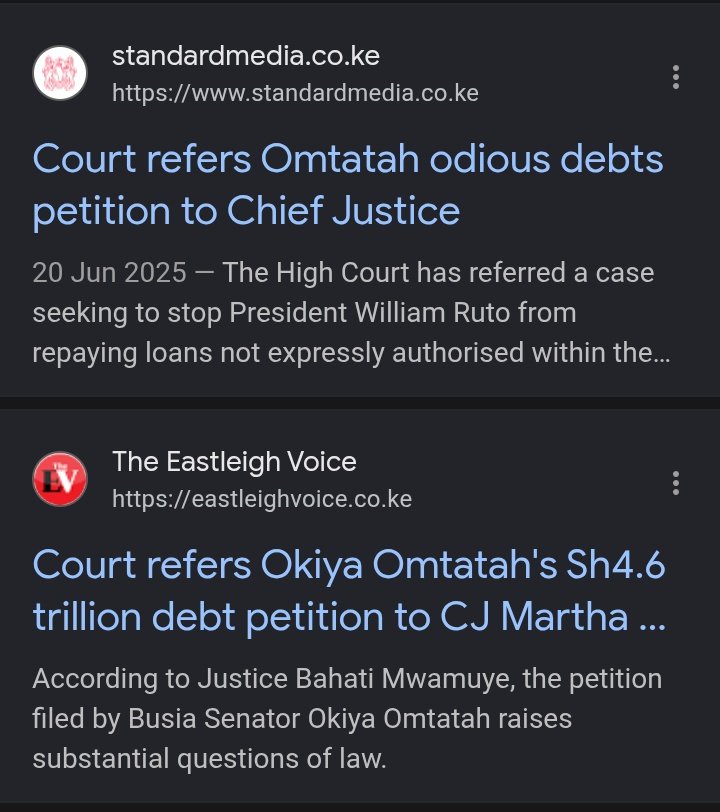
On 19th June 2025, Justice Bahati Mwamuye certified that the petition met the threshold for empanelment under article 165(4) of CoK 2010 and it was referred to the Chief Justice to empanel a bench of uneven number of judges to determine the matter.
Six months down the line we are still waiting as more illegal loans are being borrowed to service the lavish lifestyles of crooks.
As active citizens, we are going to start taking bold actions of demanding truth and accountability.
We cannot continue suffocating under the armpits of Odious debts.
Kataa deni bandia kataa!
#DeniBandia #RutoMustGo
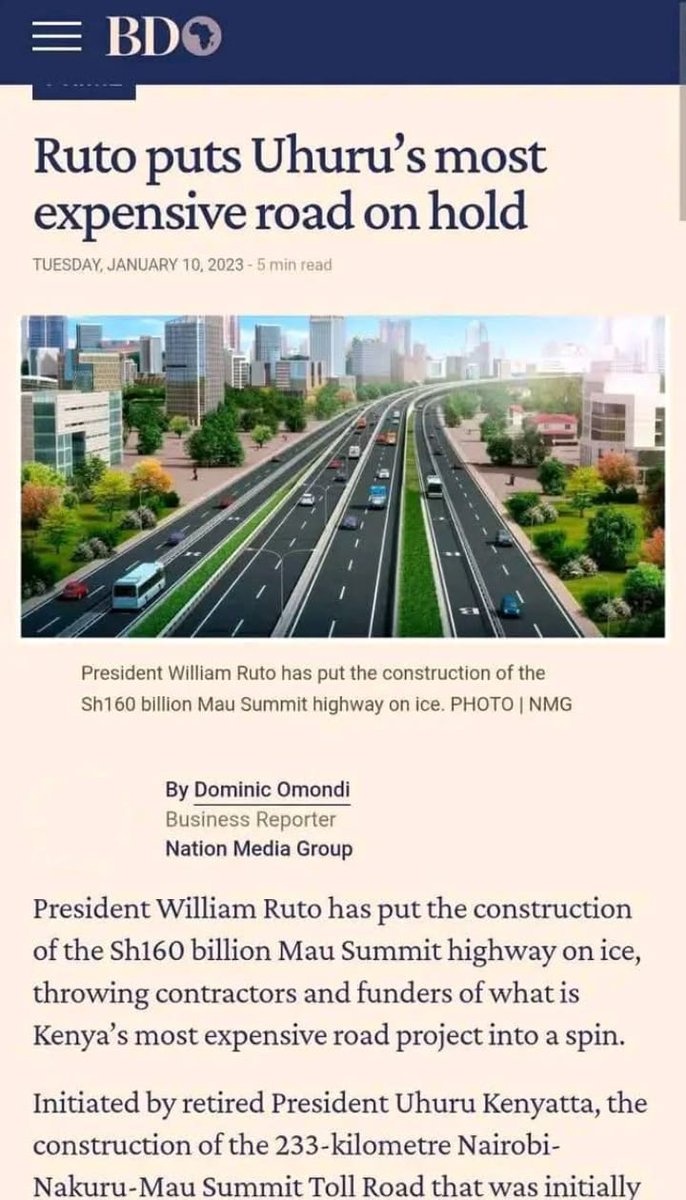
Rironi - Mau Summit Highway: At the cost of Kshs 160 billion corruption fees had been factored in. Now Kenyans must pay Kshs 200 billion; plus Kshs 7 billion penalty to the French firm + questionable toll rates. A special corner of hell should be preserved for these Fellows.
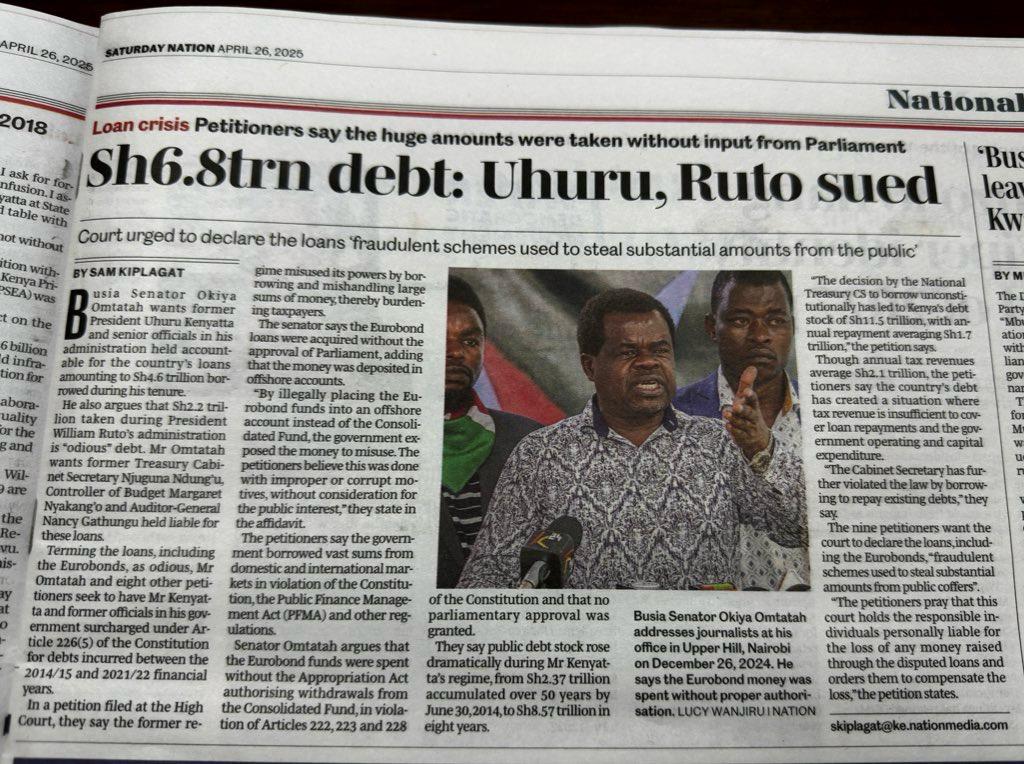
Over Ksh 6.8T was borrowed outside the law, without the approval of the Parliament and was deposited in offshore accounts outside the Consolidated Fund.
This Ksh 6.8T is undocumented and is not attached to any single development project.
Kenyans are servicing non existing debts. We are suffocating under the armpits of Odious debts which were illegally borrowed to service the lavish lifestyles of crooks.
A total of 10.2T has been used to service these illegal debts and we are being told that the debt ceiling still stands at Ksh 12.4T.
That begs the question, " Where is our money going?"
These debts must be audited one by one. We cannot pay what was looted. Audit the truth.
If we remove the illegal 6.8T from 12.4T we remain with 5.6T. That means that we've paid our debts in excess and the numbers don't lie. Kenyans don't have debts.
Kila mtu abebe mzigo wake. Kataa deni bandia kataa!
The data never lies. 8-4-4 worked for majority of the population. I mean look at Kenyans in other countries they do wonderfully.
Did it have flaws? Yes. We have data for 40 years that could be used to do incremental improvements. But no, throw out the baby and the bath water.