🚨 SPACEX JUST GOT FAA APPROVAL TO TEST ITS NEW “STARFALL” CAPSULES.
These are not regular reentry vehicles.
SpaceX’s new circular Starfall capsules are designed to bring up to 1,000 kg of payload back from orbit safely, repeatedly, and at scale.
They can launch on either Falcon 9 or Starship, perform in-space manufacturing, then reenter and splash down in the Pacific for rapid recovery.
Why this matters:
• Enables true commercial in-space manufacturing (microgravity + vacuum) that can be returned to Earth
• Could become a “proliferated successor” to the ISS for self-sustaining space industry
• Opens the door to rapid point-to-point cargo delivery from orbit to anywhere on Earth
• Directly competes with companies like Varda that have been flying similar missions on SpaceX rockets
The deeper implication is massive:
We are moving from “occasional experiments in space” to routine manufacturing and logistics in orbit.
If Starfall works at scale, companies could build factories in space, produce high-value materials that can’t be made on Earth, and ship them back down regularly all without needing a full space station.
This is one of the clearest steps yet toward a real, self-sustaining commercial space economy.
What do you think will in-space manufacturing finally become a serious industry, or is this still too early?
Follow for more frontier space and future technology.
How XRP Will Reach $300+ *Part 4*
In the institutional market, you cannot manage companies with trillions of dollars in daily volume using a small market cap of 500 billion or 1 trillion dollars. Because at that exact moment, the available XRP is what matters. This is the very starting point of my thesis.
The biggest mistake that traditional stock investors and shallow analysts make is calculating XRP with a stagnant "market cap" logic, as if it were a stock. In reality, XRP is a velocity (liquidity) asset designed to transfer the quadrillion-dollar burden of the financial system from one side to the other within seconds.
*Size of Derivatives Markets: $846 Trillion
*World Stock Markets: $150 Trillion
*Global Debt Stock: $496 Trillion
*DTCC Annual Volume: 4.7 Quadrillion
*BIS, FX, Banks, OTC, and Nostro/Vostro Accounts, and more...
When the system becomes fully integrated "as I have already explained before" the price will not move based on the small buy and sell orders on exchange screens. When institutional automated software (APIs) send transfer orders worth billions of dollars per second into the system, they will not look for "cheap XRP for sale" in the order books. To complete the transfer, the system will draw liquidity from the pool with the highest depth at that moment.
The moment that massive financial mechanism (DTCC, BIS, CME, BANKS), which is forced to carry trillions of dollars per second, cannot find available supply in the market, it will be mathematically forced to skyrocket the unit price to $300 and beyond just to keep its own wheels turning.
In short; $300+ is not a wish, it is a technical necessity of the system architecture built to carry global financial volume.
My posts are for informational purposes only.
Not a financial advice.
Everyone is responsible for themselves.
DYOR
I'm not sure people remember how violent a Discontinuous Repricing event can be. And Four lessons you don't want to forget 👇
XRP's 2017–2018 Cycle: What Actually Happened
The lesson isn't that XRP slowly climbed to its all-time high. The lesson is that most of the gains came in the final 30–90 days — and missing a few weeks meant missing most of the move.
Part 1 — The Full 2017 Explosion
XRP spent most of 2017 quietly building. A spring rally brought early believers a 67× gain, followed by months of consolidation that tested patience. Then, in the final weeks of the year, price discovery happened at a speed almost no one was prepared for.
Jan 1, 2017 — $0.006 (baseline)
May 2017 — $0.40 (67× from Jan)
Jul 2017 — $0.15 (pullback)
Oct 2017 — $0.20 (recovery)
Dec 1, 2017 — $0.25 (42× from Jan)
Jan 4, 2018 — $3.84 (640× from Jan)
The pattern: Months of boredom → weeks of disbelief → one month of absolute chaos.
Part 2 — The Final Parabolic Move
This is the phase most XRP holders remember. In just 34 days, XRP moved from $0.25 to its all-time high of $3.84 — a 1,436% gain.
Price progression:
Dec 1, 2017 — $0.25
Dec 15, 2017 — $0.60
Dec 21, 2017 — $1.00
Dec 29, 2017 — $2.00
Jan 1, 2018 — $2.30
Jan 4, 2018 — $3.84 ATH
Step-by-step gains:
$0.25 → $1.00 = +300%
$1.00 → $2.00 = +100%
$2.00 → $3.84 = +92%
$0.25 → $3.84 = +1,436% total
Part 3 — Hypothetical Equivalent: Starting June 1, 2026
What if June 1, 2026 at $1.30 were the equivalent of December 1, 2017?
Applying the same 15.36× multiplier from the 2017 blow-off top:
June 1 — $1.30
June 15 — $3.12
June 21 — $5.20
June 29 — $10.40
July 1 — $11.96
July 4 — $19.97
This represents the mathematical equivalent of XRP's move from $0.25 → $3.84.
Part 4 — Hypothetical Equivalent: Starting October 1, 2017
In the broader 95-day window, XRP moved from $0.20 → $3.84 — a 19.2× increase.
Applying that multiple from a $1.30 starting price:
June 1 — $1.30
July 1 — $2.60
August 1 — $5.20
September 1 — $10.40
September 4 — $24.96
Part 5 — Hypothetical Equivalent: The Full 2017 Run (640×)
In 2017, XRP ran from $0.006 on January 1 to $3.84 on January 4, 2018 — a 640× increase over the full year.
Applying that same multiple to today's price of $1.30:
$1.30 × 640 = $832
The Real Lesson
XRP's 2017 cycle wasn't a steady climb. It was a long, boring wait followed by a brief, violent repricing.
Four things were true then — and worth remembering now:
1.Most gains were compressed into the final 30–90 days.
2.XRP looked boring for months before the breakout.
3.Once momentum arrived, price discovery happened extremely fast.
4.Missing a few weeks meant missing most of the move.
History never repeats exactly. But understanding how XRP's previous cycle unfolded provides valuable context when evaluating future market behavior.
🚨 Samsung & XRP 🚨
$1 trillion Samsung just announced a $400 million investment into a major XRP exchange in Korea.
The biggest corporations in the world are positioning early.
$XRP is impossible to ignore. 🚀
🚨 stellar:native JUST SKYROCKETED 20% IN HOURS
THE MASSIVE ANNOUNCEMENT JUST DROPPED:
DTCC, the $114 TRILLION Wall Street giant is tokenizing blue-chip stocks & bonds on Stellar by 2027!
Institutions are flooding in.
This is the spark the bulls have been waiting for. stellar:native to $1 this cycle?
Or are we going parabolic sooner? #XLM #Stellar #Crypto #DTCC
The difference between you and me is this;
If the Clarity Act does not pass and banks do not use XRP, your chart might come true.
But if the Clarity Act passes and banks start using XRP, the lines you draw will have no meaning at all.
You see XRP as an investment vehicle, whereas I see it as the Bridge Asset described in the whitepaper.
Those who say "DTCC chose Stellar, XRP is finished" are the ones who think blockchain technology consists of just a single playground.
Think of it like a factory, Stellar is the system that packages and labels the products inside the factory; XRP, on the other hand, is the massive highway and logistics network that transports those products to ports worldwide in milliseconds.
DTCC starting to tokenize assets on Stellar will only accelerate the asset volume (quadrillions of dollars) flowing onto the digital finance highway. As this volume hits the market, the only bridge asset capable of absorbing that massive liquidity will once again be XRP
BREAKING🚨 OVER $2 BILLION IN ELECTRICITY IS NOW TOKENIZED ON $XRP LEDGER. 👇
Not crypto. Not DeFi yield. Electricity.
Real energy. Real economic value.
ON XRP INFRASTRUCTURE
Justoken turned real-world electricity production into digital financial assets living on XRPL.
That's physical energy flowing through power grids being represented, traded, and settled on the same blockchain that powers XRP.
This is why every XRP holder needs to understand what this means for token demand.
Every single transaction on XRPL requires XRP for fees. Issuing tokens. Moving them. Trading them. Settling them. Managing them. Each action burns a fraction of XRP.
$2B in tokenized electricity generates constant transactional demand. Every new account on XRPL requires XRP reserves.
More companies.
More brokers.
More settlement accounts.
More wallets holding tokenized energy.
Each one locks XRP just to exist on the ledger.
Every trust line requires XRP reserves. XRPL tokens operate through trust lines.
Each trust line locks additional XRP. $2B in tokenized assets means thousands of trust lines.
Thousands of XRP reserve requirements.
As tokenized energy gets traded, financed, and settled, XRP sits at the center of liquidity routes.
The native DEX on XRPL means these tokens can be exchanged through XRP as the bridge asset.
Payment paths. Exchange routes. Settlement layers. All flowing through XRP.
This is not a partnership announcement. This is $2 billion in real-world commodity value creating measurable, ongoing demand for XRP through network fees, account reserves, trust lines, and liquidity routing.
The tokenization of assets on XRPL is the demand driver most people haven't modeled yet.
Justoken just proved it at $2B scale.
TRILLIONS COMING SOON
How XRP will reach $300
Shortly after the clarity law is enacted, banks will start using XRP. Those who say XRP will rise slowly or only reach $5 or $10 view banks like grocery stores joining the system one by one. However, Ripple has already partnered with giant infrastructure providers like Volante, ACI Worldwide, and FINASTRA.
The reality is that these infrastructure providers serve thousands of banks with a single update. In other words, Ripple does not need to sign individual contracts with 13,000 banks. The moment they plug into the central cloud, all banks connected to the system become capable of using XRP liquidity.
Therefore, "it will take years" claims represent a failure to understand the speed of the software world. XRP is a payment transfer system.
If XRP remains at $10-$20, it would be like trying to transfer the water in the ocean with a small straw. The straw needs to grow, and large pipes are required. Therefore, as the price increases, the pipes expand and the transfer becomes much faster.
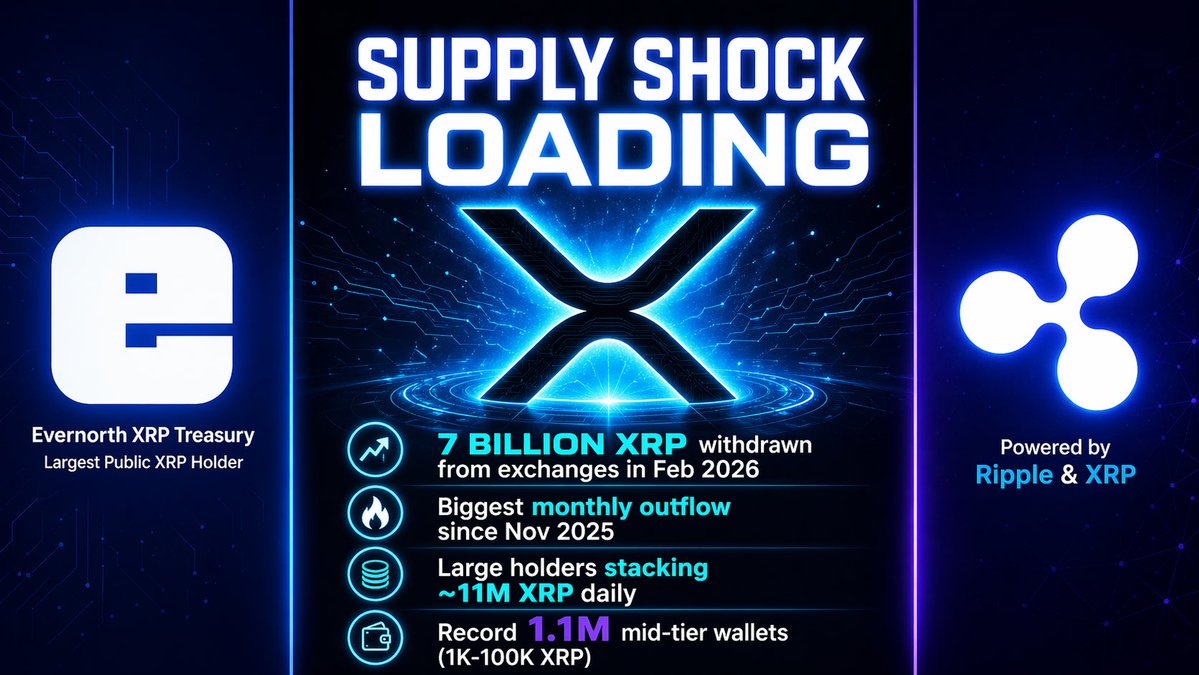
🚨 EVERNORTH SAYS IT LOUD AND CLEAR | SUPPLY SHOCK COMING FOR $XRP 🤯
The largest public XRP treasury company just dropped a banger thread and it’s straight fire 🔥
Here’s the breakdown :👇
1️⃣ February 2026 > 7 BILLION XRP pulled from exchanges. That’s the BIGGEST monthly outflow since November 2025.
2️⃣ When smart money wants to SELL… they move coins TO exchanges. When they want to HOLD long-term… they move them OFF.
Exchange balances = sellable supply. And that supply just got slashed hard.
3️⃣ Early April update: Large holders are stacking ~11 MILLION XRP per day on average. Mid-tier wallets (1K–100K XRP) just hit a record 1.1 MILLION wallets - all-time high.
4️⃣ Translation? Two things are happening at the exact same time: ✅ The pool of XRP available to sell is shrinking fast ✅ The army of long-term diamond hands is growing bigger every single day
This is textbook SUPPLY SHOCK setup.
Less liquid XRP on exchanges + more coins locked away in strong hands = when real demand hits… the squeeze is going to be HISTORIC.
We’ve been saying it for years, XRP wasn’t built to trade sideways forever. It was built for utility at scale.
And the on-chain data is now screaming that:
Smart money is accumulating $XRP +
The supply shock is loading 🌊📈
#XRP #XRPArmy
🚨XRP overnight to $26…then to $113🚨
Sounds pretty accurate to me.
Remember what I said. After the clarity act is law, I don’t think we’ll see XRP retrace. It wouldn’t make any sense for it to.
Instead, I think we’ll see intervals. Each “phase” will have a certain price point. For example…
•Phase 1 $5-$15
•Phase 2 $25-$75
•Phase 3 $100-$150
…so on and so forth. Phase 2 never falling back into Phase 1. Phase 3 never falling back into Phase 2.
Again this is what makes sense to me…as a utility crypto. It may not happen that way but if it’s being used for transactions, it should. At that point XRP would have to be a high number for it to be efficient without slippage as it goes from phase to phase.
Thats why I always say, take profits and in my opinion save a small bag “just in case”
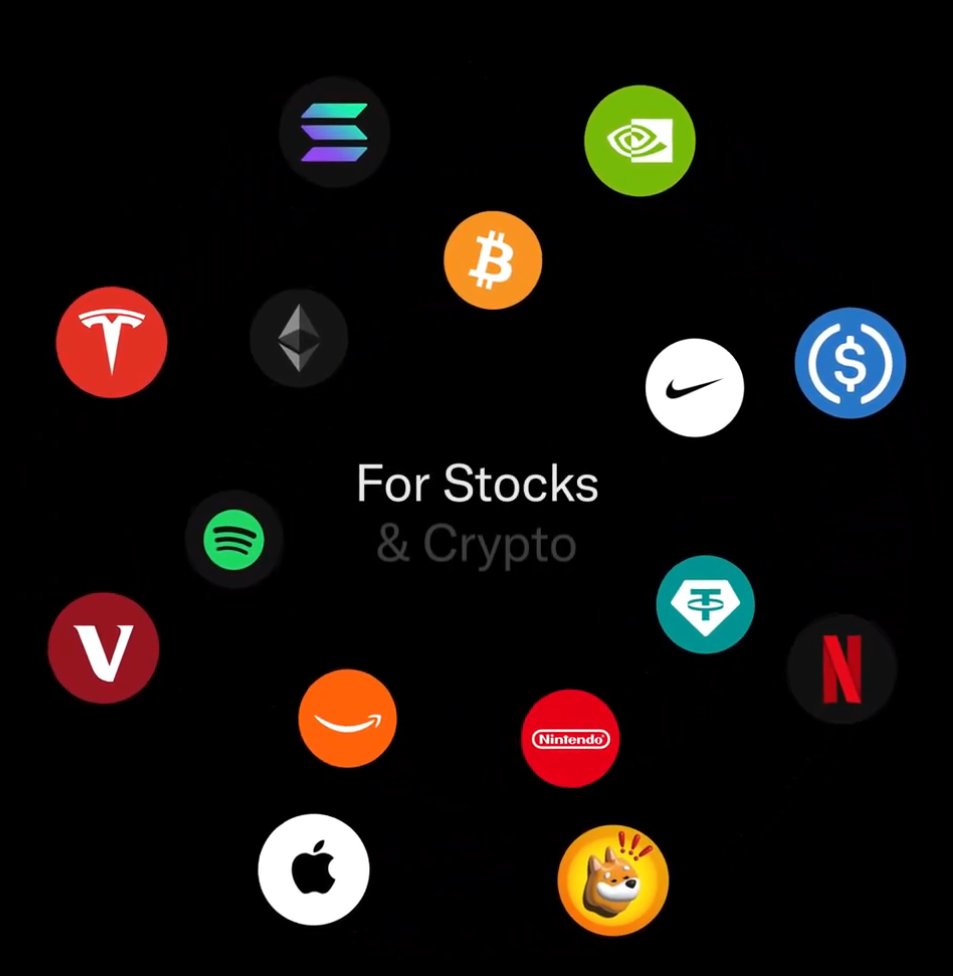
🚨X CASHTAGS DRIVE $1B IN TRADING IN JUST 2 DAYS
X’s new cashtags feature that lets users tap stock or crypto tickers and trade instantly generated an estimated $1B in global trading volume just days after launch.
It’s currently a limited pilot only available in Canada (not the US), making the $1B volume even more notable.
Not a single fintech CEO slept well last night.
X just shipped a full financial stack in 48 hours. And most people didn't even notice.
Here's the sequence:
- Tuesday: Smart Cashtags go live. Any ticker, any contract address native price chart, right in the timeline. No redirect. No third-party app.
- Already in beta: X Money. Fiat wallet with 6% APY, metal Visa debit card with 3% cashback, P2P payments, direct deposit. FDIC-insured through Cross River Bank, the same bank behind Coinbase and Stripe.
- Already live: Brokerage routing via Wealthsimple. One tap from a post to a placed trade.
Three products. All shipped. All pointing the same direction:
Discovery → Chart → Trade → Pay.
Inside one timeline scroll.
Here's what that looks like for you and me:
Someone posts a $AAPL cashtag. I tap it. Chart loads. I see the conversation around it. I buy. Never left the app.
I send $50 to a friend. On X. I earn 6% on what's left. My debit card gives me 3% back on coffee.
Why would I open Robinhood? Why would I open Venmo? Why would I open CoinGecko?
And here's why they can't compete:
X has 550M monthly users. Robinhood has 24M funded accounts. Venmo has ~90M accounts. CoinGecko has ~30M monthly visits.
X doesn't need the best product. It needs a good-enough product inside the app people already live in.
Now zoom out.
X was an ad revenue company. ~$4.4B in 2023, almost all advertising.
The new revenue stack:
> Visa interchange on every card swipe
> Brokerage referral fees on every routed trade
> APY spread on held deposits
> Trading behavior data from 550M users
X didn't add a feature. X changed its entire business model.
"Is this good for X?"
Wrong question.
X just stopped being a social media company.
It's now a financial infrastructure company that happens to have 550 million users already scrolling.
Everyone else is competing against a distribution gap they can never close.
I wrote about this yesterday before any of it was announced. The sequence played out exactly as mapped.
The only piece left: which chain gets the default crypto trading slot.
That answer will move markets.
20 Million XRP Bought by Whales as $27 Target Comes Into Focus
Whales accumulated 20 million XRP over the past week, adding fuel to growing speculation of a potential breakout toward the $27 level.
https://t.co/ufvf3CzyKk