@surya_14kumar Is He The T20 GOAT?
Yes He Is! The data illustrates this. Plays more than 77% his innings as either Impact (53) or cameo (24). Fails rarely 13% (the lowest in whole world). And only 10 % of his innings are pressure creating. The most perfect T20 batter?
#SKY
🚨 RECORD RECORD RECORD.
50 runs in total, all in boundaries, equal amount of fours [5] and sixes [5]. 50 runs of 10 balls, one ball as dot, total 50 in 11 balls. Equally joint fastest in recorded cricket history.
Blud is special isn’t he? Its hard to digest any sort of batter playing this flawless range hitting cricket at any point of their lives. Now consider someone doing it at what? 15? Unbelievable. He is here to rule, I bet ya!
Joe Root will walk into England’s second [Oval] Test with more Test caps to his name than the other ten players in the XI combined.
This will be the 46th such instance in Test cricket history.
The last time it happened was during Pakistan’s Test against West Indies in [Multan] in 2025. West Indies captain Craig Brathwaite entered the match with experience of 96 Tests, while the remaining ten players in the XI had played just 80 Tests combined.
Before that, a similar instance was recorded against Pakistan during Ireland’s inaugural Test match at [Dublin] in 2018. Ireland’s most experienced player in that XI was Boyd Rankin, who had previously represented England and had experience of just 1 Test match. The remaining ten Irish players were all making their Test debuts, giving the rest of the side a combined experience of 0 Tests.
The third-last and fourth-last occurrences came during the series in which Sachin Tendulkar played his [199th] and [200th] Test matches at Eden Gardens [Kolkata] and Wankhede [Mumbai] in 2012.
In the first of those two matches, the rest of the Indian XI had experience of only 167 Tests combined. By the time the second Test began, another match had been added to each player’s tally, taking the combined experience of the remaining ten players to 177 Tests.
Now, more than a decade later, Joe Root joins that remarkable list, carrying more Test experience on his own than the rest of England’s XI put together.
The Price Sachin Tendulkar Paid For Playing Too Long
People often look at Sachin Tendulkar’s final Test average of 53.78 and call it one of the greatest records in cricket history.
And rightly so. For 200 matches long career comprising of 329 innings its a ridiculous number to be honest.
But what many don’t realize is how much that number had dropped because he chose to keep playing for India long after most legends would have walked away.
By the Lahore Test against Pakistan in 2004, Sachin’s Test numbers looked like this:
• Matches: 113
• Innings: 192
• Runs: 9459
• Average: 58.39
• Highest Score: 241*
At that point he had already spent 15 years carrying the expectations of a cricket-mad nation.
He had survived the fearsome pace attacks of the 1990s, dominated every major bowling attack in the world, and reinvented his batting after serious injuries.
An average of nearly 59 after more than 100 Tests is ridiculous.
Very few batters in history have managed to stay near those numbers for that long.
Then came the second half of his career.
The injuries kept piling up.
Tennis elbow became a constant battle.
The reflexes were no longer as sharp as they once were.
The pressure of chasing the 100th international hundred became a burden of its own.
Every innings was analyzed, every dismissal debated, and every low score was treated as a national event.
Yet he kept going.
When he finally retired after his 200th Test at Wankhede Stadium against West Indies, his numbers stood at:
• Matches: 200
• Innings: 329
• Runs: 15921
• Average: 53.78
• Highest Score: 248*
Just think about that.
After reaching an average of 58.39 in 2004, he played another 87 Test matches.
That’s almost an entire Hall of Fame career on its own.
He added more than 6400 runs, scored his highest Test score of 248*, and continued playing under the biggest spotlight cricket has ever seen.
The average eventually dropped from 58.39 to 53.78.
For most cricketers, finishing with 53.78 after 200 Tests would be the achievement of a lifetime.
But for those who followed Sachin throughout his career, that drop tells a story.
It tells us that even the greatest players are not immune to time.
It tells us how difficult it is to maintain greatness across 24 years of international cricket.
And it shows the price he paid for staying in the arena longer than almost anyone else.
We often remember the records.
But sometimes the decline itself is part of the greatness.
Because unlike many legends who left before the struggle arrived, Sachin stayed long enough for the world to see both the peak and the fall.
And somehow, that makes his journey even more human.
[Australia Found Three Future Stars That Day, But Lost One Too Soon]
On 1st December 2011, [Australia] handed Test caps to three young cricketers who had already made plenty of noise in the domestic circuit. The trio included David Warner, Mitchell Starc, and James Pattinson. Warner and Starc represented New South Wales, while Pattinson had been turning heads in Victoria.
By the end of the Test, the standout performer among all 22 players on the field was James Pattinson. He picked up 1 wicket in the first innings and then produced a devastating spell of 5 for 27 in the second. Remarkably, the first five wickets of New Zealand’s innings all belonged to Pattinson, and those wickets included the top five batters: Martin Guptill, Brendon McCullum, Bracewell, Kane Williamson, and Ross Taylor.
Only Guptill managed to reach double figures [12]. The others were dismissed for [1], [2], [0], and [0] respectively.
At one stage, his spell read an astonishing 7-5-7-5.
The debutant stunned the cricketing world with his pace, aggression, and relentless accuracy. Meanwhile, the other two debutants had fairly ordinary starts. Warner scored 3 and 12*, while Starc returned figures of 2/90 in the first innings, scored 32 runs, and followed it up with 0/33. Across both innings, he conceded runs at an economy rate close to 5.
The irony? The player who looked like a seasoned veteran on debut ended up playing only 21 Tests, while the two debutants with comparatively modest starts went on to play 100+ Tests for Australia and are now regarded as modern-day legends of the game.
Pattinson never really suffered through a prolonged slump in form. Injuries were the real opponent throughout his career, repeatedly forcing him out of the side and ultimately robbing him of what could have been a truly special journey.
He finished with 21 Tests, 15 ODIs, and 4 T20Is for Australia. He claimed 81 Test wickets at an average of 26, 16 ODI wickets at an average of 42, and 3 T20I wickets at an economy rate of 8.
Test cricket was where he truly made his name. In just 38 innings, he struck every 48 deliveries, collecting wickets at an outstanding strike rate while registering 4 four-wicket hauls and 4 five-wicket hauls.
Pattinson was a force to reckon with. Early in his career, opposition teams specifically prepared for him in training sessions, knowing the threat he posed with the new ball and his hostile pace.
What could have been a career every bit as illustrious as those of his batchmates ultimately became a story of unrealized potential because of injuries. Yet he left his mark on the game and showed everyone what he was capable of.
If only.
And there is another fascinating twist to the Pattinson story. His brother, Darren Pattinson, played for England and picked up two wickets against South Africa in the only Test of his career at Leeds in 2008.
[The Spinner International Cricket Lost Too Early]
Saqlain Mushtaq retired very early, at just 27 years of age. Looking at his numbers, he could have easily played till the 2011 World Cup, especially in subcontinent conditions where his skills would have been even more effective.
His ODI record was simply outstanding. At one stage, he was the fastest bowler to reach 100, 150, 200, and 250 wickets.
Even today, he still holds the record for the fastest to 250 ODI wickets.
In matches Pakistan won, his impact was even bigger, taking more than 2 wickets per game and averaging around 15, which is elite for any bowler.
He played his last ODI in 2003. His final Test came in 2004 in Multan against India.
That was the same match where Virender Sehwag scored 309.
Saqlain had a tough game, finishing with figures of 1 for 204, and after that, he was never selected again.
By that time, his form had already dropped. Injuries, especially his knee issue, played a big role in that decline.
At the same time, new players were coming in.
Bowlers like Danish Kaneria in Tests and Shoaib Malik in ODIs started getting opportunities, which made it even harder for him to make a comeback.
If he had stayed fit and in form, Saqlain could have easily crossed 400 ODI wickets and continued playing till 2011.
[Two Yeara In The Wilderness. Five Minutes To Blow The Roof Off LORD'S!]
[•], [w], [•], [w], [w]
The timeline of first six deliveries Ollie Robinson bowled during first day of Lord’s Test.
After being cast aside in 2024 amidst heavy doubts over his fitness and commitment, Ollie Robinson just staged one of the most cinematic comebacks in Test cricket history.
England after getting bundled out for 140 against New Zealand on first day wanted something sparked to start their bowling with.
First over was bowled by Atkinson. Then came in to the attack the guy who was making his comeback after more than 600 days in Test cricket and what he did? He tore the spine out of the Kiwi top order with a jaw-dropping triple-wicket maiden.
Look at this sequence to leave New Zealand reeling at 2/3:
Ball 3: Devon Conway (LBW) ☝️
Ball 5: Kane Williamson (Caught at short leg for a duck) ☝️
Ball 6: Rachin Ravindra (LBW for a golden duck) ☝️
From fearing his international career was completely over during the winter to having the entire Lord's crowd chanting his name, Robinson finished the day with an unbelievable 4 wickets for 10 runs across 6 masterclass overs.
England Team who were direly feeling the absence of James Anderson can safely say, that they have found the right backup of him though his numbers, fitness, skillset and longevity is extremely difficult to replicate but Ollie Robinson certainly has got those skills.
#OllieRobinson #ENGvNZ #LordsTest #CricketComeback #TestCricket #EnglandCricket
[The Lost Years of the Universe Boss 💔]
Take a close look at these numbers. Between 2013 and 2019 [a long 6-year period] the legendary Chris Gayle played only 44 ODI innings.
During this time West Indies played 136 ODI games, out of which Gayle managed to play only 44 missing more than 90 games for his country and keeping world from some of the top notch records he could have made during his prime time.
He debuted in 1999. From that time to the Champions Trophy 2013 [his numbers shown in the top picture in the attachment], he played 255 games out of the 327 games played by West Indies. No other player could manage to play even 200 in that time period. By this time, he had some 8 and a half thousand runs with 21 centuries to his name.
Seeing the prime form he was in since the IPLs of 2011 & 2012, people were anticipating a big peak for him in white-ball cricket, where he could have easily gone on to score at least 4000 to 5000 more ODI runs with a minimum of 12 to 15 centuries.
But in the next 9 years, he could only play 44 more innings and scored some 1300-odd runs, adding 4 centuries and 9 more fifties at an average of 40 and a strike rate of 106. He also scored the highest score of his ODI career in this timeframe, hitting 215 runs in the 2015 World Cup against Zimbabwe.
For years, cricket fans around the world were robbed of pure "Universe Boss" entertainment. Why? Because of, bitter disputes, contract disagreements, and fallout with the West Indies Cricket Board (WICB).
Instead of wearing the maroon jersey and smashing records for the West Indies, Gayle was forced to spend his prime years traveling the globe playing in T20 leagues.
It is truly sad to think about the massive records and legendary knocks he could have achieved if the board had handled things better. A dark chapter for West Indies cricket, and a massive loss for cricket fans everywhere!
[AB De Villiers: The Greatest Turnaround Ever Seen In Cricket]
People often talk about AB de Villiers that in the early stages of his career he was as awesome as he was in the later part of his international career. This statement is, to some extent, true, but it holds good only for the longer formats of the game, especially Test cricket.
AB de Villiers in Test cricket was genuinely a phenomenon. The then highest individual score holder for South Africa in Tests, a three-consecutive-centuries scorer in ODIs — a record which by [2012] only [4] cricketers had ever achieved — and much more than that. In fact, by the end of [2013], he was averaging [51.7] in Test cricket with [18] centuries and [34] fifties.
In ODI cricket, he was a record master, scoring every [1000]-run increment from [3000] onwards in record innings. He was then the fastest to [4000], [5000], and [6000] runs in ODI cricket. By the end of [2013], he had scored [6331] runs in [153] innings in ODIs with an average of [50], accumulating [16] centuries and [36] fifties along the way. His strike rate was [93]. There was one unique record he was still holding, which he kept even until his retirement from the very format. It was related to the centuries he scored — none of them came at a strike rate of less than [100]. It means that whenever he scored big, he scored it quickly.
One format where everyone thinks he was quite a force to reckon with from the start of his career is T20 cricket. He was never the same AB de Villiers we know today. In his first [50] innings, he could only manage to score some [878] runs at a strike rate of [121] and an average of [21]. By the standards of T20 cricket at the time, it was a pretty average performance, especially when we look at batters like Kumar Sangakkara, who was never famous for pinch-hitting, yet had far better numbers in terms of runs, average, and strike rate in the same number of innings.
Sangakkara, in his first [50] innings, scored [1325] runs at a similar strike rate to AB de Villiers and with a far better average of [32]. AB, in the later part of his career, had a great surge as a pinch-hitter. In his next [25] innings, by the end of his career in the format, he scored close to [800] runs in [500] balls at a strike rate of [160] and an average of [44]. He could only manage to hit [25] sixes in his first [50] innings, and in the next [25] innings, he hit [35] more and ended his career with [60] sixes.
Even in T20 cricket, by [2013], he had [2708] runs in [121] innings at an average of [29] and a strike rate of [131], which was still acceptable, but the kind of aura and reputation ABD had was still below par. Anyways, by the end of his career, he had [9424] runs, meaning he went on to score [6716] runs at an average of [41] and a strike rate of [160]. He could only manage to score [1] century in the first [8] years of his career in T20 cricket, but by the time he retired, he had [3] more centuries to his name.
This can be submitted as the greatest turnaround by any sort of batter in any sort of format, to be remembered as the greatest in the format.
AB de Villiers for you.
#Zainalysis #ABDevilliers #KumarSangakkara
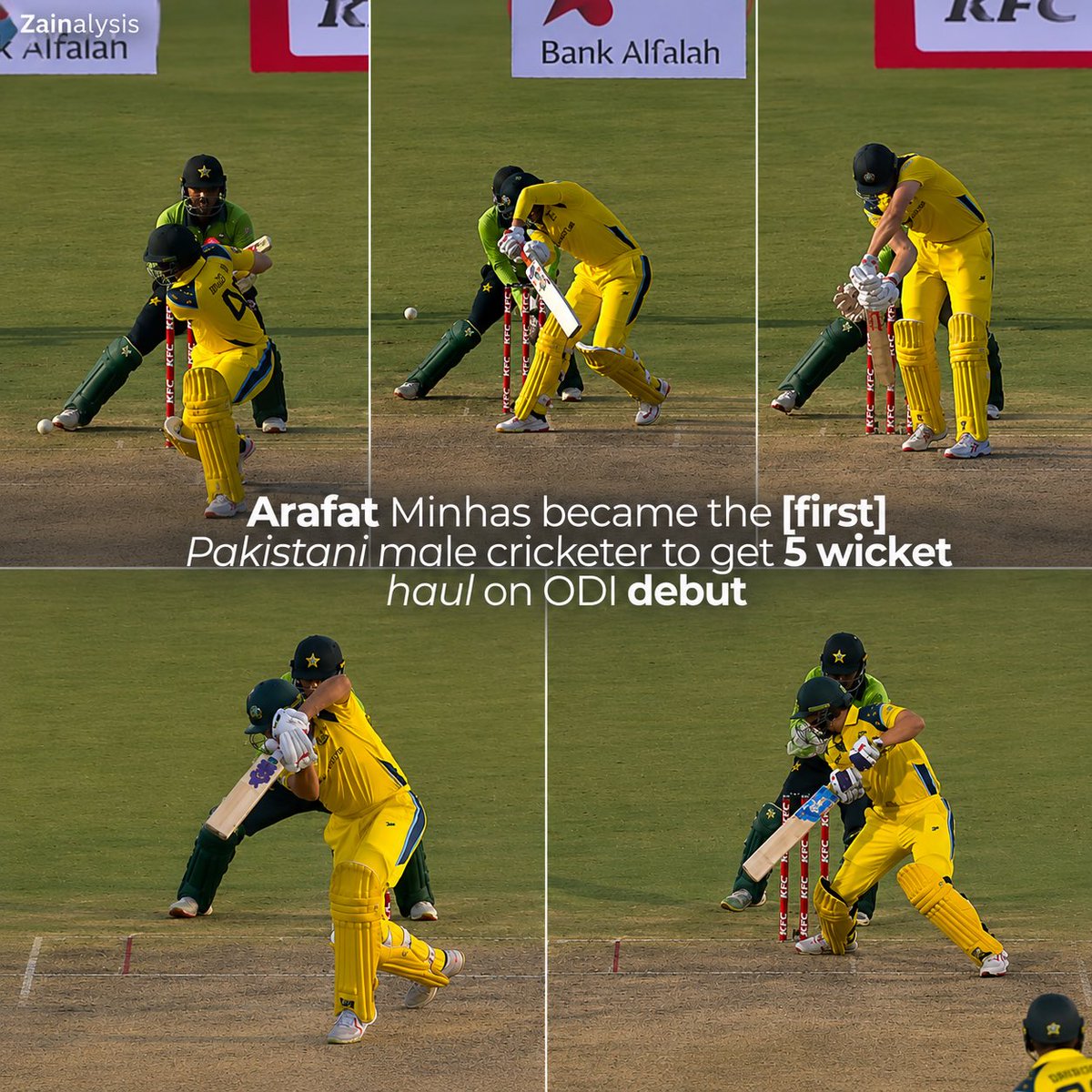
Heard someone made his ODI debut today and absolutely ripped through the record books.
If you watched the game, you must have seen that 10 over spell from Arafat Minhas. It was a complete masterclass in left arm spin bowling.
Did you see those dismissals?
Did you see the different release points?
Did you see the flight he gave the ball?
Did you notice the late dip right in front of the batter?
Did you watch that beautiful drift bringing the batter across?
Did you notice the revolutions he was putting on the ball?
Did you see how hard he was spinning it?
Everything about that spell screamed quality.
This was not a bowler simply bowling to a field. This was a bowler setting batters up, manipulating their movements, changing trajectories, and making them play shots on his terms.
And then comes the historical part.
He picked up 5 wickets during this course.
In the entire history of ODI cricket, there have been only 16 instances of a bowler taking a five wicket haul on debut.
Arafat Minhas is the first spinner ever to achieve it.
The previous 15 were all fast bowlers.
A debut to remember.
A spell to study.
A record that now belongs to him alone.
#PAKvAUS #ArafatMinhas
[Birthday Boy Misbah The Forgotten ODI BOSSMAN]
One format where he was often unfairly labelled as an average player was One Day Internationals (ODIs). But the numbers tell a different story. Scoring over 1300 ODI runs in 2013 (having record 15 50s in the calendar year) and around 1000 ODI runs in 2011, along with finishing his career with 5000+ ODI runs at an average of 44 is anything but average.
Let’s add context. During the period from his debut to his last ODI match, the top 7 batters from Test-playing nations, when playing against other Test sides, averaged just 31. That’s the benchmark. And when you zoom in on middle-order batters specifically (positions 4-7), he averaged 13 runs higher than the average middle-order batter of that era.
Yes, it’s true!! he never scored an ODI century, and that one stat became the reason for the “average” tag that followed him throughout his career. But numbers don’t lie: his consistency, his match-winning contributions, and his ability to stand tall in crunch situations tell a far more complete story than just a missing three-figure score.
His numbers stack up against the best, and the “average” tag? That just doesn’t stick.
Anyways Happy Birthday Misbah Ul Haq.
#MisbahUlHaq
680 Runs At Strike Rate Of 240
680 Runs At Strike Rate Of 240
680 Runs At Strike Rate Of 240
Orange Cap with 240 Strike Rate is as absurd as it sounds.
Forget the fact that he is 14 or 15 years old for a second. Remove age from the equation completely.
This kind of ball striking at any age is once in a generation. Maybe once in a millennium type of T20 batting display.
Now the age part only makes it even more absurd. He belongs to a generation that was born after T20 cricket had already started evolving into a format dominated by boundaries, intent and relentless scoring. He grew up watching only one version of T20 cricket — where the game is played at full throttle and six hitting is currency. And somehow, he has already pushed even those limits.
Today he smashed 97 off 28 balls and got dismissed on the 29th delivery.
One more boundary. Just one.
Had he found the rope on that ball the way he did on 9 of the previous 11 deliveries he faced, he would have registered the fastest hundred in IPL history.
Only Chris Gayle stays ahead in that race. Earlier today, he had already gone past Gayle’s season record for sixes.
This innings alone contained 12 sixes.
Season tally now stands at:
• 680 runs
• Strike Rate: 240
• 65 sixes
This is no longer power hitting. This is distortion of what we thought was possible in T20 batting.
He in recent episode of SWITCH WITH KP said that he wants to score a double hundred in T20 cricket. And tbh the way he is hitting in IPL, I can safely say he can touch that record.
#VaibhavSooryavanshi | #RRvSRH
Virat Kohli is and will be the second best thing ever happened to RBC.
First we all know who he is. ⬇️
Patidar has added 123 runs above from average replacement batter [in the same context of the gameplay] in the league so far.
He has scored 486 runs in total out of which 123 were above average replacement of a batter in the same context of match [balls left, runs scored already, run rate going on, run rate required if chasing and wickets down].
His above average runs per innings in this year comes up as 9.4 which is at 4th position in the league behind Sooryavanshi [14.8], Finn Allen [11.5] & Abhishek Sharma [11].
Luvnith Sisodia’s injury in 2022 playing for RCB is the biggest even in history of Royal Challengers Bengaluru in IPL & Champions League T20 cricket. 2nd biggest is them winning 2025 IPL.
#RajatPatidar #RCBvGT #ipl_2026
[A Cricket Record No One Has Been Able To Touch But Waqar Younis]
In 1990, [an 18-year-old] Waqar Younis just few months into his international career produced arguably the most violent ODI bowling streak the format has ever witnessed.
Not a season.
Not a career phase.
A stretch of just 17 matches.
47 wickets.
Average of 11.29.
Economy of 3.71.
Strike Rate of 18.2.
And remember, he actually started the year with two wicketless games.
What followed after that was pure destruction with a cricket ball.
In those 17 matches:
• 5 five-wicket hauls
• 2 four-wicket hauls
• A hat-trick of five-fers, three consecutive ODI fifers
• 5 five-fers in a span of only 7 matches
This was not “good bowling”.
This was sustained fast-bowling intimidation at a level ODI cricket had barely seen before.
And the most absurd part?
Out of those 47 wickets, 45 practically needed no fielding effort.
36 batters were either bowled or trapped lbw.
9 more were caught behind.
That means 45 of his 47 wickets came directly off Waqar beating the batter completely — through pace, reverse swing, late movement, yorkers, tail-inswingers and sheer ballistic skill.
Batters were not edging him to slips.
They were getting defeated.
He dismissed 15 batters for ducks in that stretch alone.
Another 14 did not even reach double figures.
29 dismissals where batters almost arrived, survived briefly, and disappeared.
And this was against proper international sides:
Australia.
New Zealand.
Sri Lanka.
The mighty West Indies.
That West Indies spell alone belongs in cricket folklore.
Pakistan defended just 211.
West Indies were cruising at 139/1 with Desmond Haynes and Richie Richardson dominating after a century stand.
Then the teenager steamed in.
139/1 became 149/4.
Eventually 181/7.
The wickets?
Richardson.
Haynes.
Brian Lara.
Carl Hooper.
August Logie.
That was Waqar Younis at 18.
Not containment.
Not defensive ODI bowling.
This was an express fast bowler hunting stumps ball after ball with one of the deadliest reverse-swing spells cricket has ever witnessed.
Kids these days hear the name Waqar Younis.
The older generation remembers the sound of middle stumps cartwheeling. 🔥
@ZaidBabarKhan1@arskhan04 I wrote a piece about it, when he played his first odi, i mentioned there that his technique suits T20 cricket more and he should be sent in there asap.
@arnav1204aj The joy of middling it towards cover. Or just showing direction to the short pitch with full extended arms to play pull. Its unmatched, unprecedented, unparalleled, incredible, indescribable and whatnot feeling.
Vaibhav Sooryavanshi against following bowlers on first ball from them respectively.
#vaibhavsooryavanshi | Vaibhav Sooryavanshi | #RRvRCB | Royal Challengers Bengaluru against Rajasthan Royals
What on earth is this new nonsense? I saw that mascot the other day doing the same thing to this new presenter.
Can we stop sexualizing women for once? Is that the only way Erin Holland, or any female presenter for that matter, should be remembered, by being objectified like this?
That’s another thing, Erin Holland might be playing along with it to some extent. But every other post, every single day?
It’s honestly pathetic. People along with these so called teams/families need to maintain some basic decency.
@zainalysis





![zainalysis's tweet photo. 🚨 RECORD RECORD RECORD.
50 runs in total, all in boundaries, equal amount of fours [5] and sixes [5]. 50 runs of 10 balls, one ball as dot, total 50 in 11 balls. Equally joint fastest in recorded cricket history.
Blud is special isn’t he? Its hard to digest any sort of batter playing this flawless range hitting cricket at any point of their lives. Now consider someone doing it at what? 15? Unbelievable. He is here to rule, I bet ya!](https://pbs.twimg.com/media/HLUDiFwXgAAWzao.jpg)
![zainalysis's tweet photo. Joe Root will walk into England’s second [Oval] Test with more Test caps to his name than the other ten players in the XI combined.
This will be the 46th such instance in Test cricket history.
The last time it happened was during Pakistan’s Test against West Indies in [Multan] in 2025. West Indies captain Craig Brathwaite entered the match with experience of 96 Tests, while the remaining ten players in the XI had played just 80 Tests combined.
Before that, a similar instance was recorded against Pakistan during Ireland’s inaugural Test match at [Dublin] in 2018. Ireland’s most experienced player in that XI was Boyd Rankin, who had previously represented England and had experience of just 1 Test match. The remaining ten Irish players were all making their Test debuts, giving the rest of the side a combined experience of 0 Tests.
The third-last and fourth-last occurrences came during the series in which Sachin Tendulkar played his [199th] and [200th] Test matches at Eden Gardens [Kolkata] and Wankhede [Mumbai] in 2012.
In the first of those two matches, the rest of the Indian XI had experience of only 167 Tests combined. By the time the second Test began, another match had been added to each player’s tally, taking the combined experience of the remaining ten players to 177 Tests.
Now, more than a decade later, Joe Root joins that remarkable list, carrying more Test experience on his own than the rest of England’s XI put together.](https://pbs.twimg.com/media/HK_DKM7XYAA0UwY.jpg)

![zainalysis's tweet photo. [Australia Found Three Future Stars That Day, But Lost One Too Soon]
On 1st December 2011, [Australia] handed Test caps to three young cricketers who had already made plenty of noise in the domestic circuit. The trio included David Warner, Mitchell Starc, and James Pattinson. Warner and Starc represented New South Wales, while Pattinson had been turning heads in Victoria.
By the end of the Test, the standout performer among all 22 players on the field was James Pattinson. He picked up 1 wicket in the first innings and then produced a devastating spell of 5 for 27 in the second. Remarkably, the first five wickets of New Zealand’s innings all belonged to Pattinson, and those wickets included the top five batters: Martin Guptill, Brendon McCullum, Bracewell, Kane Williamson, and Ross Taylor.
Only Guptill managed to reach double figures [12]. The others were dismissed for [1], [2], [0], and [0] respectively.
At one stage, his spell read an astonishing 7-5-7-5.
The debutant stunned the cricketing world with his pace, aggression, and relentless accuracy. Meanwhile, the other two debutants had fairly ordinary starts. Warner scored 3 and 12*, while Starc returned figures of 2/90 in the first innings, scored 32 runs, and followed it up with 0/33. Across both innings, he conceded runs at an economy rate close to 5.
The irony? The player who looked like a seasoned veteran on debut ended up playing only 21 Tests, while the two debutants with comparatively modest starts went on to play 100+ Tests for Australia and are now regarded as modern-day legends of the game.
Pattinson never really suffered through a prolonged slump in form. Injuries were the real opponent throughout his career, repeatedly forcing him out of the side and ultimately robbing him of what could have been a truly special journey.
He finished with 21 Tests, 15 ODIs, and 4 T20Is for Australia. He claimed 81 Test wickets at an average of 26, 16 ODI wickets at an average of 42, and 3 T20I wickets at an economy rate of 8.
Test cricket was where he truly made his name. In just 38 innings, he struck every 48 deliveries, collecting wickets at an outstanding strike rate while registering 4 four-wicket hauls and 4 five-wicket hauls.
Pattinson was a force to reckon with. Early in his career, opposition teams specifically prepared for him in training sessions, knowing the threat he posed with the new ball and his hostile pace.
What could have been a career every bit as illustrious as those of his batchmates ultimately became a story of unrealized potential because of injuries. Yet he left his mark on the game and showed everyone what he was capable of.
If only.
And there is another fascinating twist to the Pattinson story. His brother, Darren Pattinson, played for England and picked up two wickets against South Africa in the only Test of his career at Leeds in 2008.](https://pbs.twimg.com/media/HKuLuYRWQAAIK8Y.jpg)
![zainalysis's tweet photo. [The Spinner International Cricket Lost Too Early]
Saqlain Mushtaq retired very early, at just 27 years of age. Looking at his numbers, he could have easily played till the 2011 World Cup, especially in subcontinent conditions where his skills would have been even more effective.
His ODI record was simply outstanding. At one stage, he was the fastest bowler to reach 100, 150, 200, and 250 wickets.
Even today, he still holds the record for the fastest to 250 ODI wickets.
In matches Pakistan won, his impact was even bigger, taking more than 2 wickets per game and averaging around 15, which is elite for any bowler.
He played his last ODI in 2003. His final Test came in 2004 in Multan against India.
That was the same match where Virender Sehwag scored 309.
Saqlain had a tough game, finishing with figures of 1 for 204, and after that, he was never selected again.
By that time, his form had already dropped. Injuries, especially his knee issue, played a big role in that decline.
At the same time, new players were coming in.
Bowlers like Danish Kaneria in Tests and Shoaib Malik in ODIs started getting opportunities, which made it even harder for him to make a comeback.
If he had stayed fit and in form, Saqlain could have easily crossed 400 ODI wickets and continued playing till 2011.](https://pbs.twimg.com/media/HKq-KxvWYAAQVPb.jpg)
![zainalysis's tweet photo. [Two Yeara In The Wilderness. Five Minutes To Blow The Roof Off LORD'S!]
[•], [w], [•], [w], [w]
The timeline of first six deliveries Ollie Robinson bowled during first day of Lord’s Test.
After being cast aside in 2024 amidst heavy doubts over his fitness and commitment, Ollie Robinson just staged one of the most cinematic comebacks in Test cricket history.
England after getting bundled out for 140 against New Zealand on first day wanted something sparked to start their bowling with.
First over was bowled by Atkinson. Then came in to the attack the guy who was making his comeback after more than 600 days in Test cricket and what he did? He tore the spine out of the Kiwi top order with a jaw-dropping triple-wicket maiden.
Look at this sequence to leave New Zealand reeling at 2/3:
Ball 3: Devon Conway (LBW) ☝️
Ball 5: Kane Williamson (Caught at short leg for a duck) ☝️
Ball 6: Rachin Ravindra (LBW for a golden duck) ☝️
From fearing his international career was completely over during the winter to having the entire Lord's crowd chanting his name, Robinson finished the day with an unbelievable 4 wickets for 10 runs across 6 masterclass overs.
England Team who were direly feeling the absence of James Anderson can safely say, that they have found the right backup of him though his numbers, fitness, skillset and longevity is extremely difficult to replicate but Ollie Robinson certainly has got those skills.
#OllieRobinson #ENGvNZ #LordsTest #CricketComeback #TestCricket #EnglandCricket](https://pbs.twimg.com/media/HKA5DwSWgAMdP1x.jpg)
![zainalysis's tweet photo. [The Lost Years of the Universe Boss 💔]
Take a close look at these numbers. Between 2013 and 2019 [a long 6-year period] the legendary Chris Gayle played only 44 ODI innings.
During this time West Indies played 136 ODI games, out of which Gayle managed to play only 44 missing more than 90 games for his country and keeping world from some of the top notch records he could have made during his prime time.
He debuted in 1999. From that time to the Champions Trophy 2013 [his numbers shown in the top picture in the attachment], he played 255 games out of the 327 games played by West Indies. No other player could manage to play even 200 in that time period. By this time, he had some 8 and a half thousand runs with 21 centuries to his name.
Seeing the prime form he was in since the IPLs of 2011 & 2012, people were anticipating a big peak for him in white-ball cricket, where he could have easily gone on to score at least 4000 to 5000 more ODI runs with a minimum of 12 to 15 centuries.
But in the next 9 years, he could only play 44 more innings and scored some 1300-odd runs, adding 4 centuries and 9 more fifties at an average of 40 and a strike rate of 106. He also scored the highest score of his ODI career in this timeframe, hitting 215 runs in the 2015 World Cup against Zimbabwe.
For years, cricket fans around the world were robbed of pure "Universe Boss" entertainment. Why? Because of, bitter disputes, contract disagreements, and fallout with the West Indies Cricket Board (WICB).
Instead of wearing the maroon jersey and smashing records for the West Indies, Gayle was forced to spend his prime years traveling the globe playing in T20 leagues.
It is truly sad to think about the massive records and legendary knocks he could have achieved if the board had handled things better. A dark chapter for West Indies cricket, and a massive loss for cricket fans everywhere!](https://pbs.twimg.com/media/HJ2bollWMAA1HOe.jpg)
![zainalysis's tweet photo. [AB De Villiers: The Greatest Turnaround Ever Seen In Cricket]
People often talk about AB de Villiers that in the early stages of his career he was as awesome as he was in the later part of his international career. This statement is, to some extent, true, but it holds good only for the longer formats of the game, especially Test cricket.
AB de Villiers in Test cricket was genuinely a phenomenon. The then highest individual score holder for South Africa in Tests, a three-consecutive-centuries scorer in ODIs — a record which by [2012] only [4] cricketers had ever achieved — and much more than that. In fact, by the end of [2013], he was averaging [51.7] in Test cricket with [18] centuries and [34] fifties.
In ODI cricket, he was a record master, scoring every [1000]-run increment from [3000] onwards in record innings. He was then the fastest to [4000], [5000], and [6000] runs in ODI cricket. By the end of [2013], he had scored [6331] runs in [153] innings in ODIs with an average of [50], accumulating [16] centuries and [36] fifties along the way. His strike rate was [93]. There was one unique record he was still holding, which he kept even until his retirement from the very format. It was related to the centuries he scored — none of them came at a strike rate of less than [100]. It means that whenever he scored big, he scored it quickly.
One format where everyone thinks he was quite a force to reckon with from the start of his career is T20 cricket. He was never the same AB de Villiers we know today. In his first [50] innings, he could only manage to score some [878] runs at a strike rate of [121] and an average of [21]. By the standards of T20 cricket at the time, it was a pretty average performance, especially when we look at batters like Kumar Sangakkara, who was never famous for pinch-hitting, yet had far better numbers in terms of runs, average, and strike rate in the same number of innings.
Sangakkara, in his first [50] innings, scored [1325] runs at a similar strike rate to AB de Villiers and with a far better average of [32]. AB, in the later part of his career, had a great surge as a pinch-hitter. In his next [25] innings, by the end of his career in the format, he scored close to [800] runs in [500] balls at a strike rate of [160] and an average of [44]. He could only manage to hit [25] sixes in his first [50] innings, and in the next [25] innings, he hit [35] more and ended his career with [60] sixes.
Even in T20 cricket, by [2013], he had [2708] runs in [121] innings at an average of [29] and a strike rate of [131], which was still acceptable, but the kind of aura and reputation ABD had was still below par. Anyways, by the end of his career, he had [9424] runs, meaning he went on to score [6716] runs at an average of [41] and a strike rate of [160]. He could only manage to score [1] century in the first [8] years of his career in T20 cricket, but by the time he retired, he had [3] more centuries to his name.
This can be submitted as the greatest turnaround by any sort of batter in any sort of format, to be remembered as the greatest in the format.
AB de Villiers for you.
#Zainalysis #ABDevilliers #KumarSangakkara](https://pbs.twimg.com/media/HJ2bLVRWsAAj87T.jpg)
![zainalysis's tweet photo. [Birthday Boy Misbah The Forgotten ODI BOSSMAN]
One format where he was often unfairly labelled as an average player was One Day Internationals (ODIs). But the numbers tell a different story. Scoring over 1300 ODI runs in 2013 (having record 15 50s in the calendar year) and around 1000 ODI runs in 2011, along with finishing his career with 5000+ ODI runs at an average of 44 is anything but average.
Let’s add context. During the period from his debut to his last ODI match, the top 7 batters from Test-playing nations, when playing against other Test sides, averaged just 31. That’s the benchmark. And when you zoom in on middle-order batters specifically (positions 4-7), he averaged 13 runs higher than the average middle-order batter of that era.
Yes, it’s true!! he never scored an ODI century, and that one stat became the reason for the “average” tag that followed him throughout his career. But numbers don’t lie: his consistency, his match-winning contributions, and his ability to stand tall in crunch situations tell a far more complete story than just a missing three-figure score.
His numbers stack up against the best, and the “average” tag? That just doesn’t stick.
Anyways Happy Birthday Misbah Ul Haq.
#MisbahUlHaq](https://pbs.twimg.com/media/HJb93WpWoAcDqid.jpg)

![zainalysis's tweet photo. Virat Kohli is and will be the second best thing ever happened to RBC.
First we all know who he is. ⬇️
Patidar has added 123 runs above from average replacement batter [in the same context of the gameplay] in the league so far.
He has scored 486 runs in total out of which 123 were above average replacement of a batter in the same context of match [balls left, runs scored already, run rate going on, run rate required if chasing and wickets down].
His above average runs per innings in this year comes up as 9.4 which is at 4th position in the league behind Sooryavanshi [14.8], Finn Allen [11.5] & Abhishek Sharma [11].
Luvnith Sisodia’s injury in 2022 playing for RCB is the biggest even in history of Royal Challengers Bengaluru in IPL & Champions League T20 cricket. 2nd biggest is them winning 2025 IPL.
#RajatPatidar #RCBvGT #ipl_2026](https://pbs.twimg.com/media/HJQftenWsAAPfuS.jpg)
![zainalysis's tweet photo. [A Cricket Record No One Has Been Able To Touch But Waqar Younis]
In 1990, [an 18-year-old] Waqar Younis just few months into his international career produced arguably the most violent ODI bowling streak the format has ever witnessed.
Not a season.
Not a career phase.
A stretch of just 17 matches.
47 wickets.
Average of 11.29.
Economy of 3.71.
Strike Rate of 18.2.
And remember, he actually started the year with two wicketless games.
What followed after that was pure destruction with a cricket ball.
In those 17 matches:
• 5 five-wicket hauls
• 2 four-wicket hauls
• A hat-trick of five-fers, three consecutive ODI fifers
• 5 five-fers in a span of only 7 matches
This was not “good bowling”.
This was sustained fast-bowling intimidation at a level ODI cricket had barely seen before.
And the most absurd part?
Out of those 47 wickets, 45 practically needed no fielding effort.
36 batters were either bowled or trapped lbw.
9 more were caught behind.
That means 45 of his 47 wickets came directly off Waqar beating the batter completely — through pace, reverse swing, late movement, yorkers, tail-inswingers and sheer ballistic skill.
Batters were not edging him to slips.
They were getting defeated.
He dismissed 15 batters for ducks in that stretch alone.
Another 14 did not even reach double figures.
29 dismissals where batters almost arrived, survived briefly, and disappeared.
And this was against proper international sides:
Australia.
New Zealand.
Sri Lanka.
The mighty West Indies.
That West Indies spell alone belongs in cricket folklore.
Pakistan defended just 211.
West Indies were cruising at 139/1 with Desmond Haynes and Richie Richardson dominating after a century stand.
Then the teenager steamed in.
139/1 became 149/4.
Eventually 181/7.
The wickets?
Richardson.
Haynes.
Brian Lara.
Carl Hooper.
August Logie.
That was Waqar Younis at 18.
Not containment.
Not defensive ODI bowling.
This was an express fast bowler hunting stumps ball after ball with one of the deadliest reverse-swing spells cricket has ever witnessed.
Kids these days hear the name Waqar Younis.
The older generation remembers the sound of middle stumps cartwheeling. 🔥](https://pbs.twimg.com/media/HJNiR7DXAAAp7pA.jpg)


