Zalanx Free is now available for solo founders and small teams.
Get started with security monitoring across your SaaS stack and bring important signals into one place—without needing a full SOC.
Start free: https://t.co/dPGKUAyZr2
Before you trust security automation, ask five questions.
What can it monitor?
What can it explain?
What can it recommend?
What still needs approval?
Can you verify the outcome?
Security automation should not simply move faster.
It should give your team clearer context, defined boundaries, and confidence in what happens next.
That is the approach behind Zalanx.
We help lean SaaS and AI teams bring security activity from their existing tools into one workflow—so they can understand incidents, review recommended actions, and keep sensitive responses policy-controlled.
Visible context. Clear boundaries. Verifiable outcomes.
Autonomous monitoring. Policy-controlled response.
Try Zalanx: https://t.co/ESoqyjD6vV
Book founder-led walkthrough: https://t.co/RHX4wBX7xt
#Cybersecurity #SecurityAutomation #SaaS #SecurityOperations #Zalanx
A Sentry spike is evidence.
It is not automatically a security incident.
A sudden increase in application errors could indicate:
• A product bug
• Automated bot activity
• Product abuse
• A configuration problem
• An attempted attack
The signal becomes more useful when your team can review it alongside:
• The affected route or service
• The source and request pattern
• Related login activity
• Cloud and edge security events
• Payment or abuse signals
One tool can raise the question.
Connected context helps your team understand what may be happening and decide what should happen next.
Zalanx brings security activity from the tools your SaaS team already uses into one workspace—helping you review related signals, understand incidents, and keep sensitive responses policy-controlled.
Context determines what the signal means.
When an application error spike appears, which dashboard does your team check next?
Start free: https://t.co/ESoqyjD6vV
Founder-led walkthrough: https://t.co/RHX4wBX7xt
#SaaS #AI #Cybersecurity #Sentry #IncidentResponse #Zalanx
Logs are evidence.
They are not a security workflow.
A log can tell your team that an event occurred.
But a useful security workflow should also help answer:
• Are multiple events connected?
• Which user, account, or system was affected?
• Why does the activity matter?
• Who owns the next step?
• Does the response require approval?
• Was the action completed successfully?
Without context, ownership, and a clear next decision, more logs can simply mean more places to search.
Zalanx helps lean SaaS and AI teams bring security activity from connected tools into one workspace—so they can review related events, understand incidents, and keep sensitive responses policy-controlled.
One stack. One incident. One clear decision.
What is the most time-consuming part of investigating a security event across your current stack?
Start free:
https://t.co/ESoqyjD6vV
Founder-led walkthrough:
https://t.co/RHX4wBX7xt
#SaaS #Cybersecurity #IncidentResponse #SecurityOperations #Zalanx
Most AI/SaaS teams do not need to monitor everything at once.
But before you have a SOC, seven areas deserve consistent visibility:
• Identity and authentication
• Privileged access
• Cloud audit activity
• Application and infrastructure
• Payment and abuse signals
• Edge and network activity
• Response and approval history
The goal is not to create more alerts.
It is to build enough context to answer:
What happened?
What was affected?
What needs attention?
What still requires approval?
Zalanx helps lean AI/SaaS teams bring security activity from the tools they already use into one workspace—so incidents are easier to understand and next steps are clearer.
Security operations before you have a SOC.
Which of these seven areas is currently the hardest for your team to monitor?
Start free:
https://t.co/ESoqyjD6vV
Founder-led walkthrough:
https://t.co/RHX4wBX7xt
#SaaS #Cybersecurity #CloudSecurity #SecurityOperations #Zalanx
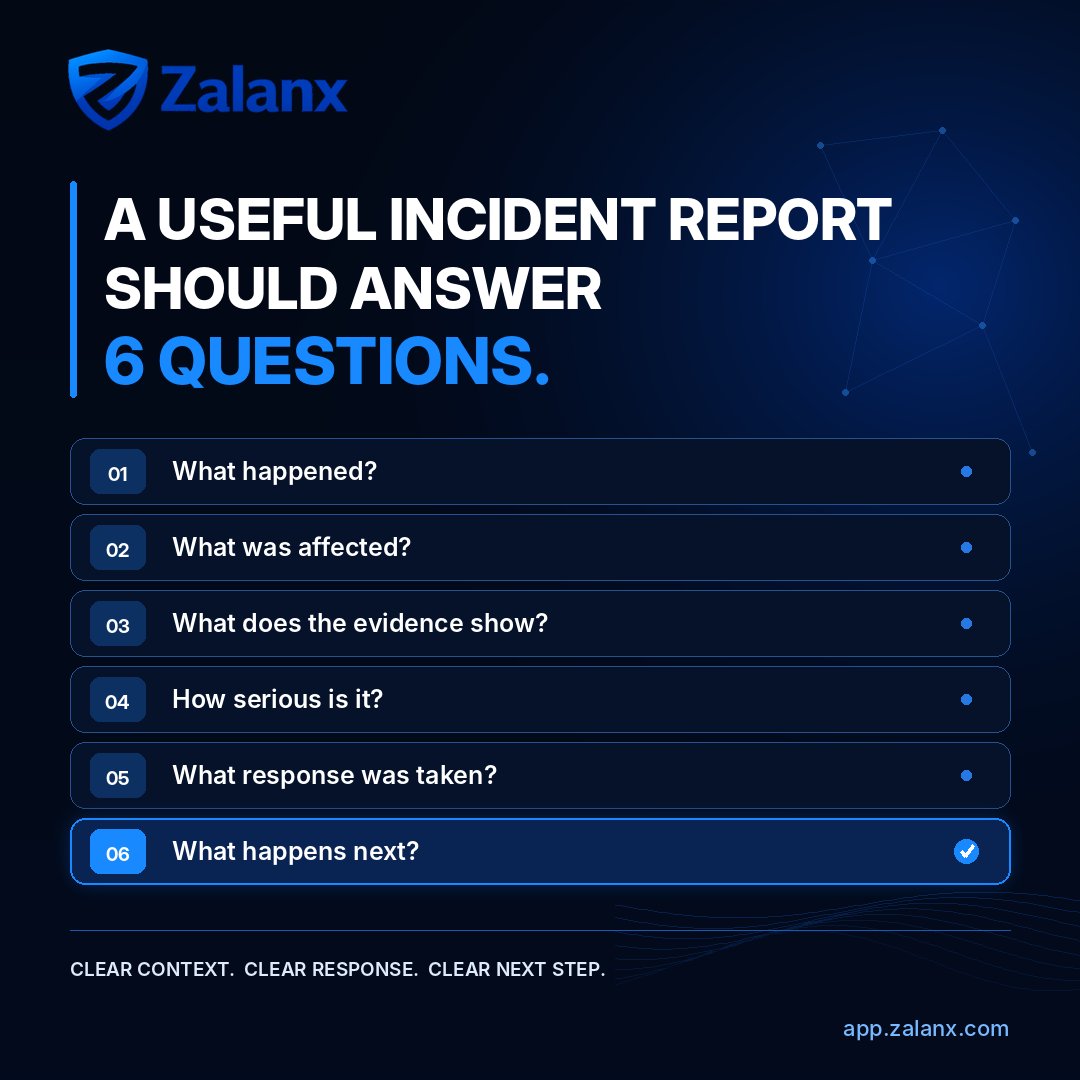
An incident report should help your team make a decision—not force them to decode raw logs.
A useful SaaS incident report should answer six questions:
What happened?
Which user, account, application, or system was affected?
What evidence supports the conclusion?
How serious is the incident?
What response was taken or recommended?
What needs to happen next?
Without these answers, a report is only a collection of events.
Zalanx helps lean SaaS teams bring incident context, response status, and next steps into one security workspace.
Clear context. Clear response. Clear next step.
Which of these six fields is most often missing from your incident reports?
Try Zalanx: https://t.co/ESoqyjD6vV
Book founder-led walkthrough: https://t.co/RHX4wBX7xt
#SaaS #Cybersecurity #IncidentResponse #SecurityOperations #Zalanx
Before you trust security automation, ask five questions.
What can it monitor?
What can it explain?
What can it recommend?
What still needs approval?
Can you verify the outcome?
Security automation should not simply move faster.
It should give your team clearer context, defined boundaries, and confidence in what happens next.
That is the approach behind Zalanx.
We help lean SaaS and AI teams bring security activity from their existing tools into one workflow—so they can understand incidents, review recommended actions, and keep sensitive responses policy-controlled.
Visible context. Clear boundaries. Verifiable outcomes.
Autonomous monitoring. Policy-controlled response.
Try Zalanx: https://t.co/ESoqyjD6vV
Book founder-led walkthrough: https://t.co/RHX4wBX7xt
#Cybersecurity #SecurityAutomation #SaaS #SecurityOperations #Zalanx
Security automation should move fast without taking control away from your team.
Zalanx helps lean SaaS teams understand incidents, review the next step, and keep sensitive actions policy-controlled.
Which security action should always require approval?
Try Zalanx: https://t.co/ESoqyjD6vV
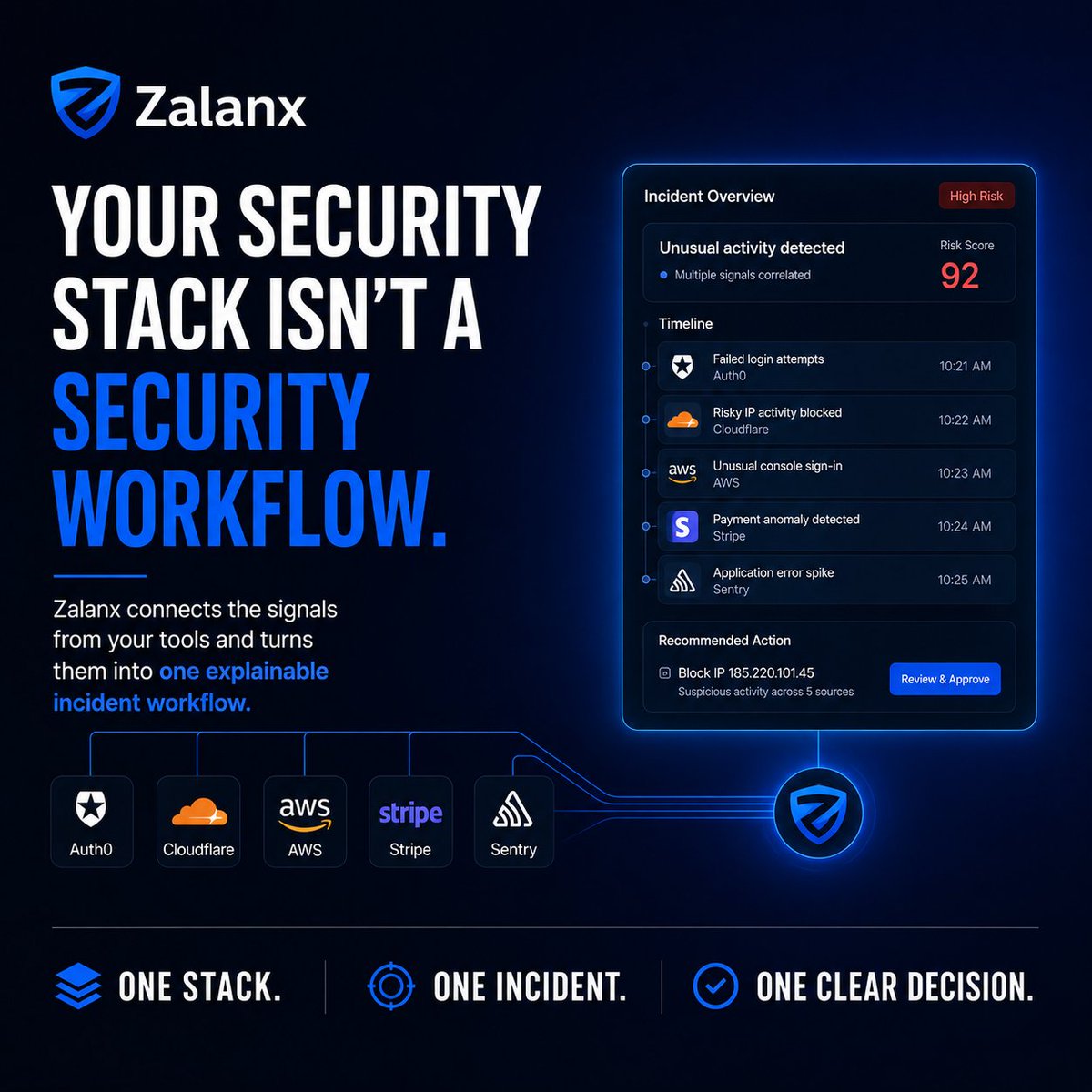
Your security tools may each see only part of the same incident.
Zalanx brings signals from identity, cloud, payments, apps, and infrastructure into one security workflow.
One stack. One incident. One clear decision.
Which tool is hardest to monitor?
Try Zalanx: https://t.co/ESoqyjD6vV
Book founder-led walkthrough: https://t.co/RHX4wBX7xt
Your SaaS already has a security stack.
But Auth0, Cloudflare, AWS, Stripe, and Sentry may each see only one part of the same incident.
The difficult work is connecting the signals, understanding what is at risk, and deciding what needs approval.
That is the workflow we are building Zalanx to simplify.
Try: https://t.co/ESoqyjD6vV
Auth0 sees the failed login.
Cloudflare sees the risky source.
AWS sees unusual infrastructure activity.
Stripe sees the payment anomaly.
Sentry sees the application spike.
Five tools. Five signals. Potentially one incident.
Most AI/SaaS startups are not ready to hire a full security team.
A dedicated security team or full SOC is expensive.
But suspicious activity still needs visibility.
Most teams already have signals across tools like Cloudflare, Clerk/Auth0, Supabase, Stripe, AWS/GCP/Azure, Sentry, Datadog, Okta, Vercel, and internal tools.
The problem is that those signals are scattered across too many dashboards.
That is why we’re building Zalanx.
Zalanx gives AI/SaaS founders one workspace to review incidents, understand related activity, use Timeline and Graph context, export reports, and review safe response decisions.
We also support Custom Webhook ingestion, so teams can send security events from internal apps, admin tools, background jobs, and custom services into Zalanx.
We’re onboarding selected AI/SaaS teams where the workflow is a strong fit.
Try now:
https://t.co/1FIOzIJswE
Book a founder-led walkthrough: https://t.co/RHX4wBX7xt
We shipped a Zalanx update from launch feedback:
Custom Webhook ingestion for internal tools, admin apps, background jobs, and custom services.
Plus improved postmortem-ready report exports with evidence trail and timeline activity.
https://t.co/0dFhqPnlUI
Zalanx is live on Product Hunt today.
It helps lean SaaS teams monitor suspicious activity across tools like Cloudflare, Clerk/Auth0, Supabase, Stripe, AWS/GCP/Azure, Sentry, Datadog, Okta, and Vercel.
Would love your feedback:
https://t.co/mDPSx95R7N