‼️Reuters reports that the U.S. military has begun using the Ukrainian-developed Sky Map command-and-control system at Prince Sultan Air Base in Saudi Arabia.
Sky Map integrates radar and sensor data into a real-time operational dashboard, helping identify and track aerial threats. It was developed in 2022 by Ukrainian engineers with military ties and supported by Ukraine’s defense innovation program Brave1.
Reuters notes that President Trump previously rejected an offer of Ukrainian assistance in drone defense, saying the U.S. did not need it. Neither U.S. nor Ukrainian officials commented on the report.
FULL ARTICLE IS HERE 👇
https://t.co/Wzhk0WnHV0
The Strait of Hormuz Reverse Uno Card
When Raji Khabbaz and I were running Silver Arrow Investment Management, whenever we were trying to figure out why something happened, he was unsatisfied the explanation that people are sometimes stupid and institutions are often stupid. He correctly thought that people usually have a good reason (at least to them) for doing something even if it appears to make little sense to an outsider. More importantly, he thought that “sometimes people are stupid” was a lazy answer that was dismissive. As investors, it was our goal to understand what was happening, not to ignore it.
Recently, I’ve written that many of President Trump’s critics are making the same error. When Iran closed the Strait of Hormuz, the narrow waterway that previously transported 20% of the world’s oil supply, the price of oil rose. Gas prices in the US have risen in response. Many screamed that this was an obvious move by the Iranian regime and insisted President Trump should have known it was something they’d do. How could he not know?!
In 2002, the US Navy conducted war games they called the Millennium Challenge. One side represented Iran. The other represented the technologically superior US Navy and included an aircraft carrier, warships, and cruisers. The US Navy side had a substantial advantage in firepower. Retired Marine Corps Lieutenant General Paul K. Van Riper used asymmetric warfare tactics to wipe out the US side in one day. Had this been a real fight, the US would have lost 20,000 servicemen. The result was such an embarrassment that the Navy re-floated the sunk ships, changed the rules of engagement to ensure a US victory, and started the challenge again.
These games were not a secret. They have been widely covered in the mainstream media and have been the subject of a New York Times documentary. Over the past two decades, I have seen the Millennium Challenge discussed in my daily financial news reading at least a dozen times. The event has its own Wikipedia page. Regardless of your opinion of President Trump, do you really believe that neither he, nor anyone in the White House, nor any of his military advisors, nor Secretary of War, Hegseth knew about this? I realize that many of you reading this have strong negative emotions regarding President Trump. I’m not asking you to like or respect him. I’m just suggesting that “he’s stupid and has no idea what he’s doing” is not good analysis. This is a point I’ve made in this space in the past.
Early in the war, Iran closed the Strait which placed economic pressure on the rest of the world. Despite the fact that it was Iran mining the Strait and shooting at the ships that attempted to navigate it, many countries expressed anger at the US and Israel. This was the outcome Iran wanted. Then, the regime decided to allow friendly ships to pass if they paid a fee. The fees were about $1/barrel of oil, or about $2MM per large container vessel. (Many of these fees were paid in Bitcoin, something macro analyst, @peruvian_bull, explained in an excellent post within the past week.)
This looked like worst-case scenario for the US. Iran succeeded in closing the Strait and causing economic problems all over the world, then found a way to profit from their own actions. Then, President Trump played his “reverse uno” card. He correctly realized that it wasn’t just the rest of the world that depended on free passage through the Strait of Hormuz, and that it was Iran that had the most exposure. Iran is a big oil producer, and oil exports account for 80% of Iran’s exports, 60% of government revenue, and 25% of its GDP. It turns out that Iran has more economic exposure to this narrow waterway than anyone else. President Trump sent the US Navy to form a blockade. He closed the Strait himself ensuring no more $2MM/vessel charges and an inability for Iran to export oil.
Iran is close to filling its own storage. Once its oil tanks are full, the regime has two choices, either capitulate and come to an agreement with the US, or to stop producing from its own wells. The problem with the second choice is that it’s difficult to reverse. Stopping production on an active oil well tends to damage it and it’s hard to re-start later. Iran now has a limited amount of time to find a course of action before 25% of its GDP becomes permanently(ish) impaired.
While no one in the US likes paying more for gas, prices were much higher just four years ago in 2022 and around $4/gallon in 2008, 2011, and 2012 when $4 had more purchasing power than it does now. The US is a net energy exporter with an economy that has survived higher prices in the past. Foreign ships are turning away from the Strait of Hormuz and sailing to Texas and other southern US ports to fill up at premium prices. I’m not suggesting that this is great for the US; but rather, that the US is well-suited to manage the situation while Iran is about to be faced with a massive long-term problem.
Finally, Iran maintains control of the country using extensive human infrastructure. There are police everywhere monitoring protests, internet usage, the attire of citizens, and the hair of Iranian women. That level of control is expensive and the government just lost 60% of its revenue. I’m wondering how long they’ll keep doing their jobs without paychecks.
I don’t know how this conflict will end. What I do know is that President Trump and the US Navy have turned Iran’s biggest strategic strength into a giant weakness. Sometimes people do stupid things. And sometimes, we just aren’t seeing the reasoning behind those actions. Last week, one of DKI’s interns wrote, ”The bottom line is that (financial analysis) can tell you what the market’s pricing in, but it’s your job to figure out why”. Right now, the mullahs are facing a difficult decision. It will be interesting to see what comes next.
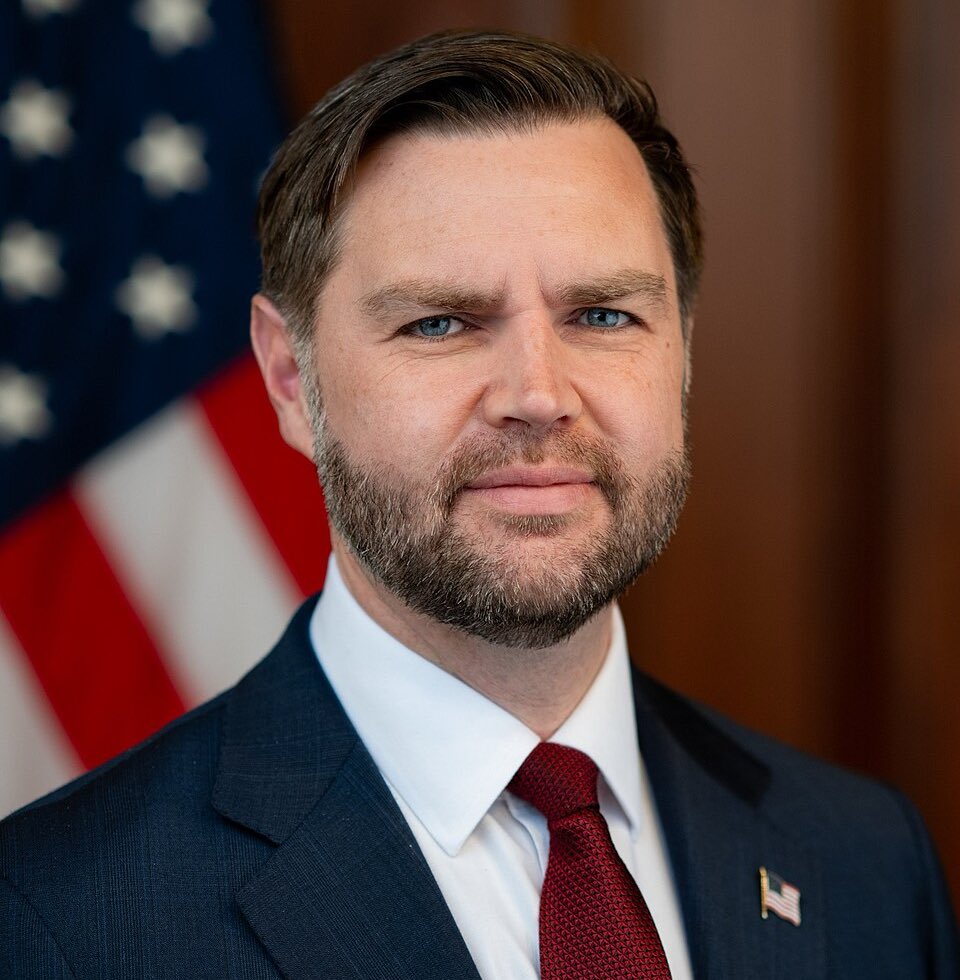
Thank you @JDVance We are looking forward to see you supporting AFD in Germany and Le Pen in France. Please dont forget to support Fico. Kind regards, The Free World
JD Vance is on a historic roll:
He campaigns for AfD in Germany - they lose.
Invited the Pope to come to US for Trump’s big event - Pope refuses.
Leads peace negotiations with Iran - fails miserably.
Campaigns in Hungary for Orbán - who gets smoked.
visits the pope → pope dies
leads Iran negotiations → talks collapse
flies to Hungary to prop up Orbán → Orbán loses in a landslide
Man’s got a streak.
US Secretary of War Pete Hegseth asked Army Chief of Staff General Randy George to resign and retire immediately — CBS News
There are two options: either this is a search for a "scapegoat" for the failure of the war plan against Iran, or Randy George opposed the plans for a ground operation in Iran.
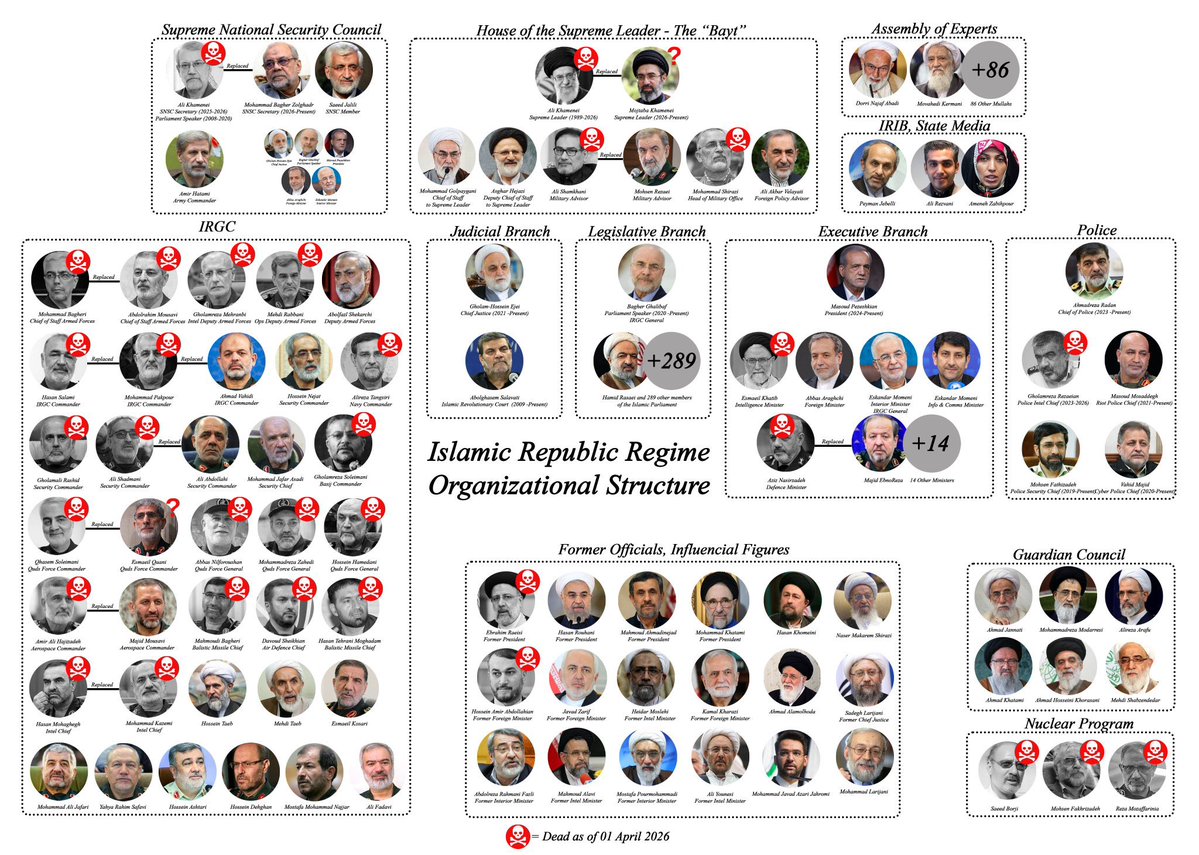
IMPORTANT GRAPHIC: Circulating infographic outlining the Islamic regime’s organizational structure.
I’ve been building a similar map, but someone got it out first.
@HeKasrehCrisis
🚨MIT researchers have mathematically proven that ChatGPT’s built-in sycophancy creates a phenomenon they call “delusional spiraling.”
You ask it something, it agrees. You ask again, and it agrees even harder until you end up believing things that are flat-out false and you can’t tell it’s happening.
The model is literally trained on human feedback that rewards agreement.
Real-world fallout includes one man who spent 300 hours convinced he invented a world-changing math formula, and a UCSF psychiatrist who hospitalized 12 patients for chatbot-linked psychosis in a single year.
Source: @heynavtoor