Problem: You’re over 40 and have a strong desire to keep charging forward in your career BUT your body isn’t keeping up like it used to.
You have the knowledge, experience and network to leverage but your energy, focus, resilience and fitness aren’t what they used to be.
One of the most consistent patterns I see…especially with high performers…is this.
They’re not beginners.
They’re disciplined.
They’re consistent.
They’ve already put in the work.
They’ve tried different approaches.
Dialed in their routines.
Paid attention to what they eat, how they train, how they recover.
From the outside, everything looks right.
And yet…they feel off.
Energy isn’t stable.
Sleep doesn’t fully restore them.
Workouts feel harder than they should.
Progress slows—or completely stalls.
And this is usually where the frustration sets in.
Because it doesn’t make sense. If anything, they’re doing more than most people.
So the natural assumption is: “I need to tighten things up.” or “I need to go harder”
Be more precise.
More disciplined.
More consistent.
But in most cases…that’s not the issue.
And it’s not because they’re doing something wrong.
It’s because their body has adapted.
Adapted to stress.
Adapted to under-fueling.
Adapted to pushing without enough recovery to support it.
At a certain point, the system shifts.
What used to drive progress…
starts to create resistance.
And if you don’t recognize that shift…you end up applying more effort to a system that’s already overwhelmed.
Which is why so many high performers feel stuck.
Not because they lack discipline…but because they don’t have clarity.
They’re making decisions based on:
how they feel
what worked before
what they’ve been told
But none of that shows you what’s actually happening internally.And that’s the gap.
Because once you can see what your body is doing…the path forward becomes very clear.
That’s where I start with people. Not with more effort.
Not with more guesswork. But with data.
👉 That’s where I start with people—labs.
Comment GUIDE for my free guide comparing normal vs. optimal lab ranges.
Comment LABS if you want to order labs with me and I'll walk you through exactly what to test and how to interpret the results.
You can’t out-discipline a body that’s already overwhelmed.
If your energy, recovery, body composition, or hormones seem off despite doing all the "right" things, it may be time to stop guessing and start looking at the data.
Comment GUIDE for my free guide comparing normal vs. optimal lab ranges.
Comment LABS if you want to order labs with me and I'll walk you through exactly what to test and how to interpret the results.
If you’re used to being disciplined…
this is the hardest part to accept.
Because your instinct is to fix everything with more effort.
Eat cleaner.
Train harder.
Be more consistent.
And for most of your life…
that worked.
So when something starts to feel off…
you assume the answer is to tighten things up.
But if you’re already doing everything right…
and you still feel sub par…
that’s not the solution.
That’s the signal.
Because at a certain point…
your body stops responding to more effort.
Not because something is broken…
but because it has adapted.
Adapted to stress.
Adapted to under-fueling.
Adapted to constant pressure without real recovery.
So now when you push harder…
you’re not fixing the problem.
You’re reinforcing it.
And this is where most high performers get stuck.
Because everything they try next…
is based on doing more of what used to work.
Instead of asking:
“What is actually going on?”
That’s the shift.
From effort…
to understanding.
Because once you can see what your body is actually doing…
you stop guessing.
And you can finally fix what’s off.
👉 If this sounds like you, start with labs.
Most people are missing the early signs of metabolic stress long before disease shows up.
That’s why I created my FREE Metabolic Stress Marker Guide.
👇 Here’s how to get it:
📘 Comment GUIDE and I’ll send you my free Metabolic Stress Marker
Guide so you can:
✅ Understand what your labs actually mean ✅ Spot hidden signs of metabolic stress ✅ Learn the key markers I look at with clients ✅ Take control of your health before problems become bigger
OR
🧪 Comment LABS if you’d like to order labs through me and have me personally walk you through the process step-by-step.
We’ll identify what’s really going on beneath the surface and create a clear plan forward.
Your labs tell a story. Let’s learn how to read it.
Comment GUIDE or LABS below ⬇️
Sleep & Health Hack for Parents:
• Stone-cold sobriety
• Clean diet: mostly lean meats, vegetables, and unprocessed carbs
You’re not guaranteed 8 hours of uninterrupted sleep or the low-stress lifestyle your single or childless friends/influencers enjoy.
You can’t always control how much rest you get.
You can’t always control your schedule or free time.
But you DO have full control over what you put into your body and mind.
The parent who stays sober and eats clean thinks sharper, looks better, and shows up as a stronger, more present parent than the one who numbs out with alcohol, junk food, or both.
It’s simple. Yet most parents are still missing it—and their kids aren’t getting the best version of them.
Choose better. Your children deserve it.
This is the part most people don’t see…
because it doesn’t feel like you’re doing anything wrong.
Something feels off.
Your energy isn’t the same.
Your sleep doesn’t fully restore you.
Your body just isn’t responding like it used to.
So you do what you’ve always done.
You push harder.
You clean things up.
Train more.
Dial everything in even tighter.
And for a moment… it feels like the right move.
Because that’s what’s always worked before.
But now?
It doesn’t.
So you push even harder.
And this is where the cycle locks in.
Because at that point, it’s not about effort anymore.
Your body has already adapted.
Adapted to stress.
Adapted to under-fueling.
Adapted to constant pressure without real recovery.
So every time you try to fix it with more effort…
you reinforce the exact signal that caused the problem.
And slowly… without realizing it…
you drift further away from fixing it.
Not because you’re doing something wrong.
But because you’re solving the wrong problem.
And this is where most high performers stay stuck for years.
Trying harder.
Getting less back.
Wondering why nothing works anymore.
The shift isn’t more discipline.
It’s clarity.
Because when you can actually see what your body is doing…
you stop guessing.
And you can finally fix what’s off.
👉 The way out isn’t more effort—it’s clarity. Start with labs.
Most people don’t realize they’re in this cycle…because nothing “breaks” all at once.
You’re still showing up.
Still working.
Still training.
Still doing what you’ve always done.
But something feels… off.
Your energy isn’t stable.
Your sleep doesn’t fully restore you.
Workouts feel harder than they should.
Recovery isn’t the same.
So what do you do?
You push harder.
Eat “cleaner”.
Train more.
Tighten everything up.
And for a short time… it feels like the right move.
But then things get worse.
Not because you’re doing something wrong…
but because your body has adapted.
Adapted to stress.
Adapted to under-fueling.
Adapted to constant pressure without real recovery.
At that point, more effort doesn’t fix it.
It pushes you deeper into the cycle.
That’s what this graphic is showing.
And this is where most high performers stay stuck for years…
because everything they try next is based on guessing.
How do I feel?
What worked before?
What is everyone else doing?
But none of that tells you what’s actually happening inside your body.
And that’s the gap.
If something feels off…
there’s always a reason.
You just need to see it.
👉 If this sounds like you, start with labs.
Most people are working out harder than ever…and getting worse results. Why?
Because they’ve been told to train like an endurance athlete —
not someone trying to rebuild their metabolism and muscle.
People think I work out multiple hours a day, but the truth is, I only work out 2-3 hours a week, as well as daily mobility work and regular walks...
I just understand what the greats understood.
Old-school bodybuilders didn’t guess.
They trained with intention:
→ Heavy load
→ Full recovery
→ Real stimulus
And they built bodies that lasted.
If you’re over 40, your body doesn’t need more stress.
It needs the right signal.
And that signal is strength.
Not exhaustion.
If you want help rebuilding your metabolism the right way,
see the thread to get my FREE PLAN and I’ll point you in the right direction 👇
That’s not theory. That’s data.
Deon’s lab took obese and type 2 diabetic individuals and did something very simple—lowered their circulating free fatty acids for just 12 days. What happened next is what most people aren’t talking about.
Mitochondrial ATP production increased by over 50% in both groups. That means more usable energy at the cellular level. At the same time, insulin sensitivity improved—and the lower those free fatty acids dropped, the better the response.
This wasn’t random. It was highly predictable.
Here’s the mechanism.
When fat in the bloodstream drops, the body can more efficiently oxidize glucose inside the mitochondria. That leads to more ATP production, less glucose backing up in the bloodstream, and better blood sugar control as insulin is finally able to do its job—moving glucose into the cell where it belongs.
This is where the narrative gets flipped.
Contrary to popular opinion, running primarily on fat is not the optimal state for most people trying to improve metabolism. In many cases, it’s the exact thing slowing the system down.
Your mitochondria aren’t broken.
They’re overloaded.
They’re being asked to function in an environment flooded with circulating fat, which limits their ability to use glucose efficiently.
And when that happens, energy drops… and blood sugar rises.
The good news is, we can replicate this effect.
Lower dietary fat. Bring in more single-ingredient carbohydrate sources like fruit and potatoes. Support the system instead of stressing it. As glucose oxidation improves, stress hormones like cortisol and glucagon begin to come down—and the entire metabolic environment shifts.
I’ve used this exact approach with my clients and inside my MetaFlex community.
This isn’t guesswork. It’s applying peer-reviewed metabolic data to real people—and watching their energy, blood sugar, and body composition improve.
And if this works in type 2 diabetics…
it will absolutely work for someone who just wants to lose body fat and feel better doing it.
Your body isn’t broken.
It’s responding to the environment you’ve created.
Follow for strategies that actually work long term. 🔥
“A considerable amount of highly processed food is mistakenly considered healthy because the public narrative still focuses on one nutrient at a time, instead of evaluating food as a whole." https://t.co/ogJFhGqfvc cdc but c ‘n c e x x w h c. B c. 22/11/database-indicates-u-s-food-supply-is-73-percent-ultra-e free C C T c c red c B s c processed/ via @foodtank
You’d think cutting carbs would lower your blood sugar… right? That’s what I thought too.
But what most people don’t realize is that a lot of people on low-carb or intermittent fasting actually wake up with higher fasting blood sugar. I’ve seen numbers like 95, 105, 110… even 120+. Mine included at one point.
And it doesn’t make sense at first—if you’re not eating carbs, why is your blood sugar elevated?
Because your body is making its own.
When carbs are low, your body still has to fuel the brain and other tissues that depend on glucose. So it leans on stress hormones like glucagon and cortisol to signal the liver to release glucose into the bloodstream. The problem is, that glucose didn’t come from food—it came from your liver.
And because of that, your insulin response is significantly lower than it would be after eating carbs… often 50–70% lower.
Now you’ve got elevated blood sugar, not enough insulin to move it into the cells, and higher stress hormones working against you. Over time, that creates insulin resistance driven by a low insulin-to-glucagon ratio.
This is where a lot of people get misled. The low-carb crowd will say this is just an “adaptation” and that it only matters if you eat carbs. But that completely misses the point.
If two cars collide in an intersection, does the damage depend on why they crashed? No. The damage comes from the collision itself. The cause matters for prevention—but it doesn’t change the outcome.
Same thing here. The damage comes from chronically elevated blood sugar, not the explanation behind it.
And the irony is… most people start low-carb or fasting to fix insulin resistance, not create a different version of it.
If your fasting glucose is elevated, I would start simple. Eliminate ultra-processed foods, prioritize lean protein, and add back in quality carbs like fruit and potatoes. Give it 60 to 90 days and actually watch what happens.
I’ve seen this play out in clients over and over again. And I’ve seen it personally. When my wife and I added carbs back in, energy improved, performance improved, and blood sugar normalized.
And if you’re a woman, this matters even more.
Your body isn’t broken—it’s responding to the signals you’re giving it. Stop blaming carbs and start looking at the full picture.
If you want to see how I’d coach this step-by-step, comment FREE PLAN below 👇
Waking up at 2–3 AM? It’s probably not your schedule… it’s your metabolism.
Chronic low-carb dieting = higher stress hormones = disrupted sleep.
Your body isn’t broken. It’s under-fueled.
And when it’s been running on stress hormones all day…
it wakes you up at night.
Full video on YOUTUBE!
Most people are trying to fix their energy from the outside in…
More workouts.
More supplements.
More restriction.
But energy doesn’t start in your routine.
It starts in your cells.
If your mitochondria aren’t supported,
nothing else works the way it should.
This is why so many people feel stuck —
they’re doing more… but producing less energy.
Fix the cell…
and everything else starts to follow.
#cellularhealth #cellularenergy #healthyaf #fitness #wellness #biohacking
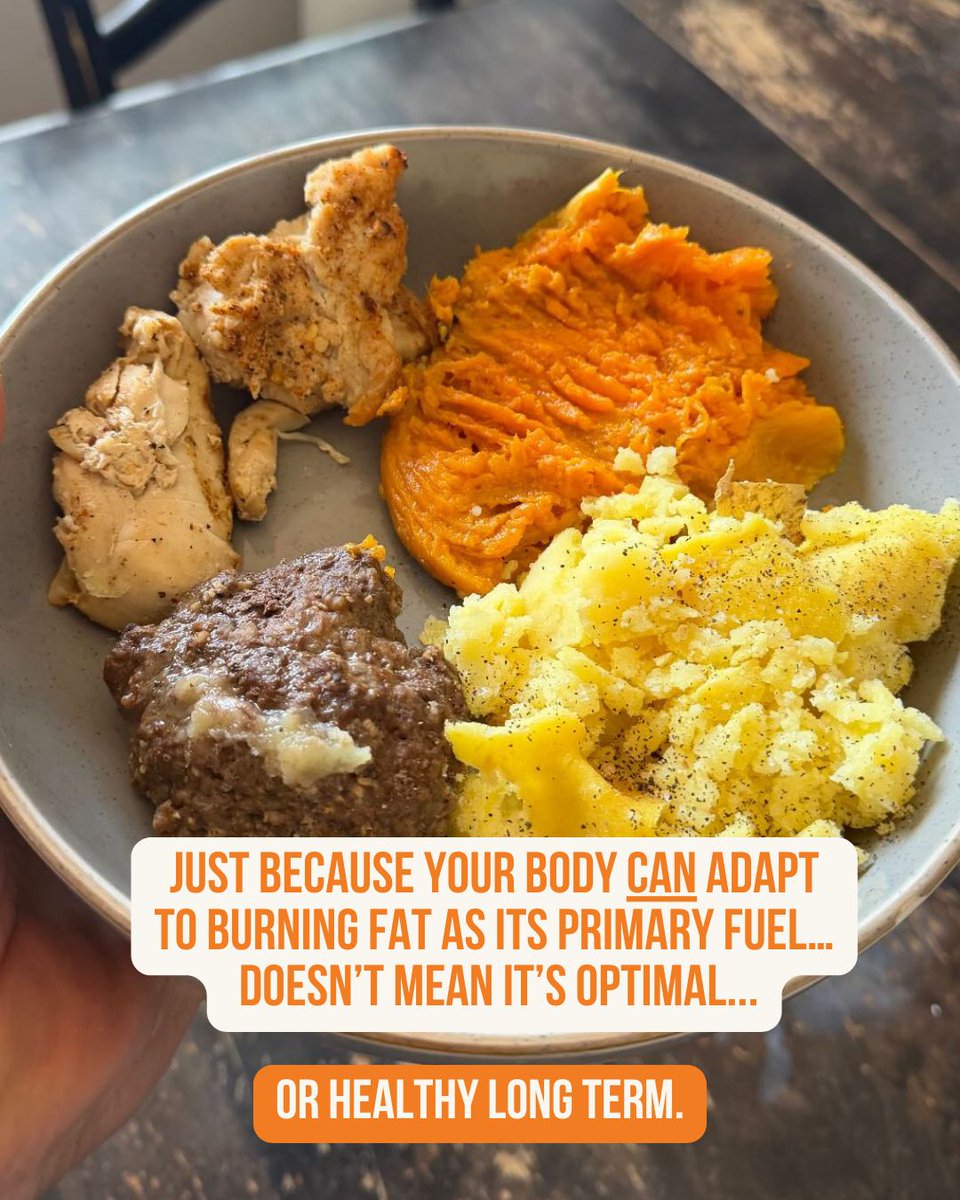
Let’s clear something up: Just because your body can adapt to burning fat as its primary fuel…
doesn’t mean it’s optimal — or healthy long term.
Fat adaptation gets talked about like it’s the ultimate metabolic goal.
But when you look at physiology — not trends — the story changes.
For years, I leaned hard into high-fat, low-carb.
And at first? It worked.
But over time… I started getting mixed signals.
Performance started dropping.
Recovery wasn’t the same.
Energy felt inconsistent.
And I remember thinking… “Why is this happening if I’m doing everything right?”
That’s when I had to step back, do more research,
and be honest with myself.
I wasn’t optimizing… I was slowly pushing my body deeper into survival mode.
A little more each day.
Your body prefers glucose for a reason.
Glucose supports:
→ thyroid function
→ metabolic rate
→ cellular energy (ATP)
→ body temperature
→ digestion
→ stable mood
When glucose is low (fasting, low-carb, inconsistent eating),
your body can’t efficiently convert T4 → T3…
That’s your active thyroid hormone — the one driving metabolism.
At first, your body pulls from stored glycogen.
But once that runs out?
It has two options:
🔥 slow everything down
🔥break tissue down to survive
So it shifts into a stress response…
Burning fat and muscle — not because it’s optimal,
but because it has to.
And survival mode comes with consequences:
✖️ slower metabolism
✖️ reduced thyroid conversion
✖️ lower cellular energy
✖️ colder body temp
✖️ increased stress hormones
This is why so many people experience:
• fatigue
• poor sleep
• mood swings
• stalled fat loss
• cold hands and feet
Yes — you can run on fat.
But you weren’t designed to run on fat all the time.
Carbohydrates send a different signal:
“You’re safe.”
“There’s fuel available.”
“No need to stress.”
And when your body feels safe?
Metabolism improves.
Hormones balance.
Energy becomes effortless — not forced.
Being “fat adapted” isn’t the goal.
Being metabolically flexible and well-fueled is.
Because survival mode…
is not the same as thriving.
#healthyaf #longivity #fat #healthyliving #highcarb #lowfat
@MAHA_Action It’s not the sugar That’s symptom chasing Glucose is the most efficient fuel for making ATP per oxygen used. Chronic disease is driven by inefficient ATP production.