Rewards or punishment? Targeted programmes that worked mostly used positive responses, the EEF says.
That's support for pupils who struggle, not a test of punishment. Most of the evidence is from primary schools.
Source: EEF (2019) Improving Behaviour in Schools
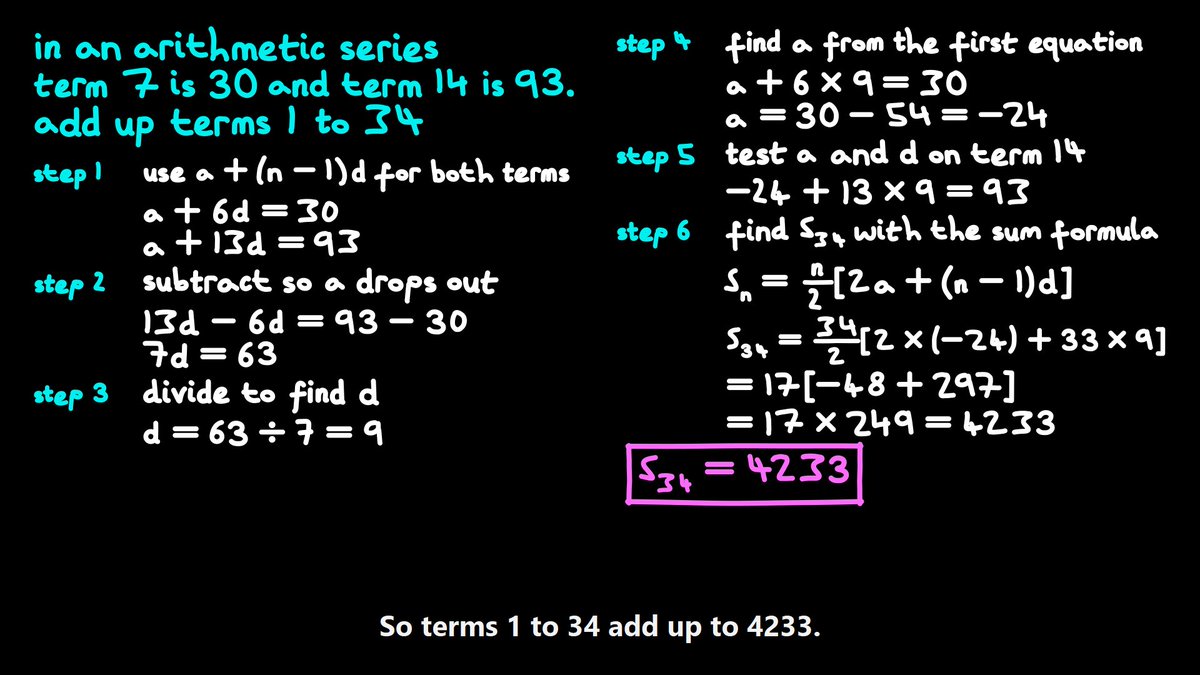
Need help with sum after finding a and d? Book your place on the GCSE Maths 5-Day Programme, taught by a qualified secondary maths teacher.
https://t.co/CLip8urfjo
Pupils who repeated a school year made about two months' less progress on average, the EEF finds.
Across 95 mostly US studies, about 2 months' less progress on average, and typically 4 at secondary. Evidence: limited.
Source: EEF Toolkit: Repeating a year
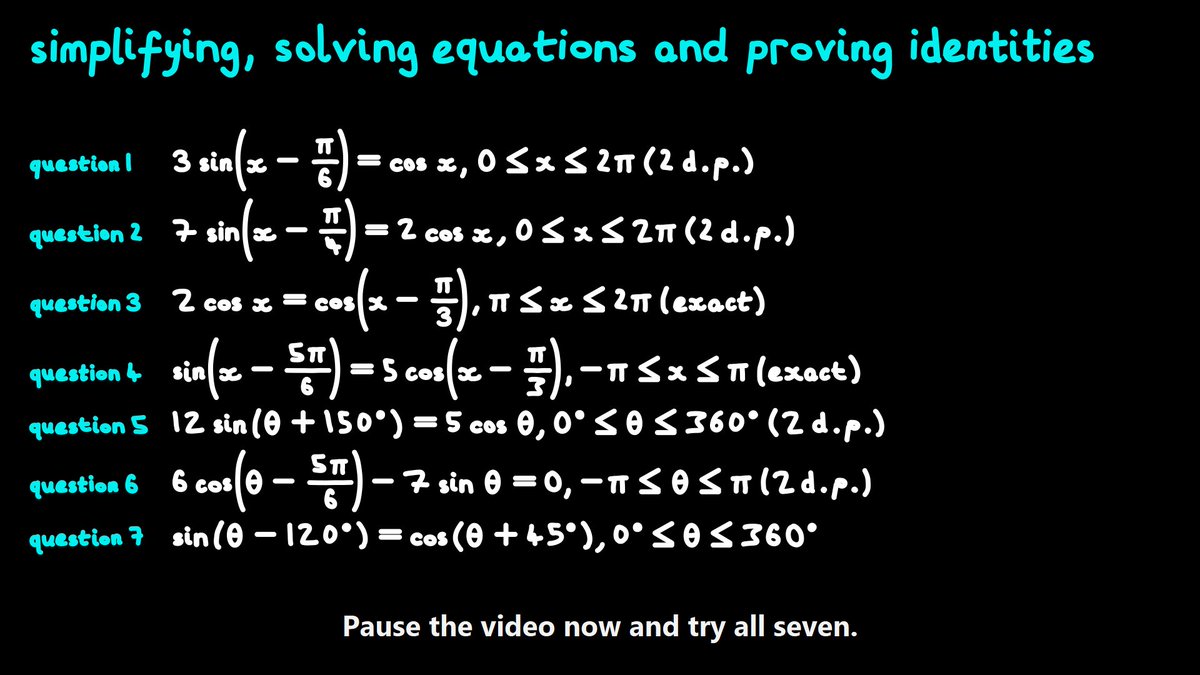
Simplifying, solving equations and proving identities 2: try these. Question 3 has 2 cos x equals cos of x minus pi over 3. This time x runs from pi to 2 pi. Keep the exact value.
Decorative pictures or ones that show the idea? In one study in an EEF review, only the second helped.
In a study of 404 pupils, pictures showing the idea helped and decorative ones didn't. One session of test questions.
Source: Perry et al. (2021), EEF cognitive science review
Has your child been given extra maths instead of an option? A Chicago study tracked what followed.
It mostly replaced music and art. The authors estimate a 12 percentage point rise in finishing school. Not randomised.
Source: Cortes et al. (2015), J Human Resources
Finding the range from a continuous domain: worked example. This worked example finds a range. Here f of x equals 5x minus 25. Its domain runs from 6 to 9.
At GCSE, England's National Tutoring Programme was linked to under a month's extra progress.
Links with GCSE English and maths were all under a month's progress in 2022-23. It wasn't randomised.
Source: Moore et al. (2024), NFER report
Short or long reading support? Across studies, targeted programmes of up to 9 weeks tended to do best.
That's a pattern across studies, not a head-to-head test. The EEF draws on 184 studies, and results varied a lot.
Source: EEF Toolkit: Reading comprehension strategies
Simplifying, solving equations and proving identities 2: swipe for the example, questions and answers. Question 5 uses degrees. It has 12 sin of theta plus 150 degrees equals 5 cos theta. Take theta from 0 to 360 degrees. Give 2 decimal places.
Does your child say they're not a 'maths person'? A trial taught Year 6 pupils that ability can grow.
Growth mindset lessons in Year 6 led to no extra progress in SATs, in 101 English schools. Older pupils may differ.
Source: Foliano et al. (2019), EEF report
Normal approximation to a binomial distribution 1: worked example. X is B of 240 and 0.46. Show that a normal Y can approximate X. Then find mu and sigma squared.
RE is required up to sixth form, but Ofsted found little after Year 9 for pupils not taking an RE exam.
Where none was timetabled, inspectors judged pupils retained little. From visits to 25 schools, not tests.
Source: Ofsted (2024) RE subject report
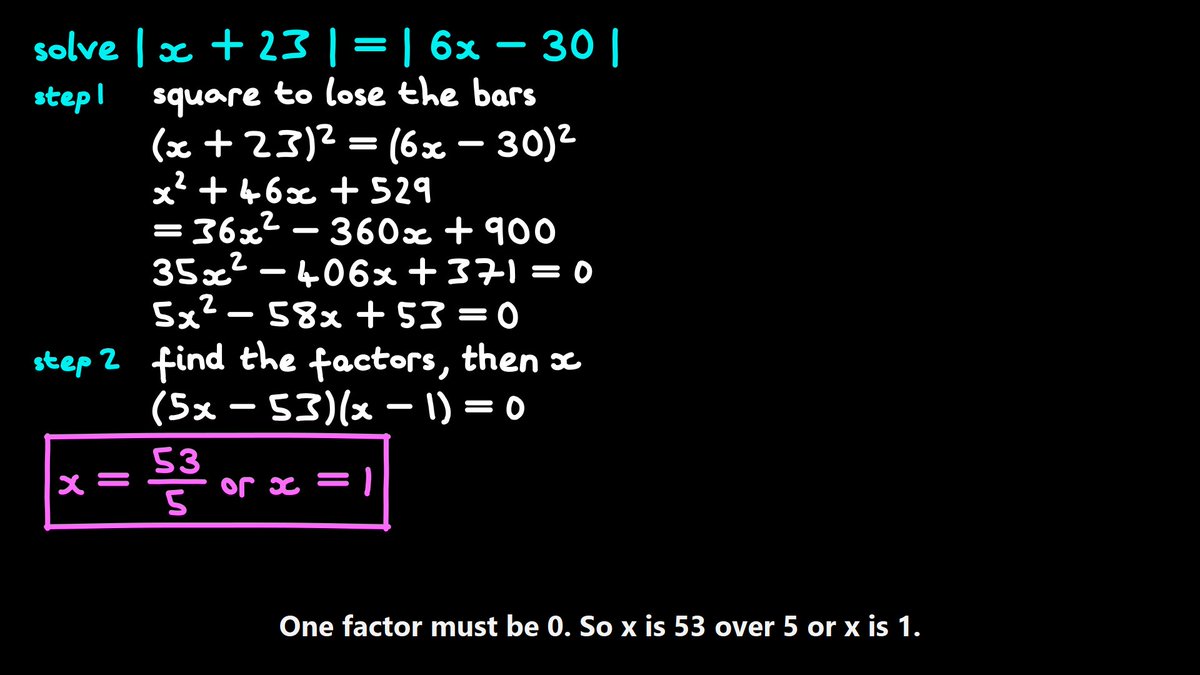
Solving modulus equations and inequalities 3: swipe for the example, questions and answers. For question 5 the modulus of 8x minus 15 equals that of 7x minus 25.
TV or phones, games and computers? In a review of 67 studies, TV was least often linked to poorer sleep.
Computers were linked in 94% of studies, TV in 76%. It's a comparison across observational studies, not proof of cause.
Source: Hale and Guan (2015), Sleep Medicine Reviews
Does your child find fractions or division hard? A study followed British children from age 10 to 16.
Fractions and division at 10 predicted maths at 16 more than other skills, in UK and US data. Observational, not proof.
Source: Siegler et al. (2012), Psychological Science