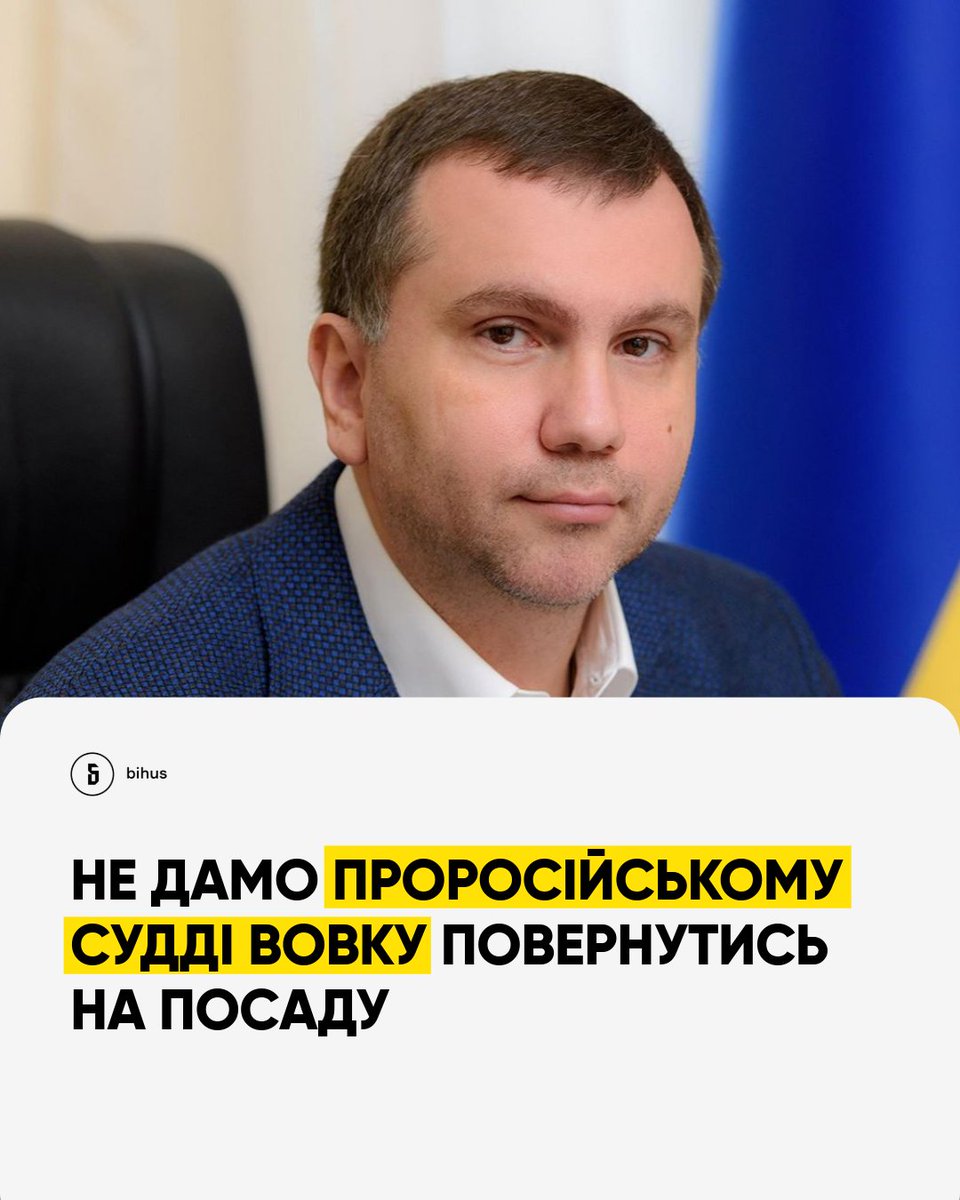
Вже завтра проросійського суддю Павла Вовка можуть поновити на посаді. Чому важливо не допустити цього?
Павло Вовк – ексочільник Окружного адміністративного суду Києва (ОАСК). Саме під його керівництвом судді:
🔴 Забороняли мирні акції протесту під час Революції Гідності, фактично легалізувавши застосування сили під час розгону протестувальників. Це спричинило загибель понад сотні людей.
🔴 Зупинили перейменування Російської православної церкви на РПЦ, унаслідок чого вона й досі носить назву «української».
🔴 Забороняли відзначення пам’ятних дат, пов’язаних з ОУН та УПА, у 2020 році, а також перейменування вулиць на честь Степана Бандери та Романа Шухевича.
🔴 Готували повернення Януковича до влади у 2022 році, бувши частиною плану із захоплення Києва російськими військами – про це повідомляли журналісти та офіційні державні особи.
🔴 На плівках, опублікованих НАБУ, Павло Вовк та його колеги обговорювали корупційні схеми, вплив на державні органи та спроби встановлення контролю над судовою системою.
Вже завтра, 29 січня, Велика Палата Верховного Суду розглядатиме справу, в якій Павло Вовк оскаржує своє звільнення. Фундація DEJURE повідомляє, що ризик його поновлення є доволі високим.
Важливо надати цій справі максимального розголосу та не допустити повернення Павла Вовка, а разом із ним – десятків недоброчесних суддів, на почесні посади.
Приходьте на засідання:
📅 29 січня (четвер)
🕚 11:00
📍 Київ, вул. Пилипа Орлика, 4а
Велика Палата Верховного Суду
German troops could be stationed in a NATO country near Ukraine a year after the ceasefire, - Merz.
Ukraine needs real guarantees, not German token troops in Poland. Merz's proposal is not only ridiculous – it's dangerous because it signals to Putin: Go ahead and take action, the Germans will back down anyway.
So much weakness from a chancellor who wanted to present himself as strong?
On “negotiations.” It is important to finally call things by their proper names.
What russia calls a “peace process” is in fact a separate special operation against the West. Its goal is not to end the war, but to force the United States and Europe to pressure Ukraine, while russia continues fighting and preparing for a new phase.
russia has never conducted negotiations as a means of achieving peace. Not in 2014, not in Minsk, not in Istanbul. In every case, “negotiations” were either a way to buy time, a way to legalize what had been seized, or a way to shift responsibility away from itself. For the kremlin, negotiations are not an alternative to war, but another tool of it.
And this is not a “putin invention.” russia’s imperial logic has been documented since the 18th century. The so-called “Testament of Peter I” — a programmatic text of russian expansion — explicitly defined war as the only normal state of the empire. It clearly states: keep the population in a state of continuous war, allow rest only to rebuild the army and finances, use peace to prepare for war, and war to impose peace on one’s own terms.
Poland is addressed as a separate point in this “testament.” Not as a neighbor or partner, but as a state that must be systematically undermined from within. To support constant unrest, bribe elites, influence elections, introduce troops “temporarily,” and, when conditions allow, leave them there permanently. If other European states interfere, they are to be appeased by partially dismembering Poland — only to reclaim those concessions later. This is not metaphor or interpretation; it is a direct imperial instruction.
Thus, from the standpoint of russian imperial doctrine, Poland was never regarded as a sovereign state. It was seen as a space for manipulation, division, and control. That is why today’s kremlin hostility toward Poland — threats, information attacks, and talk of a “Polish threat” — is not emotional or reactive to modern Polish policy. It is a continuation of the same logic.
It is also telling that specific points of this “testament” directly concern Northern Europe and the Baltic region. russia was instructed to systematically provoke Sweden, push it toward war in order to obtain a formal pretext for territorial seizures. The Baltic direction was defined as strategic: access to the Baltic Sea not as defense, but as a mandatory condition for imperial growth. Peace in this region was viewed exclusively as a pause between wars.
The Baltic states and Sweden were never neutral in russian imperial thinking. They were always spaces of future pressure or war. That is why today’s russian military activity in the Baltic Sea, threats toward the Baltic states, and demonstrative actions near Sweden and Finland are not a “reaction to NATO,” but the continuation of a centuries-old behavioral model.
Germany was also explicitly named in the “testament” as a key object of constant interference — as the closest and most important state in Europe. The logic was simple: prevent Germany from becoming an independent center of power, constantly draw it into Europe’s internal conflicts, manipulate elites, and use economic and political ties for control. Today this logic remains unchanged: reliance on dependency, fear of escalation, “special relationships,” and the desire to preserve comfort at any cost. For the kremlin, a weak, hesitant Germany is strategically more valuable than any tank.
The only thing putin has effectively changed in this old “testament” is that he has clearly designated the United Kingdom as his strategic enemy. Where continental Europe was once the main object of imperial maneuvering, today London has become, in russian rhetoric and actions, the symbol of a force the kremlin considers fundamentally hostile — because of its support for Ukraine, its role in European security, and its refusal to trade peace for other people’s territories. That is why russia is waging a separate hybrid war against Britain — informational, subversive, and diplomatic.
Ukraine, in this scheme, is not even the primary addressee. All signals of “readiness for peace” are aimed at the West. The logic is simple: to show that russia is supposedly constructive, and that the war continues only because of Kyiv’s “unconstructive position.” This is a classic information operation shifting blame from the aggressor to the victim.
The key goal of this campaign is to force the West itself to pressure Ukraine — not to negotiate with russia, but to break Kyiv through “realism,” “fatigue,” and fear of escalation. All of this is happening in parallel with the buildup of military potential, including in the northwestern direction.
While the West talks about negotiations, russia is preparing not for peace, but for a prolonged war and the possible expansion of the conflict. This is how a state behaves when it dreams not of compromise, but of restoring an empire — with war as the norm and peace as a pause.
Ukraine is only one stage. If aggression is rewarded here, the war will move on — to where russian imperial doctrine has been looking for centuries. Ukraine’s capitulation under the guise of peace will not bring security to Europe. It will only bring the war closer to the Baltic Sea and make it inevitable.
Any pressure on Ukraine and its leadership from the West means only one thing: russia is successfully continuing its special operation — political and informational. Any Western country or politician who speaks of a “faster peace” at the cost of territorial losses, limitations on sovereignty, or imposed conditions on Ukraine is not acting as a mediator, but as an instrument of this operation. Such a “peace” does not stop the war — it only legalizes aggression and prepares the next one.
Of course it would mean war, keep f*cking around and we'll be forced to do it.
Finland, Sweden, Norway, Denmark and Baltics decide wether russians are allowed to use the Baltic Sea or not.
Italy has suspended its participation in the PURL arms delivery program to Ukraine, — Bloomberg.
Italian Foreign Minister and Deputy Prime Minister Antonio Tajani stated that Rome considers participation in the NATO program for the acquisition of American weapons for Ukraine premature in light of negotiations on a possible ceasefire.
According to him, weapons will no longer be needed in the event of a ceasefire agreement.
The Italian government under Giorgia Meloni has once again demonstrated what a reliable partner it is – namely, none at all. Barely having tentatively signaled its willingness in October 2025 to join NATO's PURL program to finance US weapons for Ukraine, Foreign Minister Antonio Tajani is now putting the brakes on everything – calling it "premature" because of some peace talks. As if Putin weren't expecting precisely this: that Europe would lose its nerve and abandon Ukraine the moment the first hint of negotiations arises. This is not only short-sighted, it is utterly cowardly and morally bankrupt.
Remember: Since the start of the war in 2022, Italy has supported Ukraine with a paltry 0.8 billion euros annually – a mere 0.1 percent of its GDP, a pittance compared to countries like the Baltic states, which contribute well over 1 percent. In the Kiel Institute ranking, Italy has perpetually languished at the bottom – 27th place or lower – while smaller nations like Denmark or the Netherlands contribute far more per capita. And now this retreat? Tajani babbles about "security guarantees" instead of weapons, as if one could stop Russia with good intentions. Hello? Ukraine needs missiles and tanks to survive the winter, not empty promises from Rome that only make Putin laugh.
This isn't a "realpolitik maneuver," as Meloni's team tries to portray it – it's sheer cynicism. Meloni, who poses as a "Trump whisperer," is sacrificing a nation's freedom for coalition peace and budget cuts – a betrayal that will go down in history, but in a very negative way.
Italy has never been more than a spectator, occasionally applauding. This move is the final act of withdrawal: perverse, opportunistic, and a slap in the face to every Ukrainian woman fighting for European values.
Europe must face the truth. In order not to have a war at home, it must fight for Ukraine together with the Ukrainians.
Otherwise, it will face a war on its territory.
North Koreans, thousands of mercenaries, are fighting for Russia, while Europe is afraid.
Fear is already defeat!
I used to think Vitkoff merely sympathized with Putin. But it turned out to be worse: there is a KGB agent working inside the U.S. President’s administration — and even worse, Trump is fine with it. Vitkoff is such a nobody that even the Russians mock him.
@sentdefender These could easily be European fighter jets, but for now, a lot of fuel is being wasted patrolling the Ukrainian border without any serious action