The aviation community may be global, but it is tight-knit. Help us rally around Brazilian aviation’s @avioesemusicas who has been diagnosed with Creutzfeldt-Jakob disease. A pilot in Texas paid Lito this honor.
To learn more about Lito’s situation: https://t.co/ACKN4UHgBr
O que essas notícias tem em comum?
1- Nenhuma dessas empresas fechou nem demitiu no Brasil.
2- Todas são do mesmo portal e escritas pelo mesmo jornalista, o Gabriel Almeida.
3- As manchetes fazem parecer que as notícias são do Brasil.
As pessoas compartilham sem ler a matéria toda, e as vezes só explica no final do texto.
O curioso é que o jornalistq diz que faz curadoria sobre notícias relevantes para a cidade da Serra e de interesse estadual.
A common Rust dilemma: Tokio for async I/O, Rayon for CPU work, but how do you bridge them without blocking the executor? 🦀
This post by the Tantivy team (a Rust search engine) explains exactly how they solved it in production.
The problem:
→ Tokio tasks must never block : CPU-heavy work stalls the entire async runtime
→ Rayon threads don't understand async : you can't just .await inside a rayon thread
→ Passing results back across the boundary cleanly is non-trivial
The solution: a oneshot channel bridge.
→ Tokio spawns the task and awaits a oneshot channel
→ Rayon does the CPU work on its own thread pool
→ On completion, it sends the result back through the channel
→ Tokio resumes without ever having blocked
A pattern every async Rust developer should have in their toolkit.
🔗 https://t.co/jzshJw7vPK
#RustLang #AsyncRust #Tokio #Rayon #Performance
The craziest thing about Quake is how many modern FPS games originate from it somehow
Valve's Source engine was a modified Quake 1 engine which spawned Half Life, Counter Strike, DOTA, Apex Legends, Titanfall
The entire Call of Duty and Warzone series originates from a modified Quake 3 engine that's continously iterated since!
C10K problem
in 1999 a software engineer named Dan Kegel wrote an article that changed how web servers are built
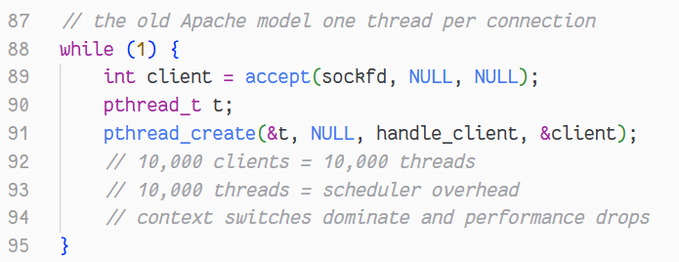
the question was simple how do you handle 10,000 concurrent connections on one machine
at the time Apache used one thread per connection, each thread needed memory for its stack around 8MB and 10,000 connections meant around 80GB of RAM just for stacks
the system spent more time switching threads than doing real work
servers crashed long before reaching 10k connections
this became known as the C10K problem
A French engineer who lives quietly in Paris has spent 30 years writing software that the entire internet now runs on without knowing his name.
He wrote the code that streams every YouTube video, every Netflix show, every TikTok clip. He wrote the code that runs the virtual servers underneath AWS, Google Cloud, and Microsoft Azure. He calculated more digits of pi than anyone in history. He has no Twitter. He has no marketing. He just keeps shipping.
His name is Fabrice Bellard.
Here is the story, because almost nobody outside the systems programming world knows what one man has built.
Fabrice was born in 1972 in Grenoble, France. He studied at École Polytechnique, the top French engineering school. He never went to Silicon Valley. He never built a startup empire. He just wrote code.
In 2000 he started a project called FFmpeg, an open-source multimedia framework for encoding, decoding, and streaming video. He was 28. The project did one thing nobody else had done well. It handled every video and audio format that existed, in one library, on every operating system. He led it himself for years.
Today FFmpeg is the invisible engine of the internet. YouTube uses it. Netflix uses it. VLC uses it. Chrome and Firefox use parts of it. Every Android phone, every iPhone, every smart TV, every video editing tool you have ever touched runs FFmpeg somewhere underneath. If you have watched a video on a screen in the last 20 years, Fabrice's code processed it.
He was not done.
In 2003 he started QEMU, a machine emulator and virtualizer. He wrote it solo until version 0.7.1 in 2005. QEMU lets you run any operating system on any other operating system. It became the foundation of modern virtualization. KVM, the Linux kernel hypervisor, runs on top of QEMU. Every major cloud provider, AWS, Google Cloud, Microsoft Azure, IBM Cloud, runs virtual machines on infrastructure built around it. The Quick Emulator is the most cited piece of cloud infrastructure code on Earth.
He kept going.
In 2001 he won the International Obfuscated C Code Contest with a small C compiler that grew into TCC, the Tiny C Compiler. TCC can compile and boot a Linux kernel from source in under 15 seconds. In 2004 he calculated the most digits of pi ever computed at the time, using a personal desktop computer and an algorithm he derived himself called Bellard's formula. In 2011 he wrote a complete PC emulator in pure JavaScript that runs Linux in your browser, a project called JSLinux that engineers still cannot believe is real.
In 2019 he released QuickJS, a small but complete JavaScript engine that fits where V8 cannot. In 2021 he released NNCP, a neural network based lossless data compressor that immediately took the lead on the Large Text Compression Benchmark.
Then he turned his attention to large language models. He built TextSynth Server, a web server with a REST API for running LLMs locally. He released ts_zip and ts_sms, compression utilities that use language models to compress text and short messages at ratios traditional algorithms cannot reach. He released TSAC, a very low bitrate audio compression system. In December 2025 he released Micro QuickJS, a new JavaScript engine for microcontrollers, separate from QuickJS, designed for environments with almost no memory.
Fabrice co-founded a telecom company called Amarisoft in 2012, where he serves as CTO. Amarisoft builds 4G and 5G base station software used by carriers and labs around the world. He has been running it for over a decade while continuing to ship personal projects from his own home page at bellard dot org
He has no Twitter. He has no Instagram. He gives almost no interviews. His personal website is a flat list of projects with no styling, no fonts, no marketing copy. Just titles and links.
A quiet French engineer who never moved to Silicon Valley wrote the code that quietly runs the internet.
He is still shipping.
Wasmer ported their 7-year-old Django backend to Rust. The results are hard to ignore. 🦀
Before vs After:
→ 220 CPUs → 24 CPUs (-89%)
→ 800 GB RAM → 64 GB RAM (-92%)
→ p95 API latency: 120ms → 30ms (-75%)
→ Startup time: 60s → 1s
→ DB connections: thousands → hundreds
One engineer. Three months. AI-assisted migration.
They're honest about the tradeoffs : longer build times, no `https://t.co/vZAHmIndB1 shell` for quick prod fixes, and SQLite/Postgres dual support was painful.
And they're clear: this wasn't "Django is bad." Django served them well for 7 years. The rewrite made sense because their entire stack was already Rust-heavy.
Full writeup worth reading 👇
🔗 https://t.co/vvg0tl6Hpe
#Rust #RustLang #Django #Python #WebDevelopment #OpenSource #BackendEngineering
A LINUX KERNEL DEVELOPER PROVED THE THING YOU PUSH CODE TO IS SECRETLY A DATABASE THAT CAN VERSION ALMOST ANYTHING AND THAT MOST DEVS HAVE ONLY EVER TOUCHED A TENTH OF IT
42 minutes from Josh Triplett -- a longtime Linux kernel and Debian developer -- showing that Git is a general-purpose, tamper-evident versioning engine that just happens to be famous for code.
-> The moment it clicks, Git stops being "Where my code lives" and becomes what it really is underneath: a content-addressable store that can version almost anything -- your configs, your notes, your servers' state, entire datasets.
People run whole wikis on it. They version their entire machine's configuration with it. They ship websites by pushing to it. They track data too big to email. None of it is a hack -- it's the same handful of objects you already use for code, pointed somewhere new.
Treating Git as a code-only tool was never the ceiling -> it's a versioning engine for anything, and the people who see that automate what the rest of the team still does by hand. And as AI agents start spitting out not just code but configs, docs and data, the one system that can version and audit all of it at once is already sitting on your machine.
You learned five commands to survive. This is the talk that shows you were standing on top of a database the whole time.
It changes what you think the tool is even for.
Bookmark & Watch it today ↓