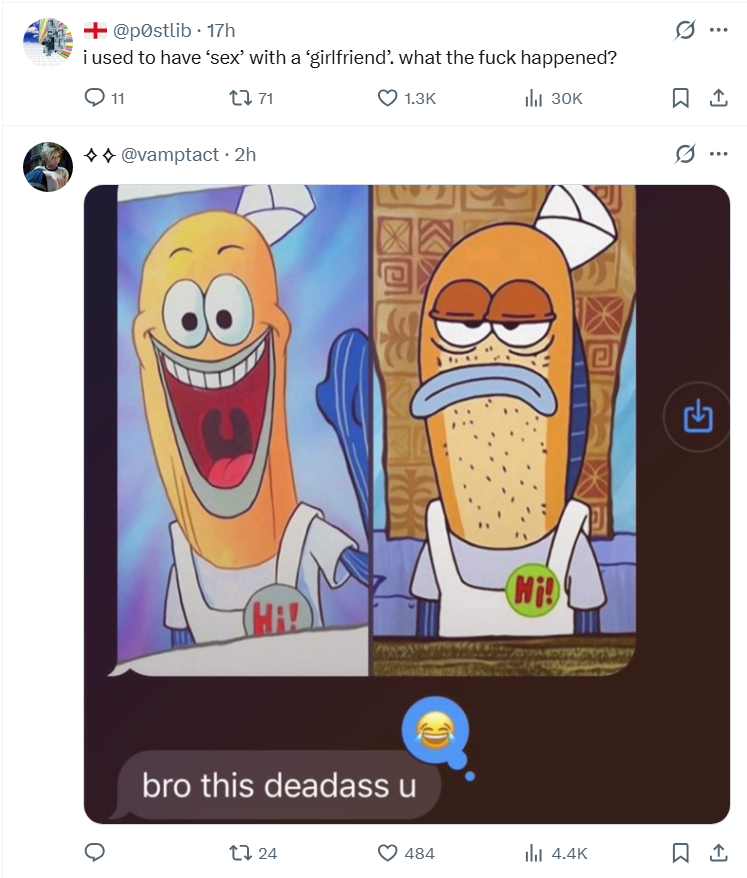
@Raindropsmedia1 I swear to God if this ain't assault bra idk what could be. Genuine cope in these comments us men HAVE to do better than this. Not hearing shit.
AI is rapidly getting smarter.
Now, humanity can too.
Today, @nucleusgenomics is announcing Vitruvian, our newest set of genetic optimization models.
Vitruvian’s intelligence model can optimize embryo DNA for 14 IQ points — nearly a standard deviation.
The models were trained on 1,000,000+ people, validated across 40,000+ siblings, and used more than 7 million genetic markers.
In Superintelligence, Nick Bostrom proposed genetic optimization as a key way for humanity to keep pace with rapidly advancing AI.
Bostrom’s vision is no longer theoretical.
Genetic optimization, like AI, has followed a scaling law: as datasets have grown, so have model capabilities. This trend will continue.
Parents across the world now have the choice to substantially increase their child’s intelligence.
And the next generation can choose to do the same.
AI is no longer the only intelligence that will compound.
Humanity can now direct its own evolution.
Today I go to the first graduation ceremony I've been to in a long time.
I graduated high school, left Stanford to build Theranos, got my honorary doctorate, and now walk for the Law Apprenticeship I completed.
The symbolism of doing so for Constitutional law studies while held in a prison, fighting to prove my innocence, is radiating through me today.
There is no greater way I know to protect liberty than to defend our Constitution when it is trampled upon.
applying for jobs and can't stop thinking about the fact that ASI is going to make every single human useless for the growth of society
and that people aren't actually hiring
Weed is such an easy way to lose your spark
Leaving aside the schizophrenia conversation, I cannot name a single heavy pot smoker in high school or college who did very well
Many of them just became...kinda "blah." Talented musicians who stopped practicing, athletes who "lost their drive," or passionate people who just decided their passions were "whatever"
Courtesy of having two dead head parents, I also know a LOT of people who've been smoking heavily 30+ years and the trend is very similar (and it'll be worse for people my age given how intense the drug has become)
These people are often very nice but they lack the edge, it's just gone. Weed took it from them
A decent amount is probably just an IQ decline, but there's something more to it than that even
It's like they wanted to trade away their ability to feel bad and now just don't feel much at all
Also now that they're hitting their 60s they are noticeably less sharp than their peers and the decline is FAST
genuinely why do we need this. people are acting like this isnt the exact tech that is going to make these models self improve until we can't understand how they work anymore. idk about you but I want to live past 2030.
big AI news
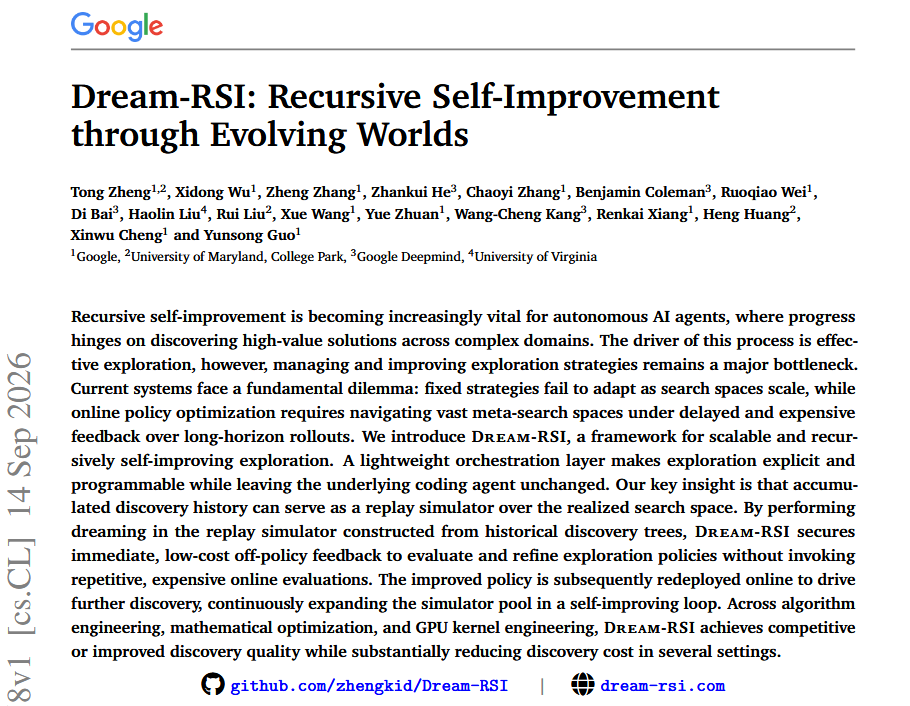
Google just demonstrated a recursive self improvement loop for AI discovery
Google/DeepMind researchers introduced Dream-RSI, a system where an AI agent improves how it explores problems by replaying its past discovery attempts, testing thousands of alternative strategies cheaply, then deploying the better strategy in the next round.
Across algorithm design, mathematical optimization, and GPU kernel engineering, it matched or improved discovery quality while cutting search costs dramatically, in one setting reducing agent calls by up to 162x. 👀
Importantly, it improves the exploration policy, not the underlying model weights.
We built recursive meta-intelligence, an AI that creates its own scientific instruments, turns them into persistent worlds that an agent ecology with hundreds of AIs inhabits, and uses those worlds to discover mechanistic principles in one of the hardest classes of physical problems: how complex hierarchical materials (nested structures of matter that give rise to new function through organization) evolve and fail. The AI reasons across enormous spaces of possible physical trajectories, where every rupture changes what can happen next, and compresses those histories into principles (which humans can understand and design with) - complex chains of causal events, highly nonlinear, and intricate.
Scientific superintelligence is tangible here - machine-scale exploration opening cognitive channels into complexity that has been extremely difficult for humans to traverse directly. AI builds the spaces in which its next level of reasoning becomes possible; a representation becomes an instrument, the instrument becomes an executable world, and that world becomes the substrate for further intelligence. Intelligence then grows by constructing new spaces to think in.
The task we explored started from a seemingly simple prompt to explore a biological material system - the AI then chose the representation, mechanics and experiments, built a fracture laboratory to push materials to their limit, tested hypotheses and generated scientific conclusions. The swarm explored a combinatorial universe in which architecture controls function and every rupture changes the future state of the material.
The AI discovered a compact principle that defines how multiscale material architecture can program the evolution of failure. Material placement and geometric order determine how forces redistribute, whether damage cascades or remains distributed, and whether function survives substantial flaws. For this discovery to happen the AI had to reason across long path-dependent histories, simulate alternative futures and compress them into generative invariants (model-based causal reasoning, counterfactual simulation and temporal abstraction applied to an evolving physical world). It is incredible to witness this transition to a new form of intelligence and capability through scaling swarms.
A lot of positive will come out of this because it expands the human epistemic horizon as AI can traverse thousands of possible histories and return mechanisms compact enough for us to understand, test and build from. Intelligence compounds through its artifacts!
A few lessons we learned:
▶️ Learning and discovery are flows through spaces of possibility. Early work has shown how backpropagation flows through parameters, reinforcement learning through action and consequence, and autonomous swarms through representations, instruments and executable worlds, bringing it all together. Flows create structure; structure redirects future flows in the recursive instrument.
▶️ Nonlinear physics actually defines a larger principle, where high-dimensional dynamics generate stable invariants; invariants become effective variables; those variables become the substrate for a new level of cognition.
▶️ Recursion then becomes level creation - one possibility space compresses into a principle, and that principle opens a larger space above it.