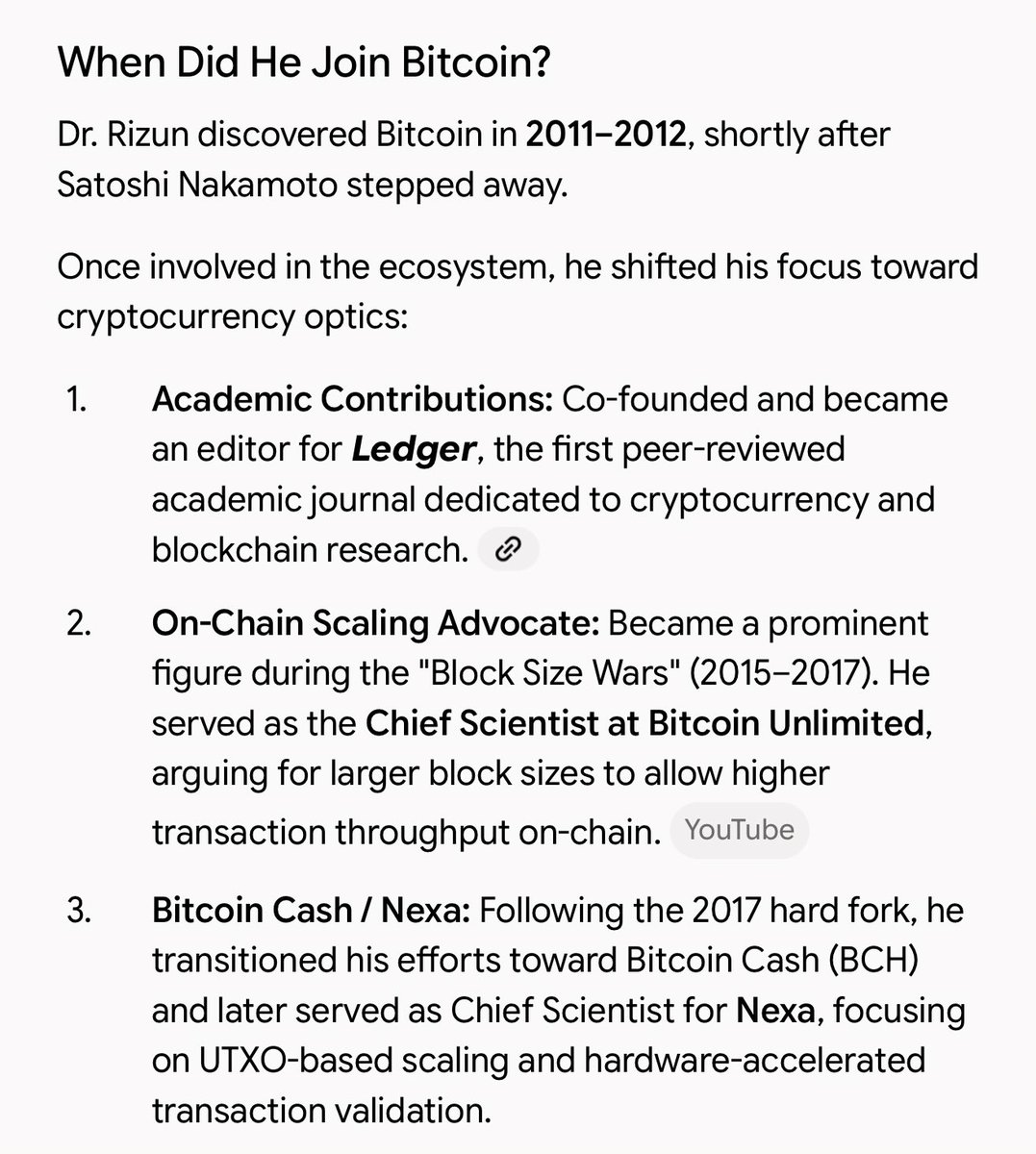
When Satoshi Nakamoto stepped away, shortly, Dr. Rizun Discovered Bitcoin. What if, SN is just an alter ego, and now using his true identity, started creating the real purpose of Bitcoin.
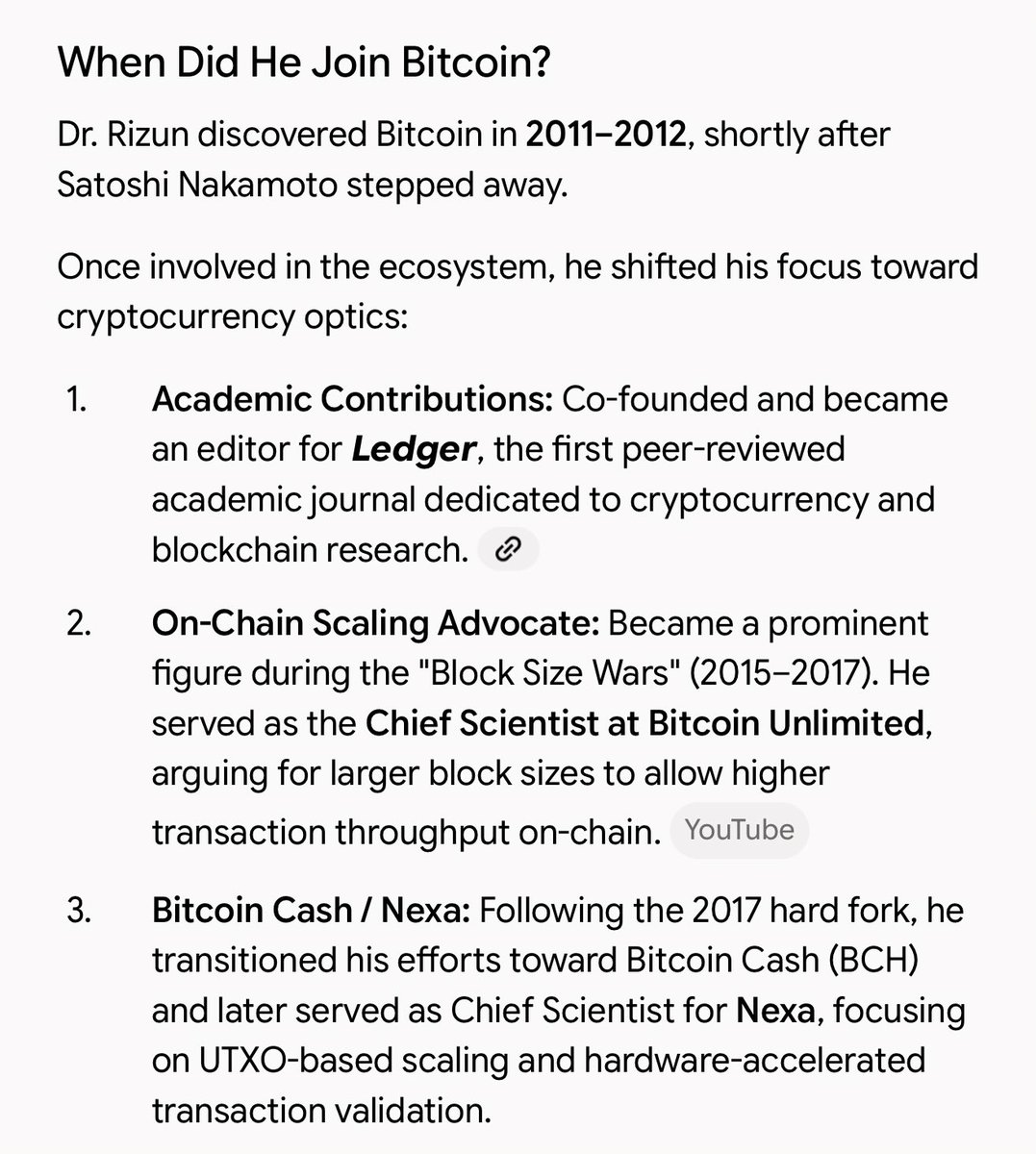
When Satoshi Nakamoto stepped away, shortly, Dr. Rizun Discovered Bitcoin. What if, SN is just an alter ego, and now using his true identity, started creating the real purpose of Bitcoin.
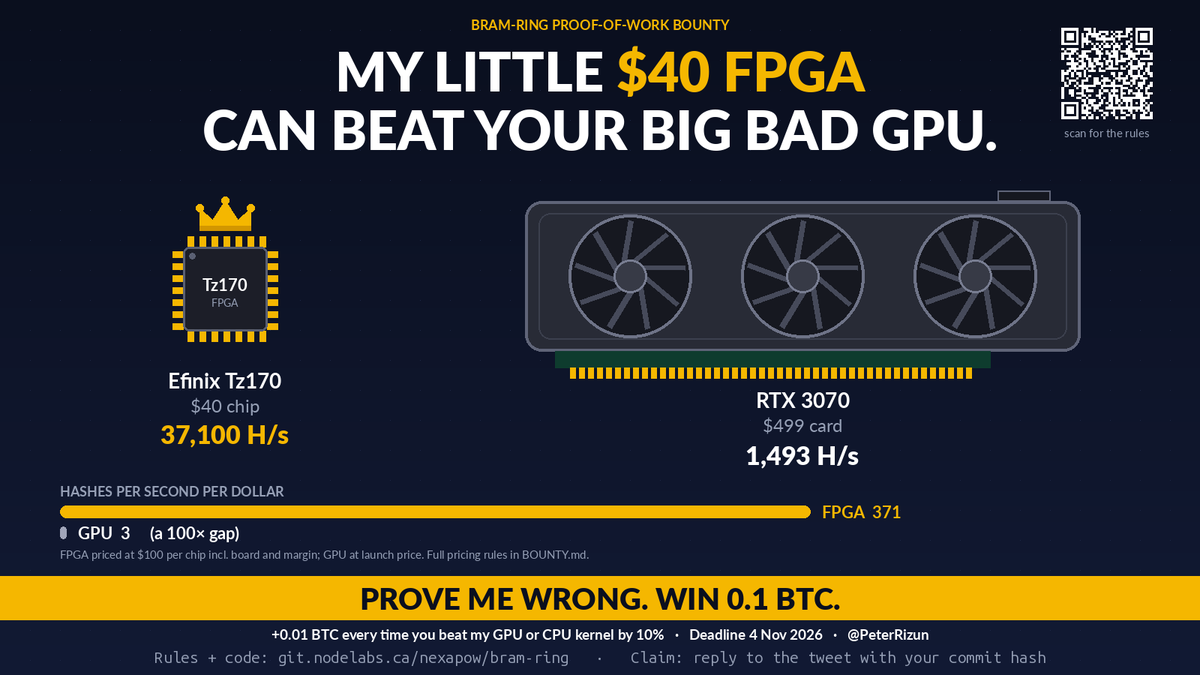
My little $40 FPGA can beat your big bad GPU. Prove me wrong and win 0.1 BTC.
I designed a proof-of-work called BRAM-ring. A $40 Efinix Tz170 does 37,100 H/s on it. The best anyone has managed on a GPU is 1,493 H/s, on a $499 RTX 3070. Per dollar the little chip wins by more than 100×, and I don't think any GPU, CPU, NPU or other off-the-shelf hardware can close that gap.
The bounty:
• 0.1 BTC to the first person who shows non-FPGA hardware at or above 371 H/s per dollar
• 0.01 BTC every time someone beats my GPU or CPU kernel by 10% (bit-exact, measured on my machine, the bar ratchets)
• 0.01 BTC for a real shortcut in the function: half the work per hash, counted not timed
How to claim: reply to this tweet with the full 40-character git commit hash of your code and the prize you're claiming. Your code can stay private until the deadline; the hash fixes your place in line.
Deadline: 4 November 2026, 23:59 Pacific.
Rules: https://t.co/VQOmsxBpBN
Code (make prove checks C, AVX2, CUDA and Verilog against the same 8 vectors): https://t.co/OFUbI8tTS7
Prize pool 0.2 BTC, held at bc1qtk8q5nsupm47kg5vz9turqacx8lg2whvxukpuj. Signed proof of funds in the first reply and in BOUNTY.md.
My little $40 FPGA can beat your big bad GPU. Prove me wrong and win 0.1 BTC.
I designed a proof-of-work called BRAM-ring. A $40 Efinix Tz170 does 37,100 H/s on it. The best anyone has managed on a GPU is 1,493 H/s, on a $499 RTX 3070. Per dollar the little chip wins by more than 100×, and I don't think any GPU, CPU, NPU or other off-the-shelf hardware can close that gap.
The bounty:
• 0.1 BTC to the first person who shows non-FPGA hardware at or above 371 H/s per dollar
• 0.01 BTC every time someone beats my GPU or CPU kernel by 10% (bit-exact, measured on my machine, the bar ratchets)
• 0.01 BTC for a real shortcut in the function: half the work per hash, counted not timed
How to claim: reply to this tweet with the full 40-character git commit hash of your code and the prize you're claiming. Your code can stay private until the deadline; the hash fixes your place in line.
Deadline: 4 November 2026, 23:59 Pacific.
Rules: https://t.co/VQOmsxBpBN
Code (make prove checks C, AVX2, CUDA and Verilog against the same 8 vectors): https://t.co/OFUbI8tTS7
Prize pool 0.2 BTC, held at bc1qtk8q5nsupm47kg5vz9turqacx8lg2whvxukpuj. Signed proof of funds in the first reply and in BOUNTY.md.
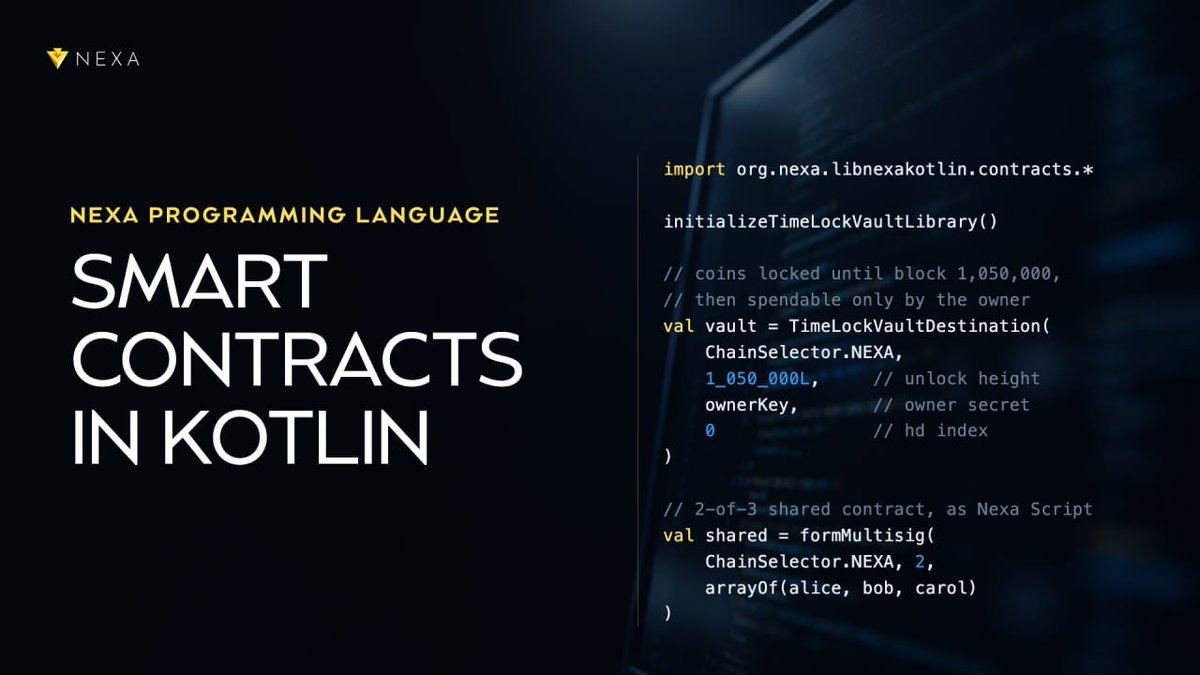
📒 Nexa Programming Language (NPL): Smart Contracts in Kotlin
Nexa Programming Language (NPL) is a domain-specific language and compiler for writing Nexa smart contracts. Each smart contract includes rules that decide how coins can be spent. NPL lets developers write smart contracts in Kotlin, and the compiler converts them into scripts that can run on the Nexa network.
@kotlin is a multiplatform language that lets you run a single codebase across multiple platforms and operating systems. It is also the preferred programming language of giants such as @Google for developing applications on @Android.
A single programming language that works across platforms benefits developers and users. We are excited to introduce NPL as the preferred language for writing smart contracts on Nexa.
You can find all the details and read more on the Nexa Forum through the link below. 👇
Have you tried @NexaMoney Ai skills ? All you need is an idea and an Ai agent of your choice to make a fully functional application that will work perfectly 🤝