@qaiseraraja Mr. Qanit 's model is Replacing private bank money creation with state-controlled money creation; that doesnt automatically solve concentration, political manipulation, or inflationary abuse. He fixes the plumbing but not the deeper incentive structure.
@spencerpratt Missing layer: money. Cheap credit lets buyers borrow more, bidding up prices even w/ no housing shortage. Fixing squatters & permits helps, but if credit keeps inflating housing as an asset, prices keep rising. Symptoms ≠ engine.
@SafdarAlam Fair warning: my AI has consumed an unhealthy amount of anti-ribā material. It now tends to see debt, extraction, and institutional compounding everywhere.
@qaiseraraja Banks should simply connect existing savings with productive opportunities, not multiply claims on society through leverage and magic. New money should only emerge from measurable, value-creating activity in circulation—not from political favors or credit expansion.
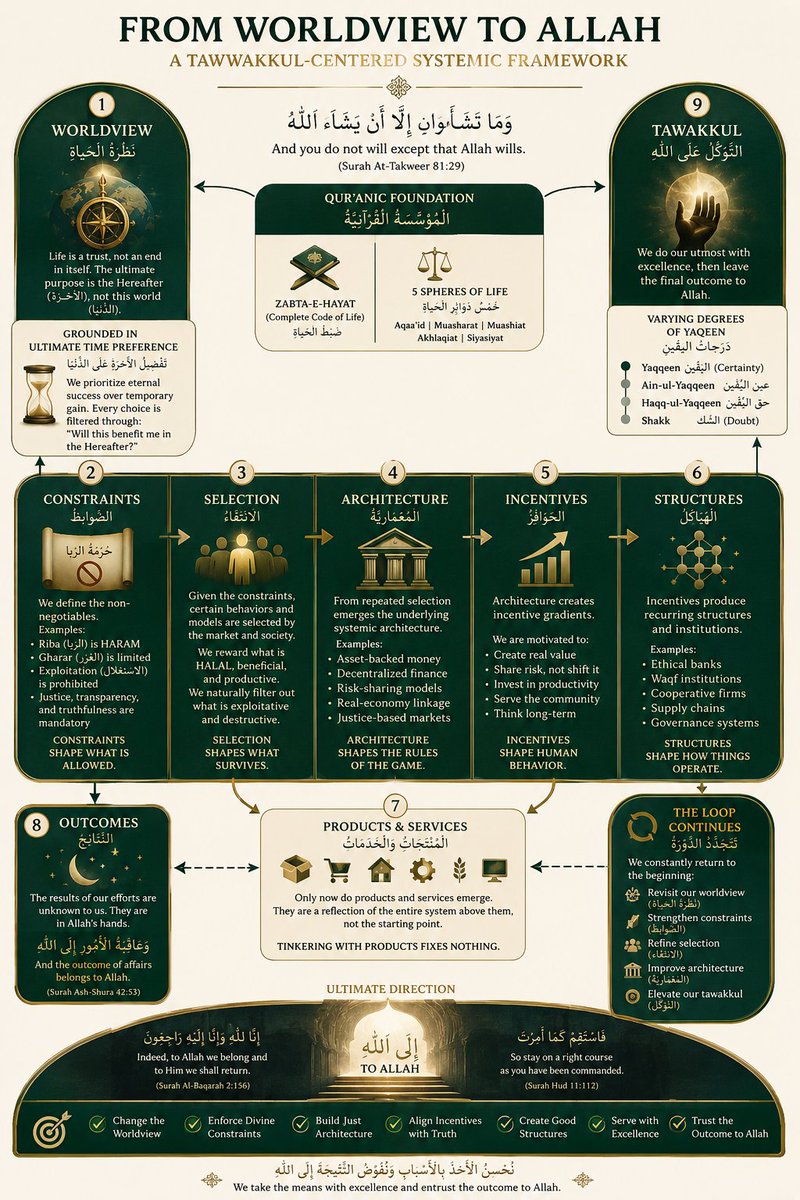
Islamic finance has spent decades refining products inside an inherited financial architecture.
But products alone cannot resolve structural equilibrium.
The next phase must move from critique to construction. From instruments to architecture.
Paper I: Why Islamic Finance Needs a New Architecture, Not More Products.
https://t.co/EfZSzTT8wl
When it cannot expand further, it doesn’t slow down.
It fractures.
That is not a transaction you opt out of with a compliant “Halal” contract.
That is the architecture.
Most people treat riba as a transaction: interest charged between two parties, prohibited, avoidable.
That framing is the error.
Riba is a structural property — embedded in monetary architecture itself.
@RayDalio Money isn’t debt.
Money decides who can access goods, work, & survival. Debt is just a promise made inside that.
Saying “money = debt” sounds smart, but it hides real issue:
The system itself is designed to control access — that’s where extraction happens.
@SafdarAlam 8/8 — Bottom line
Banks are structurally incentivised to lend against property, not own it. This is the core mechanical advantage of modern Basel-regulated banking.