@JK_Lundblad It is also amazing to see it succeed without failing more than 10 times like SpaceX. Solving the engineering problems on the ground vs by trial and error.
@ManhttanMetsFan@MaitreyaBhakal Lol, that should be the norm. Just like cars, washing machines, TVs, there is no solid reason why house should be doing the opposite.
@Hedgeye It sucks for people who bought the houses at higher prices but it is good for the next generation who will benefit from the housing affordability.
Taiwan solved tax evasion in 1951 with a trick so cheap it should embarrass every tax authority on the planet.
The problem was an all-cash economy full of small shops. A merchant pockets the cash, skips the receipt, and the sale never existed. Auditors can't catch what was never recorded, and hiring enough of them to watch every noodle stand costs more than the missing tax.
So finance chief Ren Xianqun flipped the incentive. Print a lottery number on every receipt. Draw winners every two months on live TV. Top prize today: NT$10 million, about $310K.
Suddenly the customer and the shopkeeper want opposite things. The merchant wants the sale off the books. The customer wants the ticket. And there are millions more customers than merchants. Every transaction now carries a built-in witness demanding the paper trail.
Year one, reported tax revenue jumped 75%, from NT$29 million to NT$51 million. Seventy-five years later, roughly 70% of Taiwanese still play. Convenience stores redeem the smallest NT$200 prizes at the register, so even a coffee receipt feels like a scratch card.
The elegant part is what the audit force costs. The prize pool runs about NT$7 billion a year, roughly $20 million. In exchange, the government gets 23 million unpaid auditors working every checkout line in the country, forever. No inspector general on earth delivers that coverage at that price.
Greece, Italy, Portugal, and Slovakia all copied it. The most effective compliance tool ever built looks like a game, and that's exactly why it works.
In-depth Analysis of Huawei’s Tau (τ) Law & Unified Bus Tech Verification
Full breakdown of Huawei’s new semiconductor Tau (τ) Law — with real, open-sourced architectural proof ✨
Most people misread this law as a manufacturing upgrade. It’s actually a post-Moore’s Law system-level revolution.
Insights from Zhihu Contributor 李博杰👇
📌 What Is Huawei’s Tau (τ) Law?
• Industry-first principle: China’s pioneering semiconductor industry guiding law for global chip development
• Core mechanism: Replaces traditional geometric transistor scaling with innovative temporal scaling via logic folding
• Performance target: Achieves 1.4nm-class equivalent chip performance by 2031 through system-level optimization
💡 Core Insight: Tau Law Is Not a Manufacturing Story
• Dennard scaling failed, Moore’s Law is slowing down drastically
• Free performance gains from advanced process nodes are no longer available
• The next order of magnitude of performance growth relies on system & architecture optimization, not tiny transistor shrinking
• The “equivalent 1.4nm” target emphasizes system-level performance equivalence, not physical manufacturing breakthroughs
🚀 Real-World Proof: Unified Bus (UB) & OpenURMA Implementation
UB (launched 2025, mass-produced on Huawei Ascend 950 NPU) is the perfect industrial verification of Tau’s temporal scaling theory.
I developed OpenURMA — a clean-room open-source UB implementation — for fair, apples-to-apples comparison with classic RoCEv2 RDMA.
⚡ Key Architectural Breakthroughs & Benchmark Results
✔4.47X Lower Latency (Zero Process Upgrades)
• Traditional RDMA: 4–5 PCIe round trips per remote memory access (~1650ns overhead)
• UB Architecture: Move the controller to on-chip bus, replace complex PCIe interaction with direct CPU load/store instructions
• End-to-end latency dropped from 2186ns to 500ns
• All gains come from eliminating abstract system overhead, not better transistor processes
✔4855X Smaller Connection State Overhead
• Legacy RDMA: O(N·M) state complexity (square explosion under full-mesh networking)
• UB Innovation: Decouple per-app endpoint state (Jetty) and per-host transport state (TP Channel)
• Optimized to O(N+M) additive scaling
• 1024×1024 scale: UB only needs 110KB on-chip SRAM vs RoCE’s 537MB
• Avoids DRAM spillover and repeated PCIe refetch latency
✔2.8X Higher Throughput with Opt-In Ordering
• Traditional RDMA enforces rigid global in-order execution (huge idle performance loss)
• UB provides flexible multi-dimensional ordering modes
• Applications only pay consistency costs they actually need, eliminating head-of-line blocking
• Sustains 2.80× higher throughput than baseline RoCEv2 RC
✔Fully Verified Reliable Data
• Three-tier verification: Synthesizable FPGA RTL, cycle-accurate SystemC simulator, gem5 full-system Linux scaffold
• Baseline matches real ConnectX-7 hardware data (±5% error)
• Open-source & fully reproducible, no PPT-only empty concepts
🎯 Core Conclusions About Tau (τ) Law
• It redefines chip performance iteration: Architecture > Manufacturing Process in the post-Moore era
• It upgrades the semiconductor industry’s growth logic: Temporal scaling balances and surpasses geometric scaling limits
• It opens a new track for global chip innovation, led by Chinese technological theory
🤖 Bonus: AI Empowers Tech Research Innovation
• Completed OpenURMA’s RTL development, simulation, and paper writing in days via AI tools
• AI drastically cuts research iteration latency — another advanced practice of temporal scaling
Open Resources for peer review & collaboration
📄 Paper: https://t.co/ZC8nfDP534
💻 Code: https://t.co/Eh9uOlBtQ7
Welcome to replicate, discuss & challenge!
#Huawei #TauLaw
#OpenSource #TechnologyInnovation
Full article:https://t.co/zLXXPTeObT
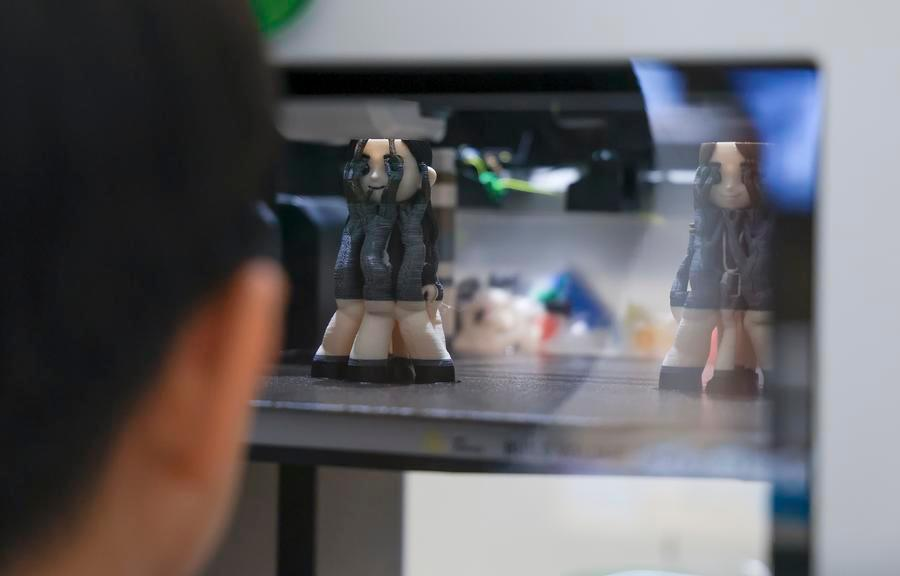
China's 3D printing sector registered rapid expansion in the first four months of 2026, latest data showed:
- Production of 3D printing devices grew by 50.9% YoY
- Exports of 3D printing equipment reached 2.46 million units, up 100.3% YoY
- So far, about 90% of consumer-grade 3D printers globally were produced by Chinese companies
@Brooklynmonk@Pranav_Kale@JChengWSJ That is obviously not true. Tons of products are for sale in China for fraction of the price in US if converted to $.