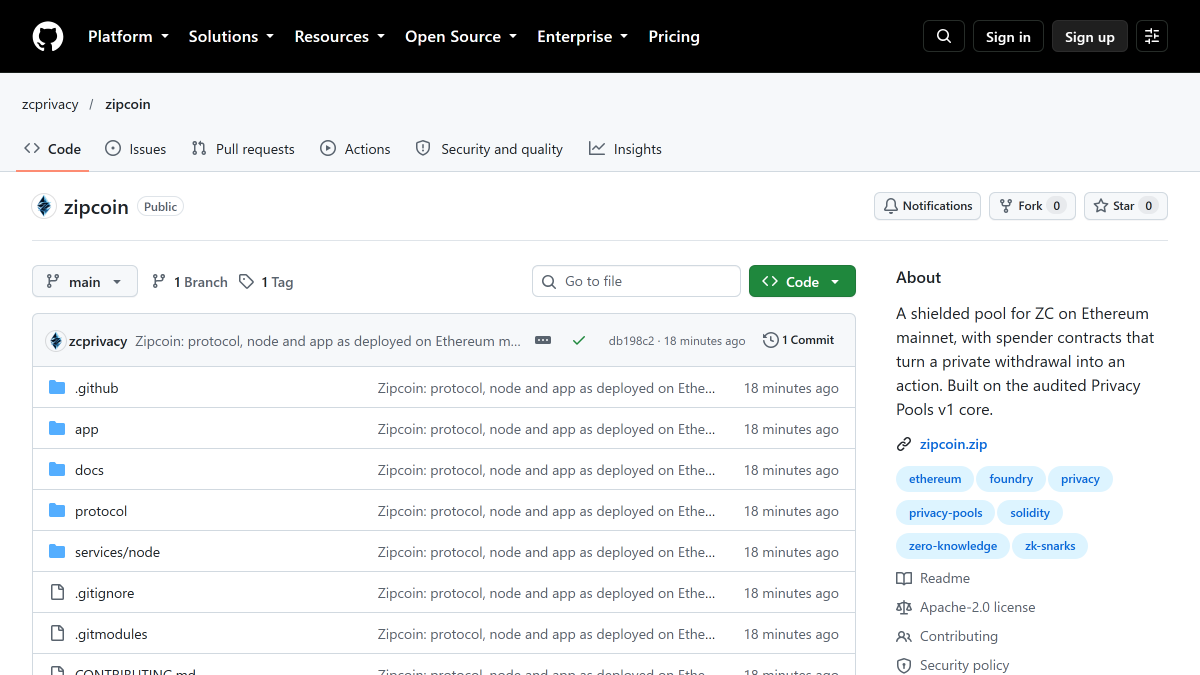
Zipcoin is now open source. Contracts, node and wallet, Apache-2.0, as
https://t.co/yF4CaETf4Q
The tag in the repository matches the bytecode on Ethereum mainnet byte for byte.
$ZC 0xA2f6441c4839A7fD4eF8536b971ceD04c48A1CEA
🧵A thread on what that changes.
New website. https://t.co/Dge7Bu0SDq has been rebuilt around what we are building next: ZipHook, private swaps on @Uniswap v4
Custody failed again this week. The answer is self-custody, and more volume will move on-chain because of it.
It should. But every DEX trade is a permanent public record: wallet, size, time, counterparty, and everything that wallet has done before or since, in one index anyone can query.
Zipcoin started as a shielded pool for $ZC on Ethereum mainnet, on the audited Privacy Pools core. Then the Book and the Doorstep: speech paid for with a burn, no author attached. The next question was obvious. A private note can pay and it can speak. Can it trade?
ZipHook:
A Uniswap v4 hook, and the first one we know of built for privacy rather than fees or routing. Here is what we are building, piece by piece:
- An ETH pool as the hub. Every market connects to it, so every market shares one anonymity set.
- One hooked v4 pool per token, paired with ETH. Anyone will be able to open one for any ERC-20. No listing fee, gas only.
- Shield on buy. A buyer attaches a precommitment to the swap and the hook deposits the output straight into the token's privacy pool as a note. No wallet ever holds the tokens.
- Private swaps. Spend an ETH note into the market with a zero-knowledge proof and the output lands as a token note. Selling runs the same way back.
- Recovery as a hashed commitment per note, revealed only on ragequit.
- Screening at the door, not surveillance after. Deposits follow a published association policy, and the sets are content-addressed so anyone can verify them.
The market pays, the shield does not. 1% per swap: 0.6% to LPs through the pool's dynamic fee, 0.4% in ETH to the Zipcoin treasury, which is meant to fund shielded staking rewards for ZC later.
No custodian. No new DEX. The liquidity, the router and the positions are plain Uniswap. The hook adds the door.
The first market will be ZC / ETH, our own token as the first test.
https://t.co/qRouuUXnmV
https://t.co/7eRBsACB4n
Zcash spent a year proving one thing: shielded coins stay shielded. Reported figures put its pool near a third of supply. Analysts call it a supply sink.
Our Shielded supply is the metric. The rest is weather.
Shielded supply share will rise
Different kind of staking, and a fair question underneath it.
Zipcoin has no validators and no slots. Shielded staking is a lock inside a Privacy Pools instance: you prove you own a note in the pool and spend it into the staking contract. Nothing about consensus is involved.
On linking: the proof is generated in your browser, from secrets derived by your own wallet signature. No server takes part in proving and none ever sees a key or a note. The relayer receives the finished proof and the public signals, submits them, and learns exactly what the chain learns: a nullifier, an amount, a tier. There is no step at which a wallet is presented to anyone.
The wallet reads only bulk public data, the same deposit events and tree leaves every user reads, so there is nothing per-user to correlate. And the node and relayer are open source, so anyone can run their own; nothing in the design depends on ours.
Shielded staking as a service: any token could open a pool for its holders by burning ZC at the door. An interesting thought for the protocol.
Privacy came to payments first. It has not reached staking.
Every stake on Ethereum is in plain view: an address, an amount, a date. Who holds what, and for how long, is the most legible thing about a holder, and the one thing almost nobody chose to publish.
It does not have to be. A stake could be a nullifier and an amount, the way a Book entry is: the chain sees that a lock exists and how large it is, and nothing about who is behind it. When the lock ends, the value returns into the shield as a fresh note, never surfacing at an address.
And staking does not have to mean locking. Staked ETH is already a token. A token can live inside a pool. Holding it there would give every ETH holder what validators never offered: yield without a public balance.
If one token can lock inside a shield, so can staked ETH. And so can any token willing to burn $ZC at the door.
Repository: https://t.co/yF4CaETf4Q
Mainnet tag and release: https://t.co/8WPX81D10t
Run your own node, relayer or wallet: https://t.co/z3giEJyehn
The Book entry: https://t.co/HzG1RB1Kbv
Zipcoin is now open source. Contracts, node and wallet, Apache-2.0, as
https://t.co/yF4CaETf4Q
The tag in the repository matches the bytecode on Ethereum mainnet byte for byte.
$ZC 0xA2f6441c4839A7fD4eF8536b971ceD04c48A1CEA
🧵A thread on what that changes.
From here, everything is built in public.
Novel First ever shielded staking arrives as pull requests with tests, reviewed before it ships.
The snowmoon novel this is built from is GPL. The protocol built from it is Apache-2.0. Both can be read end to end.
yesterday entry appeared on the Book.
It cost 2,000,000 zipcoin, sent to the furnace, 0.2% of all $ZC that will ever exist. It says: "In Veridia the year runs Snowmoon to Snowmoon. Some notes are about to learn how to wait that long."
🧵A thread on why.
Shielded staking. Lock a note from inside the pool. When the lock ends, principal and reward return to the pool as a new note, never to a wallet. The chain sees an amount, a tier and a nullifier. Not who.