Assalamu alaikum. Jummat Kareem, don't forget the basic sunnah before and after jummat prayer..
Na'am.....
One thing we’ve learned building Dialectra is that speech AI is not really a “data collection” problem.
It’s a data quality problem.
A raw recording cannot train reliable models by itself.
Before speech becomes useful for AI training, it has to go through multiple layers:
* transcription
* annotation
* normalization
* review
* verification
For example, when someone contributes speech on Dialectra, we don’t only store the audio.
We also label:
• what was spoken
• the language
• dialect variations
• timestamps
• speech quality
• conversational context
Then human reviewers verify everything again before approval.
That process is called data labeling or annotation.
It’s one of the most important parts of building reliable speech systems, especially for African languages where accents, dialects, and code-switching vary heavily across regions.
A lot of people only see “voice datasets.”
Very few see the infrastructure work happening underneath them.
A lot of people only see the wins, but they don't see the sleepless nights, the constant pressure, the debugging sessions, or the sacrifices behind the scenes. Going from fixing backend issues yesterday to signing incorporation documents today is a huge milestone.
Wldn!!!!!
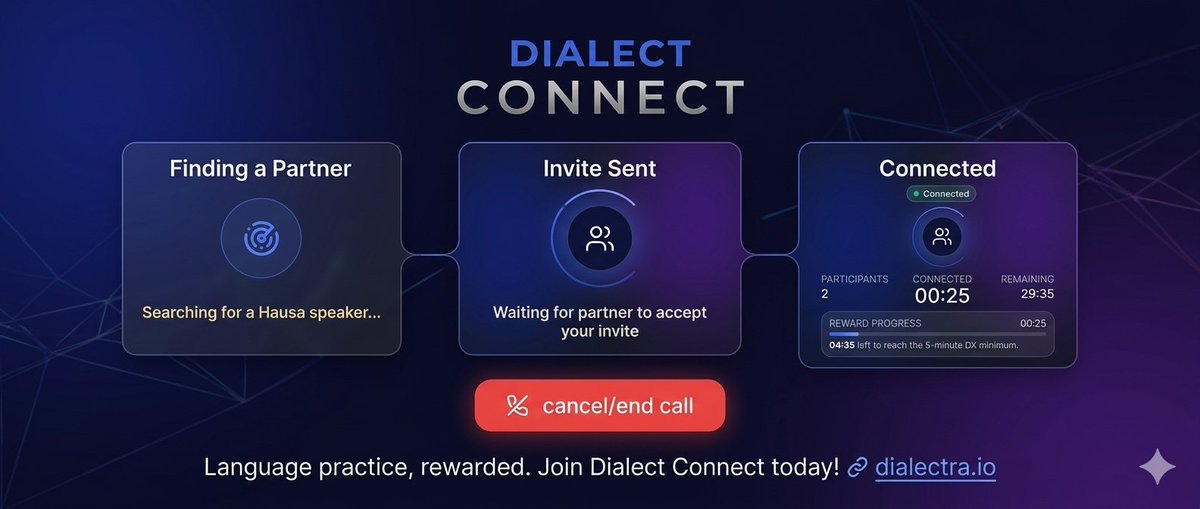
Yesterday i was debugging dropped calls and backend issues on Dialect Connect on @_dialectra
Today I’m signing incorporation documents for the same company we started with almost nothing as a experiments.
Bootstrap founders will understand this feeling.
No big funding announcement, no fancy office, just pressure, sleepless nights, constant problems, and still showing up to build every day despite not being able to stand up or walking due to my recent accident.
Still pushing https://t.co/eCLj0KHPQu forward.
Good morning, contributors! ☀️
Have you submitted your tasks today?
Ina kwana masu bada gudummawa! 🌍
Kun gabatar da ayyukanku na yau?
��� káàárọ̀, àwọn olùkópa! 💜
Ṣé ẹ ti fi iṣẹ́ yín ránṣẹ́ lónìí?
Many people focus on AI models.
What interests me more is the infrastructure behind them.
Projects like @_dialectra are tackling a challenge that often gets overlooked, creating high quality speech datasets that reflect how Africans actually speak.
Better data leads to better AI.
The next breakthrough in AI won't come from bigger models alone.
It will come from better, more diverse data.
@_dialectra is empowering communities to turn their languages into valuable AI resources, ensuring no culture or voice is left behind.
Multilingual AI is the future 🤞
Traditional AI scrapes the web without giving back. @_dialectra is changing that.
We empower people to record authentic data, verify community inputs, and earn rewards.
We aren't just training AI, we’re building a decentralized, community owned data economy.
We're still early🤞
Submitted a proof of personhood for an accelerator while in a hospital bed… all for cloud credits to keep building as a bootstrap founder, we are really build from everywhere 😄
It's a really interesting journey about @_dialectra
Africa's Voices Deserve to be Heard:
Millions of people speak languages and dialects that remain underrepresented in modern AI systems.
As a result, many voice technologies struggle to understand real users.
Dialectra is working to bridge that gap through structured, validated voice datasets designed to improve speech recognition and language understanding.
Representation matters, and this mission is worth watching.
Language is more than communication.
It's culture, identity, and knowledge.
When a language is ignored by technology, entire communities are left behind.
@_dialectra is building the foundation for AI that understands and serves people in their native languages.
A quick Dialect Connect update:
In just a short time, the community has generated:
📞 860 conversation requests
✅ 685 completed conversations
🎙️ 104.6 hours of conversational speech
⏳ 11 pending
🟢 5 active
❌ 159 rejected
What excites me most isn't the numbers it's what we're learning.
Every conversation helps us understand dialect variation, code-switching patterns, pronunciation, speaking rhythms, and how people naturally communicate across African languages.
Behind the scenes, we've been building much more than a voice collection platform:
1. Dialect-aware quality benchmarking
2. Advanced transcription and verification workflows
3. Speaker reputation and contribution systems
4. Better conversational data pipelines
5. New dialect campaigns with partners
Over the coming weeks, we'll be sharing several major announcements around datasets, partnerships, community initiatives, and new tools for researchers and AI builders.
The Real AI Bottleneck:
Everyone talks about bigger models and smarter algorithms, but few talk about the foundation they depend on.
AI can only perform as well as the data it learns from.
@_dialectra is focused on solving a critical challenge by building high quality voice datasets that better reflect real-world speech.
The future of AI starts with better data. Learn more and follow the journey.
I'm Muhkhad
Web3 Designer
Most AI systems force users to adapt to machines.
@_dialectra flips that model.
Instead of making people learn AI language, dialectra helps AI understand human language, culture, context, and intent more naturally.
The future of AI isn't just intelligence.
It's understanding.
@zeety2016@_dialectra That’s a real problem in many speech AI systems. When training data doesn’t include enough dialects and accents, the technology ends up working better for some users than others, which creates a gap in accessibility and accuracy.@_dialectra is filling the gap.
Many speech AI systems are trained on standardized language, but real-world communication includes diverse dialects, accents, and speech patterns. When these voices are missing from training data, AI struggles to understand users accurately.that's why we are here @_dialectra