Your feedback really matters to me! Join our Telegram chat at https://t.co/hkHevwrxW9 and share your thoughts — criticism, suggestions, anything at all is welcome
I made the same mistake and lost a significant amount of money. In the end, Bybit refused to recover my funds, citing technical limitations. Honestly, I don’t understand what technical reason could prevent them from simply transferring the tokens from a wallet whose private keys they control. It’s frustrating.
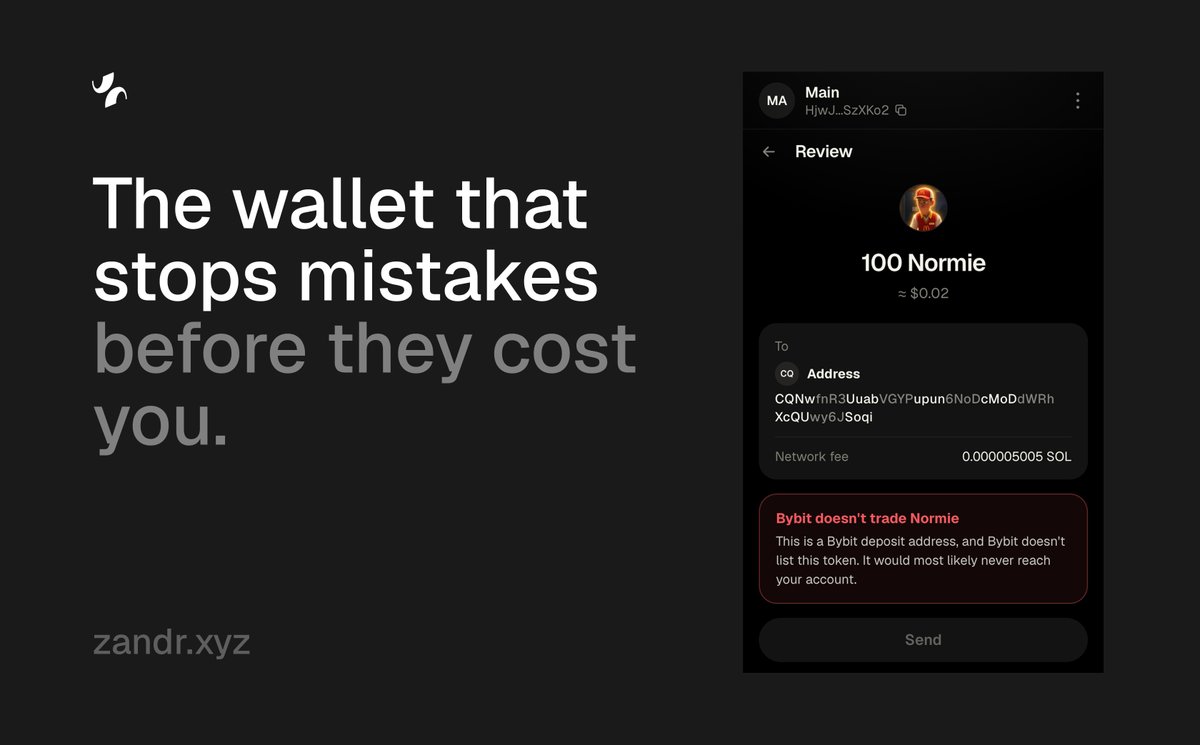
That’s why I decided this should never happen to me again. I’m building a wallet with built-in protection that prevents you from sending tokens to exchanges that don’t support them
@ZaraVerse01@MySpenda Guys, if you use Solana, I’m building a wallet that prevents you from sending tokens to an exchange if that exchange doesn’t support the token you’re trying to transfer.
If you think this wallet is useful, I’d really appreciate your support by following my account!
Guys, if you use Solana, I’m building a wallet that prevents you from sending tokens to an exchange if that exchange doesn’t support the token you’re trying to transfer.
I’m planning to add support for more networks in the future.
If you think this wallet is useful, I’d really appreciate your support by following my account!
You can help me make this wallet better: download it https://t.co/tDmS8sbKDY and leave your suggestions and feedback in the comments on this post
@solana
One careless transaction cost me $50,000. After six years in crypto, I was sure that if I ever lost serious money, it would be because of my own trading decisions. It wasn’t.
I was rushing to send USDT to Bybit, didn’t double-check, and sent the wrong token. Three weeks of back-and-forth with support ended in a polite refusal. In that time, the token dropped more than 90% from its ATH. The money was gone. The lesson stayed.
That’s when I decided: if I’m a developer, I should solve this problem for myself once and for all, so it never happens again.
Now I’m building Zandr, a wallet. Right now it’s a Google Chrome extension, with mobile apps coming later. While other wallets chase features that are nice to have but not critical, I’ve focused on what actually matters for a wallet: security in an environment where mistakes are irreversible.
Zandr already does everything the wallet you’re using now does. Plus, it:
recognizes centralized exchange deposit addresses and won’t let you send a token that exchange doesn’t support;
recognizes program addresses, spam addresses, and scammer addresses, and blocks the transfer;
shows human-readable information before you sign a transaction and warns you if something looks suspicious;
protects against password brute-forcing if attackers get hold of your device.
Right now I’m optimizing the architecture to match the speed of leading wallets. After that, I’ll release the first version on the Chrome Web Store, and then move on to the mobile app.
One careless transaction cost me $50,000
Over 6 years in crypto: trading, providing liquidity, and plenty of other activities. I was sure that if I ever lost money, it would be because of my own trading decisions.
But definitely not because of a simple transfer.
What happened
I wanted to send USDT to Bybit. I was in a hurry, didn’t double-check, and sent the wrong token: my entire holding.
What followed were three weeks of back-and-forth with support. Template replies, “your request is under review”… And then a final email with a rejection.
That’s where I stopped. During those three weeks I missed the chance to take profit, and the token eventually crashed more than 90% from its ATH.
Do I regret it? No. The money is gone, but the lesson will stay with me forever.
And I’m not the only one
Did you know that hundreds of people make exactly the same mistake every day?
📊 In 2022–2023 alone, Binance resolved 381,616 cases where crypto was sent but never credited to the account, returning $4.4 billion in assets to users. That’s around 500 cases a day, and those are only the successfully resolved ones.
📊 Upbit has fixed more than 20,000 erroneous deposits over 4 years.
📊 Kraken doesn’t disclose numbers, but admits that clients often send coins through the wrong or an unsupported network.
Binance’s Chief Security Officer Jimmy Su believes these mistakes will keep happening, especially as newcomers flood in.
And this is just the tip of the iceberg. The statistics only count submitted requests. How many people never reached out, or got rejected like I did, nobody knows.
The takeaway
Analysts say these mistakes mostly happen to beginners. My case proves otherwise: six years of experience won’t protect you from rushing and one wrong click.