I am 32 , I live in Dubai , stay in a penthouse , ride a Porsche and party in yacht!
That's none of this true.
A year ago, I stood at the edge of a lake, exhausted from months of research into quantum risk and grinding through quantum security, earning certifications, studying with PhD cryptographers, and building from scratch. Some will say it’s too far. Some will say it’s too early. What matters is who moves before it’s too late.
That moment gave birth to QuantZen™ (patent pending) . We focused on the application level the one place where the hashtag#quantum attack becomes real right before the transaction is executed.
Zenith Studio LLC and the team worked on a true hashtag#innovation - a Dual-signature structure (ECDSA + NIST-approved CRYSTALS-Dilithium) at the application level, making transactions quantum-proof without modifying L1 or L2 architecture. No Hard-forks. Works with hashtag#EVM , NON-EVM even hashtag#BTC
We launch QuantZen™ today
A layer that makes any wallet or dApp quantum-proof instantly, across any chain. If you’re building the future, now is the moment to secure it .
Get the SDK Now - https://t.co/Ktl4OVb9Yx
Everything is possible to innovate you just need to change the perception of how you see it ~ Ashish
#Quantzen #QuantumSecurity #PostQuantum #Web3Security #Cybersecurity #NIST #Cryptography #Innovation #DeepTech
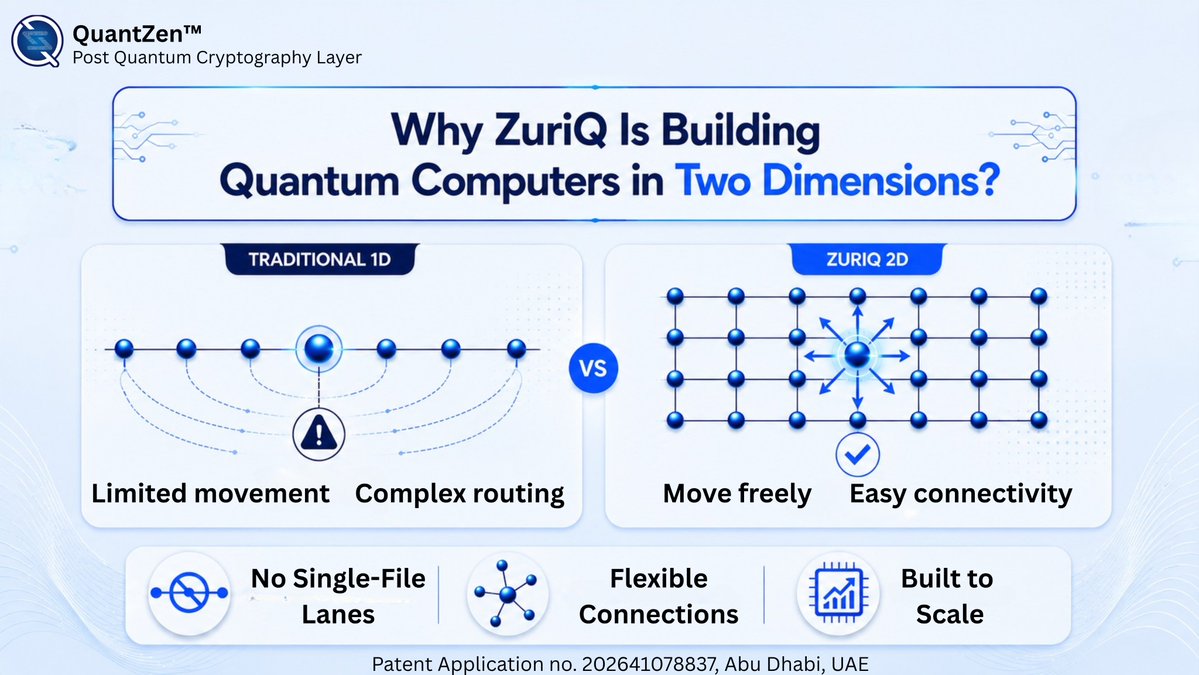
Why ZuriQ Is Building Quantum Computers in Two Dimensions?
Swiss startup ZuriQ, a spinout from ETH Zürich, has raised $25.5 million in seed funding to build what could be a much more scalable quantum computer. The company had already raised $4.2 million in pre-seed funding in 2025. Now, it's using this new investment to grow its team, expand research, and scale chip manufacturing.
What makes ZuriQ different? Most trapped-ion quantum computers today are built in a one-dimensional (1D) layout. It helped the industry get started, but scaling those systems has become increasingly difficult. ZuriQ took a different route from day one.
Instead of building in 1D, it designed its processors in two dimensions (2D) from the ground up. Think of it as the difference between adding houses along a single street versus building an entire city grid. A 2D design gives quantum bits far more room to connect, move, and grow.
The company has already built a 3×3 array with nine individually controlled qubits (currently the largest 2D trapped-ion array demonstrated to date). Even better, the chips are being manufactured with Infineon, showing that the technology can be built using established semiconductor manufacturing processes.
ZuriQ's next goal is ambitious: scale from a handful of qubits to hundreds on a single chip, paving the way for commercially useful quantum computers.
As CEO Dr. Pavel Hrmo puts it: "Many trapped-ion companies started with one-dimensional designs. We built our architecture in two dimensions from the beginning because it's inherently easier to scale."
#quantum #tech #science #innovation #bitcoin
Bank of Baroda Reportedly Hit by an Alleged 1TB Data Leak
BOB is facing an alleged 1TB data leak that has surfaced on the dark web, and if the reports are accurate, this isn't just another cyber incident.
The leaked data is said to include customer names, Aadhaar numbers, loan records, NetBanking details, collected from multiple branches across India. What's even more concerning is that the threat actor reportedly made the data available for free on the dark web. Sample files have also appeared online.
Cybersecurity researcher Srikanth Lakshmanan, founder of CashlessConsumer, called it "a cyber disaster." He said he was able to verify the sample files and found what appeared to be genuine internal Bank of Baroda documents, including customer-related records.
The incident first came to light through https://t.co/AYXO7OTD9N, a website that tracks ransomware and cyberattack activity. The attack has not been officially attributed to anyone. However, Lakshmanan said a relatively new hacking group called TripleX could be behind it. The same group was previously linked to the breach of PT. BANK NEGARA INDONESIA (Persero) Tbk., where around 2TB of sensitive data was reportedly stolen.
Whether you're a customer or not, this is a reminder: Banks don't just protect our money anymore, they also protect our identity, personal data, and the trust millions of people place in digital banking.
If these allegations are confirmed, this could become one of the most significant banking data exposure incidents in India.
#security #banking #data #cyberattack #bitcoin
US Scientists Create Ultra-clean Silicon for Next-gen Quantum Chips
99.9999% pure silicon might sound like a tiny improvement. It could be a giant leap for quantum computing. One of the biggest problems in quantum isn't building faster chips, it's keeping them stable.
Think of a quantum chip like someone trying to hear a whisper in a noisy room. Even tiny magnetic signals from a few atoms inside the material can interrupt the conversation, causing qubits to lose information.
Now, researchers at the US Department of Energy's Oak Ridge National Laboratory and Pacific Northwest National Laboratory have found a way to make 99.9999% pure silicon-28 and ultra-pure germanium by removing almost all of the "noisy" isotopes that interfere with quantum systems.
Here's why that's exciting:
- Less atomic noise means qubits can stay stable for longer.
- More stable qubits could lead to more reliable quantum computers.
- The US now has a domestic way to produce these ultra-pure materials instead of relying on limited overseas suppliers.
One line from the announcement really stood out to me: "By achieving isotope purities never before seen on Earth, we are hand-delivering the foundation for the world's most stable quantum computers."
The researchers didn't redesign the quantum computer, instead they improved the material before the chip is even built.
Quantum computing still has many challenges ahead, but breakthroughs like this quietly move the industry one step closer to practical, large-scale quantum machines.
#quantum #tech #research #science #bitcoin
Japan Made Quantum Computing Available to Everyone
Japan just put a quantum computer online. And the most exciting part? You don't need to work in a secret lab to see it. Japan has opened its homegrown quantum computer to users around the world through a web browser, giving researchers, and developers a chance to explore the technologies of the future.
This isn't just another quantum computer. It's Japan's first fully domestically built quantum computing system, where both the hardware and software were developed entirely in Japan by The University of Osaka, RIKEN, and Japanese industry partners.
That means Japan isn't just building a machine; it's building its own quantum ecosystem. Even better, the entire software stack is open source. Instead of treating the technology like a black box, researchers and developers can actually study how it works, learn from it, and build on top of it.
The quantum processor runs just a few thousandths of a degree above absolute zero, colder than outer space because that's where quantum physics starts doing things traditional computers simply can't.
Of course, today's quantum computers are still experimental. They're not ready to replace your laptop, and they still make mistakes.
By making this system available online, Japan is giving people across the world a chance to learn, experiment, and prepare for the next generation of computing, while taking a major step toward technological independence with a fully homegrown quantum platform.
If you had free access to a quantum computer today, what would you want to explore first?
#quantum #innovation #tech #science #bitcoin
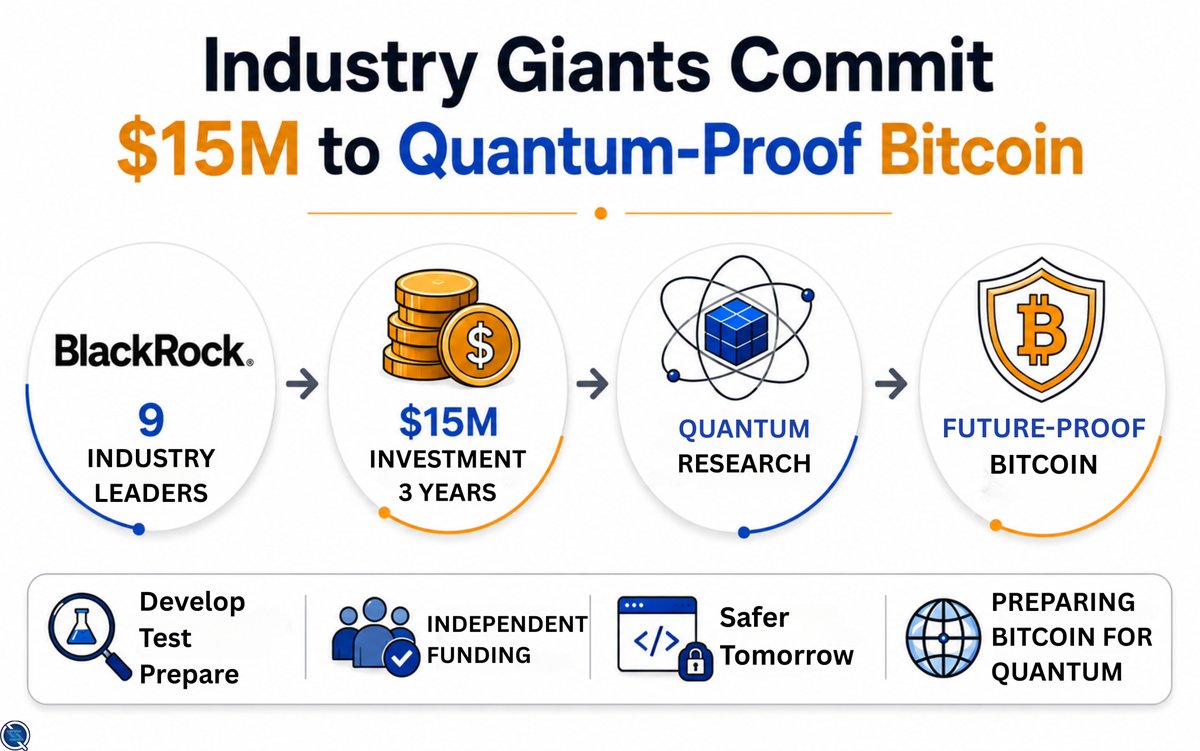
Industry Giants Commit $15M to Quantum-Proof Bitcoin
BlackRock, Coinbase, Strategy, Fidelity Digital Assets, Block, Blockstream, Galaxy, ARK Investment Management LLC, and Anchorage Digital have come together to launch the Bitcoin Security Consortium, committing $15 million over the next three years to strengthen Bitcoin's long-term security.
They're not fixing a broken system. They're preparing for a future where quantum computers could challenge the cryptography that protects Bitcoin wallets and transactions.
Today's Bitcoin relies on elliptic-curve cryptography to prove that a wallet owner is authorized to make a transaction. Quantum computers aren't capable of breaking it today, but experts believe that could change in the future. And preparing for that isn't as simple as flipping a switch.
Researchers need to:
🔹 Develop and test quantum-resistant cryptography.
🔹 Identify which wallet keys could be exposed.
🔹 Design safe migration paths for users.
🔹 Ensure any future upgrade doesn't introduce new security risks or split Bitcoin's network consensus.
What's equally important is how this consortium plans to work. There isn't one central fund. Each member will independently support developers, researchers, and organizations they believe are advancing Bitcoin's security.
And despite their influence, the consortium has made it clear that it won't push a specific Bitcoin code change or claim authority over Bitcoin's decentralized developer community.
This isn't an emergency response. It's long-term planning for a technology that could eventually reshape digital security. And it's not just Bitcoin. Banks, governments, defense, and technology companies all rely on cryptography that quantum computing may one day challenge.
#bitcoin #quantum #security #blockchain
Keyfactor Just Made Quantum Readiness Easier for Businesses
Preparing for the quantum era isn't something companies can leave for "later" anymore. Keyfactor has expanded its Global Partner Program to help businesses get quantum-ready; not with complicated new products, but by helping organizations strengthen the security they already rely on.
Why does this matter?
AI is creating millions of new machine identities, certificates, and digital keys that need protection. At the same time, quantum computing is getting closer, and today's encryption won't protect sensitive data forever.
Instead of waiting for that day, Keyfactor wants its partners to help organizations prepare now. Here's what stood out to me:
- Helping businesses become crypto-agile so they can adapt as security standards evolve.
- Giving partners the training and tools to guide organizations through the move to post-quantum cryptography.
- Shifting the conversation from selling software to becoming trusted advisors for long-term digital trust.
The biggest takeaway? Post-quantum security is no longer just a future problem, it's becoming a business priority today.
The organizations that start preparing early won't just reduce risk. They'll be far better positioned for an AI-powered future where digital trust becomes more important than ever.
#cybersecurity #quantum #AI #crypto #bitcoin
Singapore Is Preparing Its Military for the Quantum Era
Singapore is preparing for a future where military planning could become much smarter. Not by replacing people with AI. Not by building quantum computers of its own. But by learning how to use quantum computing before it becomes mainstream.
Singapore's The Digital and Intelligence Service (DIS) and Defence Science and Technology Agency (DSTA) have partnered with IBM Quantum to explore whether quantum computing can help solve one of defence's biggest headaches: Moving the right people, equipment and supplies to the right place at the right time.
Mission planning isn't just about making a schedule. It's about balancing thousands of moving parts; resources, routes, priorities and time, all at once.
Today's computers can do this, but as problems grow more complex, they become much harder to optimise. That's where quantum computing could eventually make a difference.
What's interesting is that Singapore isn't claiming quantum is ready. Instead, they're investing early by:
• Giving defence engineers hands-on access to IBM's quantum systems.
• Building in-house quantum expertise.
• Testing where the technology is useful and where it isn't.
I like this approach because it's practical. Rather than waiting for quantum computing to become perfect, they're preparing people, building knowledge, and experimenting with real-world problems today.
#quantum #tech #science #innovation #bitcoin
Why Is Galaxy Spending $5 Million to Protect Bitcoin?
The biggest challenge facing Bitcoin might not be hackers. It might be quantum computers. That future isn't here yet. But some of the biggest names in crypto have decided it's time to prepare before the problem arrives.
Galaxy has just launched the Bitcoin Quantum Readiness Initiative, committing up to $5 million to help developers build the next generation of Bitcoin security.
Why now? Upgrading Bitcoin isn't like updating an app on your phone. Every major change takes years of discussion, testing, and community approval. Waiting until quantum computers become powerful enough would simply be too late.
That's why Galaxy is investing today in:
🔹 Quantum-resistant security for Bitcoin
🔹 New tools for wallets and custodians
🔹 Research into future quantum risks
🔹 Grants for developers building long-term solutions
This move follows similar efforts from Coinbase, Strategy, Ethereum, and XRP Ledger, showing that the industry is beginning to treat quantum security as a long-term priority rather than a distant theory.
The most interesting part isn't the $5 million. It's the mindset. Instead of reacting when the threat becomes real, the crypto industry is starting to prepare years in advance.
#bitcoin #quantum #cybersecurity #blockchain #bitcoin
Scientists Create a Quantum Material That Decides Which Light Can Pass
Imagine a material that doesn't care about the color of light or the direction it's traveling. Instead, it checks how the light behaves.
That's exactly what researchers have built. They created a room-temperature quantum material that can tell the difference between different kinds of quantum light and decide which ones are allowed to pass.
Think of it like airport security for photons. If the light behaves the "right" way, it passes through almost untouched. If it doesn't, the material reshapes it into an allowed state before letting it continue.
Until now, scientists could filter light based on things like color or polarization. This is the first material that filters light based on its quantum behavior. And it works at room temperature, without the ultra-cold conditions that many quantum experiments depend on.
Why does this matter? Because future technologies, from photonic quantum computers to ultra-secure communication and even more efficient solar energy systems, all rely on controlling delicate quantum states of light.
If this technology scales, it could become for quantum photonics what semiconductors became for modern electronics. A breakthrough in giving us an entirely new way to guide and control quantum light.
#quantum #tech #innovation #science #bitcoin
The World's First Room-Temperature Quantum Computer
The coolest thing about this quantum computer isn't how powerful it is.
It's that it doesn't need to be freezing cold to work. For years, quantum computers have looked like giant science experiments, surrounded by complex cooling systems that keep them close to absolute zero.
Now, a Dutch startup, QuiX Quantum, has taken a different path. It has delivered Carina to Germany's DLR aerospace institute: the Netherlands' first complete quantum computer and the world's first customer-deployed photonic quantum computer powered by particles of light (photons) instead of traditional qubits.
Why does that matter? Because light doesn't need ultra-cold temperatures. That means Carina can operate at room temperature, making quantum computers easier to deploy, maintain, and eventually integrate with today's data centers.
We've spent years trying to build quantum computers inside giant freezers. Carina asks a different question: What if we didn't need the freezer at all?
It's still early days, and room-temperature operation doesn't magically solve every challenge in quantum computing. But it removes one of the biggest engineering hurdles standing between quantum research and practical deployment.
#quantum #tech #research #science #bitcoin
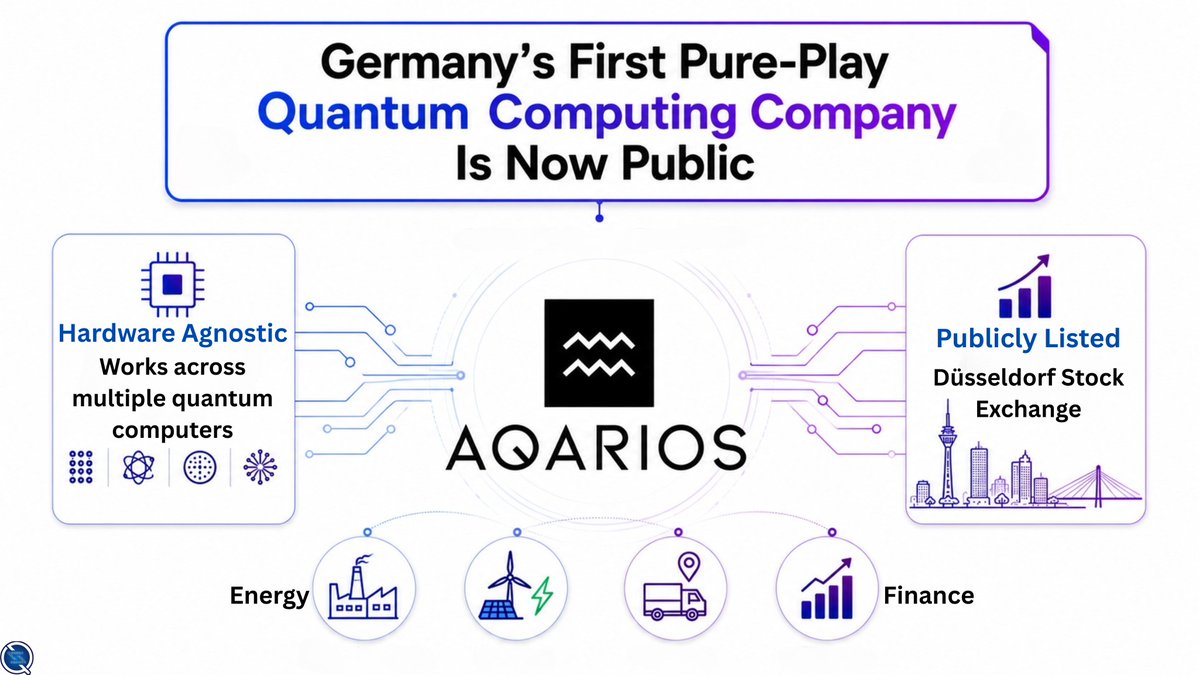
Germany's First Pure-Play Quantum Computing Company Is Now Public
Most people think quantum computing is still locked inside research labs. Aqarios is betting that's no longer true. The Munich-based startup has officially listed on the Düsseldorf Stock Exchange, becoming what it says is Germany's first publicly traded company focused entirely on quantum computing software.
Aqarios isn't building a quantum computer. It's building the software that helps businesses use quantum computing without needing to understand the science behind it.
Think of it like Google Maps. You don't need to know how GPS satellites work to find the fastest route. You just enter a destination, and the software figures out the best path.
Its platform, Luna, automatically decides when to use classical computers, when to use quantum computers, and which quantum hardware is the best fit, all behind the scenes.
That means companies can focus on solving real business problems like:
✅ Smarter supply chains
✅ Better energy planning
✅ Manufacturing optimization
✅ Financial portfolio decisions
The company is already working with organizations including BASF, E.ON, and MTU Aero Engines, showing that industry is starting to experiment with quantum solutions today.
As CEO Michael Lachner put it: "Quantum computing will help determine industrial competitiveness in the years ahead."
The companies creating the software layer that connects businesses to quantum computers may become just as important as the companies building the hardware. Hardware gets the headlines. Software is what helps people actually use it.
#quantum #software #tech #AI #science #bitcoin
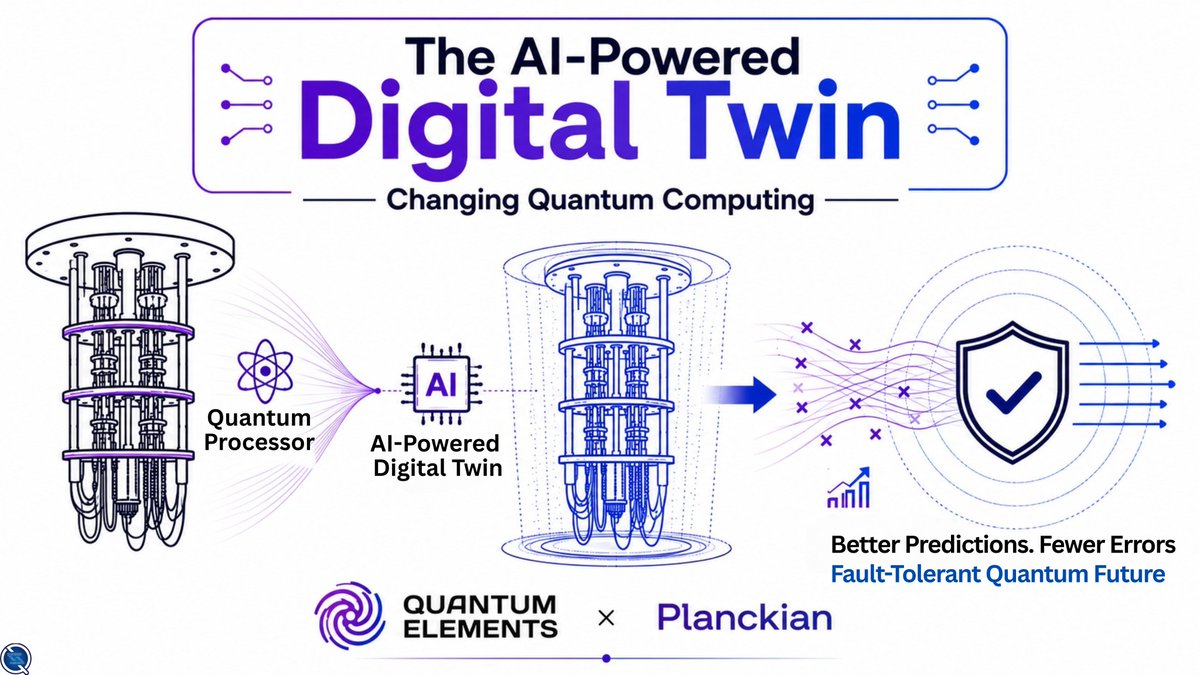
The AI-Powered Digital Twin Changing Quantum Computing
Building a quantum computer is hard. Building one that makes fewer mistakes? That's the real challenge.
Most people think the biggest challenge in quantum computing is creating more powerful chips. It's not. The real battle is understanding why quantum computers make mistakes before trying to fix them.
That's why this partnership between Quantum Elements and Planckian caught my attention. Instead of waiting for larger quantum processors to be built, they're creating AI-powered digital twins, virtual copies of quantum processors that run on classical computers.
Think of it like a flight simulator for pilots. You can safely test different situations, understand what goes wrong, and improve the system long before the real thing is pushed to its limits.
For quantum computing, that means researchers can:
✅ Study how noise and errors affect a processor.
✅ Test different error-correction methods before deploying them on hardware.
✅ Build a clearer path toward fault-tolerant quantum computers: machines that can produce reliable results at scale.
One line from the announcement stood out: "We need a faithful picture of our own noise environment before we decide how to correct it."
That's a powerful idea. You can't fix what you don't fully understand. As quantum hardware becomes more advanced, software tools like digital twins could become just as important as the processors themselves.
Sometimes, the smartest way to build the future... is to simulate it first.
#quantum #AI #innovation #tech #bitcoin
Quantum Computers Could Design Tomorrow's Jet Engines
One of the biggest barriers to building better jet engines might not be engineering anymore. It might be computing power.
Designing a modern gas turbine is like predicting the path of billions of tiny air particles moving at incredible speeds. Today's supercomputers can do it, but the more accurate the simulation, the longer and more expensive it becomes.
Now, four major organizations believe there's a better way. Quantinuum, Rolls-Royce, Riverlane, and The University of Edinburgh's EPCC have teamed up to explore how quantum computers and supercomputers can work together.
Instead of replacing today's computers, the idea is to let each system do what it does best.
💡 Supercomputers handle the heavy lifting.
⚛️ Quantum computers tackle the parts that are incredibly difficult for classical machines.
If this works, engineers could:
✈️ Design more efficient jet engines
⚡ Run complex simulations much faster
🌍 Reduce development time and potentially improve fuel efficiency
What makes this announcement interesting isn't that quantum computing has already solved these problems. It's that companies like Rolls-Royce are preparing today for the computers they'll need tomorrow.
The collaboration will start testing these hybrid workflows on Quantinuum's Helios quantum computer, while also preparing for the next generation of fault-tolerant quantum systems.
One line stood out to me: "If we want to benefit from tomorrow's quantum computers, we have to start co-developing the algorithms, hardware, and software today."
Quantum computing's biggest impact may not come from replacing classical computers but from working alongside them.
#Quantum #innovation #tech #AI #bitcoin
What If Quantum Computers Had RAM Like Your Laptop?
ETH Zürich may have quietly changed how future quantum computers are built. ETH's researchers asked a simple question: What if quantum computers separated processing from memory, just like our laptops do?
Their answer: Instead of storing quantum information using electromagnetic circuits, they stored it as tiny mechanical vibrations inside microscopic resonators. Think of it like giving a quantum computer a dedicated "working memory" instead of forcing everything to happen in one place.
Why is that exciting?
✅ More information can fit on a single chip.
✅ Data can stay intact for longer before it fades away.
✅ The architecture could make future quantum computers smaller and easier to scale.
Even better, the team didn't just build the idea, they proved it works. They successfully ran fundamental quantum algorithms, including the Quantum Fourier Transform, one of the building blocks behind many powerful quantum applications.
This isn't a faster quantum computer today. But it could become a smarter blueprint for tomorrow's quantum machines. Sometimes the biggest breakthroughs aren't about making processors faster. They're about redesigning the architecture itself.
ETH Zürich's work suggests that the future of quantum computing might not just rely on better qubits… It may also depend on giving those qubits a better memory.
#quantum #innovation #tech #science
Researchers Uncover a New Quantum Delay in Electron Motion
Possibly one of the biggest breakthroughs in watching electrons ever. For decades, scientists faced a frustrating trade-off. They could either see where an electron was with incredible precision or when it moved with incredible precision. But not both.
Now, for the first time, researchers have done exactly that. Using a new light-powered microscope, they tracked individual electrons with atomic-level detail and attosecond timing (an attosecond is one-billionth of a billionth of a second).
And that's not even the most surprising part. They discovered that electrons don't respond to light instantly. Instead, there's a tiny 500-attosecond delay. It sounds small, but at the quantum scale, it's like discovering a hidden pause that nobody knew existed.
Why does this matter? Because if we can finally watch electrons behave in real time, we can better understand how materials work, how chemical reactions begin, and how future quantum computers and ultrafast electronics can become more reliable and efficient.
Some breakthroughs make things faster. Others let us see what was invisible all along. This one does both. The better we understand the smallest building blocks of nature, the better we can build the technologies of tomorrow.
#quantum #physics #science #research #bitcoin
When AI Data Centers Meet Quantum Computers
European quantum company QUDORA Technologies has teamed up with South Korea's QAI to bring ion-trap quantum computers into real AI data centers. Instead of keeping quantum systems inside research labs, they're exploring how they can work side by side with today's AI infrastructure to solve real-world problems.
The first step? They're studying how a quantum computer can be integrated into an operational AI data center and testing hybrid AI + Quantum workflows in a real environment.
What's interesting is that this isn't just about building powerful hardware. The partnership also includes:
• Customer education and hands-on demonstrations
• Developing practical AI + Quantum solutions
• Expanding quantum adoption across businesses, governments, and research organizations
• Growing across Asia, including India, Japan, Singapore, Malaysia, Vietnam, Indonesia, and Thailand
The future may not be AI or Quantum. It could be AI working with Quantum, where AI handles today's workloads while quantum tackles problems that classical computers struggle with. Moves like this show that quantum computing is steadily moving from the lab into the real world.
What do you think will be the first industry to benefit most from AI + Quantum?
#quantum #AI #tech #innovation #science #bitcoin
The Future of Investing Might Be Quantum + Classical
𝗤𝘂𝗮𝗻𝘁𝘂𝗺 𝗳𝗶𝗻𝗮𝗻𝗰𝗲 𝗷𝘂𝘀𝘁 𝘁𝗼𝗼𝗸 𝗮𝗻𝗼𝘁𝗵𝗲𝗿 𝘀𝘁𝗲𝗽 𝘁𝗼𝘄𝗮𝗿𝗱 𝘁𝗵𝗲 𝗿𝗲𝗮𝗹 𝘄𝗼𝗿𝗹𝗱. J.P. Morgan, Amazon Web Services (AWS), Quantinuum, and 55 North Management have tested one of the largest gate-based quantum finance experiments using real market data. This wasn't about proving that quantum computers are better than classical computers. It was about making them work together.
The team combined classical computing with Quantinuum's 98-qubit Helios quantum computer to tackle portfolio optimization, the process of deciding how to spread investments to balance risk and returns. The hybrid approach performed better than a standalone quantum algorithm (QAOA) across four major financial indices.
That doesn't mean we've reached quantum advantage. It does show that the future of finance may not be quantum vs. classical. It could be quantum + classical.
One more thing worth noting: the research is currently a preprint and hasn't yet been peer reviewed. Still, it's another sign that quantum computing is steadily moving beyond lab experiments and into practical financial applications.
#quantum #finance #tech #investment #bitcoin