This company turned a ₹1 crore quarterly PAT into ₹20 crore in two years. Let's talk about Aris (formerly Arisinfra).
Aris doesn't own cement plants, crushers, or aggregate quarries. It runs a tech platform that connects developers/EPCs with 2,200+ vendors across 23 states. Think of it as the "operating system" for buying construction material.
India is spending ~₹11 lakh crore on infra capex this year alone — nearly 3x what it was 5 years back. But the materials that go into these projects are still sourced through a fragmented, informal supply chain.
That gap — reliability, execution, risk management — is exactly what Aris is built to solve. Not a pricing play. An execution play.
Three engines power the business: B2B Supply (the entry point), Contract Manufacturing (secured capacity, no assets owned), and DaaS — Developer-as-a-Service (full project execution for developers).
The magic is in the mix shift. Contract Manufacturing went from 35% of revenue to 53% in just over a year. This segment carries much better margins than plain trading.
DaaS is even juicier — high-margin, capital-light, fee-based project management. GDV under execution: ₹1,800+ crore and rising, including a fresh ₹650cr mandate from Wadhwa Group.
New kid on the block: Asphalt. Launched in FY26, already at a ₹53cr quarterly run-rate — ahead of management's own original 12-18 month guidance of ₹80-100cr.
Capacity utilization has climbed from 45% to 65-70% in a year, with another 1.5-2 MMT/year coming online in Tamil Nadu by September 2026. Room to grow without big new capex.
Now let's get into the numbers — because this is where it gets interesting.
Revenue: ₹768cr (FY25) → ₹1,067cr (FY26), +39% YoY. TTM revenue now stands at ₹1,146cr.
EBITDA doubled YoY in FY26 to ₹101cr. Margin expanded from 6% to 9%, and has since touched 11% in the most recent quarter (Q1 FY27).
PAT: ₹6cr (FY25) → ₹60cr (FY26). That's a 10x jump in one year.
Quarterly PAT trend tells the real story: -₹1cr (Mar-25) → ₹5cr → ₹15cr → ₹18cr → ₹22cr → ₹20cr (Jun-26). A clean inflection, not a one-off.
But heads up — growth cooled from 55% YoY (Q4 FY26) to 37% YoY (Q1 FY27). Still within their 35-40% guided band, and management says H1 is seasonally softer (40:60 H1:H2 split) — but worth watching next quarter.
Cash flow quality check: FY26 Operating Cash Flow was ₹142cr — HIGHER than Net Profit of ₹60cr. That's the kind of quality signal you want to see, not paper profits.
Balance sheet transformed post-IPO: Reserves jumped from ₹219cr to ₹723cr, borrowings fell from ₹343cr to just ₹70cr. Net debt/equity: -0.09x — actual net cash.
ROE: 17.16% (Q1 FY27). ROCE: 16% (FY26).
Working capital discipline: management says NWC days fell from 116 to 56 in ~18 months. Debtor days (per financials) also improved from 155 to 140.
Now, the moat. Management insists it's not about owning assets — it's about execution. 800+ deliveries a day, 6.5 lakh documents digitized, trust built over 5 years with vendors and customers.
82% repeat-order contribution. Once an EPC or developer is on the platform, they tend to stay — projects run 2-4 years, and switching suppliers mid-project is a headache nobody wants.
Raw material costs (steel, aggregates) are a clean pass-through. This isn't a commodity-price-risk business — margins come from mix and scale, not betting on input prices.
Competitive edge, in their words: "The moat is execution, not product portfolio." Big EPCs could theoretically backward-integrate — but working capital and cash flow predictability are exactly what Aris solves for them.
₹385cr in receivables, with 12-14% aged beyond 6 months. A ₹5cr expected-credit-loss charge hit Q4 FY26 "other expenses." This is a trade-credit-heavy business by nature.
After ending FY26 net-cash, management is deliberately re-levering — targeting net debt/equity of 0.5-0.6x in FY27 to fund growth. Not alarming, but a real shift in capital structure to track.
Customer concentration: top 10 customers are ~45-50% of revenue. Geography concentration: Maharashtra and Tamil Nadu dominate. Diversification is early-stage.
Final take: Strong operating momentum + credible management delivery + genuine structural tailwind = a name worth tracking closely.
Not investment advice, DYOR.
Rapicut Carbides — a 1977-founded, Ankleshwar (Gujarat) based company that's one of the very few in India that processes tungsten carbide from the ORE stage all the way to finished tools.
Most Indian carbide companies buy semi-finished tungsten powder and just shape it into tools.
Rapicut does the WHOLE chain — ore → powder → finished product. Rare capability.
That "full value chain" position is exactly why Rapicut is so exposed to the tungsten price story. They hold tungsten inventory at every stage.
Tungsten prices went from ~$330/unit (Jan 2025) to ~$2,250/unit (Mar 2026). That's almost a 7x price spike in 14 months
China controls ~80-85% of the world's tungsten supply. In Feb 2025, China started restricting exports of tungsten (along with 4 other critical minerals). In Dec 2025, China tightened the noose further — only 15 companies in the WHOLE country are now allowed to export tungsten in 2026-27.
This tweet shows who owns the BRANDS in Indian spirits. It doesn't show who's bottling FOR them.
Suraj Industries (CMP ₹66, thread below) is a picks-and-shovels play on two names on this list — it contract-bottles for Radico Khaitan AND Allied Blenders & Distillers.
It also plays country liquor. Its associate VRV Foods holds an est. ~50-55% share in Himachal Pradesh's country liquor market.
Not competing with United Spirits/Pernod Ricard — riding the smaller players' growth + a regional niche.
India's Alcohol Industry:
Who Controls the Market?
India's alcoholic beverages market is largely dominated by a few major players.
Spirits (Whisky, Rum, Vodka & Brandy)
United Spirits (Diageo India) – ~25–30% market share (Market Leader)
Pernod Ricard India – ~20–22%
Radico Khaitan – ~8–10%
Allied Blenders & Distillers – ~7–8%
Tilaknagar Industries – Emerging player with a stronger position after acquiring Imperial Blue
Beer
United Breweries (Kingfisher) – ~40% market share (Market Leader)
AB InBev India (Budweiser, Corona, Hoegaarden) – #2
Carlsberg India (Carlsberg, Tuborg) – #3
• United Spirits and Pernod Ricard together dominate India's spirits market.
• United Breweries continues to lead the beer segment with around 40% market share.
• Rising premium consumption and changing consumer preferences are creating strong growth opportunities for companies like Radico Khaitan, Allied Blenders & Distillers, and Tilaknagar Industries.
Apt Packaging & Suraj Industries: both operating-leverage turnarounds. Apt: OPM 7%→20% in 5 qtrs, ROCE -13%→10%, debt ₹23cr→₹6.5cr. Suraj: Q1FY27 rev +282% YoY, EBITDA loss→22% margin, new ENA plant could add ₹250cr revenue. Small base, big re-rating potential.
Trishakti - EBITDA grew 220% in a year and is now expanding into Saudi. 8 cranes to 155 cranes in 2 years. CEO says they are receiving RFQs daily for machines from 50 to 750
Tungsten carbide is nearly as hard as diamond and has almost no substitute in cutting tools, drill bits, and mining equipment.
China just restricted who can export it.
A tiny Indian company sitting on tungsten inventory just saw its stock 4x. This is how commodity shocks actually move small-caps.
A tiny ₹200 crore Gujarat company just went from losing money to making ₹8 crore profit in ONE quarter.
The stock is up 350%+ in a year.
Here's the wild story of Rapicut Carbides — and the metal that's suddenly a global weapon.
First, the boring-sounding thing that's actually the whole story: tungsten carbide.
Never heard of it? You've used it today without knowing.
Tungsten carbide is one of the hardest man-made materials on earth. Close to diamond-level hardness.
It tips drill bits, cutting tools, mining picks. Nothing else does this job as well at this price.
No tungsten carbide = no precision drilling, no metal cutting, no mining tools, no defense-grade machining.
It's unglamorous. It's also basically irreplaceable.
Now here's why this boring metal suddenly matters to your portfolio.
China controls ~80-85% of the world's tungsten supply.
In Feb 2025, China started restricting exports of tungsten (along with 4 other critical minerals).
In Dec 2025, China tightened the noose further — only 15 companies in the WHOLE country are now allowed to export tungsten in 2026-27.
Result? Tungsten prices went from ~$330/unit (Jan 2025) to ~$2,250/unit (Mar 2026).
That's almost a 7x price spike in 14 months
Think of it like OPEC suddenly deciding only 15 companies can sell oil. That's the scale of what China just did to tungsten.
Global proof this isn't hype: Canadian tungsten miner Almonty Industries reported Q1 2026 revenue up 221% YoY — purely from tungsten prices.
Now — why does a price spike make SOME companies suddenly explode in profit?
If a company holds tungsten inventory (raw ore, powder, semi-finished product) and prices 7x overnight, the value of what's SITTING IN THEIR WAREHOUSE goes up too.
That's a windfall gain, on top of normal business profit.
Enter Rapicut Carbides — a 1977-founded, Ankleshwar (Gujarat) based company that's one of the very few in India that processes tungsten carbide from the ORE stage all the way to finished tools.
Most Indian carbide companies buy semi-finished tungsten powder and just shape it into tools.
Rapicut does the WHOLE chain — ore → powder → finished product. Rare capability.
That "full value chain" position is exactly why Rapicut is so exposed to the tungsten price story. They hold tungsten inventory at every stage.
Now look at the numbers. Quarterly sales: Jun 2025: ₹10.4 cr Mar 2026: ₹49.3 cr Jun 2026: ₹82.0 cr
That's an 8X jump in FOUR quarters.
Profit in the June 2026 quarter alone: ₹8.17 crore.
For context, their ENTIRE FY26 full-year profit (ending March 2026) was just ₹2 crore.
One quarter > 4x the whole prior year.
Operating margin also jumped to 13% in that quarter — way above their historical 2-5% range.
The stock noticed. 52-week range: ₹66.7 to ₹369.
That's a ~450% move from the low.
Balance sheet is genuinely improving too — debt is down to near-zero, and working capital days (cash tied up in inventory/receivables) fell from 130 to 50.
So what's the bull case in one line?
Rapicut is a rare, small, direct proxy on a genuine geopolitical commodity shock — with real operating leverage because it's tiny.
Small market cap = small changes in profit create HUGE swings in the stock. That's the "enormous CAGR" appeal. A ₹200cr company doesn't need much good news to double or triple.
India's also pushing its own tungsten agenda — the National Critical Mineral Mission (₹16,000+ crore) wants to reduce China dependency. Long-term tailwind, not just a price spike.
Read this twice.
Most of Rapicut's recent profit explosion is NOT from selling more product. It's from tungsten PRICES spiking while they held inventory.
That means: if China eases the export controls (they've done this before, with rare earths), tungsten prices could fall — and Rapicut's profits could shrink just as fast as they grew.
This is not a "the business got better" story yet. It's a "the metal in their warehouse got more valuable" story. Those are very different things.
Look at Rapicut's LONG history before this: mostly break-even or LOSSES from FY20 to FY25. Their 10-year average return on equity is just ~2%.
This is the first genuinely strong quarter in years — not a proven multi-year pattern of quality execution.
Valuation check: at ₹369, the stock trades at ~17x earnings — but those "earnings" include the commodity windfall. Strip that out and the real multiple is much higher.
It also trades at ~9x book value. That's a rich price for a company with a shaky long-term profitability track record.
Bottom line: Rapicut is basically a leveraged bet on the tungsten price staying high. If you buy the stock, you're really making a call on Chinese export policy.
That's not necessarily bad — but you should KNOW that's what you're buying. Not "a great cutting tools company," but "a commodity price call wrapped in a stock."
A microcap crane-rental company grew EBITDA 220% in one year, quadrupled its fleet in 2 years. Let's dig into Trishakti Industries — the good, the great, and the red flags.
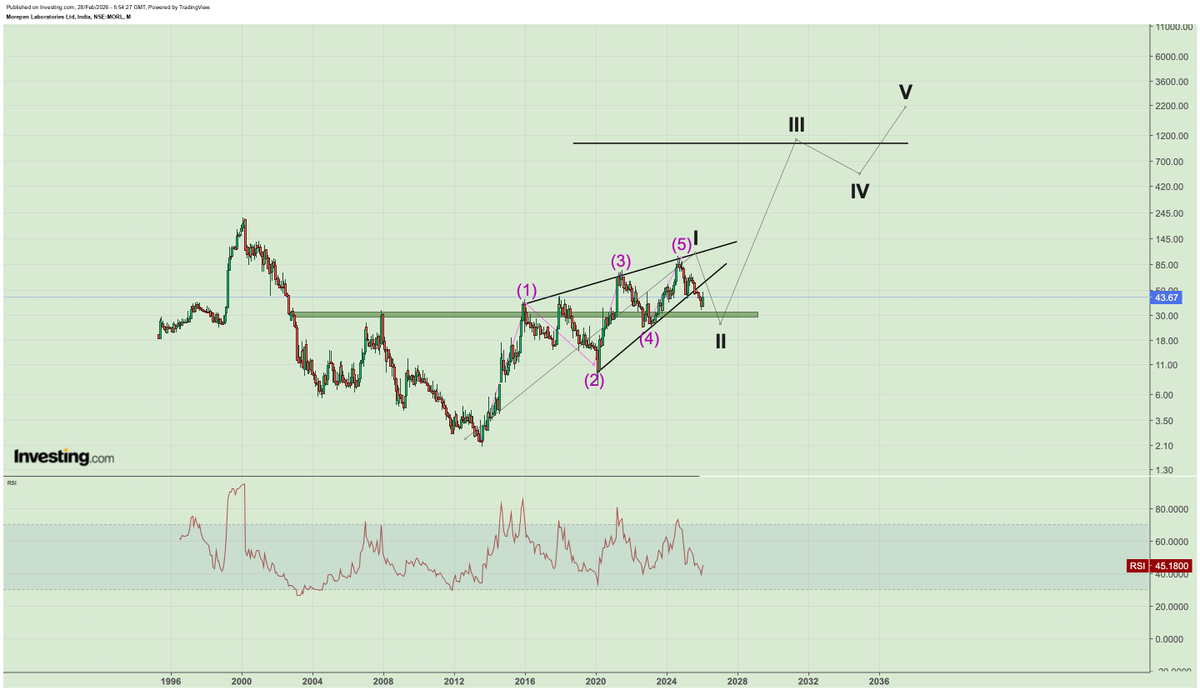
#morepen laboratories
The company is a leader in the pharmaceutical and medical devices industry, holding the top position in 6 APIs
#multibagger possibility
wave I (leading diagonal) ran for 13 years and gave 3500% returns
Wave II is near ending
Wave III is in future and can run for 3-4 years
4500% returns in next 4-5 years possibility
Always remember leading diagonals in wave I gives a very good rally in wave III.
Bookmark this tweet
A pharma company just did 3x EBITDA growth and 4x profit growth in one quarter. Let's talk about Morepen Laboratories.
You probably know Morepen for one thing: Burnol. The burn cream in every Indian household medicine box for 75 years. That's the least interesting part of this story now.
Morepen actually runs three businesses: APIs, Medical Devices (glucometers, BP monitors), and now — a brand new CDMO (contract manufacturing) business.
Think of APIs like Morepen being a spice supplier to restaurants — necessary, but commoditized, and price wars with China have hurt them for years.
CDMO is different. Instead of selling generic "spice," global pharma companies pay Morepen to be their dedicated, long-term kitchen — building one specific drug, for one specific customer, for years. Higher margin, way more predictable.
Here's the number that matters: a ₹825 Cr CDMO mandate has now entered COMMERCIAL supply. Not trial batches. Not "in talks." Actual paid dispatches: ₹58 Cr already shipped this quarter.
That's still early — only ~7% of the total mandate value has shipped so far. But it's the difference between a promise and proof.
Meanwhile the old API business, which had been bleeding on Chinese pricing for 2 years, is bouncing back hard: +31% growth this quarter, with exports up 42%.
And the boring-but-beautiful third leg: Medical Devices. 20 million glucometers in Indian homes, 500 million test strips sold every year. That's Gillette-razor economics — sell the meter once, sell strips forever. +19% growth this quarter.
Put it together and Q1 FY27 revenue hit ₹575 Cr — the highest quarterly revenue in company history.
Revenue: ₹575.31 Cr vs ₹429.64 Cr a year ago. That's +34% YoY.
EBITDA: ₹87.72 Cr vs ₹28.58 Cr a year ago. That's +207% — more than 3x.
Net Profit: ₹56.35 Cr vs ₹11.41 Cr a year ago. That's +394% — nearly 5x.
EBITDA margin: 6.65% → 15.25%. More than DOUBLED in one year (2.3x).
Export revenue: +111% YoY. Morepen is deliberately prioritising higher-value, higher-margin customers over volume.
And they're not treating this as a one-off. Capacity roadmap: 600 KL by Q2 FY27 → 800 KL by FY28 → 1,000 KL by FY29 → 1,200 KL by FY30. That's DOUBLE the current capacity in 4 years.
The moat: 4 straight USFDA inspections with ZERO 483 observations. In pharma manufacturing, that's a rare, hard-earned trust signal — it's literally why global companies are willing to hand Morepen an ₹825 Cr mandate.
Add EDQM, EU-GMP, TGA, ANVISA, China NMPA approvals — this is a company that can legally ship into almost every major regulated pharma market on earth.
The management's own framing: "Old Morepen" = commodity pricing, quarterly volatility, transaction-based, volatile earnings. "Morepen 2.0" = long-duration CDMO, recurring programmes, predictable earnings.
That's the whole re-rating thesis in one slide: less "trading company selling chemicals," more "annuity-style manufacturing partner."
In May 2025, this SAME management guided to 10–15% revenue growth and 11–12% EBITDA margin for FY26.
What actually happened in FY26? Revenue was FLAT (-0.3%). EBITDA margin came in around 7%, not 11-12%. Net profit fell ~19%.
So the "guidance vs reality" scorecard on this stock is currently 0-for-1. Q1 FY27 might be the start of a real turnaround — or it might be one good quarter after a bad year. We don't know yet.
More red flags: ROCE has been wildly inconsistent — 3%, then 23%, then 8%, then 17%, then 15%, then 8% again in FY26. That's not the smooth "ROE keeps improving" chart quality-investors look for.
Bigger one: Free Cash Flow has been NEGATIVE for three straight years — FY24, FY25, FY26. Capex has outrun cash generated from operations every single year.
That capex was funded by a 2024 QIP. But in FY26, borrowings jumped from ₹29 Cr to ₹105 Cr — up 262%. Debt is now doing some of the funding work equity used to do.
A microcap crane-rental company grew EBITDA 220% in one year, quadrupled its fleet in 2 years. Let's dig into Trishakti Industries — the good, the great, and the red flags.
Client concentration is real — a handful of large names (L&T, Reliance, Tata, Jindal) drive most of the business. Good for payment discipline, risky if even one pauses capex.