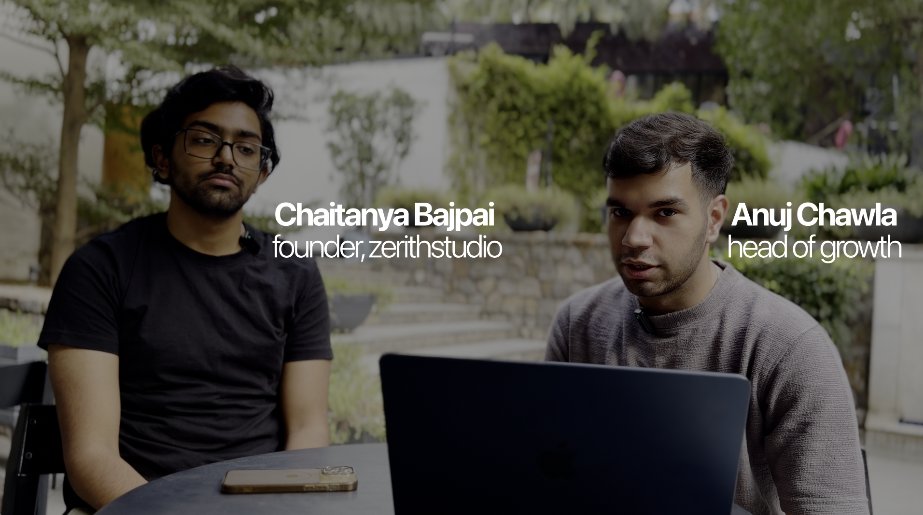
Giving everyone an AI coding assistant doesn’t make a company AI-native. We think the bar should be considerably higher. @zerithstudio https://t.co/qeheg1TC0o
i'm anuj, head of growth and media at @zerithstudio.
i used claude code to build an agentic video editing workflow and edited 28 minutes of footage.
here's how i did it.
the next project i'm taking on might just be the biggest thing i've worked on as a protocol engineer.
building out the settlement layer for an entire exchange on Solana, from on-chain custody and batched settlement to accounting, reconciliation and all the infrastructure that makes it reliable.
feels like everything i've learned about distributed systems, financial markets and blockchains over the years has been leading up to something like this.
very, very excited.
from an idea to execution. in just 4 months.
built from zero by a team that chose to bet on the vision, move fast, and turn ideas into reality.
the best part of building isn't just what you ship. it's the people who grow with you, take ownership and respect.
at the core of it, a young creative @anujonchain who's been given the freedom to ideate, experiment and turn ideas into something real.
this is everything we did to scale @zerithstudio from zero in the last 4 months
00:00 Intro
00:22 Why Zerith started
01:09 What "AI-native" means
02:35 How we operate: tools and content
04:15 Business problem → technical solution
08:41 The engineering: scope and MVP
11:07 Taking it to production
12:25 Domains we build across
13:13 Entering a new domain
14:40 The loop: distribution, execution, learning
20:03 The team
23:54 Biggest lessons
27:27 Wrap
i was never hired with an interview yet i was hired making my presence in tech startups count first.
i'm quietly very excited about the coming months.
i'm working on the biggest project of my life yet at @zerithstudio, and i don't think i've fully processed what that means to me.
there's something special about working at a startup where you get the privilege to bring an idea to life, ship it into the world and have the creative liberty to build things the way you envision them.
just an idea, a team, and the responsibility to make shit happen. dropping soon.
you should own your opinions. most people don't actually have first principles knowledge of what they're building.
they have a stack of abstractions inherited from people they follow, frame works they've read, posts that perform well on twitter.
zerith studio apart from services is also consultancy inherent. we've tested this ourselves to break this dangerous abstraction compounding.
the key is simple. build, observe, get feedbacks, update your model, build again.
your own feedback loop is worth more than 1,000 opinions on the timeline.
the stablecoin thesis gets much more interesting once you stop looking at stablecoins purely as payment rails.
stablecoins put dollars onchain, but tokenized treasuries are beginning to put something arguably more important onchain: the risk-free rate.
crypto historically hasn’t had a particularly clean reference price for capital. a protocol offering 8% and another offering 12% could reflect some combination of leverage demand, token incentives, liquidity risk, smart contract risk and temporary market conditions. “yield” existed everywhere, but there wasn’t always a coherent baseline underneath it.
once capital can move between idle stablecoins, tokenized treasuries earning something close to the short-term government rate, lending markets, fixed-rate products and progressively riskier credit, that changes. DeFi starts developing an actual term and risk structure for dollar capital.
if an onchain treasury yields 4%, lending at 4.5% against meaningfully riskier collateral suddenly has to justify that extra 50bps. an LP position has to compensate you for inventory and smart contract risk relative to simply holding treasuries. liquidity incentives stop being “8% APY” in isolation and start being decomposable into the baseline return on capital + compensation for the risks you’re taking.
the second-order effect is that idle liquidity itself becomes expensive. protocols increasingly have an incentive to make yield-bearing assets usable directly as collateral, liquidity and settlement assets rather than forcing capital to become unproductive every time it moves through the system.
stablecoins may end up owning transaction settlement while tokenized treasuries and other yield-bearing assets increasingly own capital storage, with DeFi sitting above both and pricing liquidity, duration and credit risk.
stablecoins put the dollar onchain. tokenized treasuries put the price of money onchain.
the latter might end up changing DeFi market structure even more than the former.