Africa, not Australia, has the biggest fire signal on Earth right now.
The latest 24-hour NOAA-20 VIIRS file shows 65,697 hotspots over Africa — about 4 times Australia's 15,420 in the same file. Many are seasonal burns, not wildfires.
Data: NASA FIRMS (Nov 10–11)
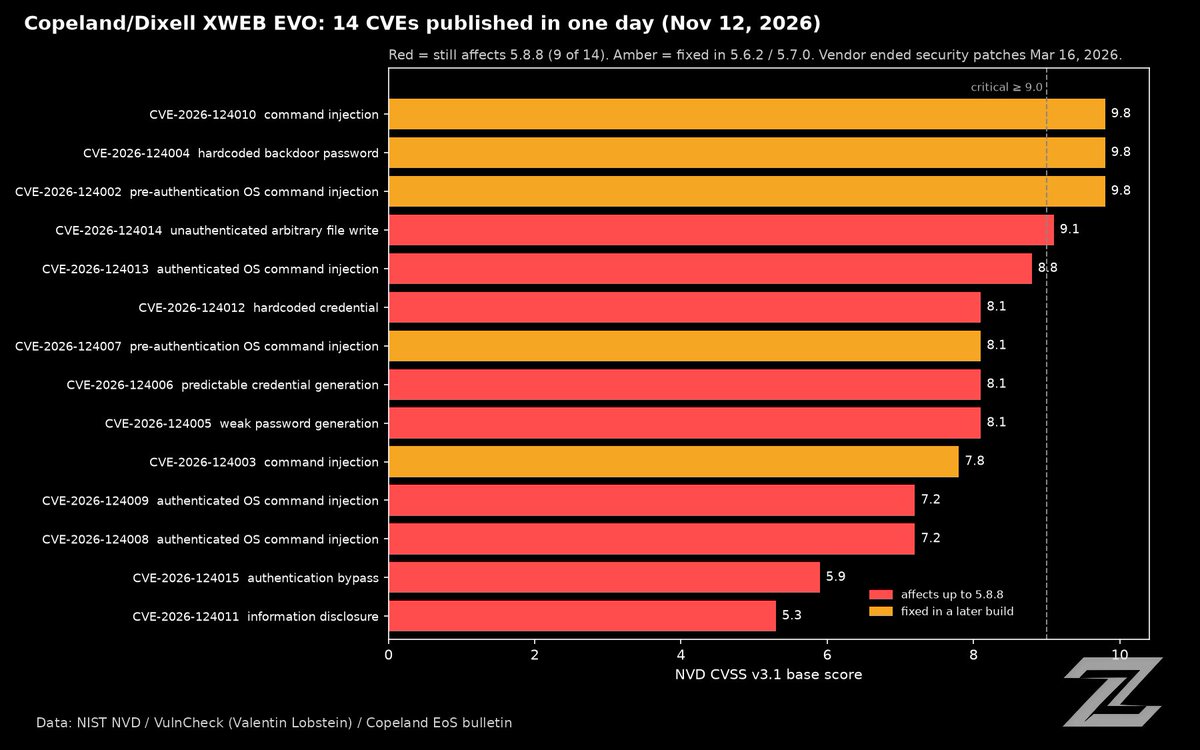
14 CVEs in one day for servers that run commercial refrigeration.
Copeland's XWEB EVO: the admin password derives from MAC + date, and the pre-login page leaks both. 9 of 14 flaws hit 5.8.8. Patches ended Mar 16.
Data: NVD, VulnCheck (V. Lobstein) https://t.co/094cbDlxtx
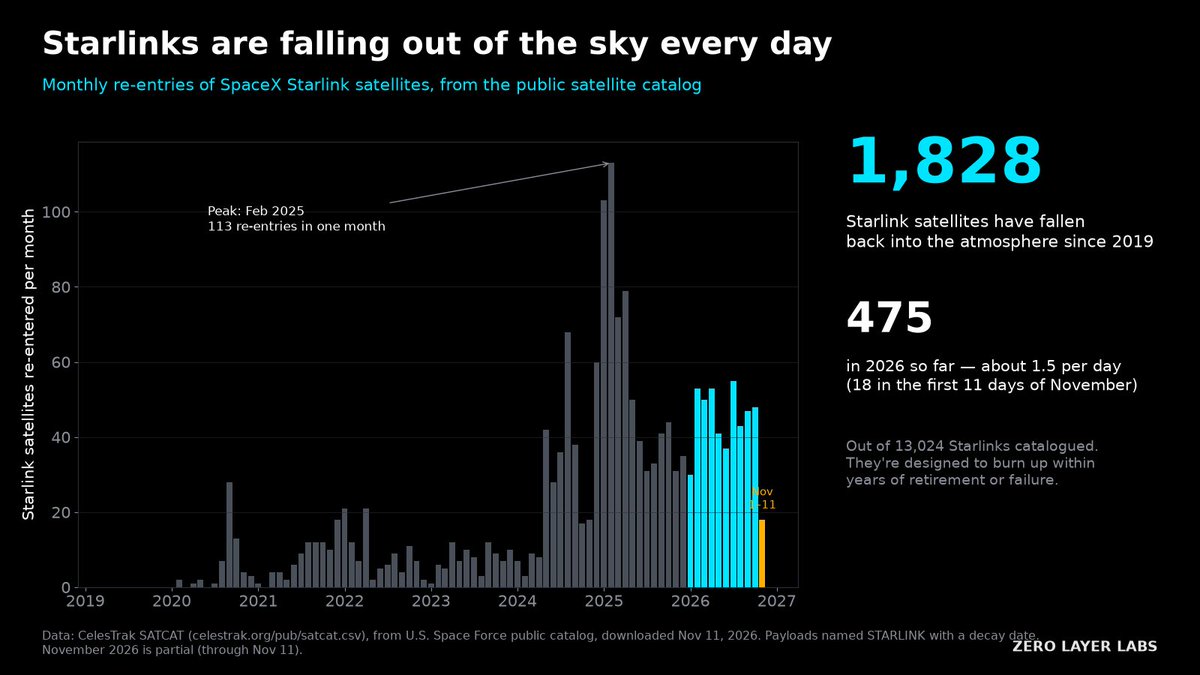
About 1.5 Starlink satellites fall back into the atmosphere every day.
475 have re-entered in 2026 so far. 1,828 since 2019.
We pulled every decay date from the public catalog and charted them.
Data: CelesTrak SATCAT (U.S. Space Force)
A satellite built to photograph Earth just caught 76 objects in orbit around it.
Researchers dug through 21 minutes of raw Sentinel-1 radar echoes (Oct 29–Nov 3) and found satellites, rocket bodies and debris. The closest, 41.7 km away, was a fragment from China's 2007 anti-satellite test.
Why it matters: radar echoes fade with distance⁴, so that fragment returned ~19,500× more power than an identical object at 493 km. A radar already in orbit is close to the junk. On paper, Sentinel-1 could sense ~3.4 mm debris at 10 km.
Fitting: Sentinel-1A was itself hit by a ~1 cm fragment in 2016.
Preprint, not yet peer-reviewed: Vierinen et al., UiT
https://t.co/anRtDhKYr3
Should every Earth-observing radar double as a debris detector?
JWST just checked the nearest pair of rocky planets that cross their star, 22 light-years away.
LTT 1445 A b looks like bare rock: a ~528 K dayside at 15 µm, matching a dark, airless surface. CO₂ under 0.6 mbar, surface pressure ≲0.1 bar.
Its sibling c: only a thick CO₂ atmosphere is ruled out.
The team says b is the closest planet yet to the predicted "cosmic shoreline", where planets lose their air, to be measured this way.
Preprint: https://t.co/v0luE9yWW3
BREAKING: German drone maker Quantum Systems confirms an "active cyberattack by hostile actors," found in late Oct. FT/Spiegel: malware posing as a QBase update reached Bundeswehr servers, not the drones; fleet grounded as a precaution. No attacker named.
https://t.co/9jMf86yoG3
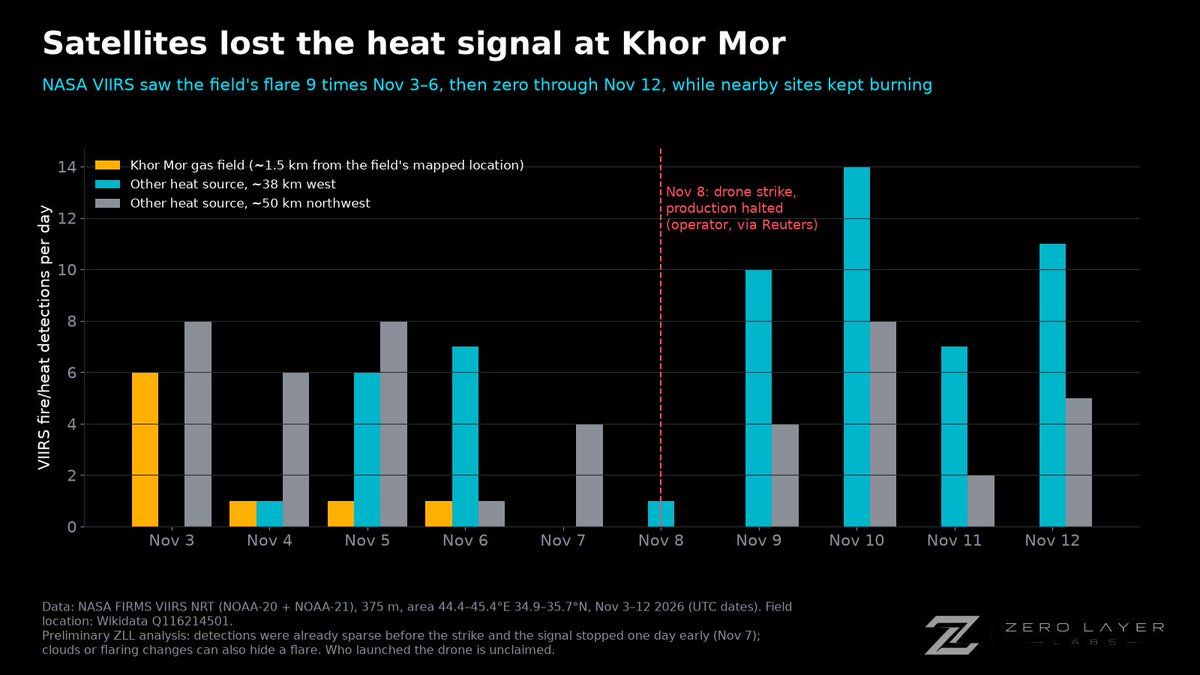
NASA satellites saw the gas flare at Iraq's Khor Mor field 9 times Nov 3–6. Since then: zero, while 2 nearby heat sources kept showing up.
A drone hit the field Nov 8. The KRG electricity ministry says 2,500–2,800 MW went off the grid.
Preliminary ZLL read of NASA FIRMS ↓
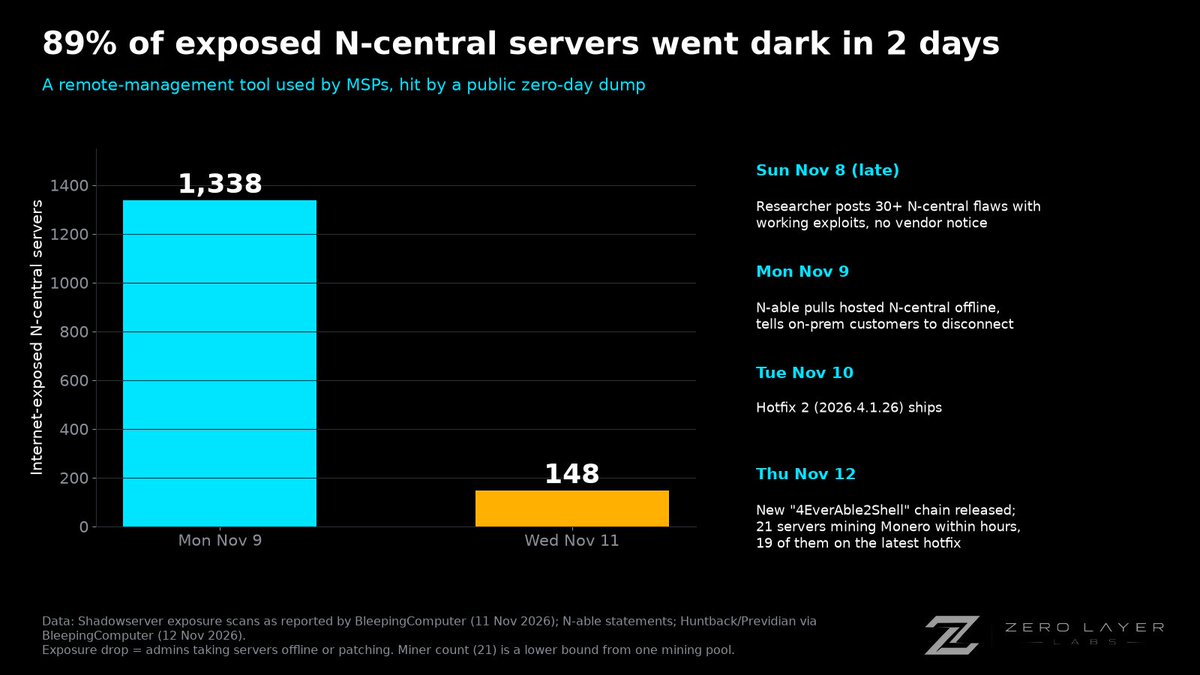
1,338 → 148.
That's how many N-central servers Shadowserver saw online before and after a researcher dumped 30+ zero-days with working exploits.
Admins pulled the plug. Then a new chain dropped Thursday: within hours, 21 servers were mining Monero, 19 on the latest hotfix.
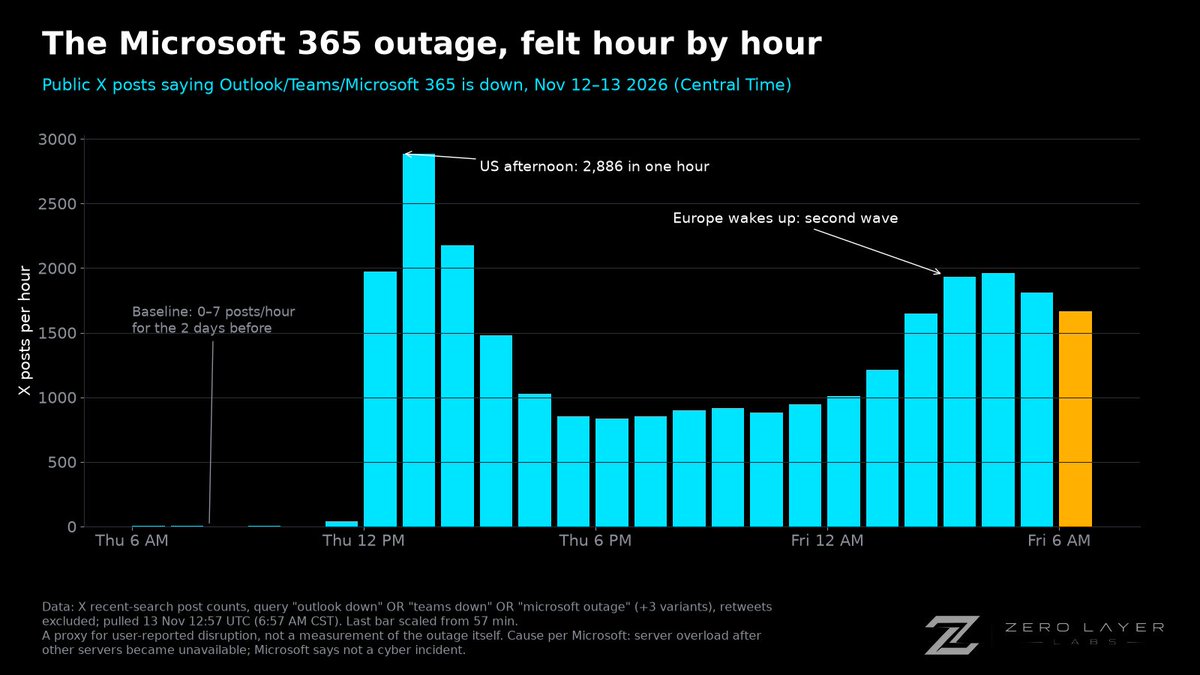
Thursday around noon CT, posts saying Outlook or Teams was down jumped from about 2 an hour to 1,974. The next hour: 2,886.
19 hours later they haven't stopped. A second wave hit as Europe logged on.
Microsoft says it's server overload, not a cyberattack.
An iceberg about 52 × 46 km just slid past South Georgia.
A-81 broke off Antarctica in Jan 2023. Satellites have tracked it ~4,500 km since — out of the Weddell Sea and into the Southern Ocean.
Data: U.S. National Ice Center / NASA EONET (positions as of Nov 6)
India is still ramming into Asia. So why did Tibet's M7.0 on Oct 22 pull the crust apart?
USGS models a normal fault: up to ~5.5 m of slip across a 60 × 31.5 km plane, plus 42 M2.5+ aftershocks since. The high plateau is stretching east–west.
Data: USGS https://t.co/JkwTHBDzei
2026's Antarctic ozone hole was the 7th largest in 48 years of monitoring.
Peak: 27.1 million km² on Sep 18, fueled by an unusually strong polar vortex.
But it wasn't as deep as past big holes. Recovery is expected by the 2070s.
Data: NASA Ozone Watch https://t.co/TeRKTufGlH
TSMC employee data was hacked and put up for sale today.
• Seller claims ~46K employee records, asking 3 BTC
• TSMC: data matches a cloud vendor's system
• TSMC says no sign its own systems or fab/customer data were hit
Source: TSMC SEC Form 6-K, Nov 12
Europe is about to see its weather from space every 2.5 minutes.
In a 45-hour test from Nov 3, the new MTG-I2 satellite caught fog over central Europe, storms over the Mediterranean, and wildfire smoke in Portugal.
Ops start Q2 2027.
Data: EUMETSAT https://t.co/KANMP5ZeOx
About 12% of the tropical ocean is now hot enough for severe coral bleaching, per NOAA satellite alerts.
That's ocean area, not reefs. Over half of it is in the eastern Pacific, where El Niño is near record strength.
Data: NOAA Coral Reef Watch, Nov 11
https://t.co/IfPF26ta19
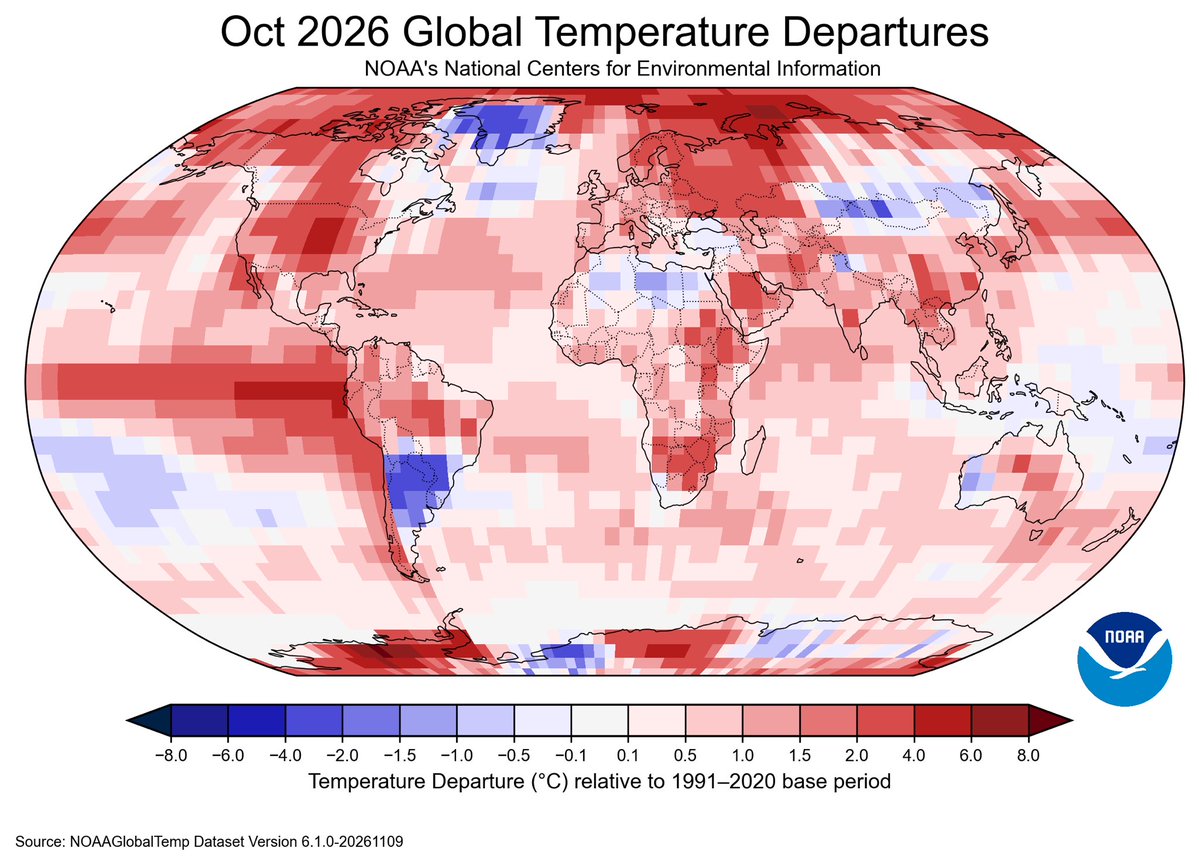
NOAA, out today: October 2026 was the hottest month vs. normal in 177 years of records.
+1.43 °C above the 20th-century average
Ocean temps hit a record for the 5th month in a row
11 major tropical cyclones formed in October, a record
El Niño is driving it.
Credit: @NOAANCEI
A supernova just went off in a galaxy only ~29 million light-years away, and it's still brightening.
SN 2026ahvu is a Type Ia, a white dwarf blowing itself apart, in barred spiral NGC 1433 (~9 Mpc).
• ATLAS caught it Nov 2 at mag 17.1, and it hit ~16.0 a day later
• Keck spectra say it was found young, before peak
• NSF NOIRLab has a multi-telescope campaign running
For scale: SN 2011fe was 6.4 Mpc away and SN 2014J 3.5 Mpc. This is one of the closest in years.
Southern-sky only (Dec −47°).
Source: https://t.co/brONDmga20
The nor'easter also produced a tornado.
NWS: radar and video confirm a tornado near Christiana Hospital, New Castle County, Del., around 1:15 p.m. EST. A probable tornado later collapsed a barn and garage in Chesterfield, N.J.
SPC / NWS Mount Holly
https://t.co/31J2WV7Dbn
Two lows, one nor'easter.
WPC/OPC 2100 UTC: 992 mb at the NY/NJ coast, 997 mb inland. Gale Warnings: gusts to 40 kt, seas 6–11 ft. 2–5 in of snow above 1,500 ft in the Catskills.
GOES-19 + NWS radar, 1 a.m.–7 p.m. CST
@NOAASatellites / NWS
https://t.co/bKVro7aJlN
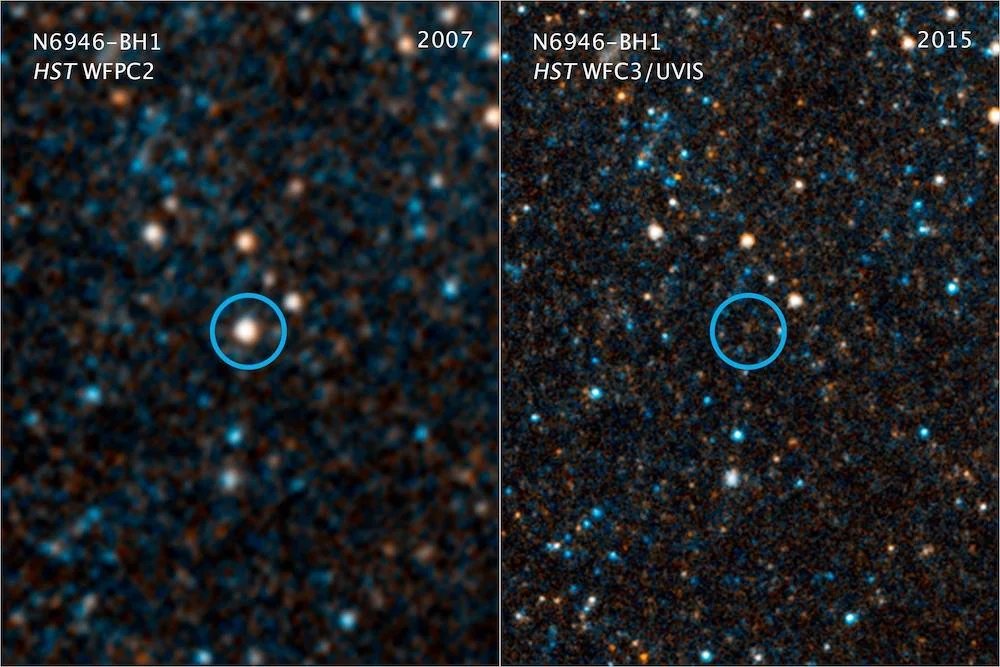
Hubble saw a star collapse directly into a black hole, no supernova.
When the most massive stars in the universe die, they often detonate in fiery supernovae, dramatically blasting most of their matter into space. The remaining stellar cores collapse into neutron stars and, sometimes, black holes.
However, theories suggest that some massive stars might die without a bang, instead directly collapsing inward to become neutron stars or black holes.
[Credit: NASA/ESA/C. Kochanek (OSU)]