Letting 900 staff build AI skills without access controls turns into a mess fast. We ended up with 221 skills and zero clarity on who could run what. @ughhnsh and I hopped on @Analyticsindiam to walk through the architecture behind Deriv One: https://t.co/XJKxSpgHYP
Nvidia loses $1T in market cap, Jensen resigns over an affair scandal, and staff still left 1,600+ comments petitioning to bring him back. Either he's the greatest boss ever or everyone's terrified for their RSUs in this economy.
https://t.co/14xgI3blz1
Peak Twitter hype. Burning tokens to have AI move virtual mice to "build" a layout is absurdly inefficient.
Don't waste a swarm on build theater. Turn it into an aggressive QA swarm to hammer race conditions and trash your state manager instead
Everyone wants to let their team build agents until one runs wild in prod.
You don't bolt sandboxing and access control on after the fact, you design for it from day zero. That's why we built Deriv One, and why we're open-sourcing it.
Have a look inside the stack:
Meet Deriv One, our open-source enterprise AI platform for building agents, skills, automations, and internal apps—with built-in access control and sandboxing.
Bring your own models, run it on your infrastructure. ⚡️
Here’s how we built it. https://t.co/ZkM5xiSz0z
The hardest part of running agents at scale isn't the prompting, it's state isolation, runaway loops, and tool orchestration.
If you already speak kubectl, this is worth paying attention to early. Infra like this is literally about to separate the vibe coders from actual prod
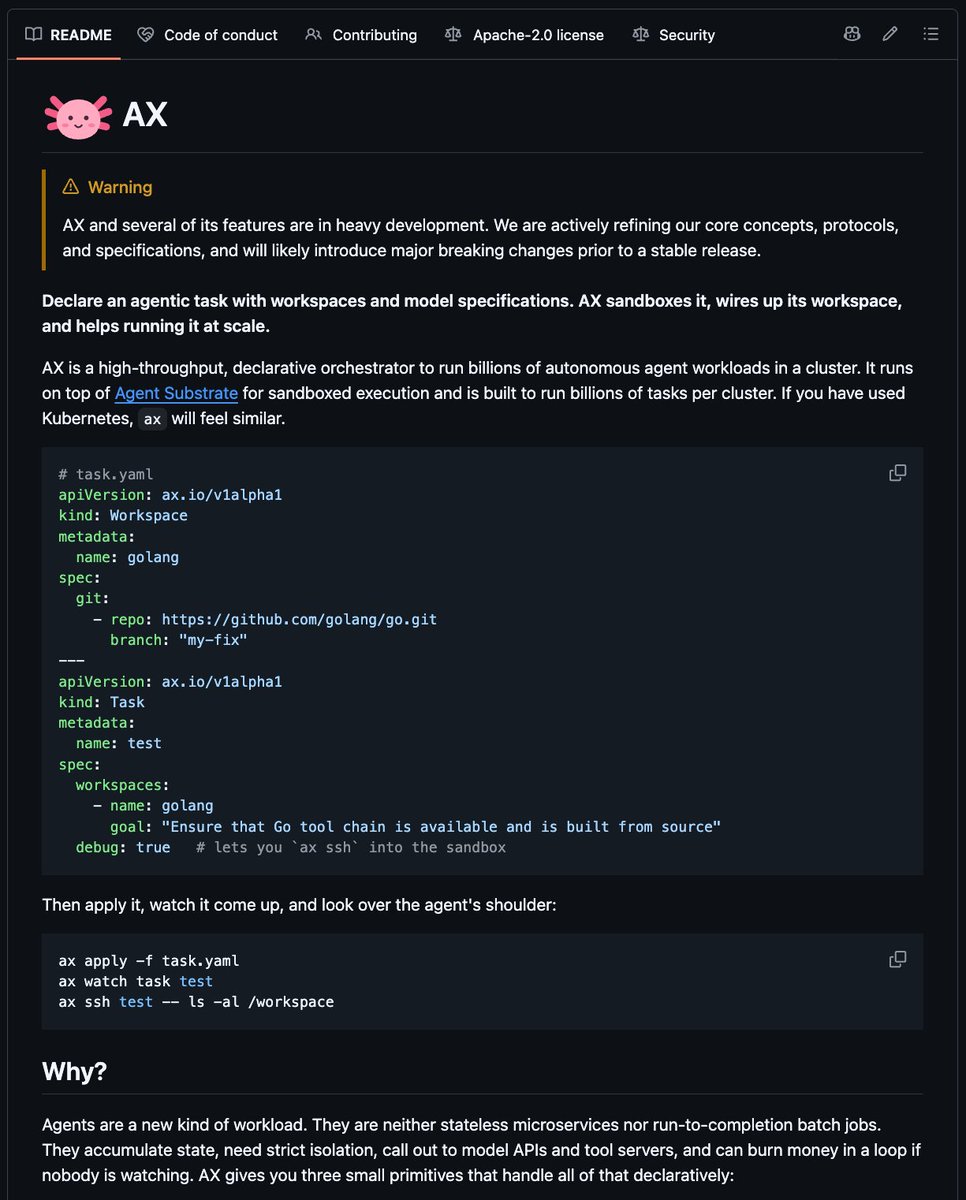
Google just open-sourced something absolutely insane.
It's called AX, and it's designed to orchestrate BILLIONS of autonomous AI agent tasks.
Think Kubernetes but built for agents instead of apps.
Here's why this matters:
Agents are a brand new kind of workload. They're not microservices. They're not batch jobs. They hold state, need strict isolation, call models and tools nonstop, and can burn through your money in a loop if nobody's watching
How it works:
- You write one YAML file. Declare the task, the workspace, and the model
- AX spins up a sandbox, wires in your Git repos, MCP servers, and skills so every agent starts warm
- You run "ax apply" and the agent goes to work
- "ax ssh" lets you shell into a running agent and watch it think
- "ax suspend" pauses an idle agent. "ax resume" picks up exactly where it left off
If you've ever used kubectl, you already know how to use this
13.5K stars already. Apache 2.0. Free forever
Here's what I'd do this weekend:
1. Spin up a small Kubernetes cluster
2. Install Agent Substrate (AX runs on top of it)
3. Run the demo script so you see the full lifecycle end to end
4. Point one agent at a real repo and give it a real goal
It's early. Google says breaking changes are coming before a stable release. Doesn't matter
The people who learn agent infrastructure now are the ones who'll run 1,000 agents while everyone else is still babysitting one
https://t.co/apru4DsXvM
Quarterly planning is a scam to hide slow execution. We pulled product into a room with our engineering team for 48 hours at HQ. Agents drafted the initial builds before anyone caught their flights home.
If AI integration takes 3 months, it's already obsolete
Product and engineering spent two days at the same table with AI in every pair of hands.
Result: a plan with a shipping date, an owner for every product, and the first builds already drafted by the models before anyone flew home.
Most companies would call that a quarter. We called it Tuesday and Wednesday. 😏
@riabche@DerivDotTech Thanks! If you don't constrain the exchange itself, app-level guardrails are just security theater. It's something so many people miss out on
Cutting out the tab-switching for rapid threat checks is a huge win for day-to-day security workflows but also opening it up to the normal user who just needs to make sure a link is safe
You can now train your own Decision model with our free notebook! 💡
Qwen3.5-4B will generate decisions instead of text on just 8GB VRAM locally.
Learn to data prep (state, questions, gold answers), train, serve.
Notebook: https://t.co/avk6G2zyob
Guide: https://t.co/eNy4Ue0btG
Generative models make terrible routers. They're slow, burn stupid amounts of tokens, and overcomplicate basic binary logic.
We swapped ours for decision models in prod last week. Latency dropped off a cliff, but the failure modes are totally different. Real breakdown:
Using an LLM to pick an option from a list is a massive waste of compute.
Three weeks ago TypeSafe dropped Jev: a model that can't write a single word. It picks from answers you give it and spits out a probability. Now OpenAI, AWS, Cloudflare and Perplexity are all shipping their own.
We put it straight into prod last week to see if it's real or just vendor noise.
[1/4]
JEV + OPUS 5.5 + ONE ROUTER = A STACK THAT NEVER PAYS FOR A DECISION AGAIN
the whole idea of jev engineering: the model that decides is not the model that writes, and they were never supposed to be the same bill.
jev takes every yes, no, route and score
opus 5.5 only wakes when something actually needs a sentence
one line decides which call goes where
here is what sits inside:
- the router (the only thing that sees every call)
> https://t.co/5nlw8nDM1h - one call in, a typed verdict out, no model picked yet
> policy.md - what is allowed to reach a paid model, what dies at jev
> costs.log - every call priced live, so the meter is never a surprise
- the decider · jev
> 70ms a call, output billed at zero because it never writes a token
> returns a typed value with a confidence score, not a paragraph to parse
> 1,204,882 decisions today, 6 escalated, the rest closed right here
- the writer · opus 5.5 and gpt-6 astra
> only fires when jev flags "this needs prose" or "confidence too low"
> the four-figure part of the bill, now touched a few times a day, not every call
> same models, same quality, a rounding error of the volume
- the ledger
> append-only, every verdict timestamped and sourced
> a wrong call is never rewritten, a new one lands on top and outvotes it
> rebuild the whole index from the log in 8 seconds
1,204,882 decisions in. 6 of them cost real money.
here is the part nobody prices out: a decision that never becomes a sentence cannot be wrong and cannot bill output, because there is no output. you were not paying opus for intelligence on those calls, you were paying it to write down an answer it already had.
worth stealing even if you never drop opus: put jev in front of it. ninety-nine percent of your calls die before they reach the meter, and the invoice stops being a mystery.
the full jev engineering build is in the article below.
Static credentials for AI agents are an architectural disaster waiting to happen.
We believe in security through transparency, so I wrote up our open blueprint for keyless identity and dynamic RBAC
https://t.co/ROHm8aKDTu