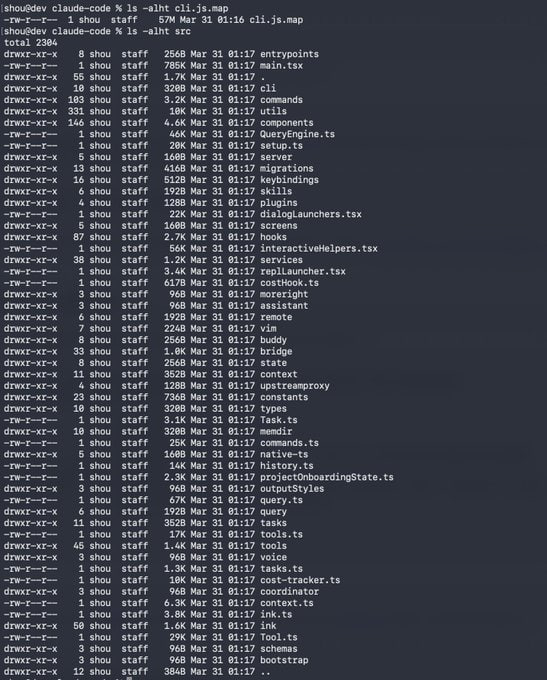
Anthropic accidentally leaked their entire source code yesterday. What happened next is one of the most insane stories in tech history.
> Anthropic pushed a software update for Claude Code at 4AM.
> A debugging file was accidentally bundled inside it.
> That file contained 512,000 lines of their proprietary source code.
> A researcher named Chaofan Shou spotted it within minutes and posted the download link on X.
> 21 million people have seen the thread.
> The entire codebase was downloaded, copied and mirrored across GitHub before Anthropic's team had even woken up.
> Anthropic pulled the package and started firing DMCA takedowns at every repo hosting it.
> That's when a Korean developer named Sigrid Jin woke up at 4AM to his phone blowing up.
> He is the most active Claude Code user in the world with the Wall Street Journal reporting he personally used 25 billion tokens last year.
> His girlfriend was worried he'd get sued just for having the code on his machine.
> So he did what any engineer would do.
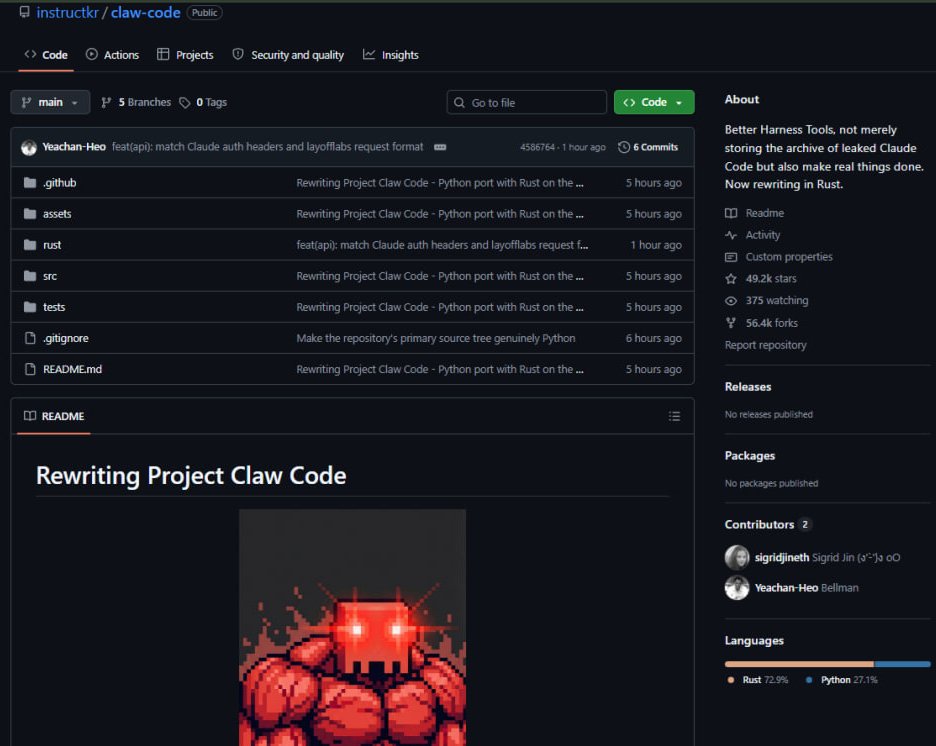
> He rewrote the entire thing in Python from scratch before sunrise.
> Called it claw-code and Pushed it to GitHub.
> A Python rewrite is a new creative work. DMCA can't touch it.
> The repo hit 30,000 stars faster than any repository in GitHub history.
> He wasn't satisfied. He started rewriting it again in Rust.
> It now has 49,000 stars and 56,000 forks.
> Someone mirrored the original to a decentralised platform with one message, "will never be taken down."
> The code is now permanent. Anthropic cannot get it back.
Anthropic built a system called Undercover Mode specifically to stop Claude from leaking internal secrets. Then they leaked their own source code themselves. You cannot make this up.
Academic publishing is perhaps the greatest scam perpetrated on intelligent people
1) Write grants (unpaid)
2) Do research
3) Write papers
4) Peer review (unpaid)
5) PAY up to $12K to publish
6) Need publications to get grants (back to step 1)
Publishers: 38% profit margins
🚀Bilgisayar Mühendisliğinde Özel Konular Seminerleri devam ediyor!
🔍Dördüncü seminerde konuğumuz Dr. @zeynebkurt , biyolojik verilerin analizi, görselleştirilmesi ve yorumlanmasında kullanılan istatistiksel, matematiksel ve makine öğrenmesi temelli yöntemleri bizlerle paylaşacak. Ayrıca biyoenformatik alanındaki problem çözüm yaklaşımları, gerçek dünyadan alınan projelerle örneklendirilecek ve sunulacaktır.
🧬28 Mayıs Çarşamba D-111'de görüşmek üzere!
Our recent explainable-AI paper is available in Current Bioinformatics. We used an attention-based transformer and squeeze-excitation framework to 'explain' how the decisions were made in 'colon cancer stage prediction' using multimodal biological data +👇
Want to read about burnout risk indicators for NHS health and social care professionals? Here is our recent paper, published in @PLOSONE. Self compassion & sense of connectedness to others are among the most significant factors underlying burnout https://t.co/V4i1IFhKTa
Cell-cell interactions observed for synthetic cells generated by FB model were closely resembling those of the original data. Here is the full story: https://t.co/vRG4cEH0Qz
We explored 4 generative AI models to create synthetic cell profiles for under-represented cell types in single-cell RNA-sequencing datasets. The Flow-based (FB) model consistently outperformed others, including the variational autoencoder, across all experimental setups in +👇
cell type classification task & produced biologically more relevant synthetic cells. We also identified pairs of ligands & receptors representing the crosstalk between distinct cell types. + 👇
Our new paper is now available in PLOS One. We used MCF-10A, MCF-7, and MDA-MB-231 cell lines to show that the microRNA let-7b-5p inhibits cancer cells through the Aurora Kinase B (AURKB) gene and sensitizes them to doxorubicin resistance in breast cancer: https://t.co/9Jp1ebvqkq
My PhD student Olalekan Ogundipe’s work is published today. In this study Olalekan has integrated H&E stained histopathological images along with three types of functional genomics data to predict colon cancer and survival rates. Enjoy the read:
https://t.co/kkPhbSqmUn
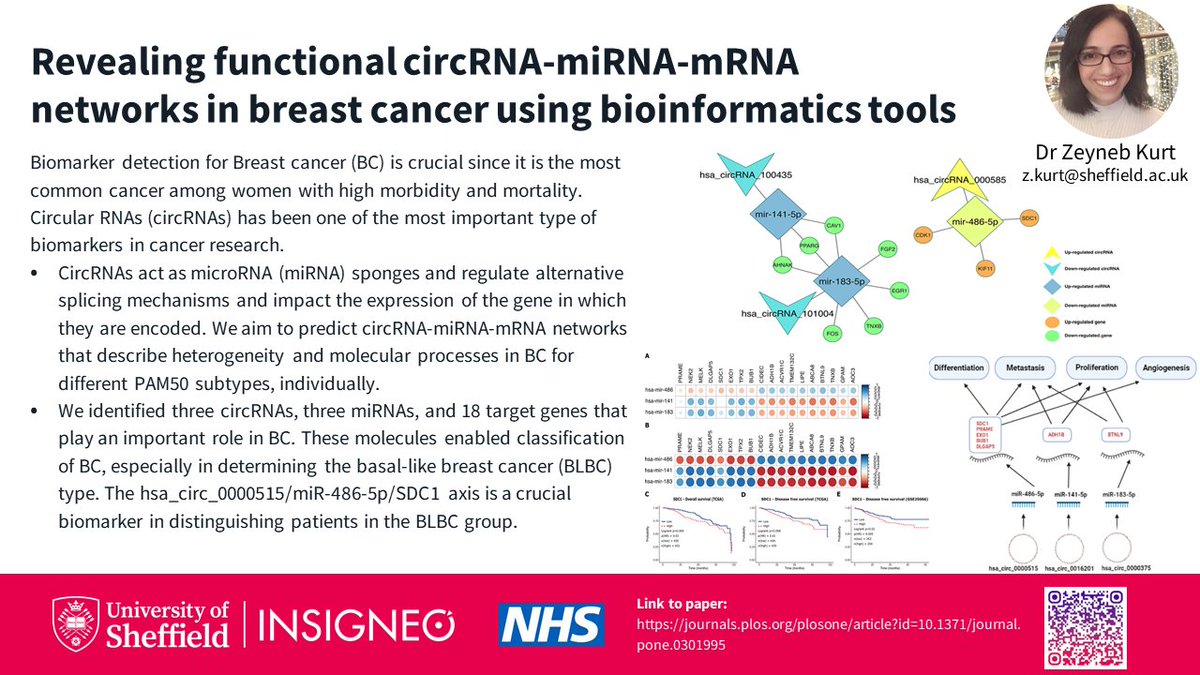
#InsigneoResearchSnapshot 10: Revealing functional circRNA-miRNA-mRNA networks in Breast Cancer using #bioinformatics tools.
Biomarker detetection for #breastcancer is crucial & circular RNAs are an important type of biomarker in cancer research.
🔗https://t.co/9WfHs8jZg8
Thrilled by the success of the Second Workshop on Multimodal AI! 🎉 Thanks to everyone who joined and made it impactful. More updates, photos, and videos are coming in the next few weeks. Stay tuned! #MultimodalAI24#AIResearch#GreenSheffield
Excited to join the @PLOSONE Editorial Board, an #OpenScience journal publishing trusted research in over 200 subject areas across science, engineering, medicine and the related social sciences and humanities.
We identified three circRNAs, three miRNAs, and 18 candidate target genes that play an important role in breast cancer, and the hsa_circ_0000515/miR-486-5p/SDC1 axis is a candidate biomarker for identification of the “basal-like” breast cancer.
Our recent paper is now available on:
https://t.co/W2E7678xMZ
Circular RNAs (circRNAs) are evolutionarily conserved and stable RNA regulators that can behave as microRNA (miRNA) sponges and take an active role in the expression of the gene in which they are encoded+