طلب أحد الاخوة شرح مبسط لعمل وكيل الذكاء الاصطناعي
وقلت اسوي له فيديو وارسله له
واستخدمت Claude Code واستخدمت Codex
واعطيتهم نفس الـ Prompt وهذه النتيجة
اعتقد هذه الفيديوهات (كانت) متعبه في انشائها
واليوم Claude أخذ حوالي 17 دقيقة، أما Codex حوالي 8 دقائق
و Claude يفوز
🚨 تخيّل تستخدم Claude Code من غير ما تدفع اشتراك!
فيه مشروع على GitHub بيخلّيك توجّه Claude Code لأكتر من 10 مزوّدي نماذج ذكاء اصطناعي مجانًا، منهم DeepSeek وKimi.
والأغرب؟ الإعداد بياخد حوالي 5 دقايق، والمشروع تخطّى 20 ألف مطوّر!
لو بتطوّر بالذكاء الاصطناعي، المشروع ده يستحق إنك تشوفه.
Draw circuit diagrams using Python!
Did you know you can create electrical circuit diagrams with Python instead of drawing them manually?
Using the schemdraw library, you can programmatically create circuit diagrams with components such as:
Batteries and voltage sources
Resistors and capacitors
LEDs and other electronic components
Wires and complete circuit layouts
Why use Schemdraw?
It makes circuit visualization easier, helps automate technical diagrams, and is useful for students, engineers, educators, and Python developers.
Start experimenting with Python and electronics by turning a few lines of code into a visual circuit diagram.
This book is designed for learners, developers, and professionals who want to eliminate repetitive tasks, boost productivity, and build real-world automation systems from scratch.
https://t.co/yWX65Ra3LE
سيبرانيين 👨💻
🏰 تبي تتدرّب على اختبار اختراق
#Active Directory
في بيئة حقيقية بدون ما تبنيها من الصفر؟
مشروع GOAD (Game Of Active Directory)
من Orange Cyberdefense مجاني،
ويعطيك لابات AD مليانة ثغرات
وإعدادات خاطئة جاهزة للتطبيق.
💡 كيف تستفيد منه؟
🔹 الريد تيم: تطبّق هجمات AD الشائعة مثل
Kerberoasting و ACL abuse
وتحركات الـ Lateral Movement
🔹 البلو تيم: تركّب إضافات ELK و Wazuh وتراقب الهجمات وتبني قواعد الرصد (Detection)
🔹 مدراء الأنظمة: تفهم أخطاء الإعداد اللي تفتح ثغرات في بيئتك وتعرف كيف تتجنبها
🔹 التحضير للشهادات: بيئة تدريب ممتازة لشهادات مثل OSCP و CRTP
⚙️ يشتغل على #VirtualBox
و VMware و Proxmox،
أو على السحابة (AWS و Azure)،
وفيه أحجام مختلفة
من اللابات (GOAD، Light، Mini)
حسب إمكانيات جهازك.
⚠️ اللاب ضعيف أمنيًا عن قصد،
فلا تنشره على الإنترنت بدون عزل.
🔗 https://t.co/Ex2GoiU5iG
#سيبرانيين #CyberSecurity #ActiveDirectory
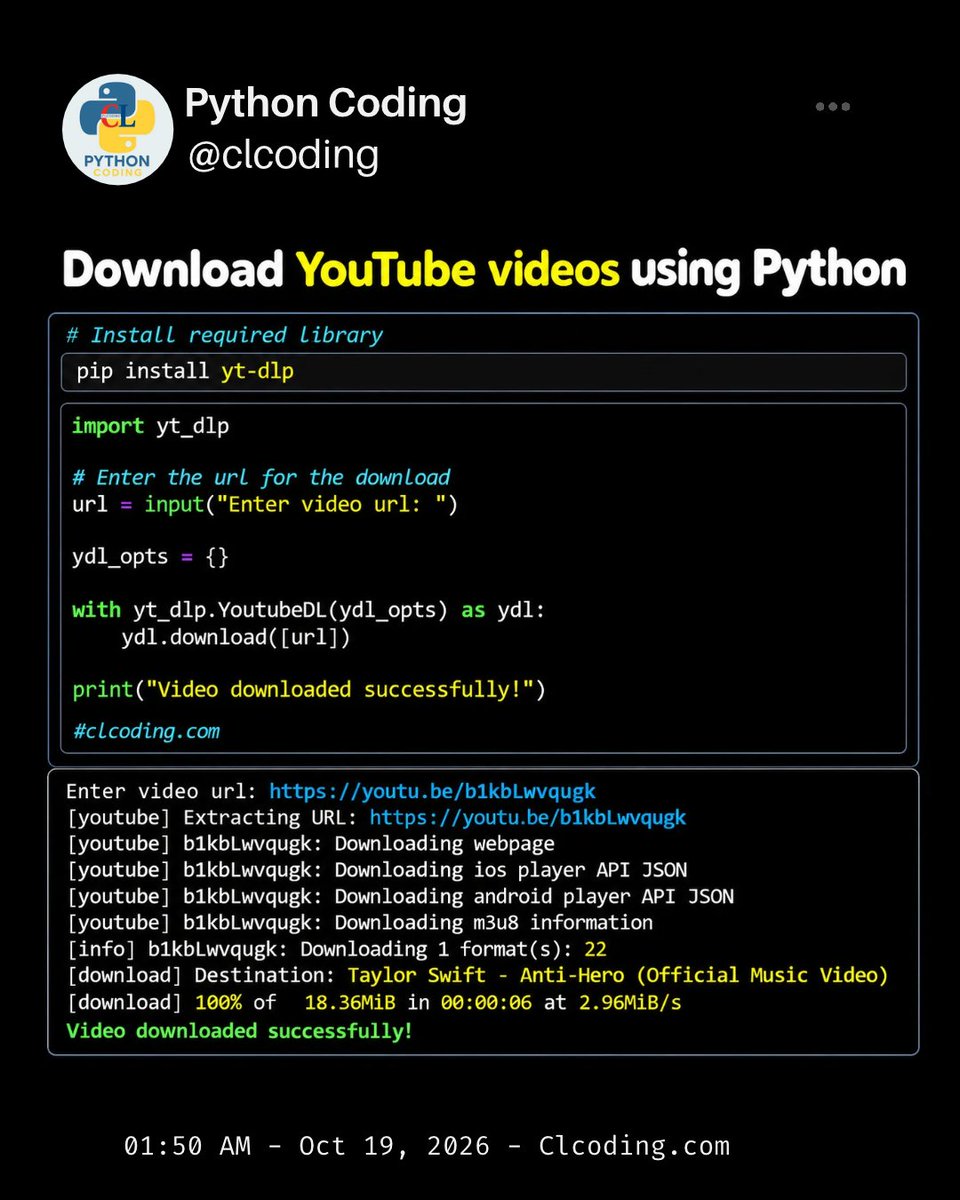
Download YouTube Videos Using Python
Did you know you can download videos using just a few lines of Python code?
With the yt-dlp library, you can build a simple video downloader by following these steps.
Step 1: Install the library
pip install yt-dlp
Step 2: Import the library and enter the video URL.
Step 3: Use YoutubeDL() to download the video.
Step 4: Display a success message when the download is complete.
This is a great Python project for practicing third-party libraries, user input, context managers, and basic automation.
💻 Try it yourself and explore more Python tutorials at https://t.co/SWfkBJdPu7
Load Balancing in System Design
➤ What is Load Balancing?
→ Definition: The process of distributing incoming network traffic across multiple servers to prevent any single server from becoming overloaded.
→ Goal → Improve performance → Increase availability → Distribute workloads → Prevent bottlenecks
→ Load balancers sit between clients and backend servers.
→ Example → 1,000 requests arrive → Load balancer distributes them across 5 healthy servers → Each server handles approximately 200 requests, assuming equal distribution.
➤ How Load Balancing Works
→ Client sends a request → Load balancer receives the request → Checks server health and availability → Selects an appropriate backend server → Forwards the request to that server → Server processes the request and returns a response
→ If a server fails → Health checks detect the failure → Traffic is redirected to healthy servers.
➤ Why Load Balancing Matters
→ Prevents individual servers from becoming overloaded → Improves application responsiveness → Increases availability through server redundancy → Supports horizontal scaling → Enables maintenance with reduced service disruption → Helps applications handle traffic spikes
→ Common use cases → E-commerce → Social media → Streaming platforms → Banking systems → Cloud applications
➤ Types of Load Balancers
→ Layer 4 Load Balancing
→ Operates at the transport layer (TCP/UDP) → Routes traffic using network information such as IP addresses and ports → Offers efficient, low-overhead traffic distribution
→ Layer 7 Load Balancing
→ Operates at the application layer (HTTP/HTTPS) → Routes requests using URLs, headers, cookies, or hostnames → Supports content-based routing and application-aware decisions
→ Hardware Load Balancers
→ Dedicated physical appliances → Common in traditional enterprise infrastructure → Can provide high performance but may increase infrastructure costs
→ Software Load Balancers
→ Run as software on servers or virtual machines → Flexible and configurable → Examples → NGINX → HAProxy → Envoy
→ Cloud Load Balancers
→ Managed load-balancing services offered by cloud providers → Examples → AWS Elastic Load Balancing → Google Cloud Load Balancing → Azure Load Balancer
➤ Common Load Balancing Algorithms
→ Round Robin
→ Sends requests to servers in a repeating sequence → Best for servers with similar capacity and relatively uniform workloads
→ Weighted Round Robin
→ Assigns more requests to servers with higher weights → Useful when backend servers have different capacities
→ Least Connections
→ Routes traffic to the server with the fewest active connections → Useful when requests take different amounts of time to complete
→ Weighted Least Connections
→ Considers active connections and server capacity → Helps distribute workloads across heterogeneous servers
→ IP Hash
→ Uses a client's IP address to select a backend server → Can help maintain routing consistency, but does not guarantee session persistence in every configuration
→ Least Response Time
→ Selects servers based on response time and, depending on the implementation, active load → Helps direct traffic toward more responsive instances
➤ Health Checks and Failover
→ Active Health Checks → Periodically send probes to backend servers → Passive Health Checks → Detect failures from actual traffic → Unhealthy Server → Stop sending new requests to that server → Recovery → Return the server to service after it passes health checks → Failover → Redirect traffic to healthy alternatives
→ Important → Health checks reduce the impact of failures, but they do not eliminate every failure scenario.
➤ Load Balancing Architecture
→ Client Requests → Load Balancer → Server 1 → Server 2 → Server 3 → Server N → Shared Cache → Database → Read Replicas
→ Traffic increases → Add backend instances → Server fails → Redirect traffic to healthy instances → Traffic decreases → Scale down excess capacity
→ For critical systems → Deploy redundant load balancers to avoid creating a single point of failure.
➤ Challenges in Load Balancing
→ Uneven traffic distribution → Session persistence and state management → Health-check configuration → Backend server failures → Load balancer capacity limits → TLS termination and certificate management → Cross-region routing and network latency → Maintaining observability across multiple servers
➤ Load Balancing vs Auto Scaling
→ Load Balancing → Distributes traffic across available servers → Auto Scaling → Adds or removes server instances based on demand
→ Load balancing helps distribute existing capacity → Auto scaling adjusts the amount of available capacity → Together → Support responsive, scalable applications
➤ In System Design Interviews
→ Estimate incoming traffic and peak requests per second → Identify potential server bottlenecks → Choose Layer 4 or Layer 7 load balancing → Select an appropriate routing algorithm → Explain health checks and failover → Discuss stateless services and session management → Consider multi-zone or multi-region deployment → Evaluate latency, availability, cost, and operational complexity
➤ System Design Handbook
→ A practical guide to mastering system design fundamentals and distributed architectures → Covers load balancing → Scalability → Consistency → Fault tolerance → Durability → Caching → Databases → CAP Theorem → Designed for developers preparing for system design interviews and building reliable production systems
Get the System Design Handbook here:
https://t.co/WIMretQFPE
إذا كان المهاجم يستخدم AI عشان يختصر وقت الهجوم …
ليش المدافع يظل يشتغل بنفس سرعة أمس؟
لفتني هذا الأسبوع أن بريطانيا أعلنت توسيع استخدام #الذكاء_الاصطناعي في الدفاع السيبراني بعد تجارب ساعدت في اكتشاف ومعالجة أكثر من 1000 ثغرة.
وهنا أشوف النقطة الأهم.
استخدام #AI في الـSOC مو معناه نخليه يتخذ كل القرارات بدال المحلل.
لكن فيه أعمال تستهلك وقت المحلل ويقدر الـAI يختصرها بشكل كبير:
فرز آلاف التنبيهات
ربط الأحداث ببعض
تلخيص الـLogs
ترتيب الثغرات حسب الأولوية
تجميع الأدلة الأولية
واقتراح الخطوة التالية للتحقيق
وبعدها يأتي دور الإنسان في الشيء الأعلى قيمة:
يفهم السياق ويتحقق ويقرر
لأن المعركة القادمة مو AI ضد الإنسان.
ممكن تكون:
مهاجم يستخدم AI ضد محلل يستخدم AI
وهنا الميزة ما راح تكون لمين عنده أداة AI أكثر.
بتكون لمين قدر يبني عملية تجمع بين:
سرعة الآلة + حكم الإنسان + ضوابط أمنية واضحة
وعشان كذا لو كنت SOC Analyst أو Vulnerability Analyst اليوم، لا تسأل فقط:
وش أداة الـAI اللي أتعلمها؟
اسأل:
أي جزء من شغلي أقدر أخليه أسرع بالـAI بدون ما أسلمه القرار الأمني؟
هذا برأيي هو الاستخدام المهني اللي يستحق نتعلمه الآن!
Blind 75: Day 26/75
Problem: Binary Tree Level Order Traversal
LeetCode: 102
Link: https://t.co/JNf1xmj1CA
Given the root of a binary tree, return the level order traversal of its nodes' values, from left to right, level by level.
Example 1:
Input: root = [3,9,20,null,null,15,7]
Output: [[3],[9,20],[15,7]]
Explanation:
Level 0: [3]
Level 1: [9,20]
Level 2: [15,7]
Example 2:
Input: root = [1]
Output: [[1]]
Example 3:
Input: root = []
Output: []
Approach: BFS + Queue
→ If the root is null, return an empty result.
→ Push the root node into a queue.
→ Process nodes level by level.
→ Store the current queue size to determine how many nodes belong to that level.
→ Remove each node, add its value to the current level, and push its left and right children if they exist.
→ Add the completed level to the result.
→ Repeat until the queue is empty.
Time Complexity: O(n), where n is the number of nodes. Every node is processed once.
Space Complexity: O(n) for the queue and the result in the worst case.
FAANG Takeaway:
The key idea is to use BFS with a queue to process nodes level by level.
Capture the queue size at the beginning of each level so newly added children are processed in the next level, not the current one.
This pattern is useful for tree traversal, level-wise processing, and many other binary tree interview problems.
Next: Day 27/75: Binary Tree Right Side View (LC 199)
🚨 أحدهم طوّر أداة تدبلج أي فيديو من يوتيوب إلى أكثر من 100 لغة، مع الحفاظ على صوت المتحدث الأصلي!
اسمها Voice-Pro، وتسوي لك كل هالأشياء:
→ تحمّل الفيديو. → تعزل الصوت البشري عن بقية الأصوات. → تحوّل الكلام إلى نص مكتوب. → تترجم النص إلى أكثر من 100 لغة. → تستنسخ صوت المتحدث الأصلي. → تعيد دبلجة الفيديو كامل باللغة الجديدة.
والأغرب؟ 👀
بحسب المنشور، العملية تستغرق أقل من دقيقتين، والأداة مجانية وتعمل محليًا على جهازك.
مناسبة لصنّاع المحتوى اللي يبغون يوصلون لجمهور عالمي بلغات مختلفة 🌍
🔗 رابط المستودع موجود في التعليقات حسب صاحب المنشور.
ملاحظة: سرعة التنفيذ ودعم أكثر من 100 لغة يعتمدان على إمكانيات الجهاز وإعدادات الأداة، ولم يتم التحقق من هذه الادعاءات بشكل مستقل.
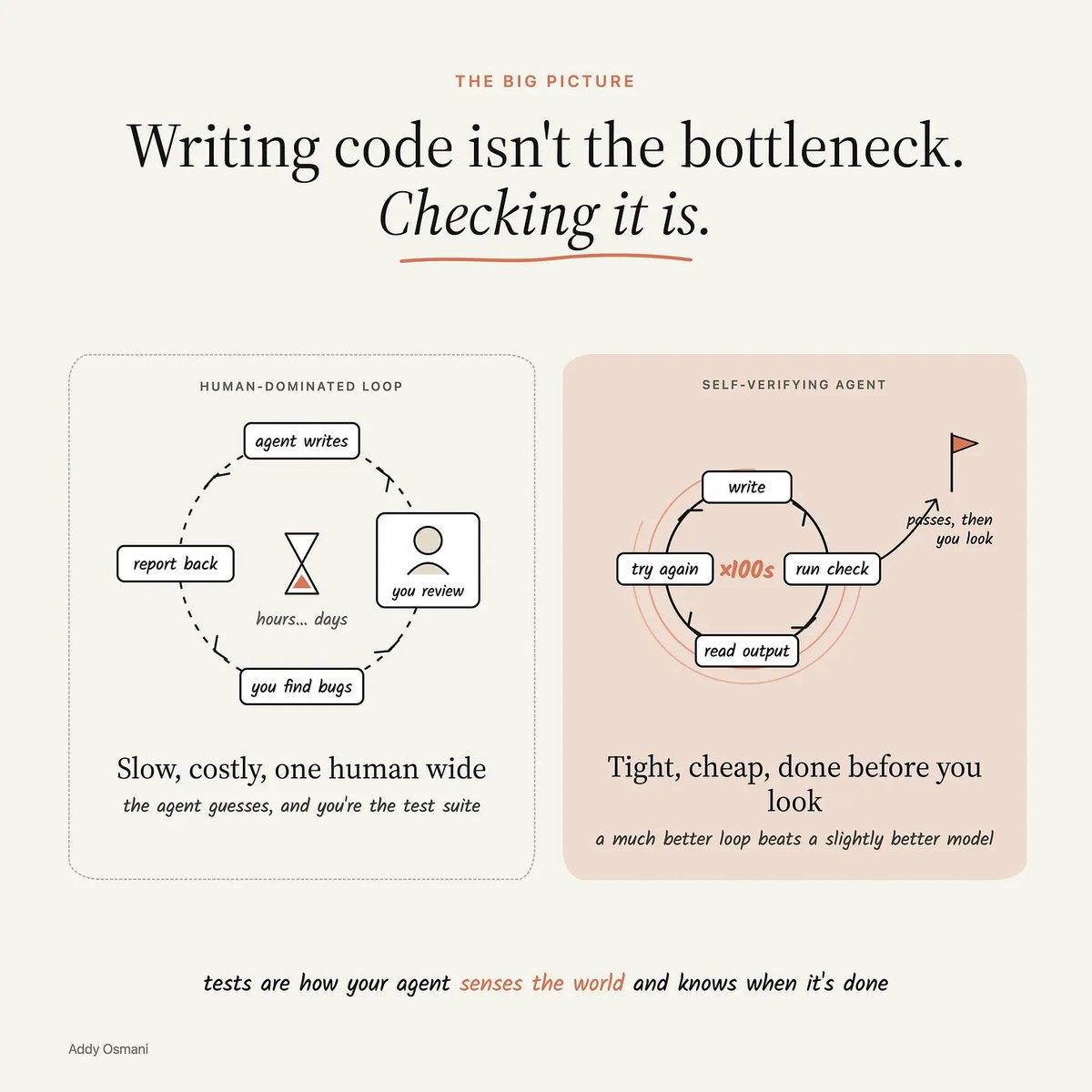
✨ Agentic Verification✨ - @addyosmani
Key ideas:
⤷ Stop reading diffs.
⤷ Verifying agent output is harder than writing the code.
⤷ Build loops where agents test their own work.
⤷Test types matter: Prioritize E2E & property tests.
⤷Tests aren't just for bugs; They define "done".
Read about how the future of code quality is shaping:
https://t.co/f76hRK7hFf
🚨 Windows Privilege Escalation — Practical Cheat Sheet & Reference Guide 🪟🔥
Privilege Escalation is one of the most important skills for penetration testers, red teamers, and OSCP students.
We created a practical Windows Privilege Escalation GitHub repository covering 21 techniques and attack paths. 🚀
🔓 SeBackupPrivilege
🎭 SeImpersonatePrivilege
🐞 SeDebugPrivilege
🔑 SeTakeOwnershipPrivilege
👑 SeTcbPrivilege
⚙️ AlwaysInstallElevated
🌐 DnsAdmins → Domain Admin
🌙 HiveNightmare
🧩 Registry Run Keys
📂 Startup Folder
🔐 Stored Credentials
⚠️ Weak Registry Permissions
🛠️ Unquoted Service Paths
🖥️ Insecure GUI Applications
⚙️ Weak Service Permissions
⏰ Scheduled Tasks
💥 Kernel Exploits
🎭 SamAccountSpoofing
🖨️ SpoolFool
🔥 PrintNightmare
👤 Server Operator Group
📚 GitHub Repository:
https://t.co/sRqJbUbBWz
🔥 Join our cybersecurity community:
🔥 Telegram: https://t.co/upuP8k8ckB
✴ Twitter: https://t.co/Za7rYILz6E
⭐ Star the repository
🔖 Bookmark it for your labs
♻️ Share it with the cybersecurity community
More Windows Privilege Escalation techniques are coming soon. 🚀
#CyberSecurity #WindowsSecurity #PrivilegeEscalation #OSCP #RedTeam #Pentesting #EthicalHacking #ActiveDirectory #InfoSec
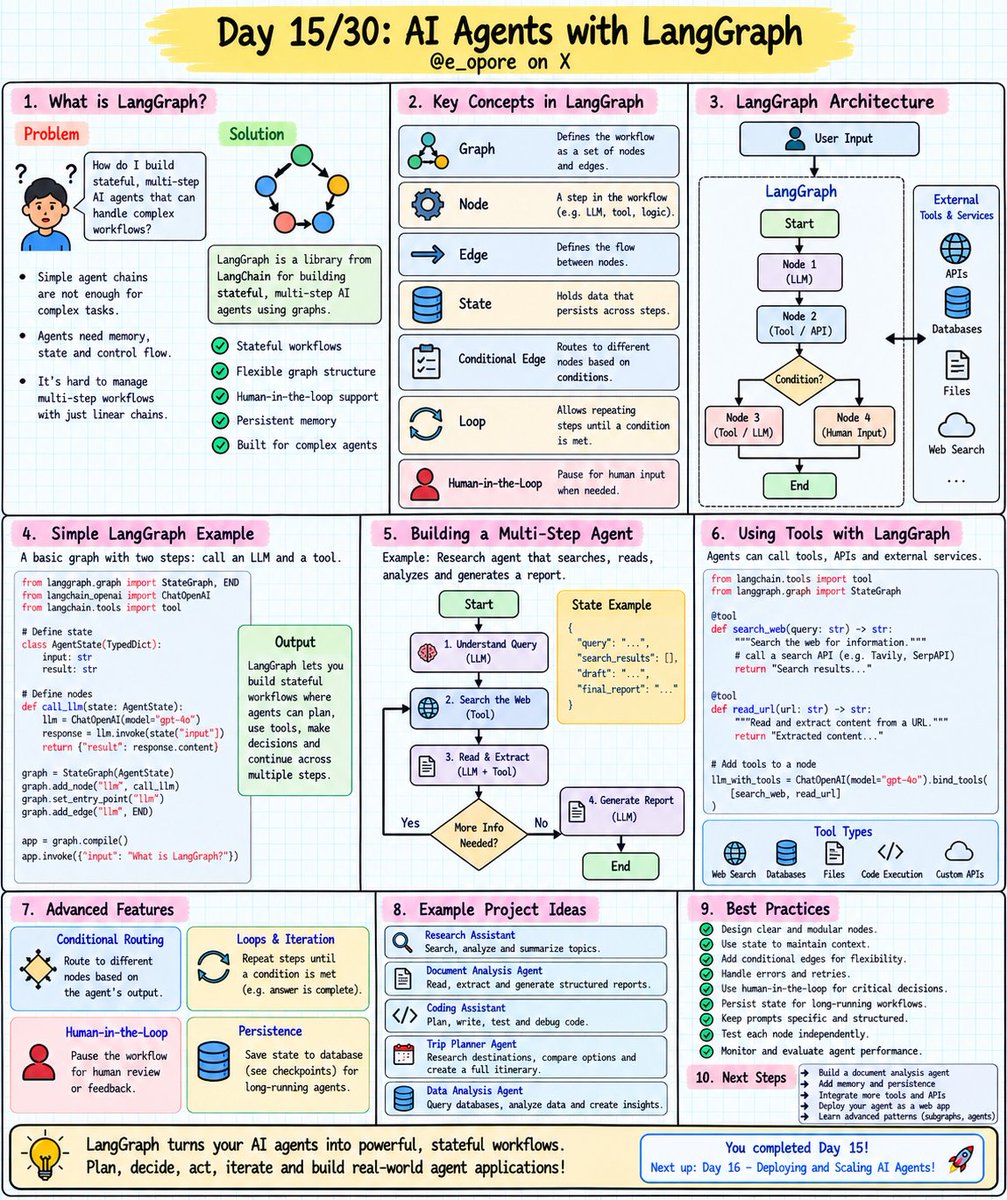
🤖 Day 15/30 - AI Agents Series
In the last post, we explored LangChain and learned how to build AI applications that combine LLMs, tools, and document retrieval. Today, we'll take the next step and explore LangGraph, a framework designed for building stateful, multi-step AI workflows and more controllable AI agents.
AI Agents with LangGraph
LangGraph is a framework for building stateful AI applications using graphs. It allows developers to define how an agent processes information, executes tasks, handles decisions, and moves between different stages of a workflow.
Unlike a simple linear chain, LangGraph supports cycles, conditional branching, persistent state, and human intervention.
These capabilities make it useful for building complex AI agents that need to maintain context and coordinate multiple operations.
How LangGraph Works
LangGraph applications are built around three fundamental concepts:
→ State: Stores information shared between workflow steps.
→ Nodes: Functions that perform specific operations, such as calling an LLM, searching documents, or validating results.
→ Edges: Define how the workflow moves from one node to another.
A typical workflow looks like:
→ Receive user request
→ Analyze the task
→ Execute an operation
→ Evaluate the result
→ Decide the next step
→ Repeat when necessary
→ Return the final response
This graph-based architecture gives developers greater control over how AI agents behave.
What Is Stateful Execution?
Stateful execution allows an AI workflow to maintain information as it moves between nodes.
For example, a research agent might store:
→ The original research question
→ Its current execution plan
→ Retrieved documents
→ Intermediate findings
→ Tool execution results
→ Errors and retry counts
→ Final report
Each node can read or update the shared state, allowing the workflow to continue without losing important information.
Conditional Routing
Not every task should follow the same path.
LangGraph allows workflows to select the next node based on the current state.
For example:
→ If information is missing, search for more data.
→ If a tool fails, retry or use an alternative.
→ If the result is incomplete, perform another analysis.
→ If the result is satisfactory, generate the final response.
Conditional routing makes AI workflows more flexible and reliable.
Persistence and Human-in-the-Loop
LangGraph supports checkpointing, allowing workflow state to be saved and execution to resume later when configured with a suitable checkpointer.
It also supports human-in-the-loop workflows, where an agent can pause and request approval before performing sensitive actions.
These capabilities are especially useful for long-running tasks, approval processes, and workflows that require supervision.
Why LangGraph Matters
LangGraph helps developers:
→ Build complex, stateful AI agents
→ Manage multi-step execution
→ Implement conditional workflows
→ Recover from interruptions
→ Add human approval steps
→ Coordinate multiple agents
→ Track execution and intermediate results
Instead of allowing an agent to operate as an uncontrolled loop, developers can define explicit execution paths and checkpoints.
Project: Build a Stateful Multi-Step AI Workflow
Today we'll build an AI workflow that can accept a complex task, plan its execution, process information, and validate its results.
Our application will:
→ Accept a user request
→ Initialize a shared workflow state
→ Use an LLM to create an execution plan
→ Execute individual tasks through dedicated nodes
→ Store intermediate results in the state
→ Route execution based on task outcomes
→ Retry failed operations within configured limits
→ Validate the final result
→ Save workflow checkpoints for recovery
→ Generate a final response summarizing the completed task
For example, you could build a research workflow that gathers information, analyzes multiple sources, checks whether the findings are sufficient, and produces a structured report.
By the end of this project, you'll understand how to use LangGraph to build stateful AI systems that are easier to control, debug, extend, and recover than simple linear LLM applications.
Grab the Building AI Agents from Scratch Ebook: https://t.co/SWCKKtbPNm
#AIAgents #LangGraph #LangChain #LLM #AIEngineering #Python
Python Functions vs Classes: Essential Syntax Every Python Developer Should Know
Understanding functions and classes is a key step toward writing clean, reusable, and maintainable Python code.
Python Functions
def defines a function.
Parameters accept input.
return sends a result back.
Function calls execute the function.
Python Classes
class defines a blueprint for creating objects.
Class variables store shared attributes.
__init__() initializes instance attributes.
Instance methods define object behavior.
pass acts as a placeholder when a method has no implementation yet.
Save this cheat sheet for your Python learning and interview preparation.
Learn more Python tutorials, coding challenges, and free resources at https://t.co/ak5tWC3o1l
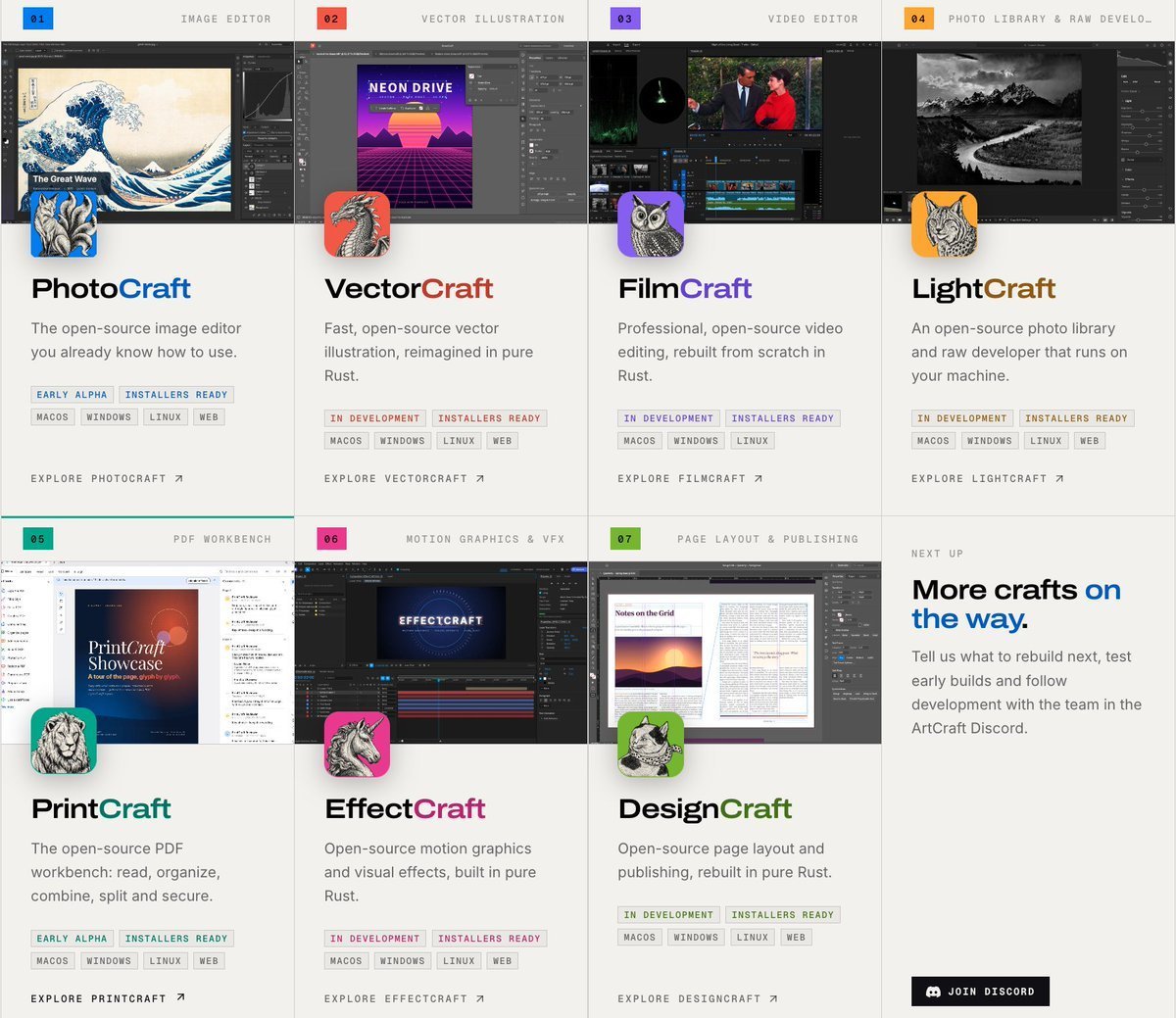
🚨 شركة Adobe تنهار اليوم رسميا.. الحزمة الكاملة لبرامج Adobe بأحجام خفيفة وبدائل مفتوحة المصدر بالكامل!
وداعاً للاشتراكات الشهرية الباهظة والبرامج الثقيلة التي تلتهم الذاكرة.. المستقبل للمصادر المجانية!
🔗 الرابط تجدونه في التعليقات ⬇️
احفظ التغريدة بـ Bookmark 🔖 وشاركها مع كل المصممين والمطورين! 🧵👇
🚨 كنز حقيقي لمطوّري الذكاء الاصطناعي!
نشرت Anthropic ومطوّرون آخرون مستودعات ضخمة تضم مئات الوكلاء (Agents) والمهارات (Skills) الجاهزة للاستخدام في مهام مختلفة.
هذي أبرز المستودعات:
1. وكلاء ذكاء اصطناعي لمختلف التخصصات
🔗 https://t.co/5ts3J1VJsh
حوالي 170 وكيلًا منظّمين كأنهم شركة متكاملة، تشمل تخصصاتهم:
→ البرمجة والهندسة. → التصميم. → التسويق والمبيعات. → إدارة المنتجات. → الاختبار والأمان والدعم.
وتوجد مجموعات إضافية للتمويل والصحة وتطوير الألعاب.
2. مجموعة متكاملة من الوكلاء والمهارات لـ Claude Code
🔗 https://t.co/SyfSUEF2tX
تضم مئات الوكلاء والمهارات والأوامر، موزّعة على إضافات متخصصة في:
→ لغات البرمجة. → مراجعة الأكواد وتصحيح الأخطاء. → البنية التحتية والأمان. → الاختبارات البرمجية.
وتقدر تثبّت الإضافات اللي تحتاجها فقط.
3. إضافات Claude الرسمية
🔗 https://t.co/gGj7NcOvoA
إضافات منظّمة حسب مجالات العمل، مثل:
→ المبيعات وخدمة العملاء. → إدارة المنتجات والتسويق. → الشؤون القانونية والمالية. → تحليل البيانات.
4. مشاريع Claude الجاهزة للتشغيل
🔗 https://t.co/m173Pt6nwd
أمثلة عملية تساعدك تبني حلولًا باستخدام Claude، مثل:
→ تلخيص يومي لنشاط Slack وGitHub. → تصنيف مشكلات Sentry. → بوتات لـ Slack وLinear. → وكيل لخدمة العملاء. → محلل للبيانات المالية.
5. مهارات تغطي دورة تطوير البرمجيات
🔗 https://t.co/H9d6gmtn6S
تضم مهارات تساعدك في مراحل تطوير البرمجيات، من جمع المتطلبات وكتابة المواصفات إلى الاختبارات، ومراجعة الأمان، والتكامل والنشر المستمر.
من وين تبدأ؟
أنصحك تبدأ بمستودع Claude Quickstarts؛ لأنه يقدّم أمثلة عملية تقدر تشغّلها وتفهم طريقة عملها، ثم تنتقل إلى الوكلاء والمهارات حسب احتياجك.
الفكرة مو إنك تجمع أكبر عدد من الأدوات، بل إنك تختار الأدوات المناسبة وتحوّلها إلى سير عمل فعلي يخدم مشاريعك.
📌 احفظ الروابط عندك، بتفيدك في مشاريعك القادمة بالذكاء الاصطناعي.