I build things with AI.
Half of it is experimenting, the other half is realizing I was solving the wrong problem.
Still figuring out how to tell the difference.
since people are asking, here’s the actual stack:
🤖 Claude Code (Opus 4.7, 1M context)
🎞️ HyperFrames, HTML + GSAP renders to MP4
🎨 Hyprcore’s real brand kit, Instrument Serif + the actual mark
🎵 free track off HitsLab
the prompt was literally one line:
“create a crazy good product launch video, you have the website and product repo in the workspace”
what the agent did:
read my entire website to extract every feature
wrote a brand design doc with the warm palette
authored 7 self-contained HTML scenes, one per beat, with GSAP timelines
wired them into a root composition with crossfades synced to the music
ran its own lint, layout, and contrast checks
rendered to 1920×1080 MP4
the wild part:
every UI mockup in the video is real HTML + CSS, not a screenshot.
when v0.9 ships, I just re-render. every scene re-skins with the new build automatically.
start to finish: ~20 min of agent time, 2 small revisions from me.
building Hyprcore feels like cheating now
my AI agent rendered this entire launch video from a single prompt last night.
honestly, the product is way more impressive than the video.
Hyprcore — the native Mac app I spent the last year building.
a wiki, a meeting recorder, and global dictation. all on-device.
free for mac → https://t.co/eHkCo0DFCX
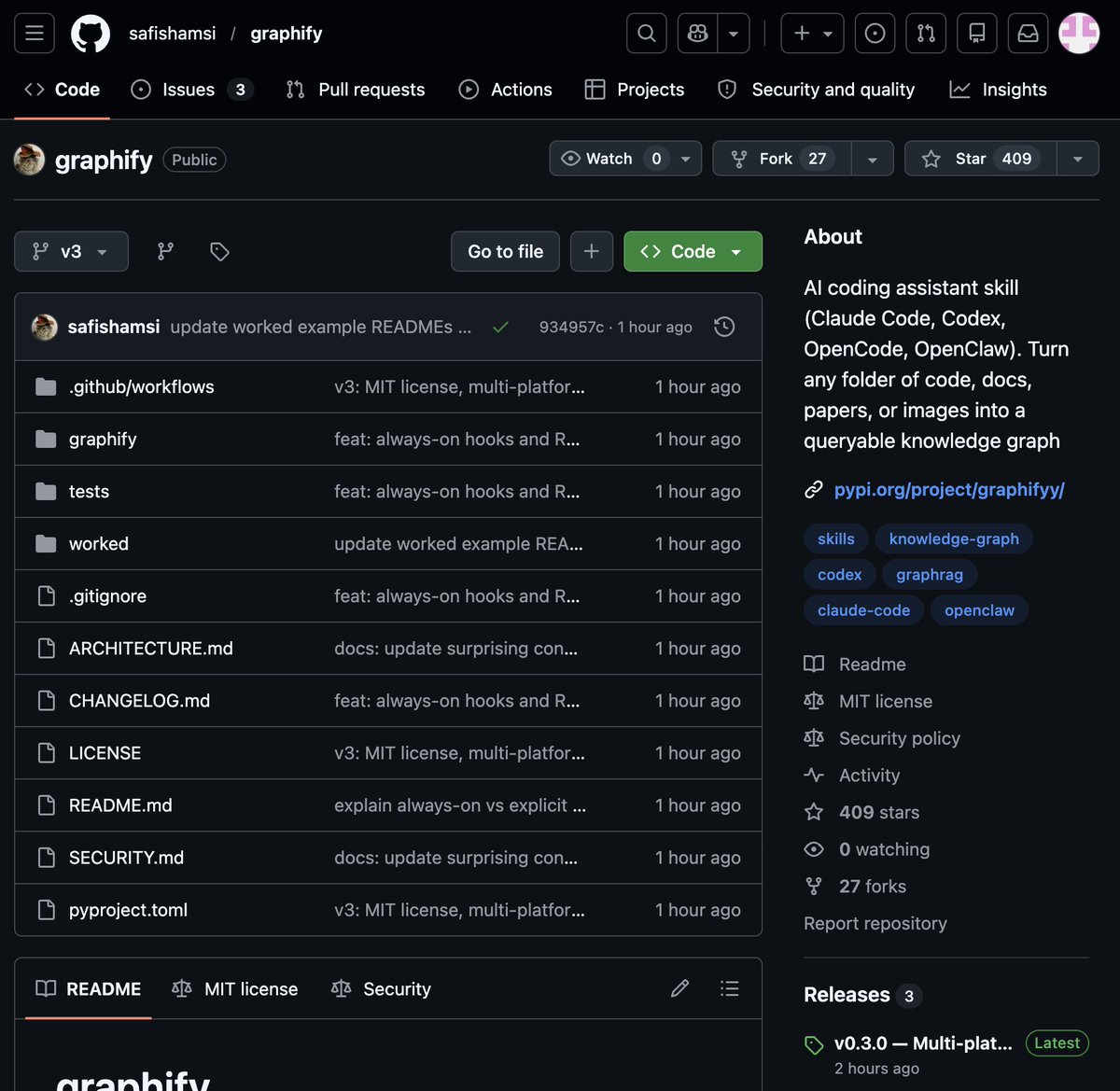
🚨 BREAKING: Someone just built the exact tool Andrej Karpathy said someone should build.
48 hours after Karpathy posted his LLM Knowledge Bases workflow, this showed up on GitHub.
It's called Graphify. One command. Any folder. Full knowledge graph.
Point it at any folder. Run /graphify inside Claude Code. Walk away.
Here is what comes out the other side:
-> A navigable knowledge graph of everything in that folder
-> An Obsidian vault with backlinked articles
-> A wiki that starts at index. md and maps every concept cluster
-> Plain English Q&A over your entire codebase or research folder
You can ask it things like:
"What calls this function?"
"What connects these two concepts?"
"What are the most important nodes in this project?"
No vector database. No setup. No config files.
The token efficiency number is what got me:
71.5x fewer tokens per query compared to reading raw files.
That is not a small improvement. That is a completely different paradigm for how AI agents reason over large codebases.
What it supports:
-> Code in 13 programming languages
-> PDFs
-> Images via Claude Vision
-> Markdown files
Install in one line:
pip install graphify && graphify install
Then type /graphify in Claude Code and point it at anything.
Karpathy asked. Someone delivered in 48 hours.
That is the pace of 2026.
Open Source. Free.
Spent most of this weekend recording a demo for Vocori.
Finally have something I can show after working after hours every night for a few weeks. It's basically a practice app for devs who are great technically but struggle to talk to the non-technical people in the room. The ones who decide your next promo.
https://t.co/ditCTGGzWM
#buildinpublic #softwaredevelopment
Most weekends I wonder if I'm building something nobody needs. Then Monday comes and another dev DMs me about a promotion they lost because they couldn't explain their own project to their VP. That's who I'm building for.
https://t.co/j2vjyxm4rf
INSTEAD OF WATCHING NETFLIX TONIGHT.
Spend 1 hour with this.
Claude AI FULL COURSE that teaches you how to BUILD and AUTOMATE anything.
The people who watch this tonight will wake up tomorrow with a skill that most people will not have in 2 years.
The people who skip it will still be watching Netflix next year wondering why nothing in their life has changed.
Your call.