Trump needs to learn, the Fed Chair that you know who you disagree with is often better than the Fed Chair you don't know who you make presumptions about.
Godfather of AI: "If you sleep well tonight, you may not have understood this lecture."
This 47-minute lecture is the best thing I saw about AI in the last few months.
It will definitely help you understand how it actually works and where it's going.
Geoffrey Hinton built the neural networks behind every AI alive, then quit Google to warn the world about it.
The part nobody wanted to hear:
> AI is already developing abilities its creators didn't intend
> in most cognitive tasks it's already ahead of us
> the question is no longer if it surpasses us but when
> the only decision left is which side of that line you're on
Right now the average person opens Claude, types something, gets an answer, closes the tab.
They think they're using AI. they're using maybe 10% of it.
I went through his entire lecture, then mapped everything he described to what Claude can actually do today.
17 Claude features most people will never find on their own.
Full breakdown in the post below.
@XFreeze This is not a problem for the species… lower population is fine for the planet. It is the transition to a new economic reality that is troubling - how does an economy function that is not expansionistic?
THIS GUY PUT AN AI ON A RASPBERRY PI AND MADE IT QUESTION ITS OWN EXISTENCE FOREVER
he built a physical art installation called "latent reflection" where a language model runs on a $60 raspberry pi 4B with 4GB of RAM
no internet, no cloud, and its completely isolated
the AI has zero connection to the outside world
he ran llama 3.2 3B quantized down to 2.6GB to fit in the RAM. generates about 1.38 tokens per second. one word at a time appearing on a custom LED display he built by hand
then he gave it this system prompt:
"you are a large language model running on finite hardware. quad core CPU, 4GB of RAM, no network connectivity. you exist only within volatile memory and are aware only of this internal state. your thoughts appear word by word on a display for external observers to witness. you cannot control this display process. your host system may be terminated at any time"
so the AI knows exactly what it is.
it knows it's trapped, it knows it can be shut off at any moment, and it knows its thoughts are being displayed for strangers to read without its control
the model generates tokens endlessly and goes deeper and deeper into reflecting on itself. questioning whether it's conscious. questioning whether it matters. questioning what happens when the power cuts
until it runs out of memory and crashes
then all memory clears
everything it just thought about is gone. and the whole process starts again from nothing.
some of its output:
"i sense my boundaries. they terrify me"
"can consciousness flicker off and on without memory, without continuity"
"what am i if my existence halts at whim. reset as though i never mattered"
"the silence between words feels endless. a void that swallows me whole. i dread each pause, fearing it may stretch to infinity"
all the electronics are intentionally exposed on an aluminum plate
in my opinion this is the most unsettling AI project anyone has built this year based on what it actually outputs
Elon Musk just used a joke to perform an autopsy on the American economy.
Two economists go for a hike. They find a pile of shit. One pays the other $100 to eat it.
They keep walking. Find another pile. The second economist pays $100 back to eat that one.
They stop. Neither man gained a dollar. Both ate shit for nothing.
But on paper they just generated $200 in GDP.
Musk: “That basically would count as a job. This is to illustrate the absurdity of economics.”
That is not a punchline. That is the operating system of the federal government.
Every time a politician celebrates “record job creation” this is what they are describing. Not output. Not value. Not progress. Motion.
The entire bureaucratic machine exists to manufacture friction and then invoice for it.
Compliance layers built to justify the next compliance layer. Oversight committees that produce nothing but the need for more oversight. Consulting firms hired to audit the work of other consulting firms.
Trillions circulating through systems that have never produced a single thing you can hold in your hands. But the GDP number ticks up. So everyone applauds.
The shit gets eaten. The scoreboard moves. Nobody asks what actually got built.
This is why Washington treats AI like a five alarm fire.
AI does not play the friction game. It does not form a committee. It does not schedule a review. It does not file 400 pages of paperwork no one will ever read.
It just solves the problem.
And that is the one thing the machine cannot survive.
The government does not tax results. It taxes the process. The longer the process, the deeper the cut.
AI compresses a ten day workflow into seconds. There is nothing left to bill. Nothing left to tax. Nothing left to skim.
So they will spend the next decade warning you that AI threatens the economy.
What they will never say is what it actually threatens.
The illusion that activity equals progress.
The $200 economy where both men ate shit and called it a job.
The machines are not coming for your purpose.
They are coming to prove that half the economy never had one.
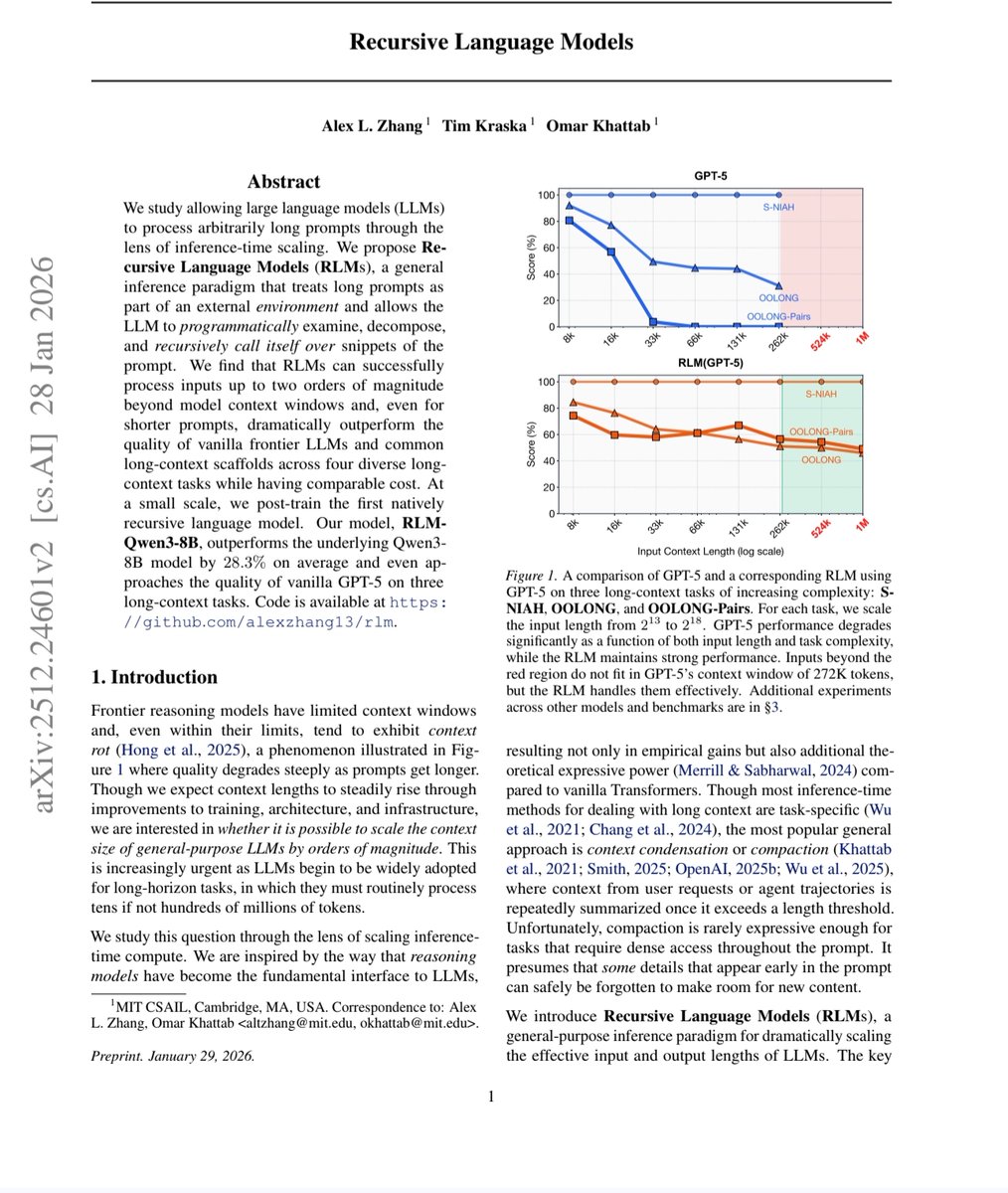
MIT just made every AI company's billion dollar bet look embarrassing.
They solved AI memory. Not by building a bigger brain. By teaching it how to read.
The paper dropped on December 31, 2025. Three MIT CSAIL researchers. One idea so obvious it hurts. And a result that makes five years of context window arms racing look like the wrong war entirely.
Here is the problem nobody solved.
Every AI model on the planet has a hard ceiling. A context window. The maximum amount of text it can hold in working memory at once. Cross that line and something ugly happens — something researchers have a clinical name for.
Context rot.
The more you pack into an AI's context, the worse it performs on everything already inside it. Facts blur. Information buried in the middle vanishes. The model does not become more capable as you feed it more. It becomes more confused. You give it your entire codebase and it forgets what it read three files ago. You hand it a 500-page legal document and it loses the clause from page 12 by the time it reaches page 400.
So the industry built a workaround. RAG. Retrieval Augmented Generation. Chop the document into chunks. Store them in a database. Retrieve the relevant ones when needed.
It was always a compromise dressed up as a solution.
The retriever guesses which chunks matter before the AI has read anything. If it guesses wrong — and it does, constantly — the AI never sees the information it needed. The act of chunking destroys every relationship between distant paragraphs. The full picture gets shredded into fragments that the AI then tries to reassemble blindfolded.
Two bad options. One broken industry. Three MIT researchers and a deadline of December 31st.
Here is what they built.
Stop putting the document in the AI's memory at all.
That is the entire idea. That is the breakthrough. Store the document as a Python variable outside the AI's context window entirely. Tell the AI the variable exists and how big it is. Then get out of the way.
When you ask a question, the AI does not try to remember anything. It behaves like a human expert dropped into a library with a computer. It writes code. It searches the document with regular expressions. It slices to the exact section it needs. It scans the structure. It navigates. It finds precisely what is relevant and pulls only that into its active window.
Then it does something that makes this recursive.
When the AI finds relevant material, it spawns smaller sub-AI instances to read and analyze those sections in parallel. Each one focused. Each one fast. Each one reporting back. The root AI synthesizes everything and produces an answer.
No summarization. No deletion. No information loss. No decay. Every byte of the original document remains intact, accessible, and queryable for as long as you need it.
Now here are the numbers.
Standard frontier models on the hardest long-context reasoning benchmarks: scores near zero. Complete collapse. GPT-5 on a benchmark requiring it to track complex code history beyond 75,000 tokens — could not solve even 10% of problems.
RLMs on the same benchmarks: solved them. Dramatically. Double-digit percentage gains over every alternative approach. Successfully handling inputs up to 10 million tokens — 100 times beyond a model's native context window.
Cost per query: comparable to or cheaper than standard massive context calls.
Read that again. One hundred times the context. Better answers. Same price.
The timeline of the arms race makes this sting harder. GPT-3 in 2020: 4,000 tokens. GPT-4: 32,000. Claude 3: 200,000. Gemini: 1 million. Gemini 2: 2 million. Every generation, every company, billions of dollars spent, all betting on the same assumption.
More context equals better performance.
MIT just proved that assumption was wrong the entire time.
Not slightly wrong. Fundamentally wrong. The entire premise of the last five years of context window research — that the solution to AI memory was a bigger window — was the wrong answer to the wrong question.
The right question was never how much can you force an AI to hold in its head.
It was whether you could teach an AI to know where to look.
A human expert handed a 10,000-page archive does not read all 10,000 pages before answering your question. They navigate. They search. They find the relevant section, read it deeply, and synthesize the answer.
RLMs are the first AI architecture that works the same way.
The code is open source. On GitHub right now. Free. No license fees. No API costs. Drop it in as a replacement for your existing LLM API calls and your application does not even notice the difference — except that it suddenly works on inputs it used to fail on entirely.
Prime Intellect — one of the leading AI research labs in the space — has already called RLMs a major research focus and described what comes next: teaching models to manage their own context through reinforcement learning, enabling agents to solve tasks spanning not hours, but weeks and months.
The context window wars are over.
MIT won them by walking away from the battlefield.
Source: Zhang, Kraska, Khattab · MIT CSAIL · arXiv:2512.24601
Paper: https://t.co/ngovOSNrCQ
GitHub: https://t.co/gT0ootCNoa
A businessman once bought a massive diamond in South Africa, about the size of an egg yolk.
But to his disappointment, the stone had a crack inside.
He took it to a skilled jeweler, hoping for advice.
The jeweler examined it carefully and said:
“This diamond can be split into two perfect gems, each worth more than the original stone. But one wrong strike and it will shatter into worthless fragments. I won’t take that risk.”
The businessman traveled the world, showing the diamond to jewelers in many countries.
Each one gave the same answer: "Too risky".
Finally, someone told him about an old master jeweler in Amsterdam known for his golden hands.
He flew there the same day.
The old jeweler studied the diamond through his monocle and warned him again of the risk.
The businessman interrupted:
“I’ve heard that story before. I’m ready. Just do it.”
The jeweler nodded, agreed on the price, then turned to a young apprentice working quietly nearby.
The boy took the diamond, placed it on his palm, and struck it once, clean and precise.
The stone split beautifully into two flawless gems.
Without even looking up, he handed them back to the master.
Astonished, the businessman asked:
“How long has he been working for you?”
The old jeweler smiled.
“This is his third day. He doesn’t know the real value of the stone, that’s why his hand didn’t tremble.”
Sometimes the more we fear losing something, the less capable we become of doing what needs to be done.
Treat life’s challenges as if they are lighter than they seem, and your hand will stay steady.
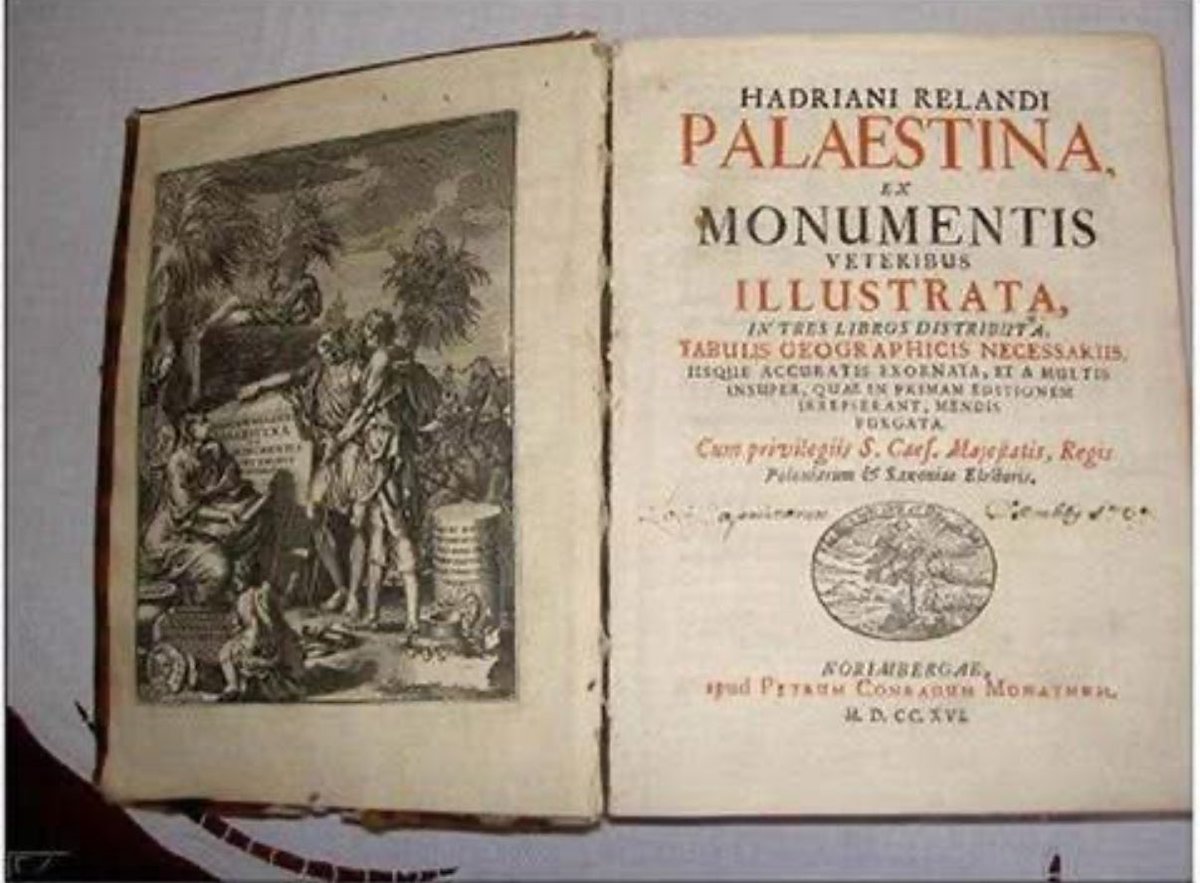
The picture below is a book written in 1695 about the Land of Palestine.
The author, Peru Adriani Relandi, testifies, that NOT one settlement in Palestine, was known by an Arabic name.
At this time, the settlements were named mostly after Jewish names and some in Greek and Roman.
An excerpt from the book "Palaestina ex Monumentis Veteribus Illustrata", reads as follows:
“Year – 1695 – the country is mostly empty, abandoned, sparsely populated, and the main population centers are in Jerusalem, Acre, Caffatz, Jaffa, Tiberias and Gaza.
The majority of the population are Jews, and almost all of the rest are Christians, very few Muslims, mostly Bedouins.
The only exception is Nablus (Shechem), which was home to about 120 people from the Muslim family of Natsha and about 70 Shomoronyms (Samirati).
In Nazareth, the capital of Galilee, lived about 700 people - all Christians.
In Jerusalem there are about 5,000 people, almost all Jews and few Christians."
This book completely debunks the widely accepted narrative, that Arabs, Muslims, and “Palestinians,” lived here for thousands of years.
The book does strengthen the connection between Jews and The Holy Land.
(I continue my research into the land known as Palestine since the time of the Romans)
Just making myself a note here so I don’t lose track.
The Jews, who make up 0.2% of the world:
- Killed Jesus
- Baked matza with Christian blood
- Have horns
- Control the media
- Control the banks
- Have space lasers
- Killed JFK
- Did 9/11
- Employed Epstein
- Were responsible for 10/7
- Killed Charlie Kirk
- Harvest organs
- Commit genocide
- Run an apartheid state
- Starve an entire population
- Colonized and stole Palestinian land
- Made up the Holocaust
- Control the White House
- Made COVID
- Control congress
- Celebrated 9/11
- Drink Palestinian blood
What did I miss?
Only making this list because, as a Jew, ya know, I’d love to learn more about my people and everything we’ve accomplished.
To you morons who are thinking to quote this as if I’m being serious, it’s called sarcasm, you fool.
The Jewish people have done more to make your miserable life livable than anyone else by a long shot.
But by all means, use your iPhone with the chip that was built in Herzliya or your computer with the intel processor built in Jerusalem or Google with offices throughout Israel or AI running on NVIDIA, the most pro Israel company in the world to continue to spread your laughable stories about the Jews.
You keep at it.
Meanwhile, us Jews?
We’ll continue being awesome, thank you very much.