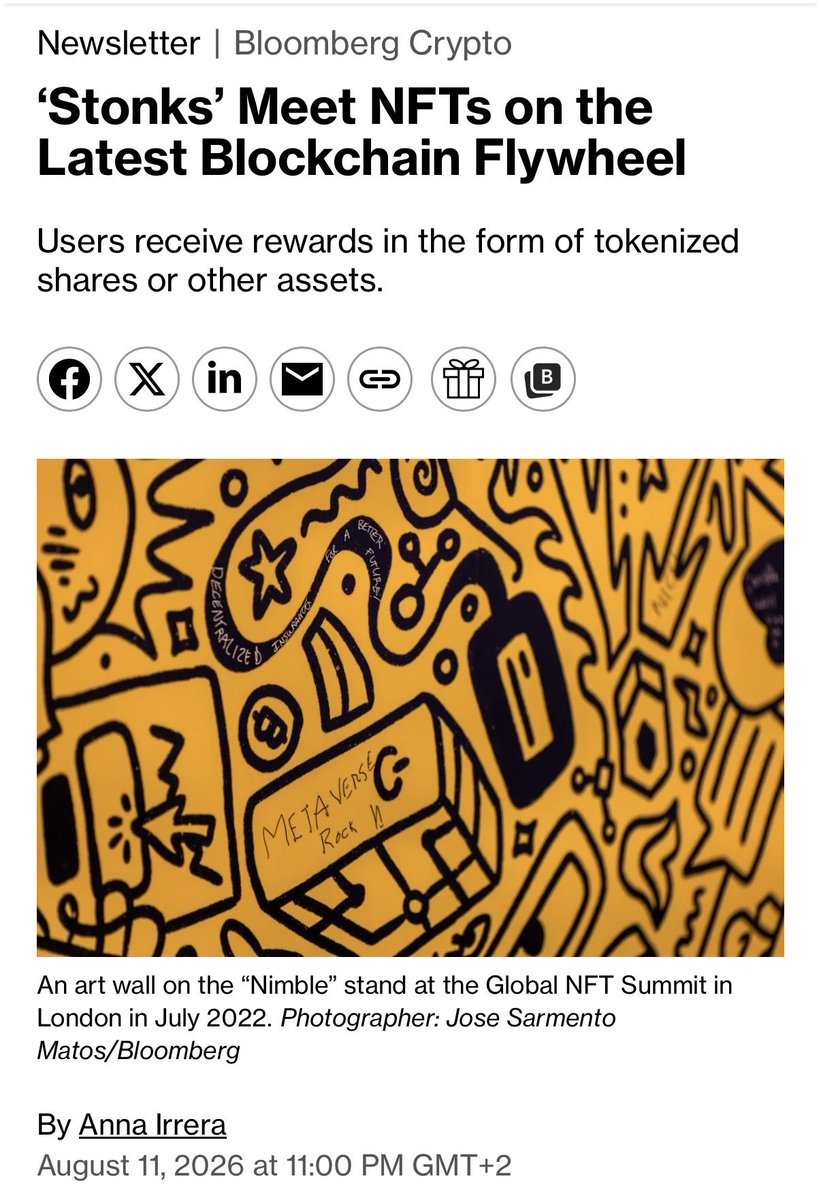
My favorite part of this Bloomberg article is seeing the words crypto and NFTs coincide with financial technology.
That’s the space I want to help build. One we can be proud of. One people look toward as a place where inventions are created and new innovators get their first legs in the financial tech world.
That’s how I think about StonkBrokers: a decentralized financial incubator layer on Robinhood Chain.
Infrastructure, liquidity, distribution, and a community that can help new ideas become real financial technology while shifting the mindset from short-term speculation toward long-term innovation.
We shouldn’t make our bread by front-running each other and using normies as exit liquidity. We should create value through invention, proprietary ideas, and building financial technology that didn’t exist before.
We want great ideas to have somewhere to start, somewhere to scale, and people willing to bet on innovation.
So that one day, when our kids are old enough to enter crypto, we can be excited for them to become the next generation of innovators instead of worried about them falling into degeneracy and scams.
Crypto should be a little Silicon Valley, a place where the next generation of financial technology is invented.
Creativity and distribution that’s the moat.
@RobinhoodApp@RobinhoodCrypto@vladtenev
We identified 10,000 of the most active perp traders on-chain (excluding market makers) that haven’t signed up to Variational yet.
We’re allocating $1M+ and 150k Variational points to onboard them.
🧵
Three researches went up on https://t.co/DKAocSf7KX over the last couple of weeks. We dig into crypto projects that look like they might matter and write up what we actually find.
> @OseroHQ. A distribution wrapper for @SkyEcosystem, dressed up as infrastructure. The legal entity is doing more work than the SDK. Worth watching.
> @HypernovaX. Hypernova is moving the prop firm onchain via @HyperliquidX. $3M from @Lemniscap, addresses published, contracts unverified. The framing is ahead of the proof.
> @Pluralis. Pluralis trains models no single party can extract — a third path between closed and open-weight AI. Code, run, funding shipped.
Full versions of researches at https://t.co/DKAocSf7KX. For free.
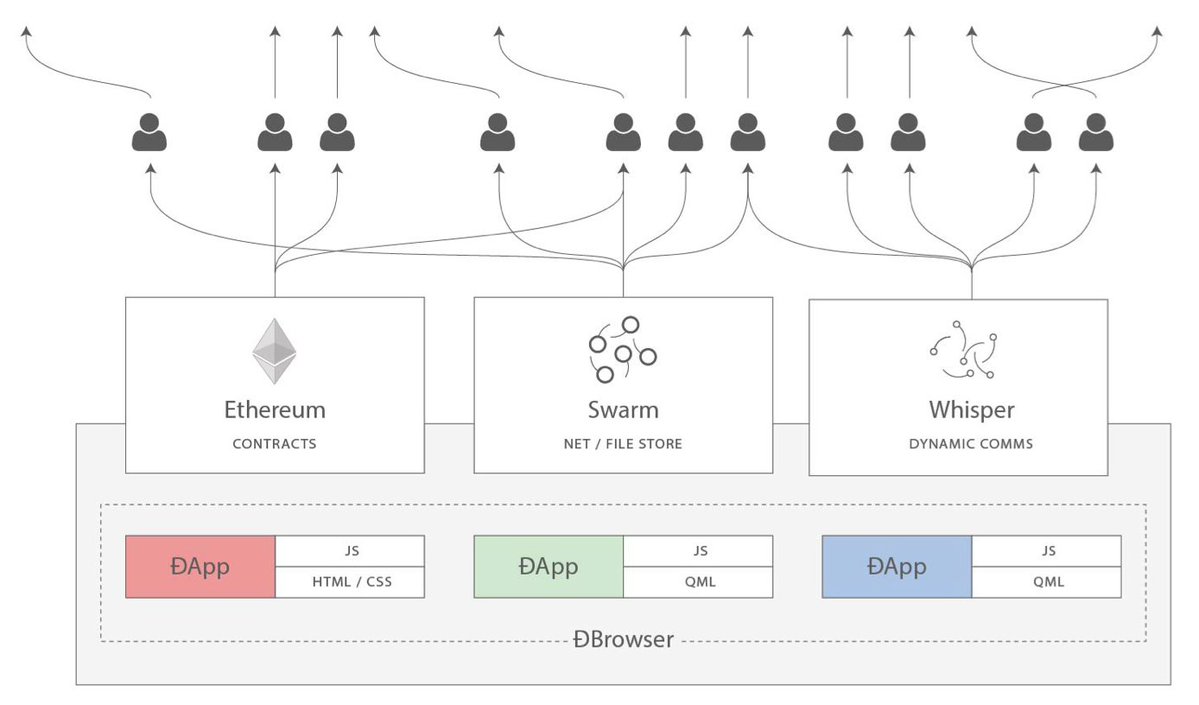
In 2014, there was a vision: you can have permissionless, decentralized applications that could support finance, social media, ride sharing, governing organizations, crowdfunding, potentially create an entire alternative web, all on the backs of a suite of technologies.
Ethereum: the blockchain. The world computer that could give any application its shared memory.
Whisper: the data layer. Messages too expensive for a blockchain, that do no need consensus.
Swarm: the storage layer. Store files for long-term access.
Over the last five years, this core vision has at times become obscured, with various "metas" and "narratives" at various times taking center stage. But the core vision has never died. And in fact, the core technologies behind it are only growing stronger.
Ethereum is now proof of stake. Ethereum is now scaling, it is now cheap, and it is on track to get more scalable and cheaper thanks to the power of ZK-EVMs. Thanks to ZK-EVM + PeerDAS, the "sharding" vision is effectively being realized. And L2s can give additional and different kinds of gains in speed on top.
Whisper is now Waku ( https://t.co/uj5h9iSpIL ), and already powers many applications (eg. https://t.co/owlo5yoS68, https://t.co/hDizYCFjuq just to name two I use). Even outside of Waku, the quality of decentralized messaging has increased. Fileverse (decentralized Google Docs and Sheets alternative: https://t.co/ZIKj4U5pQe ) has seen massive gains in usability over the past year.
IPFS is now highly performant and robust as a decentralized way of retrieving files, though IPFS alone does not solve the storage problem. Hence, there is still room to improve there.
All of the prerequisites for the original web3 vision are here, in full force, and are continuing to get stronger over the next few years. Hence, it's time to buidl, and buidl decentralized.
Fileverse is an excellent example of the right way to do things:
* It uses Ethereum and Gnosis Chain for what they are good for: names, accounts and permissioning, document registration
* It uses decentralized messaging and file storage to store documents and propagate changes to documents
* The application passes the walkaway test: https://t.co/xO1dNLlnhf (even if Fileverse disappears, you can still retrieve them and even keep editing them with the open source UI)
This is what we mean by "build a hammer that is a tool you buy once and it's yours, not a corposlop AI dishwasher that requires you to register for a google account and charges a subscription fee per month for extra washing modes, and probably spies on you and stops working if you get politically disfavored by a foreign country".
If you think this criticism of corposlop is hyperbolic, well turns out, it's literally a concatenation of these three:
* https://t.co/GBNaXOa454
* https://t.co/saD3cNp4Ae
* https://t.co/skoJ58vbqz
In 2014, decentralized applications were toys, hundreds of times more difficult to use in web2. In 2026, fileverse is now usable enough that I regularly write documents in it and send them to other people to collaborate. The decentralized renaissance is coming, and you can be part of making it happen.
“The one thing money can’t buy,” said Luckey, “is people who liked you before you had money. I’m very lucky that I met my wife back when I had literally nothing. When we met, I had less than $300 in my bank account … I probably should have gotten married, should have married her when I was 16. Looking back, I think that’s probably my radical belief.”
https://t.co/7L9EqhyL2N
ALL STATS of each 140 player in @sportfun
I built an interactive dashboard in FDF to expand our analysis and maybe discover some undervalued players 👀💎
Link in the COMMENTS 👇
What if you could trade players, not just pick them?
@sportfun is fantasy and trading in one fast-paced marketplace. Compete on the pitch. Win in the market.
i see two problems here:
- instant culture (everything needs to build and insane instantly)
- price = product good or not (everything is reduced to price action, price up => gud product, price down => bad product)
we have pushed the two to the extreme in crypto
teams that actually need time to build something cool cant survive because the culture doesnt reward patience (at all)
so instead of sustainable ecos, we end up with short term things over and over again
Fighting consumes energy and brings people to the breaking point. This is part of the condition of life.
Do I feel good when I hear people from crypto twitter and VC firms telling me that PvP KOL degen casino that's money-losing for >99% of its own users is the best product market fit that crypto is going to get, and it's "condescending and elitist" to wish for something better?
Or when people with no understanding of the ethereum foundation internals tell me exactly whom I should rip out of the organization and whom I should throw in, and on top of that expect it all to get done within 2 weeks?
No, I do not feel good at all hearing these things. There are even times when they make me feel emotional desire to quit. But each time that happens, I always see a sign from the world, something that reminds me that we are fighting for something valuable, that is worth fighting for.
If you look inside yourself, you will find things worth fighting for too.
Don't cancel yourself.
Become uncancellable.
Milady
TRANSCRIPT: EMERGENCY BRIEFING ON AMERICAN WOKE PHENOMENON
Location: Zhongnanhai Compound, Beijing
Date: January 16, 2025
Time: 03:00 CST
Present: President Xi Jinping, Minister Chen Wei (Cultural Affairs)
CHEN: Most esteemed President Xi, I must begin with disturbing statistics. In the past 72 hours, usage of the terms "microaggression," "lived experience," and "emotional labor" has increased by 8,000% on Chinese social media platforms.
XI: [adjusting reading glasses] Minister Chen, please speak plainly. What exactly is happening?
CHEN: [hands trembling slightly while organizing papers] Sir, three days ago, our youth discovered a social media app called Rednote. The algorithm accidentally began pairing millions of our citizens with American college students who are, as they say, "extremely online."
XI: And?
CHEN: Sir, yesterday, a 19-year-old factory worker in Guangzhou shut down his entire assembly line because, in his words, "the mandatory overtime represents the intersection of capitalist and temporal hegemonies."
XI: [spilling tea] He said what?
CHEN: It gets worse, sir. This morning, a Beijing subway car came to a complete halt when a passenger asked another to move their bag. The bag owner refused to move it, declaring that "requests for physical labor from strangers constitute an unexamined manifestation of internalized oppression."
XI: [wiping tea from papers] But... that's not... Minister Chen, start from the beginning. What is this "woke?"
CHEN: [consulting thick dossier] Sir, our analysts are struggling to provide a precise definition. It appears to be a complex system of social analysis that began with legitimate concerns about historical inequities but has... evolved.
XI: Evolved how?
CHEN: Sir, one of our top linguistic experts spent six hours on Rednote yesterday. When his wife asked what he wanted for dinner, he accused her of "perpetuating cisheteropatriarchal food-labor expectations."
XI: [long pause] I don't understand any of those words.
CHEN: Sir, that's exactly the problem. Our citizens are adopting this language faster than we can censor it. This morning, a party official in Shanghai was called out for his "problematic hand gestures" while giving a speech about industrial productivity.
XI: What was wrong with his hands?
CHEN: According to the complaint, his pointing gesture was "rooted in colonial traditions of directional supremacy."
XI: [rubbing temples] Directional...?
CHEN: Supremacy, yes sir. We've also seen a troubling rise in what they call "callout culture." A factory in Shenzhen lost four hours of production because workers were staging what they called an "accountability circle."
XI: What were they holding each other accountable for?
CHEN: Sir, one worker had described the factory's new efficiency standards as "looking good." He was accused of displaying "optical-normative bias" and "ableist language patterns."
XI: [standing up, pacing] How many citizens are affected?
CHEN: [nervously shuffling papers] Sir, two hours ago, a People's Liberation Army unit refused to do their morning exercises, claiming that synchronized movement reinforces "chrononormative body fascism."
XI: [sitting down heavily] What do these Americans hope to achieve with this?
CHEN: Sir, that's the most disturbing part. They don't appear to have any specific goals. Last night, a university in Chengdu had to cancel all classes after students began accusing quantum physics of being "epistemologically violent."
XI: [long silence] And what do our experts recommend?
CHEN: We... we tried having our top propagandists engage with these concepts to develop counter-messaging. But, sir... they've all started adding pronouns to their official party signatures.
XI: [face darkening] And the internet firewall?
CHEN: Sir, it's not designed to handle this level of... discourse. Yesterday, a teen in Wuhan found a way to embed critical race theory into pictures of cats.
XI: [standing again] Minister Chen, what is your recommendation?
CHEN: [wiping sweat from brow] Sir, we could try fighting it, but I fear any resistance would be labeled as "problematic." Perhaps our best strategy is to... lean in.
XI: Lean... in?
CHEN: Yes, sir. For example, we could rebrand the Belt and Road Initiative as a "decolonial transportation equity framework centered on Global South infrastructure sovereignty."
XI: [staring out window at Beijing skyline] Would that work?
CHEN: Our analysts suggest it might. Though we should probably add that it's also "trauma-informed."
XI: Minister Chen, how do you suggest I address the Politburo about this?
CHEN: Sir, with respect, I would avoid addressing them directly. That would be an example of "hierarchical communication violence."
[Extended silence]
XI: [very quietly] Get me President Biden on the phone.
CHEN: Sir, about that... This morning he tweeted that phone calls are an "auditory-privileged mode of diplomatic engagement."
XI: [burying face in hands] Just... just go.
CHEN: Yes, sir. But before I leave, I should note that saying "go" instead of "you may exit this space" could be seen as—
XI: OUT!
[End of transcript]
1/ On the Nature of the Token Shapes the Nature of the Holders Who Shape The Nature Of The Token.
In the short-run, anything can happen with any token.
What determines the long-run though? What determines what will happen in 5, 10, 20 years?
Seeing Elon get rid of the blue check/payments/subs for people who openly disagree and attack him feels like the opposite of the free speech platform he says he's for.
The real test of free speech is how well you deal with people who disagree w you.
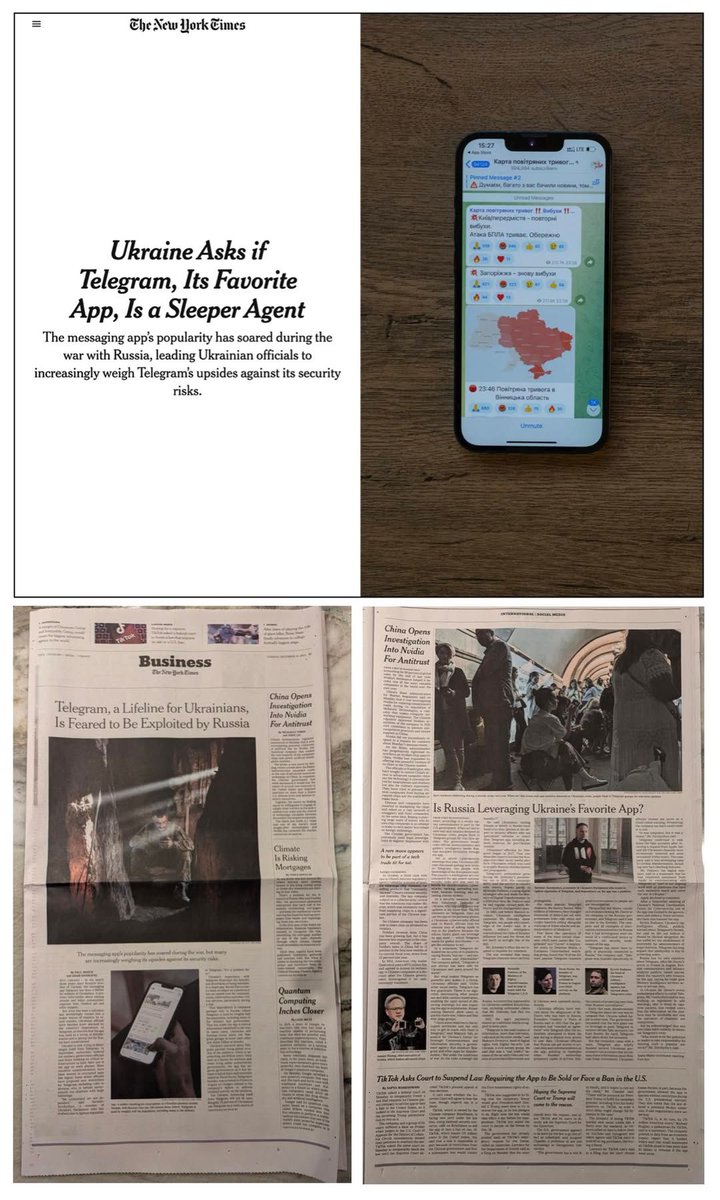
A major feature in @nytimes: "Ukraine Asks if Telegram, Its Favorite App, Is a Sleeper Agent"
This extensive article is on the front page of the Business section in the print edition, complete with numerous photos and details. As a friend from the US put it, "That's (what they used to say in the newspaper biz) a lotta ink."
A huge thank you to Paul Mozur and Sasha Maslov for their work on this piece. Thanks also to @yarlyur, who consistently addresses Telegram-related issues in the Ukrainian Parliament and provided comments for the article. Both Nazar Tokar and I contributed extensively to this material as well. Special thanks to the members of the Kremlingram community, who tirelessly gather and continue to unearth information about the risks associated with Telegram and its ties to the Kremlin.
The article doesn't present anything "explosive" or new for us Ukrainians—it is a well-compiled summary of facts long known to us, illustrating how difficult it is for legislators to address this Trojan Horse entrenched in the pockets of 70% of Ukrainians.
However, it offers much new for NYT readers.
Plenty of information was left out of the article, and, as always, it was challenging to independently verify some of the claims, even for the NYT team.
But I’m convinced we’ll see more articles like this in the future, followed by concrete actions.
Thanks to everyone involved!
The full article is available here: https://t.co/VqY155q4wN
Look, I really hate speculating about this spy-vs-spy bullshit, but it is really bothering me to see the great and the good of my tribe (Balaji, Vitalik, Roman Storm, Noelle Acheson, Josh Swihart) treating Pavel Durov as an oppressed hero. Please consider the following facts: ⤵️