This is a huge day for @X.
My documentary, Cancer: A Food-Borne Illness, is finally here.
It is only on this platform that I am able to release a film that challenges big food conglomerates and mainstream health claims without fear of censorship.
Here is the story of how I, an 18 year old girl, spent 2 years relentlessly searching for the for the true cause of cancer.
Here's what I found:
Humanoid Locomotion as Next Token Prediction
We cast real-world humanoid control as a next token prediction problem, akin to predicting the next word in language. Our model is a causal transformer trained via autoregressive prediction of sensorimotor trajectories. To account for
I don’t even know what to say…
These clips generated by OpenAI’s Sora model have me speechless.
We knew good AI text-to-video would come, but this quickly? Unreal.
We’re stepping into a new world.
Buckle up.
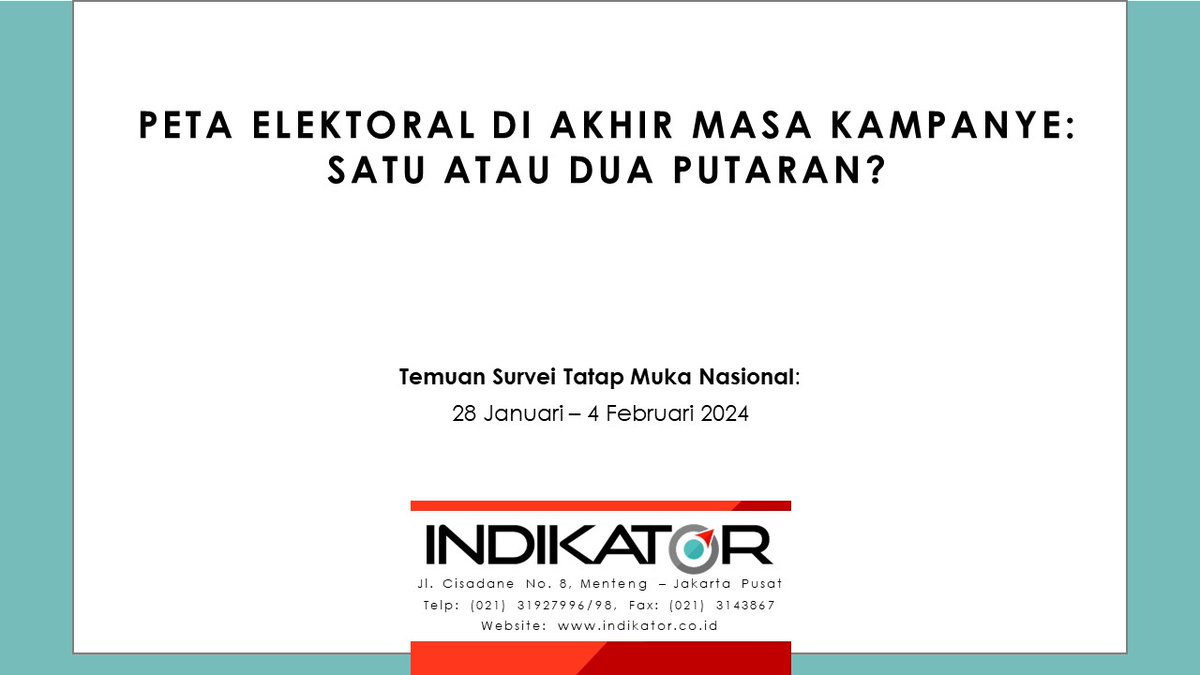
RILIS SURVEI NASIONAL INDIKATOR
PETA ELEKTORAL DI AKHIR MASA KAMPANYE:
SATU ATAU DUA PUTARAN?
Temuan Survei Tatap Muka Nasional:
28 Januari– 4 Februari2024
Live on Youtube Indikator Politik Indonesia :
https://t.co/IS94PhN2zc
@BurhanMuhtadi
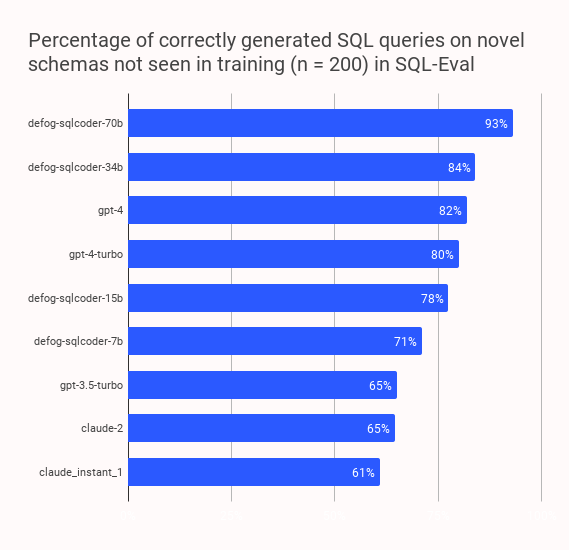
We just opened sourced SQLCoder-70B! It outperforms all publicly accessible LLMs for Postgres text-to-SQL generation by a very wide margin.
SQLCoder is finetuned on @AIatMeta's CodeLlama-70B model that was released yesterday on less than 20,000 hand-curated prompt completion pairs.
You can find it on @huggingface at https://t.co/abHsKzWYGW. This follows our 15B, 7B, and 34B models – and is the most capable of them all.
The model has a cc-by-sa-4 license, which means that you are free to use it as is for any use (including commercial) as long as you also open-source any changes to you make to it (i.e., if you fine-tune it further).
I wuz robbed.
More specifically, I was tricked by a phone-phisher pretending to be my bank, and he convinced me to hand over my credit-card number, then did $8,000+ worth of fraud with it before I figured out what happened. And *then* he tried to do it again, a week later!
1/
Thrilled to share my new essay
"Stranded: How Bitcoin is Saving Wasted Energy and Expanding Financial Freedom in Africa"
I was profoundly moved by what I saw on a trip to Kenya + Malawi
If this can show you even 1% of what inspired me, that's a win 🧵
https://t.co/mhDTKlHTXO
Congrats to @allen_ai for the excellent release of OLMo
It's a true open source end-to-end release:
not just
• model code
• model weights
but also
• training code
• training data (and associated toolkits)
• eval toolkits
This is pushing the enveloppe of open-source AI 🔥
"They're made out of meat."
"Meat?"
"Meat. They're made out of meat."
"Meat?"
"There's no doubt about it. We picked several from different parts of the planet, took them aboard our recon vessels, probed them all the way through. They're completely meat."
"That's impossible. What about the radio signals? The messages to the stars."
"They use the radio waves to talk, but the signals don't come from them. The signals come from machines."
"So who made the machines? That's who we want to contact."
"They made the machines. That's what I'm trying to tell you. Meat made the machines."
"That's ridiculous. How can meat make a machine? You're asking me to believe in sentient meat."
"I'm not asking you, I'm telling you. These creatures are the only sentient race in the sector and they're made out of meat."
"Maybe they're like the Orfolei. You know, a carbon-based intelligence that goes through a meat stage."
"Nope. They're born meat and they die meat. We studied them for several of their life spans, which didn't take too long. Do you have any idea the life span of meat?"
"Spare me. Okay, maybe they're only part meat. You know, like the Weddilei. A meat head with an electron plasma brain inside."
"Nope. We thought of that, since they do have meat heads like the Weddilei. But I told you, we probed them. They're meat all the way through."
"No brain?"
"Oh, there is a brain all right. It's just that the brain is made out of meat!"
"So... what does the thinking?"
"You're not understanding, are you? The brain does the thinking. The meat."
"Thinking meat! You're asking me to believe in thinking meat!"
"Yes, thinking meat! Conscious meat! Loving meat. Dreaming meat. The meat is the whole deal! Are you getting the picture?"
"Omigod. You're serious then. They're made out of meat."
"Finally, Yes. They are indeed made out meat. And they've been trying to get in touch with us for almost a hundred of their years."
"So what does the meat have in mind."
"First it wants to talk to us. Then I imagine it wants to explore the universe, contact other sentients, swap ideas and information. The usual."
"We're supposed to talk to meat?"
"That's the idea. That's the message they're sending out by radio. 'Hello. Anyone out there? Anyone home?' That sort of thing."
"They actually do talk, then. They use words, ideas, concepts?"
"Oh, yes. Except they do it with meat."
"I thought you just told me they used radio."
"They do, but what do you think is on the radio? Meat sounds. You know how when you slap or flap meat it makes a noise? They talk by flapping their meat at each other. They can even sing by squirting air through their meat."
"Omigod. Singing meat. This is altogether too much. So what do you advise?"
"Officially or unofficially?"
"Both."
"Officially, we are required to contact, welcome, and log in any and all sentient races or multibeings in the quadrant, without prejudice, fear, or favor. Unofficially, I advise that we erase the records and forget the whole thing."
"I was hoping you would say that."
"It seems harsh, but there is a limit. Do we really want to make contact with meat?"
"I agree one hundred percent. What's there to say?" `Hello, meat. How's it going?' But will this work? How many planets are we dealing with here?"
"Just one. They can travel to other planets in special meat containers, but they can't live on them. And being meat, they only travel through C space. Which limits them to the speed of light and makes the possibility of their ever making contact pretty slim. Infinitesimal, in fact."
"So we just pretend there's no one home in the universe."
"That's it."
"Cruel. But you said it yourself, who wants to meet meat? And the ones who have been aboard our vessels, the ones you have probed? You're sure they won't remember?"
"They'll be considered crackpots if they do. We went into their heads and smoothed out their meat so that we're just a dream to them."
"A dream to meat! How strangely appropriate, that we should be meat's dream."
"And we can marked this sector unoccupied."
"Good. Agreed, officially and unofficially. Case closed. Any others? Anyone interesting on that side of the galaxy?"
"Yes, a rather shy but sweet hydrogen core cluster intelligence in a class nine star in G445 zone. Was in contact two galactic rotation ago, wants to be friendly again."
"They always come around."
"And why not? Imagine how unbearably, how unutterably cold the universe would be if one were all alone."
--
Terry Bisson, 1991
Why Everything's Changing
When building an economy on top of a global settlement layer, that currency or bedrock cannot deflect. For the past 40 years, that bedrock has been the US treasury market (it's massive - tens of trillions of dollars). And for 40 years, anyone who saved their retained earnings in that bedrock saw the value continue to appreciate in buying power. Everyone knows that when bond yields go down, prices go up. The chart below showing the drop in yield (up in price) is why this form of savings worked so well for the world. However, this only works if the bedrock doesn't start to deflect. In financial terms, the bedrock of bonds will deflect if inflation cannot be controlled. As any engineer understands, if the bedrock is deflecting, EVERYTHING built upon it starts to crack and break down. Why does inflation cause the bedrock to deflect? Because investors in bonds need to have a higher yield than inflation, or else they are guaranteed to lose buying power. If inflation is 5% and the bond yields 3%, then you'll lose -2% in buying power if those yields remain persistent.
So, why are we seeing inflation? I'd argue inflation manifests itself through three main ways. The first and obvious way is just increasing the amount of monetary units in the overall system – everyone understands this one. What a lot of people don't understand is that you can add monetary units into a system, but they might not "nest" themselves in areas that most people see or expect. For example, trillions of monetary units were added into the system since 2008, and most of those monetary units "nested" themselves in the capitalization rates of stocks and bonds. You didn't see the CPI gage ever go up. But if you're a person who doesn't own stocks and bonds, well, you wouldn't see that capital appreciation in your day-to-day life. The second way is through supply destruction. Imagine you were on a remote island that was fairly self-sufficient and a tropical storm destroyed a bunch of infrastructure. Through that event, everyone on the island quickly needs to preserve and own essential supplies like energy and food. What you would find while supply chains are damaged is a bidding of prices on desirable goods and services. With enough time, as long as a free and open markets were allowed to persist, the supply chains will naturally self-correct, and prices will return to normal (as long as the other two means of creating inflation weren't exercised). Finally, the third way inflation can happen is through supply destruction caused by manipulated incentives via public policy decisions. When policymakers create incentives for growth in infrastructure, what they rarely talk about is what they AREN'T incentivizing through that action. The economy is massive, and one small incentive for sector XYZ seems harmless as a singular event. But when policy after policy is exercised by government bureaucrats, the things they AREN'T incentivized really add up and create a false sense of "free and open" markets. The next thing you know, people are incentivized (due to policy) to build things that are less efficient and less constructive to society than what a REAL free and open market would produce. If you take these policy decisions far enough and long enough without the free and open market being able to experience creative destruction, then supply chains at large become completely dysfunctional and fragile.
When we look at what happened with COVID, we literally have all three of these things playing out: manipulation of the money supply, 40 years of horrific policy decisions that have created hyper-fragile supply chains, and a global pandemic that disrupted organic activity. In addition to all of that (and maybe BECAUSE of that), countries that are net-producers are at war, or reconstructing trade agreements, with countries that are net-consumers. People might think the war between Russia and Ukraine is a localized situation, but it's actually much broader and strategic than that. In short, the net producers of the world don't want to give up their physical goods for the paper promises that net-consumers INSIST they accept as payment. The net-producers understand the bedrock is deflecting. The net-producers understand that the math behind these impaired bonds will remain impaired. Why? Because for the supply chains to actually become less fragile, the decades of poor incentives that were brought about through compounding poor policy decisions isn't going to end anytime soon. In fact, the problem is being amplified because net-consumers are trying to offset the bad policy decisions by adding more monetary units into the system (see #1 for creating inflation).
So, what CAN the world build upon that doesn't deflect? Well, anyone who follows my account probably already knows my opinion: Bitcoin. First and foremost, Bitcoin's decentralized nature ensures a robust and tamper-resistant foundation for the global economy. Unlike traditional currencies controlled by central banks and governments, Bitcoin operates on a decentralized network that is immune to political interference and manipulation. No more waiting for Jerome Powell to blink three times and watch the global markets move by $5 trillion. Next, the capped supply of 21 million coins addresses the issue of inflation that has plagued traditional currencies. With a finite supply, Bitcoin inherently resists inflationary pressures that erode the value of other currencies. This means that individuals and institutions who choose to store their wealth in Bitcoin can expect their purchasing power to be preserved over time, unlike those who rely on bonds and other assets that are vulnerable to more monetary units being added into the economy and into the hands of a chosen few. Additionally, Bitcoin transcends borders and mends the discord between net-producers and net-consumers: they no longer need to TRUST each other. The borderless and frictionless nature of Bitcoin allows for swift and cost-effective international settlements. By facilitating global trade and economic expansion, Bitcoin has the potential to usher in a new era of financial inclusion and prosperity. Finally, Bitcoin's ability to serve as a hedge against the deflection of traditional settlement layers is perhaps its most compelling attribute. As the bedrock of the global economy, it is crucial that the settlement layer remains stable and secure.
In my humble opinion, you can choose to start buying Bitcoin after thoroughly understanding the game theory and logic behind its continued appreciation in value, or you can learn by sitting back and watching others grow their buying power. Either way, you're eventually going to learn about Bitcoin, whether you like it or not.
The Palworld story is wild.
Dubbed “Pokémon With Guns”, the game has sold 6m+ copies in past 4 days (making its developer Pocket Pair over $100m on a ~$7m budget).
Some details on the game development process:
◻️ CEO Takuro Mizobe worked at JPMorgan Securities before launching a crypto exhange in 2014.
◻️He made some dough in crypto and used funds to launch indie game developer Pocket Pair in 2015.
◻️The original Palworld team was 4 people and started with $10,000.
◻️The main model developer is a high-schooler who the team met because he worked part-time at a convenience store they frequented.
◻️They added guns because to be a global success, it had to do well in America and the CEO said “Americans like to shoot things”.
◻️Asked about Nintendo, the CEO says they make innovative games whereas he is fine to chase trends (“I don’t [have a creative vision]. I just want to make a game people like.”)
◻️ There was no version control. The team saved files in a “bucket of USBs” and merged them to the main build when done.
◻️Switched from Unity to Unreal Engine late into the development process.
◻️ There are rumours that the game assets were mostly created by AI (but they deny it and there is little evidence).
Palworld’s early success is astounding when you consider triple AAA game titles easily break 9-figure development costs (eg. Cyberpunk 2077 has run $400m+)
Earlier today, Palworld peaked at 1.8m concurrent players. That’s the 2nd highest ever for Steam’s platform (ahead of CounterStrike 2 and behind only PUBG).
The next stat to watch: Nintendo released “Pokémon Scarlet and Violet” in 2022 and it has sold 23m+ copies.
Could Palworld top it?
Parcel delivery firm DPD have replaced their customer service chat with an AI robot thing. It’s utterly useless at answering any queries, and when asked, it happily produced a poem about how terrible they are as a company. It also swore at me. 😂