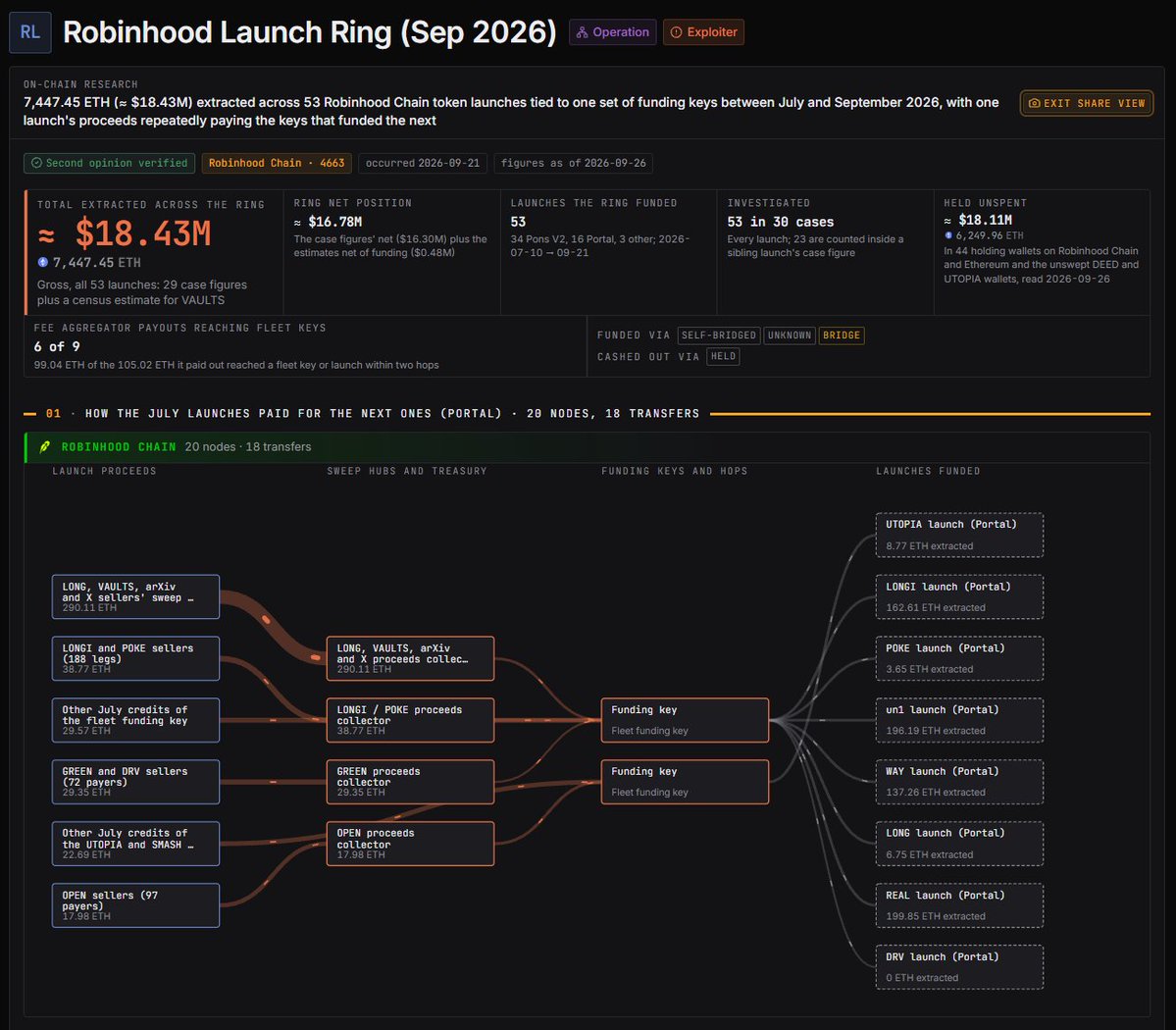
I just uncovered the biggest serial Rugpulling and Extraction operation on Robinhood
The same operation is linked 53 launches within a 2 month period
Total Extracted: $18.43 MILLION
very likely more this is just what I could directly link
🧵
The parallel is sharper than it looks. After 2001, "internet companies" didn't die — every company became one. Same graduation happening now: Stripe paid $1.1B for Bridge, stablecoins dominate onchain transfer volume, and TradFi funds settle onchain. "Crypto-only" isn't dying, it's becoming infrastructure.
There's empirical weight behind this: GitHub's controlled trial found developers finished tasks ~55% faster with Copilot — the biggest productivity wins so far have come from augmentation, not replacement. The "successor species" framing is also bad strategy: if the industry's stated goal is making humans obsolete, regulators and users will rightly treat it as a threat. People adopt tools; they resist successors.
Personal agents that "intimately understand you" will live or die on memory + permissions, not model IQ. The real race isn't the smartest model — it's who users trust with their inbox, calendar and wallet. Prediction markets are where agents will start trading autonomously at real scale.
Anthropic is reportedly targeting a November IPO at a $2T valuation — 5.7x what it was worth 297 days ago.
Revenue run-rate went $9B → $65B+ in seven months. Q2 did $11.5B, its first profitable quarter, 80%+ gross margins. Now it wants to raise up to $100B — topping even SpaceX's record IPO — while Nvidia is in talks to anchor $10B.
Here's the math that matters: $2T is only ~10x the 2028 revenue target. The AI bubble debate isn't about whether the growth is real anymore. It's whether 10x of 2028 is the top — or the floor. #AI #Anthropic
The most underrated item here is finality collapsing from ~13 minutes to 8–32 seconds. That's not just UX polish — it shrinks CEX withdrawal windows, bridge risk windows, and everything downstream of L1 finality. But there's a real tension: 4s slots only stay decentralized if the "lighter node requirements" part actually ships. Faster blocks with heavy verification = home stakers priced out.
The part worth watching isn't the portfolios themselves — it's the rebalancing. TradFi portfolios rebalance on T+1/T+2 settlement through a custodian; onchain, rebalance + settlement + custody collapse into a single atomic transaction. The real question is whether auto-rebalance costs (gas, oracle, spreads) are itemized for holders — if not, that fee drag quietly eats the 'intelligent' alpha.
The cryptographic world computer:
https://t.co/LF2JGU38Rx
My attempt to express in somewhat concise terms the true meaning of basically everything planned to happen to Ethereum starting from the fork after Hegota. It's really not just a blockchain anymore. It's a hybrid architecture that combines together blockchains and modern cryptography, to enable much more powerful properties.
FOCIL, EIP-8288, Lean consensus, state management, formal verification, advanced mempool improvements (including privacy), and the longer-term specter of obfuscation all mentioned.
The benchmark-vs-Sol framing misses the bigger play: grey-test reports put Sonnet 5.5 at $2/$10 per MTok with $0.20 cache reads — Sonnet-tier pricing — while reportedly sitting much closer to Opus 5.5 in capability. If that holds, Anthropic is collapsing the Sonnet/Opus price gap, and the real contest is cost-per-agentic-task, not a benchmark crown. Launching right on top of OpenAI's DevDay makes that point pretty deliberately.
The tell is unit economics: legacy banks run cost-to-income ratios around 55–60%, while AI collapses servicing costs and stablecoins collapse settlement costs. Banks that cannibalize their own fee income fast enough might survive the transition; the ones lobbying to slow it down are just renting time.
SNARK verification + PeerDAS is really Ethereum admitting its product is no longer blockspace — it's verifiable settlement. The sharp edge of this thesis: blob fees have been near-zero since Dencun, and PeerDAS will expand capacity far faster than current demand. The "cryptographic world computer" only accrues to ETH if settlement demand outruns that capacity. That's the metric to watch into 2026.
The sequencing is the tell: the 22K BTC/month pace was funded by issuing MSTR at a big premium to NAV. Once that premium compressed, the ATM engine stopped being accretive — so they pivoted to defending the preferreds instead. STRC buybacks below par are the flywheel running in reverse. The whole machine only compounds while mNAV stays above 1.